
“Far from being the chaotic bacchanalia of oppressed savages, the revolution in Haiti followed with precision the rise and fall of the revolutionary wave in France.” (CLR James, The Black Jacobins)
As contradiction or as duality, for a long while the “modern and the free” have had to co-exist with the “primitive and the enslaved” — on the same planet. Within the same geographies, enclosures and islands. The so called primitive also embodied the slave, one who functioned as an active part of the economy, a toxic sign of everyday struggle — man, woman and child enslaved, over centuries long oppression, violence and hierarchy. But popular history and dominant narratives try as much, still cannot erase nor disavow the primitive. Especially when we as a species, as modern and however superior, are still dealing with mass inequality, worse forms of imperialism, capitalism, genocide, ecocide and work based “slavery” in many parts of the world.
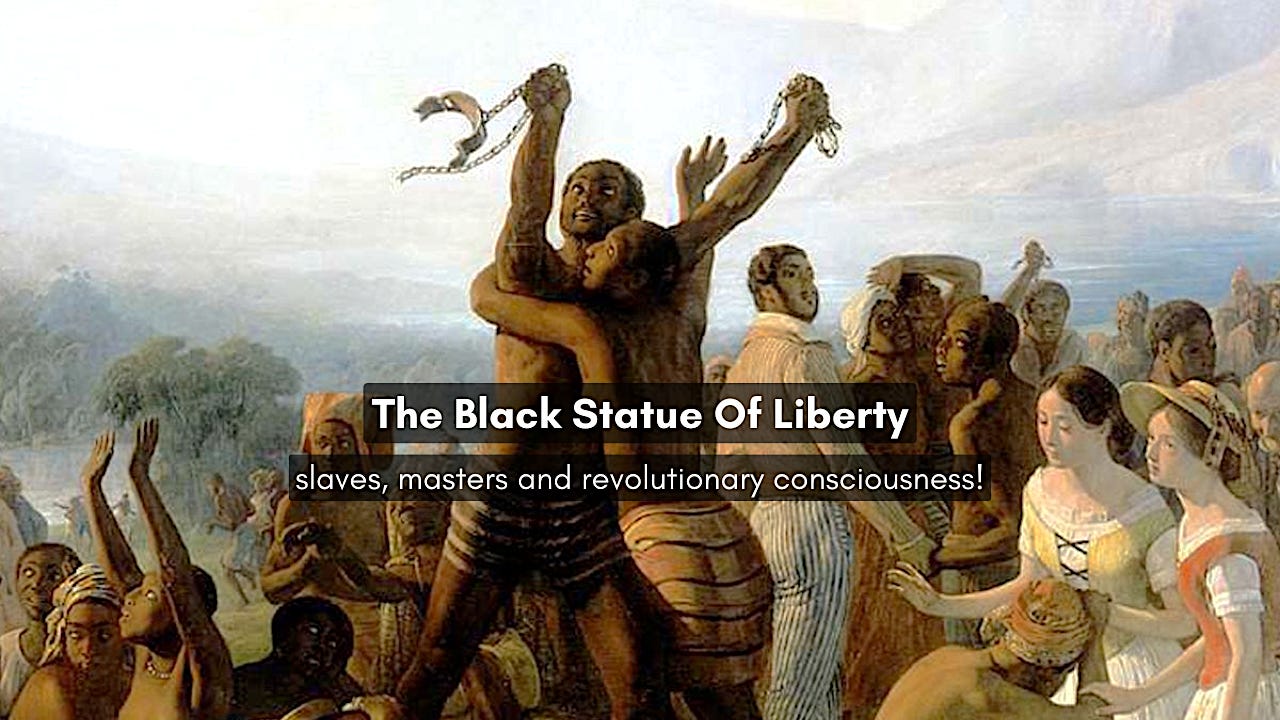
Such a shared reality also points to a time in the past. Who doesn’t know about the “Storming Of The Bastille” and the “Rights Of Man” and the French revolution (1789-92). Yet as suppressed or deliberately ignored is the history and triumph “the first and only successful slave revolution in the world”. The actual liberation of not just slaves, abolition of slavery but also a violent reorganization of existing class, governance and economy — that was achieved by “black rebel slaves” or the “Black Jacobins”. A slave based “revolutionary awareness” instead of the bourgeois at the “center of revolutionary history” and inevitable revolution. As a detonation, centuries in making also gave way to the independence of Haiti and Saint Domingue concurrent with the revolutionary waves in France and way later throughout imperial Europe, Cuba, Russia, China, etc during the 19th and 20th century.
The Black Statue Of Liberty does not exist, and what stands currently at the entry of New York City is best felt as a symbol of imperial triumph or “blessed America” (Irving Berlin). Cited by scholars of revolutionary history as the “most impactful ” in the modern era, one that was led by the “Black Jacobins” organized in ways, or as the seeds of revolutionary struggle — the abolition of slavery, expulsion of the imperial regimes and the following war for independence.
A violent detonation in favor of liberty, that spread not only across the Caribbean, but also to many other parts of the colonized world, and still going on. A short homage to Toussaint L’Ouverture for his epic anti-colonial spirit and role, leading up to “the first and only successful slave revolution in the world as yet” (Emil Cabral). The story of Haiti and Dominican Republic is written in blood and fire, led by the “black rebel slaves”.
For all that probability can define, when Columbus and his Spanish galleons landed in the pre-San Salvador (1492), looking for gold or a new route to India, they did not hang around for too long. The natives of the island managed to direct the foreigners towards the island of Haiti for better prospects with the search for the “yellow metal”. But how incredulous to call Christopher Columbus a “navigator” (Wikipedia) who unleashed a trail of terror and erasure in his voyage further into the “New World”. Whatever achieved or found in Hispaniola (Haiti) and the thousands of islanders that the Spanish could slaughter during this period (1492-1510) is still minuscule, compared to the next four hundred years of European settler colonialism, the architecture of slavery and the “North Atlantic Slave Trade”.
Even the early records of genocide, could only be measured in retrospect in the words of the literate and perhaps pious. Absolutely sickened by “the exploitation and physical degradation of the indigenous peoples, disease and crime in the Spanish colonies of the Caribbean and especially Haiti…” Fransisco Las Casas summoned the Catholic clergy and Castilian Court to stop the genocide of the islanders, and instead offer the remaining a chance to convert to Christianity. Las Casas’s official plea (1514) had no real immediate impact, but King Charles V granted Vincent Laurent de Gorrevod (Catalan) permission to haul slaves at a greater quantity, from Africa (Decreto Real, Ley Aprobada de’ 1518). Many historians posit this period as a turning point, or as Prof. David Stannard frames it as “beginning of the Afro-American Holocaust..”
The numbers are always up for revision or debate, but no less than 12 to 13 million Africans were enslaved, displaced and shipped off, uprooted from their native ecosystems — bound for the islands of the Caribbean and Brazil, under the most horrible conditions imaginable, and later towards the American colonies, Mexico, Meso America, Peru, etc. Scholars, white and black still bitterly debate as to how many perished “in transit” and how many more during “esclavitude”. New models reveal the depopulated zones and timeline of the “North Atlantic Slave Trade”. The Caribbean islands would never be the same, most often framed in terms of “Pre” or “Post” Columbus.
Rapid expansion and the outward trajectory of Spanish colonization, from Hispaniola (Haiti) into a way bigger geographic realm, titled back then as “Nueva España” (1492-1592) would eventually create a gateway for rival European colonizers. Spain’s maritime dominion over the Caribbean would rapidly dwindle during the 17th century, sabotaged first by the French and later by the British, Dutch and even later by the emergence of the United States. In any case, by 1610 thousands of non-Hispanic privateers, traders and settlers had established permanent housing, colonies, garrisons and trading posts across many islands, that we know as Jamaica, Cuba, Suriname, Trinidad, Dominican Republic, Grenada, Guyana, Saint Lucia, etc.
1595 - 1610, French pirates began establishing bases on the western side of Haiti. Initially held together by stealing slaves, domesticated animals and crops from Spanish “Haciendas” and later from British Jamaica, — they managed to create a foothold on the island. The real struggle for dominion, inside the Caribbean would tilt in favor of the French, British and Dutch, yet not without massacring each other for about 35 years (1595-1625). While monarchies based in the metropoles of Europe constantly battled on land and sea in the Caribbean and in Europe, war could not be sustained without an immense slave based economy, robbing millions of bodies over time, from the western and south western coast of Africa, towards the “New World”.
By mid 1670s, the “Pearl of the Antilles” was divided as two separate European entities — Haiti as the Spanish and Saint-Domingue as the French (Treaty of Cap-Français). Both sides remained devoted to slave trade and plantation economies, growing on a scale never achieved before. Extraction based on slavery and on Sugarcane, Coffee, Cocoa, Tobacco, Spices, etc, ramped up further by cattle farms, cotton, banana and rubber plantations. According to Dr. Sudhir Hazareesingh (British-Mauritian) the continuous flow of African slaves, rapid evolution of maritime transport and modern agronomy “reached its apex in terms of colonial efficiency … Saint Domingue was more prosperous than most provinces of France and Spain of the period, let alone by far the richest European colony in the world”. Yet the “Pearl of the Antilles” would transform into a serious “pain in the ass” or worse a total blowback on the French and Spanish empire.
By 1760, the slave population of the island had grown 5 times more than the “gens de couleur”. The majority of “freed-men” in the colony were such “gens de couleur”. They benefited from connections with their European families. These relations were often troublesome, racist or deprived in terms of access to higher education but they did at least exist. Over time, of these “colored freed-men” some grew prosperous. Mulattoes numbering thousands, were also in direct competition with slave-driven plantation systems belonging to the “Ancien Regime” whites. That situation caused terrible friction between the two groups but at the same time it did give land and slave-owning Mulattoes considerable common interests — to seek independence, or evade taxes or raise tariffs, together with the land and slave-owning whites. In any case, the slaves who outnumbered both the White and Mulattoes, were well on their way towards grassroots resistance.
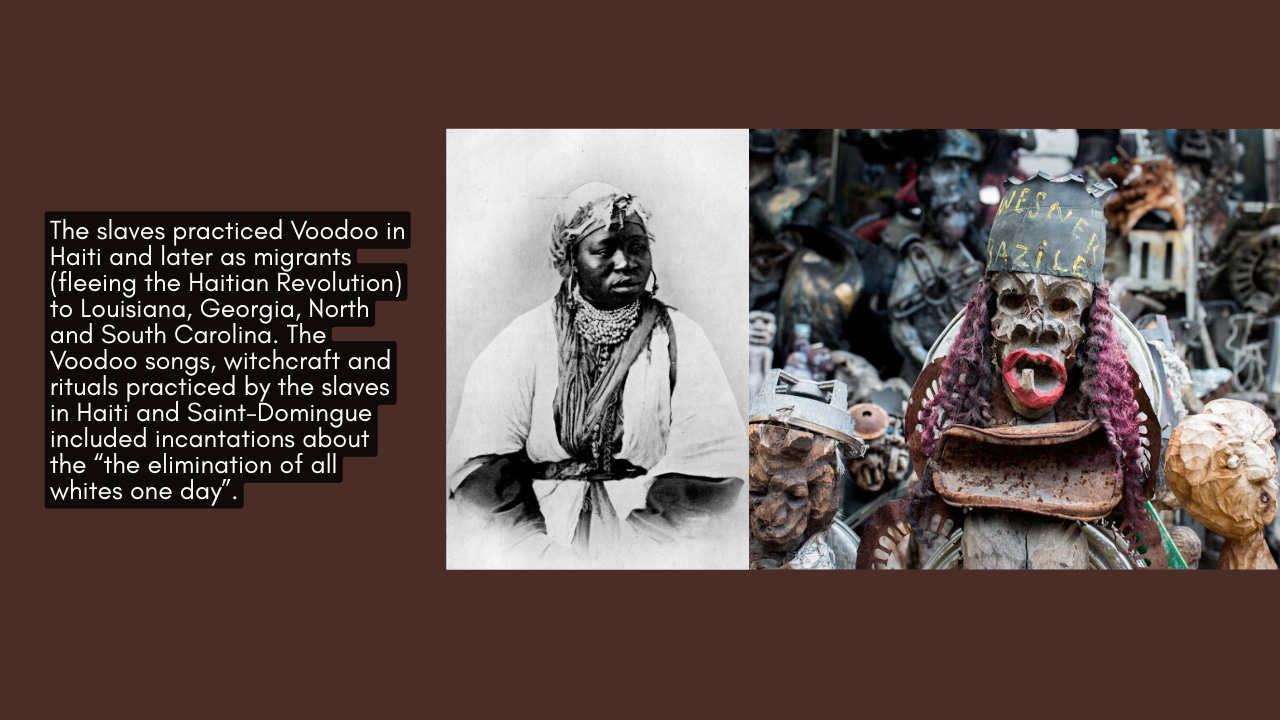
Leaders of the revolution were elsewhere, but the poorest and illiterate of slaves were slowly aspiring, learning to read, write and count, organizing themselves over time, for the day when they would rise up. The slaves practiced Voodoo in Haiti and later as migrants (fleeing the Haitian Revolution) to Louisiana, Georgia, North and South Carolina. The Voodoo songs, witchcraft and rituals practiced by the slaves in Haiti and Saint-Domingue included incantations about the “the elimination of all whites one day”. Or the Voodoo incantation for the dying and terminally ill slaves — “I’m going home, to live with God…” (Syncretism between different African tribes, 2010)
What began as a sporadic or extreme option, would grow up into a movement. Many slaves, as well as freed-slaves, poor Mulattoes abandoned their previous means of subsistence to become “Maroons”. Emerging as a chief of the “Maroons” was Francis Mackandal. A freed slave, who had managed to become an orator, in the opinion of “a white contemporary equal in eloquence to the European orators of the day”. But Mackandal was different, in his superior strength and vigor. Ahead of Toussaint, Dessalines, Christophe and Pétion the rebel leaders of Haiti and Saint-Domingue, Mackandal initiated small acts of sabotage, armed resistance, sowing the seeds of revolution. “He conceived the bold design of uniting the Negroes, attacking the Mulattoes in terms of cattle and property, and driving the weakest whites out of the colony” (Black Jacobins).
Mackandal and organized gangs poisoned many white locales as well as set fire to slave jails. Eventually apprehended by the French loyalists, he was burned alive in Saint-Domingue. Slave insurrections grew more frequent, and so would the resentment and power-play between the planters, slavers, slaves, Mulattoes and European administration. The “storming of the Bastille” and revolutionary Paris “intoxicated with liberty and enthusiasm” (François Mignet) was decades away. Funny how the “ghost of Mackandal” returns in the video game Assassin’s Creed III as the character Agaté navigating a virtual psycho-geography with “Francis Mackandal as guru and Assassination Mentor”.
“An uninstructed mass, feeling its way to revolution, usually begins by terrorism” (CLR James). There seems to be a striking similarity in such a pre-revolutionary stage, across history. The Hòa Hảo (Vietnam), Black Panthers (US), PLO (Palestine) and Zapatistas (Mexico) to name just a few. Organized militancy and resistance groups such as Hamas / Al Qasaam in Palestine, Hezbollah in Lebanon and the Houthis in Yemen and NLA (Libya). Sections of society, media, academics and the State, if so continue to insist that such “uninstructed” and militant organization equate to “terrorists” because they are clearly threatened — one way or another by the revolutionary spirit, by class based insurrections, by savage uncontrollable hordes of the “global south” as a global or local phenomena.
By 1730, hundreds of slaves had escaped into the highland and deeper jungles of the island. “Even as many were captured, lynched or placed back in the plantation, the shared motivation to abandon and reorganize was very much growing” (Black Jacobins). Such social disruption was also suffering from acute malnutrition and a rising wealth gap between the rich Whites and poor Mulattoes, both of whom also feared the growing population of the slaves. Haiti also became an element of the local political language, which was used to express the racial tensions of the independence period. The “social and economic conditions” for revolution in Haiti and Saint-Domingue was decades ahead of the French revolution, also well ahead of rebel heroes such as Toussaint, Dessalines, Christophe and Pétion. Yet the tipping point of the Haitian revolution, and what these cult-figures did, went far — far beyond the boundaries of the island.
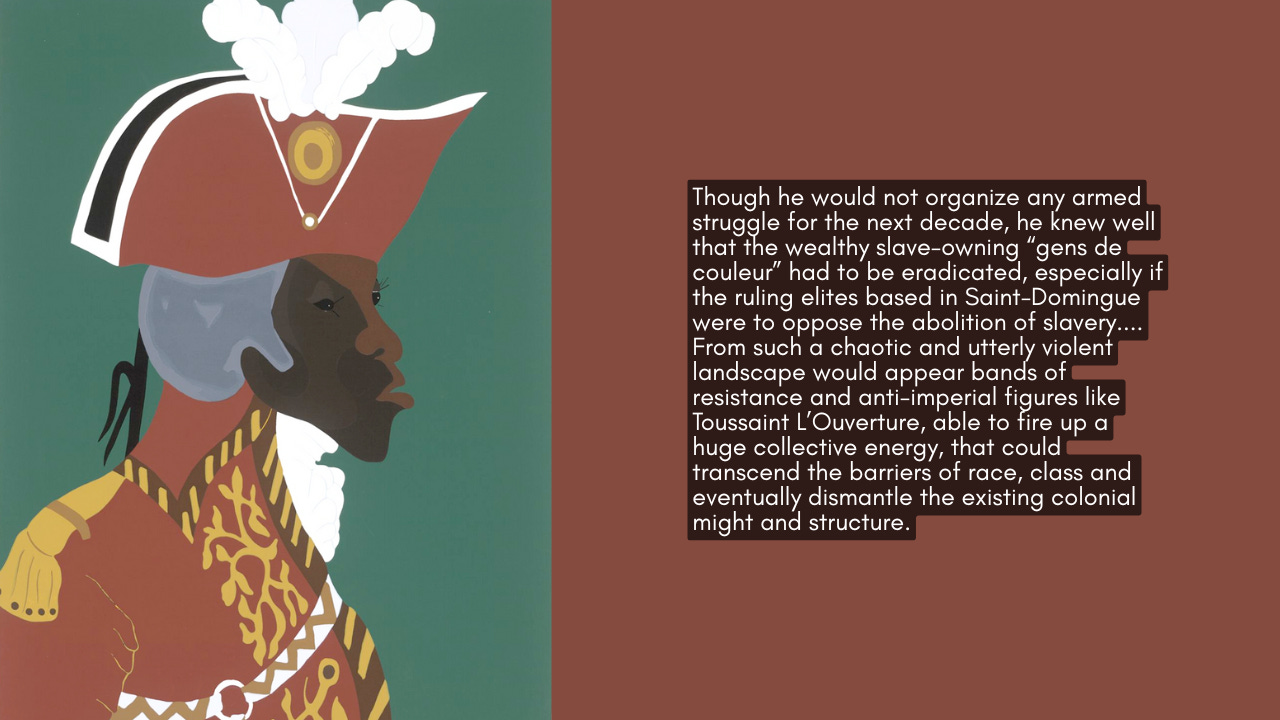
From that lattice of pan-African resistance, appeared our protagonist Toussaint L’Ouverture. Born a slave and Creole, yet eventually emancipated, educated, Toussaint joined the French Military for about 5 years, aged 40. Though he would not organize any armed struggle for the next decade, he knew well that the wealthy slave-owning class and the “gens de couleur” had to be eradicated, especially if the ruling elites based in Saint-Domingue were to oppose the abolition of slavery. Toussaint’s tryst with Sonthonax, is a great example of “black and white merger of interests and ideology, as the struggle for liberation… a collaboration, that wanted abolition of slavery and independence from metropole France” (Dr. Sudhir Hazareesingh). No irony that Sonthonax was a Jacobin based in Paris before he set sail for Saint-Domingue. Toussaint collaborated with the Spanish to attack the French, and later turned around to fool the French, by organizing raids on Spanish “Haciendas” in Haiti. Is prescient to note, that Toussaint and Dessalines also rejected various offers by the British (1799-1802). According to CLR James, “the rebel leader knew very well that one European colonizer and regime, could be no better or more trustworthy than the other”.
Edward Said suggested, that “The History Of Black Jacobins” was very much on the same revolutionary timeline, ahead of the “The Arab Awakening: The Story of the Arab National Movement”. Major events and disruptions in 1938 with news of revolutionary outbreak in France, heckled for the collapse of the French Vichy controlling Algeria, Lebanon and earlier in Morocco. France’s “richest colony” would be pilfered, ransacked, burned and reorganized between 1791 to 1795, in ways no one could envision back in “revolutionary France”. From such a chaotic and utterly violent landscape would appear bands of resistance, following anti-imperial self-styled generals like Toussaint and Dessalines, as a huge collective energy that could transcend the barriers of race, class and eventually dismantle the existing colonial might and structure. Though Toussaint never expressed the intention of becoming the “only leader” of Saint-Domingue openly, the slave-owning Whites and wealthy Mulattoes had clearly sensed the probability of such an outcome, by mid-1780.
But this is not just about “master slave hierarchies” or the “master morality versus slave morality” (a central theme of Friedrich Nietzsche’s works). Since “race” is an imaginary distinction (not biological nor evolutionary), the architecture of racial complexity, is as immense. A complexity, as a fusion of so called “races” — between the White, Mulatto and the Negro would also provide the pre-revolutionary conditions, necessary for anxiety generated by the rise of violence amongst the three groups, eventually threatening to overthrow the “Master Dominion” itself. “In a wider Atlantic frame, the sharpening of the politics of race, between Negros, Mulattoes and Whites, in particular the growing militancy that later became known to the world as Black Power” (CLR James). “Black Power” which was not an outcome of abolition of slavery in the U.S. nor the anti-colonial rebellions in Africa. Factors and sub-altern histories, summing up a general awakening that “granted the Haitian Revolution a resonance hearing across the island”.
The people of the West Indies were born in the seventeenth century in a “Westernized “productive and social system” (CLR James). Members of different African tribes were carefully split up by the European slave owners and the pedagogy of Christianity. To lessen conspiracy and possibility of the slaves uniting again. Worse as the erasure of African culture, memory and languages, slaves were compelled to master the European languages — highly complex products of centuries of civilization. Little celebrated is that history, of the slaves, as primitive as they were, albeit managed to “bring on a cultural revolution upon themselves, leading to the wipe-out of their oppressive masters” (Black Jacobins).
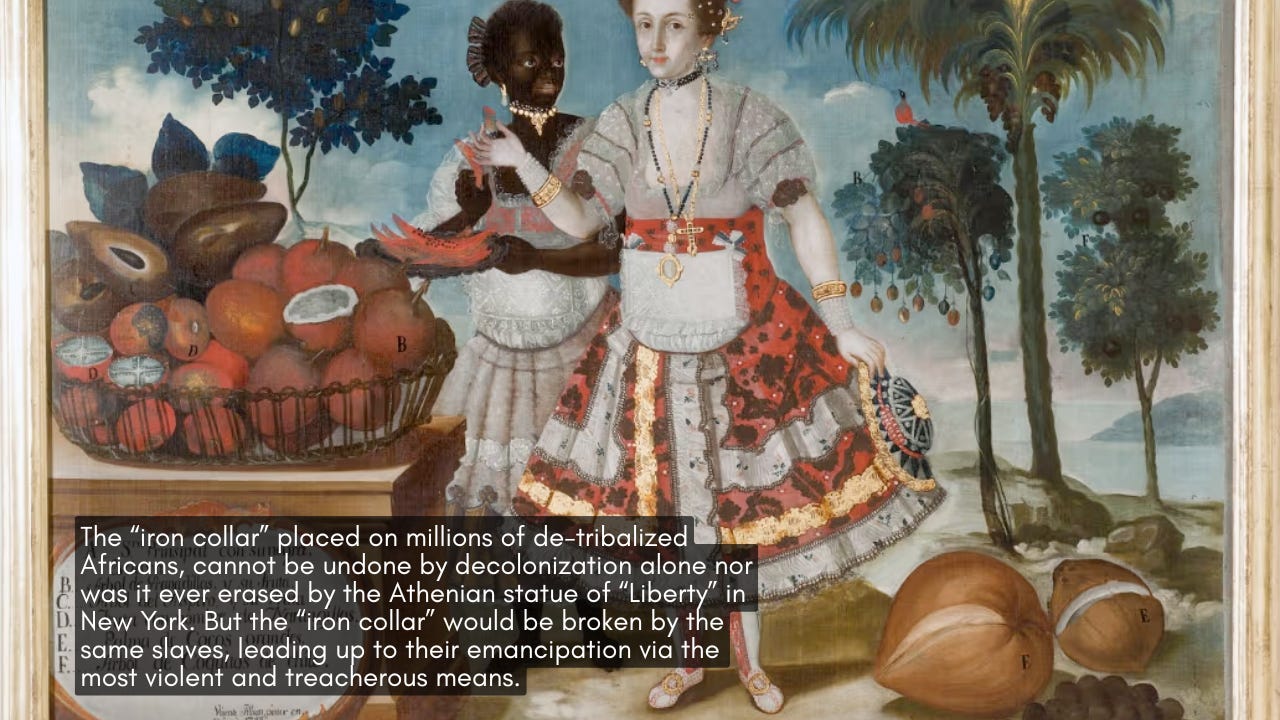
The “iron collar” placed on millions of de-tribalized Africans, cannot be undone by decolonization alone nor was it ever erased by the Athenian figure of “Liberty” in New York. But the “iron collar” would be broken by the same slaves, leading up to their emancipation via the most violent and treacherous means. No one but the slaves would pay the highest price for such independence. CLR James, born in Trinidad, argued as early as 1935 that “it was neither the Americans nor the British or even the French bourgeoisie, that was responsible for the actual abolition of Negro slavery, but just for the sole satisfaction of abolishing it on paper and never as class nor in spirit.” - Reply to Leon Trotsky, ‘Emancipation Of The Revolution’.
“Yet Toussaint did not make the revolution. It was the revolution that made Toussaint.” (The Theory of Haiti: Poetics of Universal History by David Scott). So what did Toussaint actually achieve? Not just the creation of a disciplined army, the defeat of the English and the Spanish, but also the defeat of Rigaúd and French loyalists, the establishment of local governments all over the island that were autonomous. “For Toussaint, the harmony between the races and classes were crucial, and the enlightened or European means of administration could wait for the time being….” (David Scott). But was all this inevitable? James insisted otherwise by saying, “slave revolutionaries in Haiti and Saint-Domingue were an evolutionary spark for the slaves . . . as much as factory workers in France and later laboring class of Russia or even later across Algeria, China, Africa etc”.
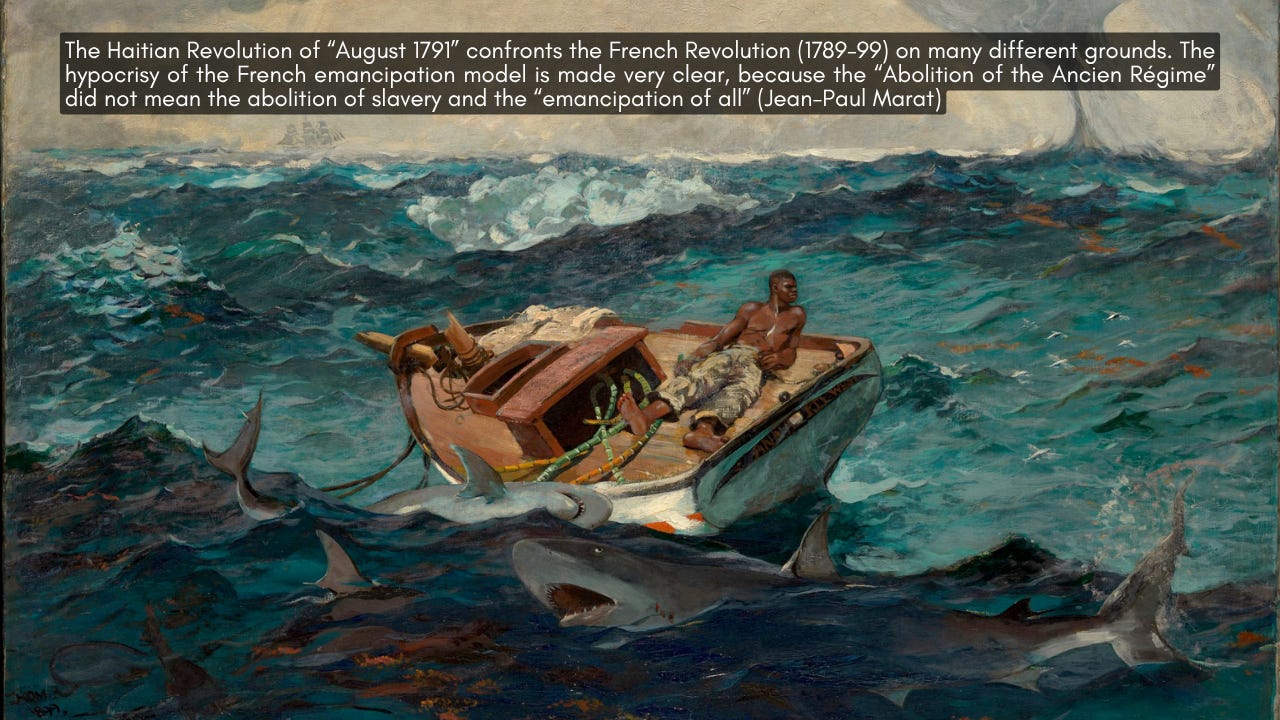
The Haitian Revolution of “August 1791” confronts the French Revolution (1789-99) on many different grounds. The hypocrisy of the French emancipation model is made very clear, because the “Abolition of the Ancien Régime” did not mean the abolition of slavery and the “emancipation of all” (Jean-Paul Marat). The abolition of slavery was addressed by Toussaint L’Ouverture and several other armed resistance groups, over time and using the word of God as well as lure of freedom, housing, education, guns, booze, clothes, shoes and whatever means possible.
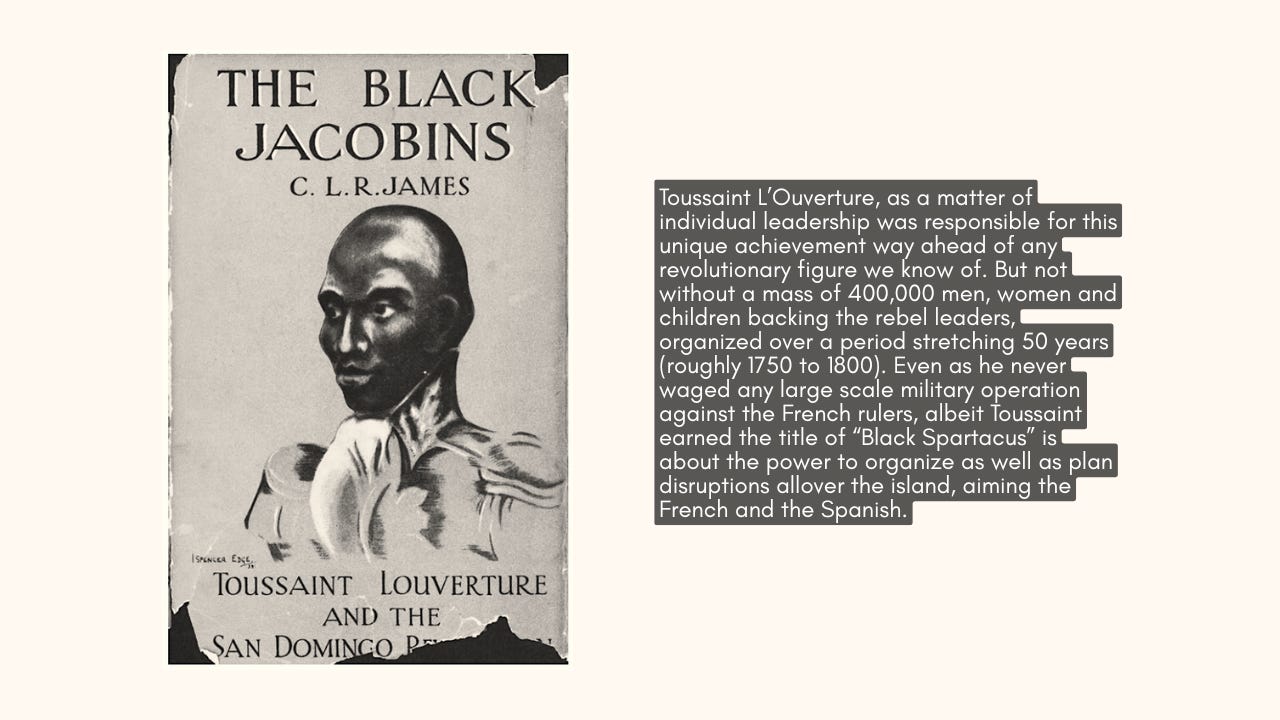
Toussaint L’Ouverture, as a matter of individual leadership was responsible for this unique achievement way ahead of any revolutionary figure we know of. But not without a mass of 400,000 men, women and children backing the rebel leaders, organized over a period stretching 50 years (roughly 1750 to 1800). Even as he never waged any large scale military operation against the French rulers, albeit Toussaint earned the title of “Black Spartacus” is about the power to organize as well as plan disruptions allover the island, aiming the French and the Spanish.
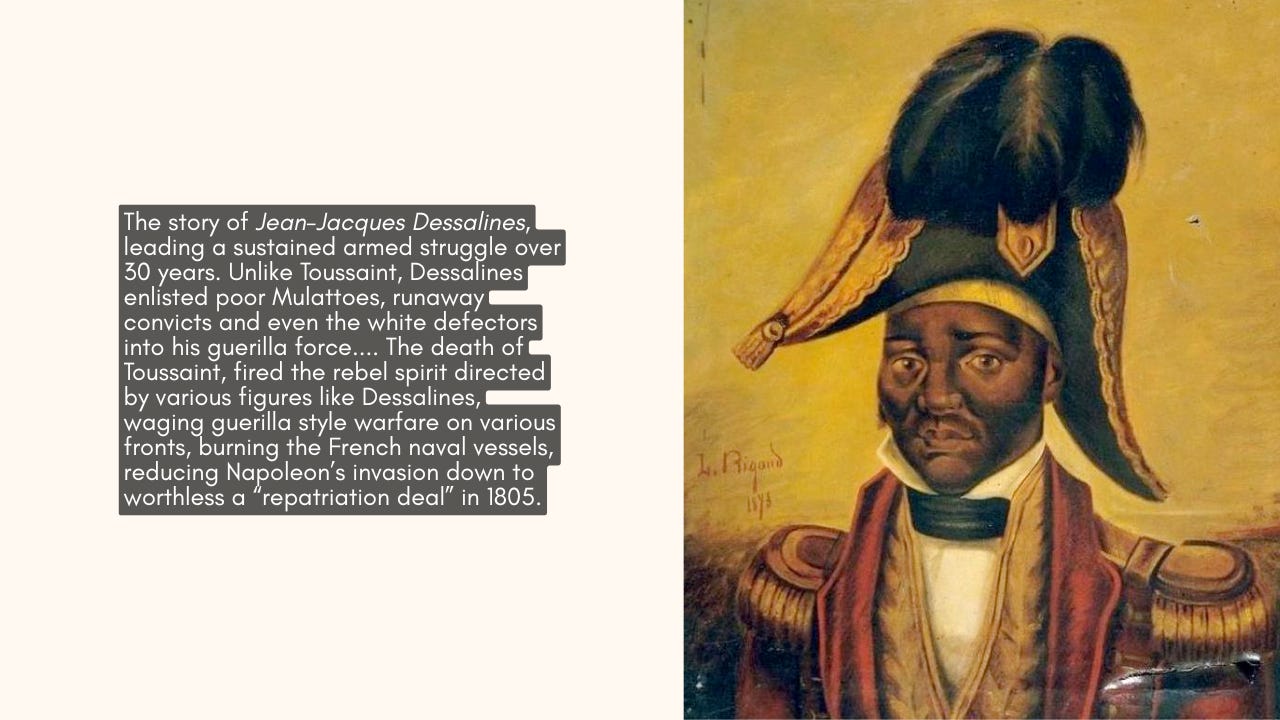
No less heroic or persistent is the story of Jean-Jacques Dessalines, leading a sustained armed struggle over 25 years. Unlike Toussaint, Dessalines enlisted poor Mulattoes, runaway convicts and even the white defectors into his guerilla force. The French revolution was smashed into numerous repressive regimes, and the “new emperor of France” Napoleon Bonaparte sent an armada of roughly 24,000 soldiers to recapture Saint-Domingue. Very briefly put, the project would eventually prove to be an epic disaster, with less than 30% of the original number of soldiers left alive by 1800. Except the largest slave owners of Saint-Domingue and Port-au-Prince, no one had answered Napoleon’s 1801 decree and offer to the islanders as “ new subjects with special laws”. Yet Napoleon’s mercenaries would manage to kidnap Toussaint’s younger and elder sons and bring them back to Paris. One decisive move that forced Toussaint L’Ouverture to a “conditional surrender” yet only after he had signed the New Constitution, along with other rebel leaders on 7 July 1801.
By July 1802 Toussaint was in France, imprisoned at Fort-de-Joux in Montpelier. As any wicked or cunning politician, Bonaparte simply let Toussaint rot in jail, without any trial or legal representation, till next year in April. The world’s first slave turned revolutionary leader would die of sickness in his jail cell, yet his role as a true revolutionary was done. Napoleon Bonaparte would come out as the eventual imperial loser, very shortly.
Clearly from late 1780s till 1810, with the single exception of Bonaparte himself, no single figure appears in world history or say “a revolutionary stage” more gifted than our protagonist, Toussaint L’Ouverture, a slave till he was 40. The death of Toussaint, fired the rebel spirit directed by various figures like Dessalines and Pétion, waging guerilla style warfare on various fronts, burning the French naval vessels, reducing Napoleon’s invasion down to worthless a “repatriation deal” in 1805. Once declared “Haitian Emperor” leader of the Haitian Revolution, “governor-general Dessalines” was eventually assassinated by rival rebel leader Alexandre Pétion in 1806. Pétion, unable to control civil unrest in the newly found “Republic of Haiti” eventually urged the emerging rebel leader Simón Bolívar to step in (1816).
News of Toussaint’s death set off even more insurrections, looting and pillaging of French plantations, factories and ports — rapidly freeing up the remaining slaves as well as capturing the principle ports, tax collection centers and military garrisons. The Armée indigène (Indigenous Army) under Dessalines and Henry Christophe seized several estates and expelled French slave-owners from the Island. By 1810, France had entirely lost its most profitable colony, and Spain would follow through relinquishing all imperial control by 1814.
The American part, in the above geopolitical catastrophe is hilarious and telling. President John Adams, opponent of slavery, supported the “slave revolt” with munitions and sent the ‘USS Constitution’ to bombard French vessels, as well as extend diplomatic support in 1798. But all that came to an end in 1801, when Jefferson, a slave-holding president, took office and rescinded all forms of solidarity. No wonder America’s own pending list of colonial horrors, based on slavery and the possibility of civil war was also around the corner (1860).
Like This Story? Please Subscribe
The Black Jacobins by CLR James is amazing in many ways. The scholar’s monumental analysis of the Haitian revolution is a kaleidoscope of revolution, race, class and more so a “demonstration of uneven but combined development of revolutionary consciousness”. The author presents the dialectic of “enslaved laborers of Haiti and Saint Domingue, suffering under the concentrated oppression of slavery, could also be totally hospitable, open to the boldest conclusions of revolutionary thought”.
The worse part of the story, beyond the revolutionary spirit and overthrow of imperialism, is about “collective punishment”. Dealt upon Haiti and the Dominican Republic by European rulers (economic and political isolation) over the next 200 years. It is a no-brainer, that “Haiti remains the poorest country in Latin America and the Caribbean and among the poorest countries in the world — medium human development category with a ranking of 166 out of 193 countries.” (World Bank, 2022). Inside Haiti, it is not surprising that a significant part of the population, still lives in “conditions little removed from slavery” (OECD, Human Trafficking 2012).
If one is inspired by revolutionary acts of Robespierre, Marx, Gramsci, Lenin, Che or many such Euro-vanguards, then one is also obliged to concur about Toussaint L’Ouverture and Jean-Jacques Dessalines. Simply put, we can’t make the mistake to see them as two political figures in a remote Caribbean island. Labor union leader and revolutionary W. E. B. Du Bois’s monumental 1935 work “Black Reconstruction in America” mirrors many of the revelations found in “The Black Jacobins”. The original Jacobins were based in Paris, and the evolution of “Black Jacobins” was nourished in the soil of CLR James’s native Trinidad.
One of James’s most striking achievements in radiating from the Jacobins in revolutionary Paris and the Marxist theory of “permanent revolution” illuminated not just anti-colonial struggles in the age of socialist revolution, but also the anti-slavery liberation struggle — one that he believed would last centuries as a “continuous cultural revolution made of many generations and all colors”. It should be clear that James’s recognition of the truth of the Haitian Revolution, is eventually about cultural and not just politics. However violent or not, the Haitian Revolution was not the result of some abstract or objective historical exercise, but actual mobilization of people (leadership) as much as their self-emancipation (of slaves) over a long period of time.
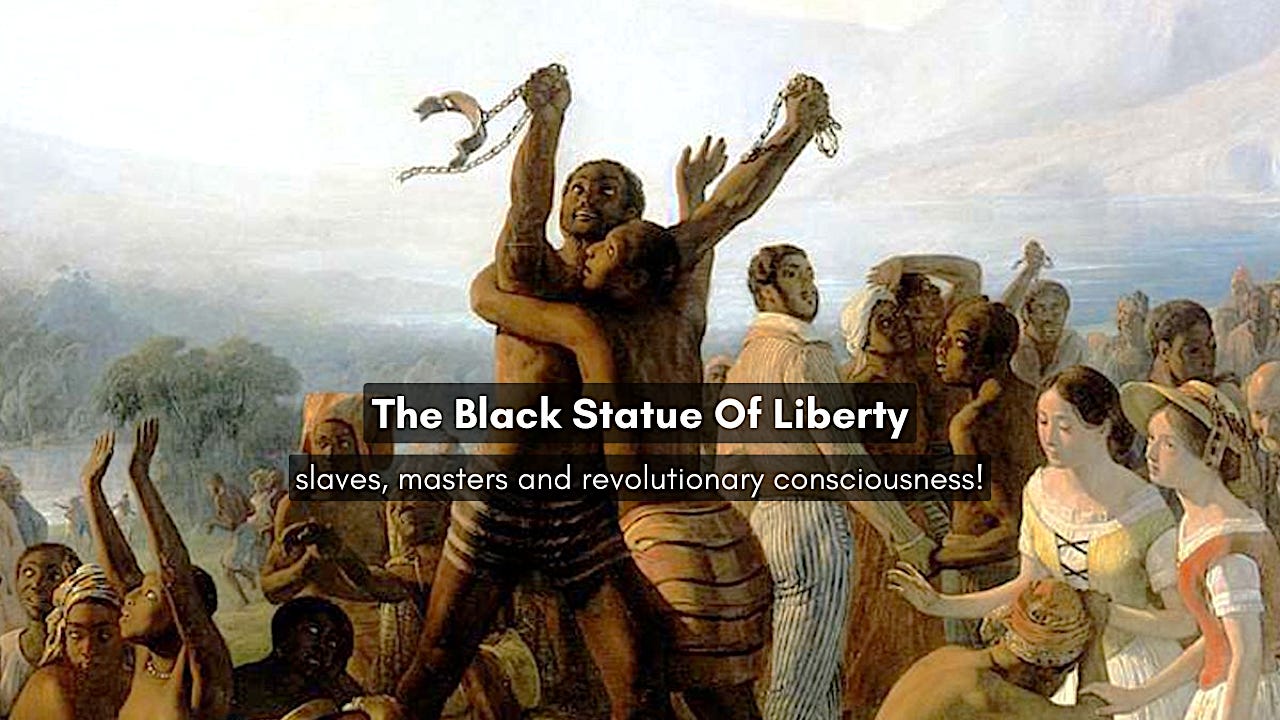
We are back where we began. The quest for liberty and emancipation is perhaps as long as that of civilization. Is also what we have come to know as “revolution”. Liberty is also a colossal “neoclassical female figure” robed and crowned in Greco-Roman aesthetics. She holds a torch above her head with her right hand, and in her left hand carries the “Tabula Ansata” with the inscription “July 4, 1776”. With her left, foot she steps on a broken chain and shackle, commemorating the national abolition of slavery following the American Civil War. After its dedication, the statue became “an icon of freedom” and of the United States as well, seen as a “symbol of welcome to immigrants arriving by sea”. But all such welcoming and patriotic myths, are long done with in terms of the United States.
Apparently the bourgeoisie of France felt a deep need to gift “Liberty” to the newly found nation of United States. And not to Haiti or the Dominican Republic ? How selective or plain racist and imperial? To sum up the matter as an “embodiment of the United States” or the confluence of the females “Britannia” (English) and the “Marianne” French. Indeed, the super-structure designed by Frédéric Bartholdi and Gustave Eiffel could never be black nor was it symbolic of any lasting class struggle or revolution.
European domination, achievement and power actualized via the blood, sweat and tears, the mutilation and disembodiment of millions of slaves — millions of beings that have been erased from history itself. From wither came such a lady of “Liberty” ?
The Black Statue Of Liberty is a cheeky euphemism to dethrone the imperial structure — one which has always been an embodiment of “concentrated oppression and racism”. As a struggle for liberation that destroyed settler colonialism in Haiti and the Dominican Republic, the same spirit lives within the “most oppressed and the most abandoned” (Wretched Of The Earth, Franz Fannon). Past and present, if we can feel togetherness in the revolutionary spirit, shared between the Caribbean slave rebels (past) and Hamas backed by the people of Palestine (present).
The more important speculation for you, me and the society we belong to — like the slaves of Haiti and Saint-Domingue, who were no less evolved, and even hospitable and “open” to the boldest conclusions — of revolutionary thought, consciousness and acts. And is that the case with us?
🌀🌍🧒🏻🌏👧🏽🌏🧒🏾🌀
🥥 To pledge support with a paid subscription 😌 CLICK HERE 🙏🏽
(yes it helps a lot).
Comments
Nothing yet. Say the first thing.
Sign in to join the conversation.