
Seemingly unconnected elements can be linked or coupled on a timeline — as parts of a historic process and evolution. Sugar, Coal, Petro-States and Post-Petro linked together as ‘The Four Horsemen Of The Apocalypse’ or ‘A Fantastic Foursome Of Energy’ or even “A Giant Metabolic Rift In Nature” (Return To Nature, John Bellamy Foster). The following story is about our addiction to excess energy, and why elements become impossible to ignore and divest from, even worse overcome.
Sugar (A Global High!)
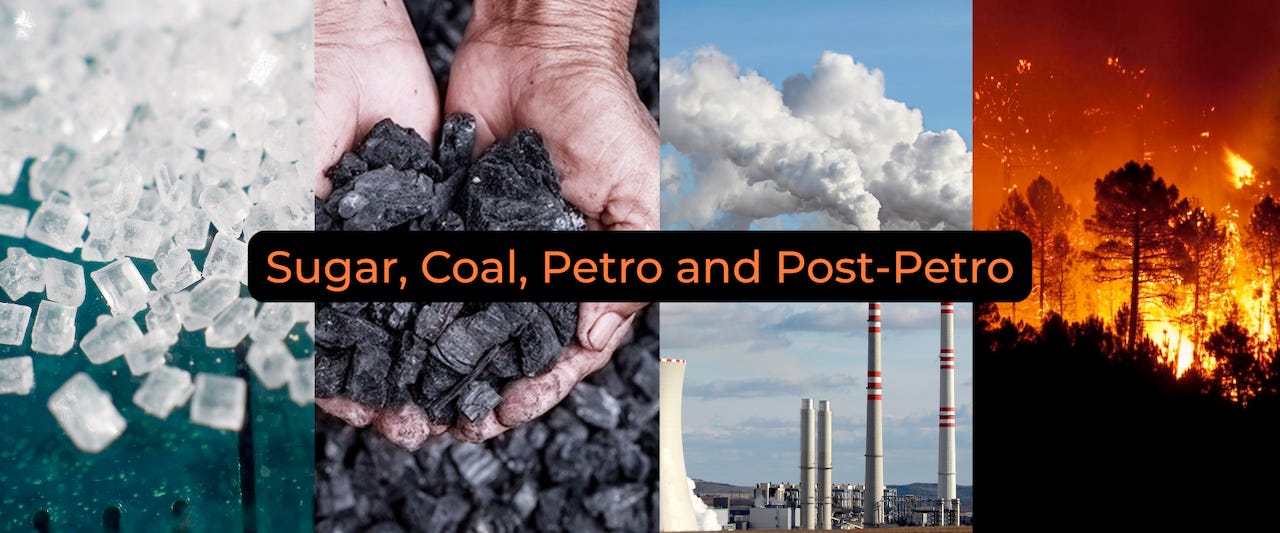
I was born at the end of 1974. A period when the world was going through an “energy crisis” and several geopolitical catastrophes, much like today. Yet human population back then was nearly 3.8 billion and now nearing 8.3 billion. My mother was 26 and my father 35. They bought ‘Rasgullas’ and ‘Raj Bhog’ (Bengali desserts) to celebrate the arrival of their newborn. Sweets (and Sugar) that symbolize the “sweetness of life” also of prosperity and togetherness. A few grains of Sugar and cooked rice were placed in my mouth by some priest, 21 days past my birth, as a common ritual to officially “bless the baby” and get on with his “upbringing”. Every newborn, female or male must receive the symbolic grains of Sugar. New life, energy and the metabolism of growth, itself ordained by Nature and surrounding community. I don’t remember details, but every celebration, social or religious, wedding or birthday, was presided over by a range of Bengali desserts, Indian sweets, western biscuits, cookies, doughnuts, cakes, pastries etc. And it still is the norm, not just in India but almost everywhere else, as living traditions. Simply put Sugar and all that is sweet “makes us feel good.” (Cookie Company). For now, never mind the downside, of obesity, diabetes, cardiovascular disease, risk of cancer, inflammations, even depression, skin problems etc, all related to Sugar intake.
“Carbohydrate metabolism” is the whole of the biochemical processes responsible for the metabolic formation, breakdown and conversion, to create energy — fundamental to the very growth of life, for humans and non-humans alike. Yet Sugar, as a produce or product, has shaped not just our metabolic activity but also cultural values, personal connections and desire to share “moments of happiness”(Cadbury). Rarely we find a society in whichever continent that is not a part of the above predisposition to Sugar and the sweet. Hence, Sugar production and consumption in it’s historic process is akin to fossil-fuels when we consume the element as a “globally available staple.” Modern life is full of “delicious stuff” that cannot be sold without Sugar, bound up within the logic of an otherwise energy addicted civilization.
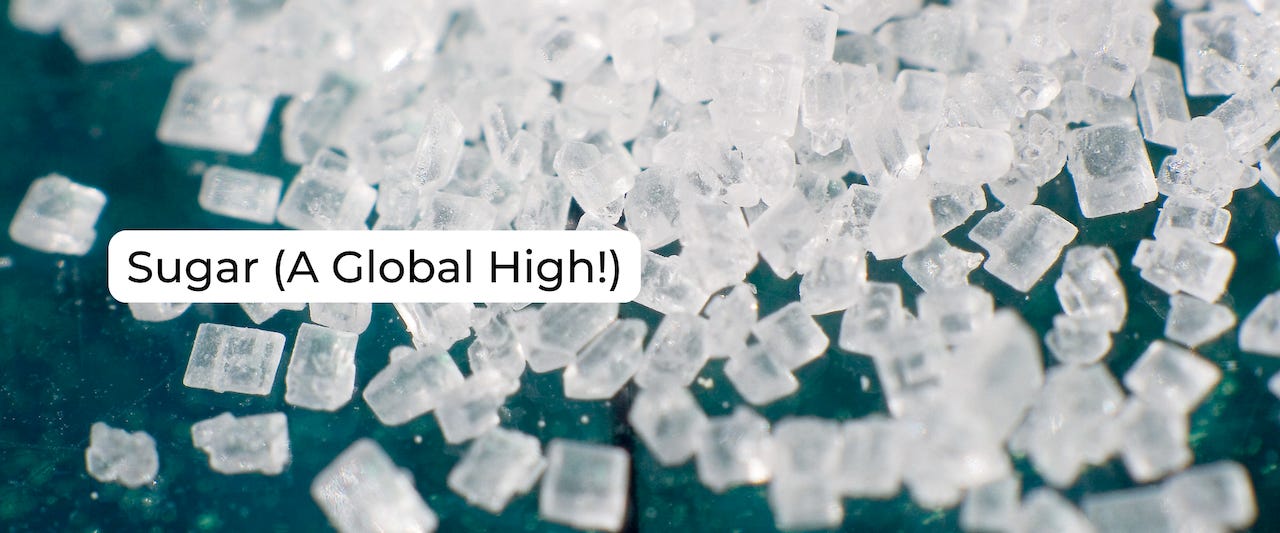
The history of Sugarcane and Sugar is ancient. Emerging first from Indonesia and Papua New Guinea (4000 BCE) the extraction of Sugar cane juice from the “Sugarcane” plant proliferated first to Southern China (3000 BCE) and then to Bengal (600 BCE). The sea-faring trajectory of Sugarcane towards the tiny pacific islands of Solomon, Tahiti and Fiji over hundreds of years, is simply amazing. Indians figured how to “crystallize Sugar” during the Gupta Empire around 340 AD. The cultivation of Sugarcane reached Persia just around the same time it hit Hawaii around 450 AD.
With the rise of Islam, Sugarcane colonized new ecosystems in medieval Iraq, Palestine, Egypt, as far as Morocco and southern Spain. The Catholic Crusades, spanning almost two hundred years (1096 - 1292 AD) also brought Europeans in contact with Sugar, as chronicled by William Of Tyre in the late 12th century, as "a most precious product, very necessary for the use and health of mankind". The fundamental problem with Sugar production, that it remained highly labour intensive in terms of growing, processing and shipping. While gold and silver, opium, coffee, tea and tobacco, spices and silk, all play a role in the power of European colonialism and early capitalism, it was Sugar that turbo-charged European prospects, during the next 300 years. “White Gold” was a common term in 14th century Spain and Portugal.
Well before Christopher Columbus discovered the “New World” (1492) the Portuguese had colonized the West African island of “Madeira” (Porto Santo) — naming it literally because it was full of tall trees (1418). Madeira can be understood as a “laboratory version” of a global model, as a proto-mechanism of colonization, extraction, slavery and enrichment, coupled together as the praxis of energy and capital. “The ravenous architecture of colonization and extraction… they cannibalized the forests, converting the wood into timber, to make new slave galleons, docks and ports, as well as clear land for the first successful mega-plantations of the Western hemisphere”. (History Of The World In Seven Cheap Things).
The “Sugar high” of Iberian plantation based capitalism using slave labor, dominated the Caribbean islands, Brazilian coast and Meso-America for a while (1510-1665). The early logic of enclosure, extraction, conversion and profit actualized into hundreds of sugar plantations powered by hundreds of thousands of slaves. The “Sucrose Monopoly” was eventually hijacked by the British, French and Dutch colonizers, introducing improved techniques and technologies of Sugar production and transport. Fact that James Watt’s “steam engine Revolution” coincides with the inception of the Jamaica Railway Corporation shows how Sugar energized the colonial arteries of Europe. From British America, it drove colonization, brought in required African slave-labor, while it fueled consumer use in Europe and it’s peripheries.
With every proceeding century the techniques and involved technologies only got better, not just in the Caribbean colonies and Southern U.S. but across Philippines, Indonesia, China, vast parts of middle Africa, the entire continent of South America except Chile. No doubt a major part of the food industry as well as high cuisine would collapse tomorrow without Sugar. The experts continue to insist that “Sugar has some addictive qualities, but it's not officially classified as an addictive substance like alcohol, nicotine, or drugs” (Harvard Gazette). Yet, Rum is a liquor made by fermenting and distilling sugarcane molasses — a globally popular drink that came about as a consequence of Iberian plantations, in the Caribbean and Brazil.
The tapestry of addiction to Sugar within the web of food is simply immense. From birth to death, Sugar is present or worse the reason of our health concerns. Global presence of Sugar within our food chain can be understood as a part of the“giant metabolic rift” (Return To Nature). A serious health crisis as well the what they call “emotional eating and social craving” Yet, the sweet element we crave, is invisible and potent, as a global energizer, a caloric success without any limits. Thousands of products that can evolve as Sugar-Free to fill any gaps in the market. However contradictory and cruel, it’s value and place, validated by us all and still turbo-charging capitalism.
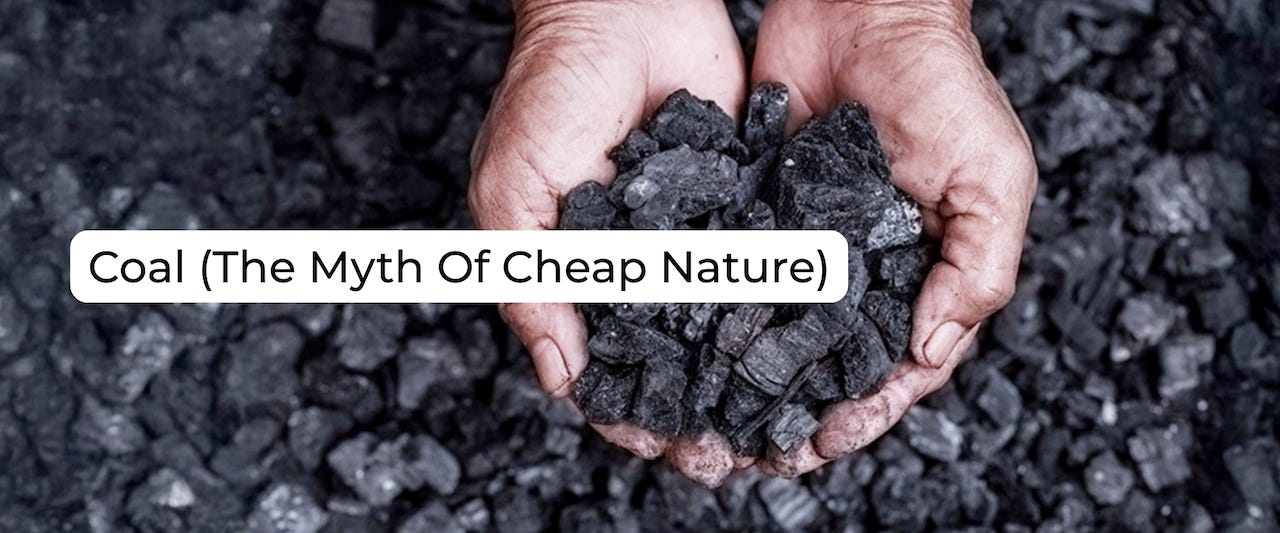
A lot has been written about the discovery, use and proliferation of Coal, to power the 2nd Industrial Revolution. Coal powered Britain’s industrial and economic expansion is also full of environmental destruction, rising wealth inequality, air pollution and penury of miners. The abundance of coal discovered in Britain (1750) “was a key factor that enabled the country’s early industrialization” (Britannica Encyclopedia). Bizarre attributions come up for the “Coal Boom” of 18th century England, as “demand for coal exploded in the 1700s thanks to a population boom” (Guardian, 2024). The fundamental driver of Coal-powered England was it’s military and maritime industries, directly connected to it’s global imperial power, and not it’s internal population boom.
Yet the prospects of cheap energy based on Coal, would be exhausted by the early 20th century, akin to how Madeira was cannibalized during 1400s — Haiti and Cuba in the mid-1600s — America in the 1870s — Road To Wigan Pier (1935). Albeit, capitalism’s tryst with Coal would manage to energize the two World Wars and several colonial wars around the world. Coal powered business, factories, towns, transport lines, shipping routes, etc would proliferate allover the world (1850-1950). “The British Empire’s decline after World War II” coincided with a significant drop in the global domination of Coal. Poorer, yet-to-develop-nations would continue the extraction of Coal at a higher rate, racing higher demands, following the West’s myth of cheap energy, for a growing population and whatever political economy.
The meta-analysis of Coal has been a “long concern” for environmentalists and climate scientists, as well as mining corporations, economists, global banks, politicians and whoever else tied to the overall prospects of “Fossil Capital” (Andreas Malm). Such as has been the case for a long time. No doubt that a range of experts blame Coal and Oil for “unprecedented rise of CO2 emissions during the 20th century” but they do so while omitting “the historic process of generation, use and change” (Somo, NL). The power of Fossil Capital is a result of decisions, practices and policies adopted and maintained by a relatively small number of “actors” and not by a global common consensus. The deeply internalized “myth of cheap Nature” (Jason Moore and Raj Patel) provides the world with the myth of cheap energy to begin with. This imbalance (and imperialism) spanning almost a hundred plus years cannot be negated, as done by western environmentalism and it’s “World-Ecology”.
The IMF and the World Bank, heavily dominated by the West, especially the U.S. “forced countries to open their economies” as well as finance the extraction of Coal, Oil and Natural Gas during the 1960s - till present date. Yet, the biggest beneficiaries of Coal are multi-commodity miners such as Rio Tinto, BHP Billiton, Anglo American and Glencore, US companies such as Peabody Energy and Arch Coal and the three state-owned behemoths of Coal India, Shenhua Group and C.C (China). Corporations, shareholders and individuals alike, complicit in the destruction of Nature, principally by mining, as well as profiting immensely under the guise of “affordable energy” and achieving some “higher good”. Coal and it’s “economic transformation projects” in India have led to several “contaminated communities and many detonator landscapes”.
India has achieved a “global milestone” by surpassing one billion tons of coal production in 2023-25. Some people see the figure as an utter disaster while some consider it as “the rest of the world’s share of Coal production has declined slowly”. (iea.org). Indeed, that too is a green colored lie, when we see Germany reopening it’s largest open-pit Coal mine (Hambach) in 2022 due to the “energy crisis” caused by the war between Russia and Ukraine. As of now China consumes nearly half the world’s Coal and it also manufactures many things that we may depend upon or whatever “trash” which ends up in the “global sink-hole”. Either path ends in a tragic way, as the “Myth Of Cheap Nature” as well as a busted biosphere for centuries to come. Who can leverage from such a crisis if not capitalism? Self interest as a “guiding value” aside for the moment, globally no alternative can be imagined yet.
Just for fun, mix Sugar and Coal, as two components of material reality that energize innumerable aspects of modern life and millions of industries.
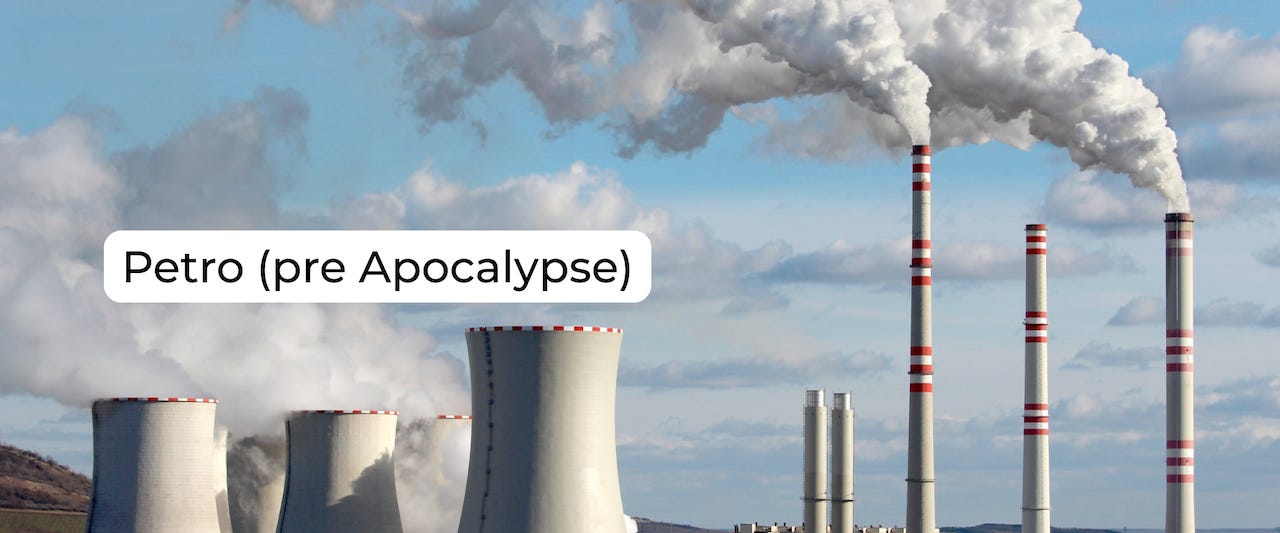
Back to the beginning of the story. Around the time I was born and the broad consensus of the era (1975 - 1985) is best understood as “productivism”. The era was about “upward mobility” or “economic liberty” or “infinite growth” and along came the so called “energy crisis”. The housing community that my parents lived in, switched from Coal powered kitchens to Liquefied Petroleum Gas (LPG) in 1977. Gas cylinders delivered by the government at an affordable price for the average Indian, to their doorstep was nothing short of a revolution. Especially for millions of housewives, maids, cooks, small restaurants etc, the transition to new energy, without all the unhealthy aspects of Coal (and charcoal) burning. The adoption was never complete but near universal, backed by the consensus of prosperity and “a matter of innovation”.
“Geographically isolated communities and Indigenous tribes in India that survive on wood and charcoal, also create a minuscule environmental footprint compared to urban Indians…” (PARI Network). Globally speaking, the “energy crisis” had been resolved for the moment or so was the broad consensus. “Affordable energy is key for a nation’s growth as much as the prosperity of each individual family… “ (Indira Gandhi, 1980). Energy abundance or it’s scarcity that beset the needs of a globalized economy, would steadily undermine the biosphere and negate “planetary boundaries”. Anthony Giddens’ definition of the matter as "an ethos in which 'work' defines whether or not individuals feel worthwhile or socially valued” yet such an ethos was made possible, only when it was energized by Oil and Gas (1960-2000).
Terms like “Peak Oil” totally ignore energy habits, the political expediency of warfare, the unreal expectations that urbanized people have about lifestyle and sustainability. Velocity of life, transport, transactions, use of resources and many more things has shot up, still accelerating, based on continuous supply of cheap energy. A world where the “velocity of construction as well destruction has spiked… velocity that can be mapped on the rise of emissions and cheap energy… no one is in control of hyper-complex systems and computational technology anymore.” (4 Times Humanity Tipped Over - Laurent Testot).
Canadian author and professor, Caleb Wellum (Toronto Mississauga) frames several energy crises together, a recurring phenomena since early 1970s. The forthcoming rise of “Petro-States” coinciding with the flowering of “World-Ecology” as well as “Petro-Masculinity”. Half a century that was emblematic of the “global victory of Fossil Capital” and neoliberal productivism. Also as a world full of “educated managers and specialists” engaged in thousands of ecologically destructive activities. Decoupling Fossil Capital from current means of production is not only being rejected by millions of people but also creating several new ecological and technological entanglements, akin to how it was with Coal and Oil in the 19th and 20th century.
“The energy crisis of the early 1970s would split in three different directions, surpassing what was achieved by Coal till the end of World War2. One being the cultural narratives based on the unlimited flow of Oil, unlimited growth of highways, air transport, shipping and privately owned cars. Two, the crisis prone relationship between the environment and energy . Three, the imperialism of Oil and Gas producing nations who profited from every energy crisis and war.” (Caleb Wellum). Contradictions that can be objectively made sense of, but in hindsight only when a new crisis is already in motion upon pre-existing ones. To wake up in a society where less and less people own homes or want to have children, raise a family is a dismal scene, a clear sign of decay. The cheap energy-ride of the 1970s till today, is a period during which the percentage of people who own property has fallen by 44% in the United States. The percentage of homeless in India has steadily risen since the mid-1990s, with well over 1% of the population (12 million) in 2012 — discounted like the millions of tonnes of Coal the “system” has extracted, sold and effectively burned in the name of “progress”.
Looking back at the “Wonder Years” and my father who spent an entire career spanning almost 30 years as a Polymers and Plastics expert, working his way up in a British era corporation called “Amines & Plasticizers” — he could imagine a house full of “durable plastic products”. But he could never visualize a contaminated planet, full of polymers and microplastics. Our own bodies and millions of living beings, now host to residual plastic particles. The oceans which now nest swaths of plastic and corrosive discarded waste. My parents generation was simply part of a broad consensus, however well meaning, in reality it was and still is destructive and irreversible. By “constructing the oil crisis in certain ways” the United States and many “Fossil Capital based nations secured a temporary future of endless growth, limitless consumption and fleeting pleasures.” (Pretty Heady Stuff).
Just for fun, mix Sugar, Coal, Oil and Plastic as components of material reality that energize and hold together innumerable aspects of our lives and millions of industries. And don’t worry too much, because the Post-Petro world is fast approaching and there will be much to cope in terms of change as is.
“Drill Baby Drill” (Donald Trump, 2023). “The world to breach 1.5°C limit in the next five years” (United Nations, 2024). “We are outside the realm of normality…” (James Hansen). “The window for meaningful change is quickly closing” (UNFCC). “It’s warming. It’s us. We’re sure. It’s bad…” (350.org). “We are out of time!” (Adam Mckay). “I want you to panic!” (Greta Thundberg). “2.0 million from 50 countries, believe climate change is the biggest emergency” (Climate Emergency Declaration). “Heaviest rainfall in 130 years.. Nowhere is safe!” (The Guardian). “Impetus for a different world has begun.” (Humanium). “Summer 2024 the hottest ever…” (WEF). “… to drill the last molecule” (prince Bin Salman Al Saud). “World enters this critical window…” (Post-Capitalism Now).
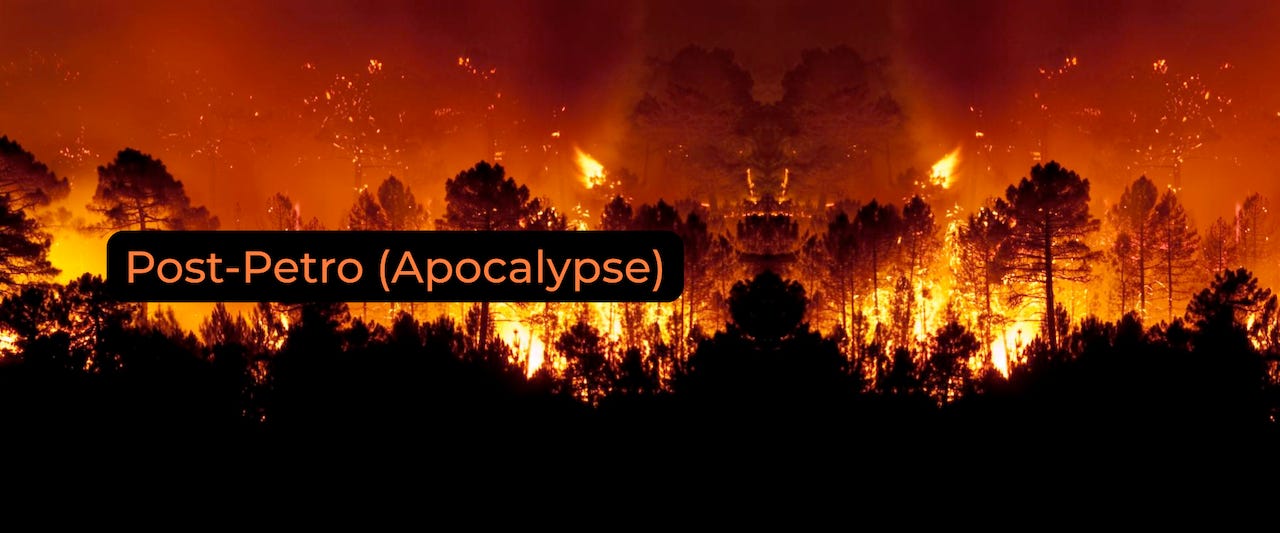
The much speculated Post-Petro world “shapes social reality” of our age. Well, a part of it at least. What appears like diverging paths, of Fossil Capital and Renewable Energy are both in sync with the old maxims of capitalism and it’s utterly destructive “Myth Of Cheap Nature”. The “Climate Apocalypse” framed by first-world imaginaries are not just ridiculous but utterly mediocre, especially when placed next to global unfolding subjectivity — of genocide, starvation, exodus, preposterous loss of biodiversity and habitat, rising social disruption and scarcity of everything important. Meanwhile Colombia emerges as the only nation to give up on Fossil Capital. “All future fossil-fuel driven projects have been cancelled” (President Gustavo Petro, 2023) How ironic his surname is “Petro”!
Globally speaking a third disruptive situation also emerges “out of class and it’s relationship to affordable energy, housing and food viz-a-viz modes of production” (Return To Nature). Similar strategies that fall back on community leadership, local ecologies, local organization of energy, as well as land protection, environmental limits and activism. Cheery as it may come across, such disruptions are minuscule, like real honey versus cheap industrial sugar. For a small group of people, the Post-Petro dream (and plan) is about changing energy and altering “personal and global behavior patterns”. Yet these folks (think global, act local) are often divorced from material scarcity as well as hogtied to systems predicated by private wealth and technology.
The biosphere crisis has also triggered ethno-nationalism, that is able to influence and hijack environmentalism and existing laws, in countries rich or poor. Be it the case in the United States, Canada, Australia, Argentina, China, Chile or countries like Burkina Faso, Congo, Tanzania, Mozambique and South Africa. Prefer nationalizing it all? Depopulating entire regions? Or building militarized walls around resources and remaining Nature? The Post-Petro world is fraught with a total downgrading of every form of existing privilege as well as accountability of who (and what) is it that has majorly destroyed the planet?
Global North are responsible for nearly 90% of the excess emissions driving climate breakdown (1850-1950). Just to be clear, not everyone in the Global North or South is equally responsible. However just 85 investor-owned companies are responsible for about one-third of worldwide emissions (1978-2018) and “just 125 billionaires emit 393 million tons of CO2 each year. That is more than the 2022 emissions of Chile and Argentina combined” (Somo, NL). Excess energy can be summarized in many scientific ways, yet to measure it as an explosion — “900,000 Hiroshima Nagasaki Atom Bomb’s worth energy every day!” (Tad Delay, Future of Denial).
Yet Fossil Capital is the “common devotion” between every nation that is at the producing, refining, shipping and burning end of the deal. And deeply desperate or devious is the stranglehold of Fossil Capital upon life itself. There is no real material difference between Donald Trump, Vladimir Putin, Nicolas Maduro, the Ayatollah Of Iran or prime minister Mark Carney of Canada or president Lula of Brazil. All tacitly committed to the outflow of cheap energy. “Fossil Fooled” we all have been! Matters of sustainability and every corresponding change merge as global solutions, just like Sugar, Coal and Fossil-Fuels did during the last 500 years (Capitalocene, Donna Haraway).
They call it “Oil Sustainability”. They wish to make sure the “demand” for fossil fuels does not drop — not for a long while! The monarchy of Saudi Arabia can be understood as a wicked bunch of thugs, who will continue drilling and selling oil till the “last molecule” (prince Bin Salman Al Saud). Indeed the royalties of Saudi Arabia, UAE, Kuwait and Qatar also signed COP mandates, the Paris Accords and whatever “fossil fool’s” agreements. The same “demons of Fossil Capital” the kings of Saudi Arabia wish to flood the poor nations of Africa and Asia, with not just oil and gas, but also highways, cars, malls, private jets, airports etc. “Oil Sustainability” is to keep the third-world hooked and shackled to one family, one deal, one and the same evil energy. Dedicated to the destruction of the biosphere, speeding up global warming, worth eliminating the Saudi Royal Family alone? Or the 1% or who else that profits from the bondage of energy slavery. But as worse situations and contradictions are framing the “climate-resilient growth policies” of France (2024). We can see blowback already in motion, in Spain, as part of it’s energy transition coupled with depopulation.
The “evil” some people associate with Sugar, is similar to rage that some people feel about Fossil Fuels and is yet identical to how some other people feel about solar fields and windmills. The “evil” eventually is a*live* as the demand and abuse of energy. Hooked we are to energy and hence unable to undertake any further evolution.
There is no widely accepted term for the process through which people are hooked up to systems of energy as individuals or as society, or what all actually energized the making of modernity — civilizations, empires and energy themselves collude into “forces of Nature, caught up in the co-production of life”. The new consensus or “thinking” about capitalism, Nature, power, energy can also be placed next to the devaluation of people and the biosphere. Next to racism, debt, inequality, poverty, climate breakdown, biodiversity loss etc. Unified through a “crisis of perception”. But that perception alone is not enough — cannot give up on energy as “the pursuit of power” (Jason Moore, Capitalism In The Web Of Life).
Empires of excess, that transitioned from Sugar to Coal to Oil to Renewables to the Post-Petro world retain the old-world praxis of “Cheap Nature”. Is why the material reality still looks more like the same old imbalance and excess, but at a greater scale — sugary desserts and cakes for a few people and dry bread or nothing for the rest.
🍰🍩🍪🎂🧁🥧🍯🍻🛢️⛽🛢️⛽🛢️⛽💲💱🛢️⛽💲💱🛢️⛽💲💱‼️
In case you wish to pledge support with a paid subscription 😌 CLICK HERE 🙏🏽
(yes it helps a lot )
Comments
Nothing yet. Say the first thing.
Sign in to join the conversation.