
Our hyper-normalization of violence is a historic process. To each, a specific narrative. The headlines and media are rife with coverage of genocide and geopolitical disasters. The term “live streamed genocide” is in vogue allover the internet. In any case, have you ever experienced a genocide or an ethnic cleansing in-person? Seen men, women and children burned alive? Tanks roll inside civilian enclaves? Shoot-at-sight orders? The sky turn black with smoke, from all the burning, looting and sacking of colonies, markets and ghettos? Terrified minorities huddling inside a basement? I did so as a child, way back in 1984. And over time the event became a milestone of shock, cloistered around communal violence that nests in the underbelly of a dense but fractured society. One that also happens to be the “world’s biggest democracy” and a land with “myriad and exquisite cultures and subcultures.”
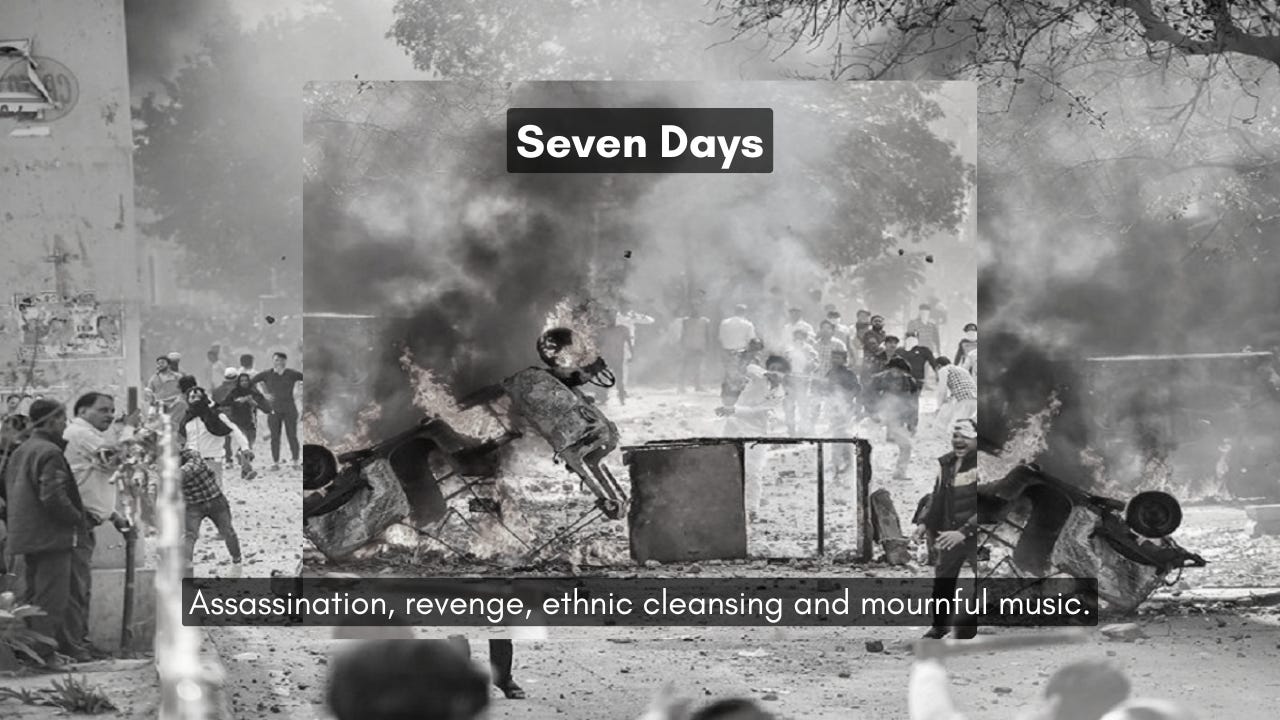
Seven Days. One week. A shocking assassination that ignited a tinderbox of communal violence, leading to widespread ethnic cleansing, witch-hunts by the police, the ruling elite’s complicity and the eventual military solution. With some mournful classical music, but as the backdrop of terror.
Prime minister of India, Indira Gandhi was assassinated by her bodyguards Satwant Singh and Beant Singh, on October 31st 1984. No less than 40 rounds were fired by the two men using various guns, over a moment which lasted no more than a minute. Surrendering without resistance, nearby police and other guards took Satwant and Beant to “closed room where Beant was shot dead” (Wikipedia). 10 hours later, the state broadcasting services Doordarshan (TV) and Vividh Bharati (Radio) declared Indira Gandhi dead.
Asian, African and European leaders mourned Gandhi as “a great champion of democracy and leader of the Non-Aligned Movement” expressing “deepest grief” (Konstantin Chernenko, USSR) and called the killing a “terrorist act” (George Shultz, U.S.). What these leaders felt or their opinions can be taken as entirely fake, yet the question as to why Indira Gandhi was assassinated was rather simple. The “reign of terror” which Indira Gandhi along with the administration and the para-military forces had unleashed in Punjab (1981-84) over the question and long struggle for independence, known as the Khalistan Liberation Movement, had reached its apex with the invasion of the holiest Sikh shrine, the Golden Temple. It was Indira Gandhi who had vowed earlier to crush the “militant spirit of independence in Punjab”.
The language of violence, is best spoken by the state, and so was the case with Indira Gandhi, who signed off operation “Blue Star” in May 1984. No doubt, that thousands of Sikhs were massacred by the Indian army and police, as many abducted and tortured and hundreds of violent martyrs belonging to the KLF would follow through as “terrorism and sectarian revenge” (Ramchandra Guha). But we are made to believe liberal lies, that frame Indira Gandhi as a benevolent figure who apparently said “when I have Sikhs like this around me, then I don’t believe I have anything to fear….” (Indira Gandhi: Death in the Garden by William E. Smith).
President of India, Zail Singh and cabinet ministers arrived at the hospital, but had to escape because a roaring mob stoned their cars. “The incident on the 31st of October, in hindsight was a small precursor to the ethnic cleansing pogroms unleashed on the Sikh, by their fellow Indians, especially certain key Congress leaders, the administration and Delhi Police.” (Sanjay Suri, 1984: The Anti-Sikh Riots and After).
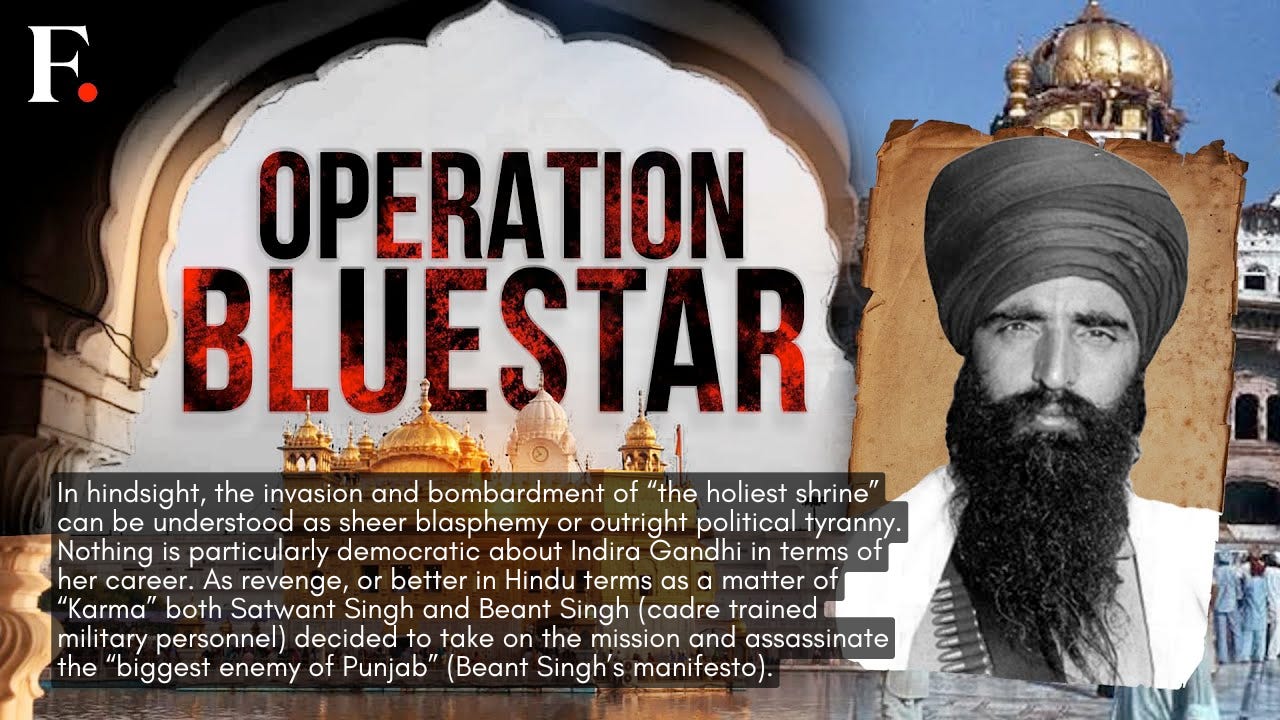
In hindsight, the invasion and bombardment of “the holiest shrine” can be understood as sheer blasphemy or outright political tyranny. Hundreds of “extra judicial killings” in Punjab during 1981-83 triggered Sikh separatists, in terms of extreme and militant response aimed at the establishment. Nothing is particularly democratic about Indira Gandhi in terms of her career. Her record of violent reprisals, include Bengal (1969-70), Emergency Period (1975-78), Assam (1981) and Tamil Nadu (1980-81). Indira Gandhi’s loyalists equated her to “Goddess Durga” (Neelam Sanjiva Reddy).
As revenge, or better in Hindu terms as a matter of “Karma” both Satwant Singh and Beant Singh (cadre trained military personnel) decided to take on the mission and assassinate the “biggest enemy of Punjab” (Beant Singh’s manifesto). Their decision, however valiant or fanatic, religious or political, triggered a great tragedy. The men after all were inspired by Jarnail Singh Bhindranwale who had been assassinated earlier by the Indian army, inside Harmandir Sahib. The entanglement of ethnic hate, revenge, ruptures and ripples that would span decades, over generations and even nations.
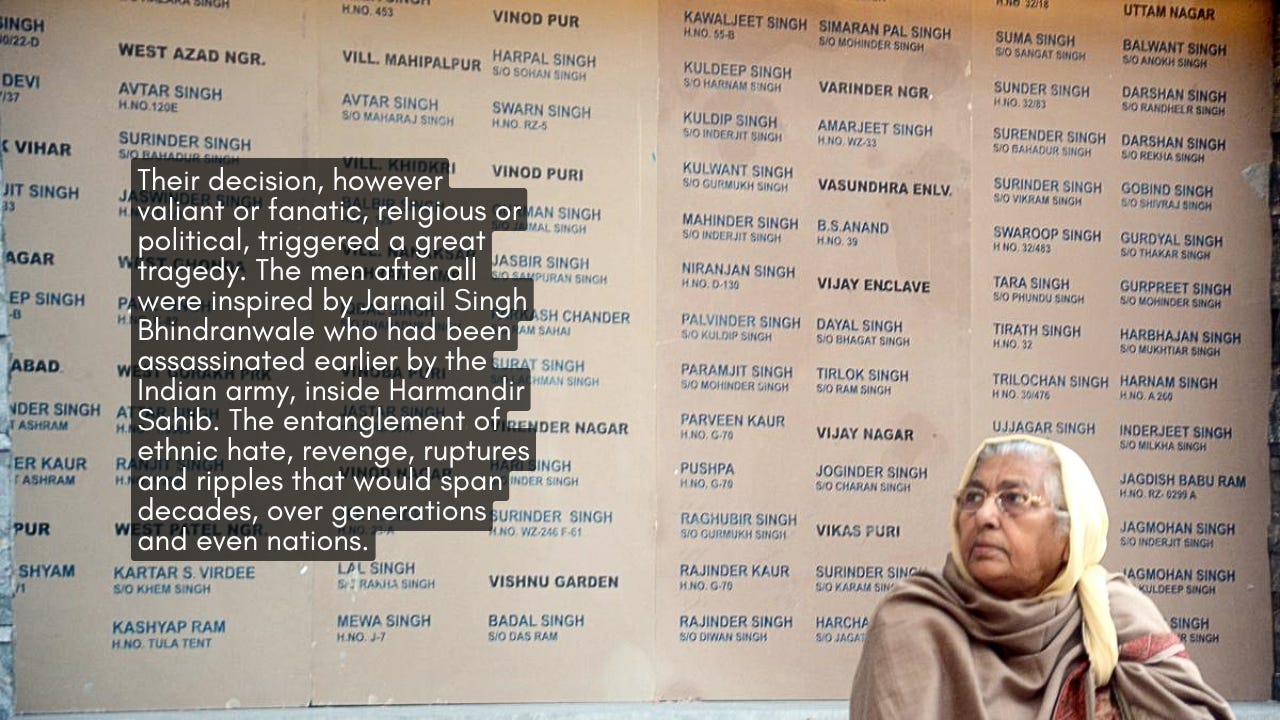
As soon as Indira Gandhi was declared “officially dead” and the guilty named, multiple riots broke out in New Delhi, spreading into Haryana, Rajasthan, Uttar Pradesh, Maharashtra and Punjab. Overnight the Sikh community became the target of many things horrible, as the collective psychosis of a nation.
The initial state of disarray, led to the suspension of roadways and trains across north India. Schools and universities in New Delhi, Bombay and Calcutta were declared shut indefinitely. Followed by the cancellation of all programming on TV and Radio, replaced by continuous, mournful, Hindustani classical music. Starting November 1st, the following seven days were an “imposed state of total elegy” (Ramchandra Guha). A “media black-out swiftly followed, especially in the metropolitan areas” (Prof. P. Sainath). All cultural, political, sports, cinema and entertainment events were suspended. Yet mournful music and devotional chants failed to impact, failed to pacify the seething roaring mobs, already bandied together to initiate “multiple pogroms against Sikhs” (UN High Commission, New Delhi).
Armed mobs blocked highways, stopped buses and trains in and near Delhi, pulling off Sikh passengers for lynching, some were burnt alive, women were raped and children separated from their kin. The carnage that followed for the next three days and nights allover north India, included sights and stories that time is yet to erase. Akin to a medieval witch-hunt, armed mobs searched out thousands of Sikhs — dragged out of their homes, beaten, raped, humiliated, hair chopped, clothes ripped off, doused with kerosene, dragged, thrown off high-rise buildings, burned with chemicals, shot, all inside densely populated enclaves of New Delhi — Tilak Nagar, Kirti Nagar, Patel Nagar, Karol Bagh, Trilok Puri, Mongol Puri, Kalkaji, Govind Puri, Malviya Nagar, Sahadra and Sultanpuri.
Unchecked, worse encouraged by the police, local leaders and administration, even bigger mobs laid siege around several “Gurudwaras” (Sikh shrines) inside which thousands of Sikhs were taking refuge. Nine Gurudwaras were raised in East Delhi, with no record as to how many escaped and how many were burned alive. Though such an outbreak was triggered by the assassination of Indira Gandhi, it was not proletarian at all. Instead the initial riots were rapidly summoned by select leaders of the ruling elite to escalate “revenge”.
HKL Bhagat, Sajjan Kumar, Jagdish Tytler and Lalit Maken were the principle agents of the anti-Sikh pogroms in North India. A special mention to Ved Marwah (IPS) who’s oversight made sure that the police force would never intervene, to stop this ethnic cleansing. “The ruling elite’s involvement, be it as administration or police or media is clear, not just from memory but all such new revelations and old records which the victims have preserved…” ( Jagmohan Singh Khurmi).
3rd November, the presence of mob violence could be felt even inside a predominantly Bengali, middle-class enclave. Several vans, jeeps and bikes driven by unknown men patrolled our colony (C.R. Park). The police lines were all off-the-hook. Men shouting anti-Sikh slogans and slurs, later set fire to small shops, kiosks and eventually ransacked the local jeweler. The “anti-Sikh pogrom” had clearly abandoned its mission. The ruling political party had turned a seething, angry, disenfranchised section of the population against the Sikh community as well as the middle-class. “They are distributing free alcohol and kerosene, plus cash, to kill Sikhs” (local shop-owner). The mournful music and religious chants continued on the TV and radio.
What shows up from that time, can be best understood as ‘prima facie’ evidence of ethnic cleansing and the complicity of the Indian state. Take the following “call to action” statements (source - anti-Sikh_riots).
☠️“Whoever kills the sons of the snakes, I will reward them. Whoever kills Roshan Singh and Bagh Singh will get 10,000 rupees each… 5,000 rupees each for killing any other Sikhs. You can collect these prizes on 3 November from my personal assistant Jai Chand Jamadar” (Lalit Makan, Congress Leader, Kalkaji South Delhi)
☠️“Two thousand rupees for liquor per person, and do as I have told you ... You need not worry at all. I will look after everything.” (HKL Bhagat, Minister of Information And Broadcasting).
☠️“Avenge we must… burn them if we have to… for they have murdered the mother of India” (RSS ideologue Nanaji Deshmukh).
☠️“Not a single Sikh should survive…” (Sajjan Kumar to DC, East Delhi)
☠️“Every sikh will answer for the assassination of Indira …” (Ajay Maken, brother of Lalit Maken)
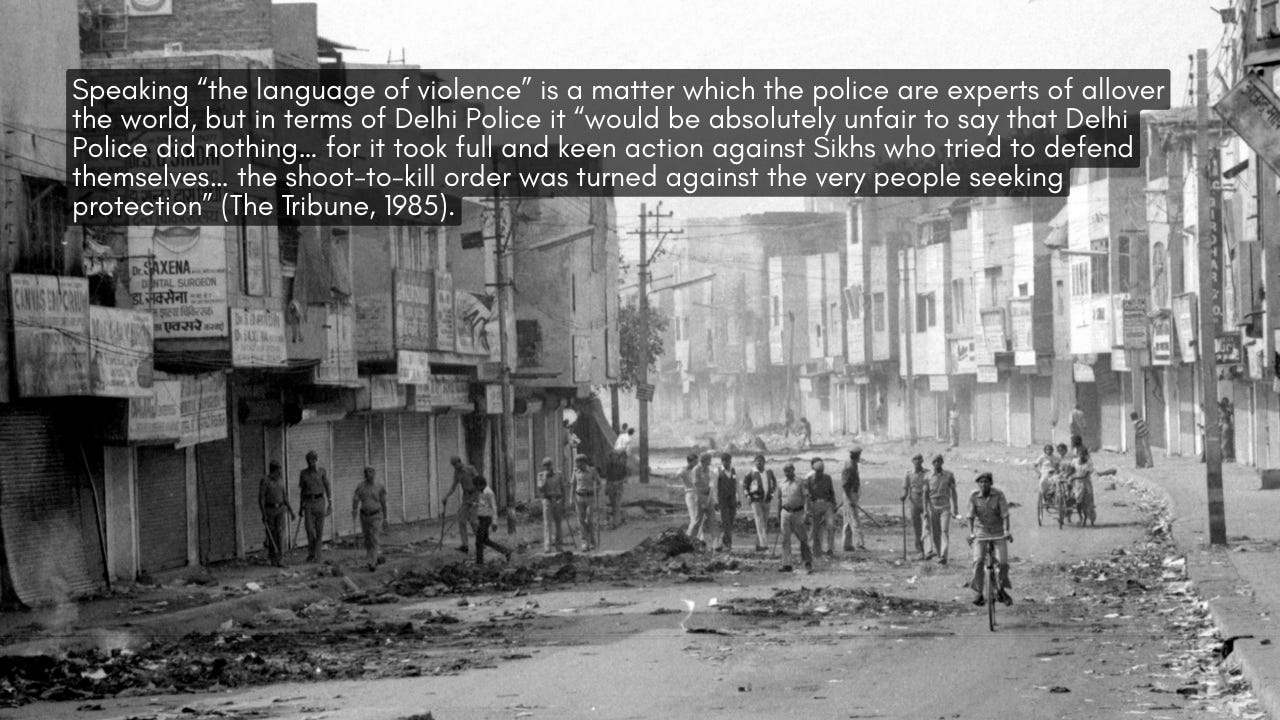
The state’s complicity was not limited to controlling the situation but also fueling it. “Combustible chemicals, kerosene, LPG cylinders and alcohol was distributed in various quantities in New Delhi and outside… whose provision required large-scale coordination.” (ENSAAF). Speaking “the language of violence” is a matter which the police are experts of allover the world, but in terms of Delhi Police it “would be absolutely unfair to say that Delhi Police did nothing… for it took full and keen action against Sikhs who tried to defend themselves… the shoot-to-kill order was turned against the very people seeking protection” (The Tribune, 1985).
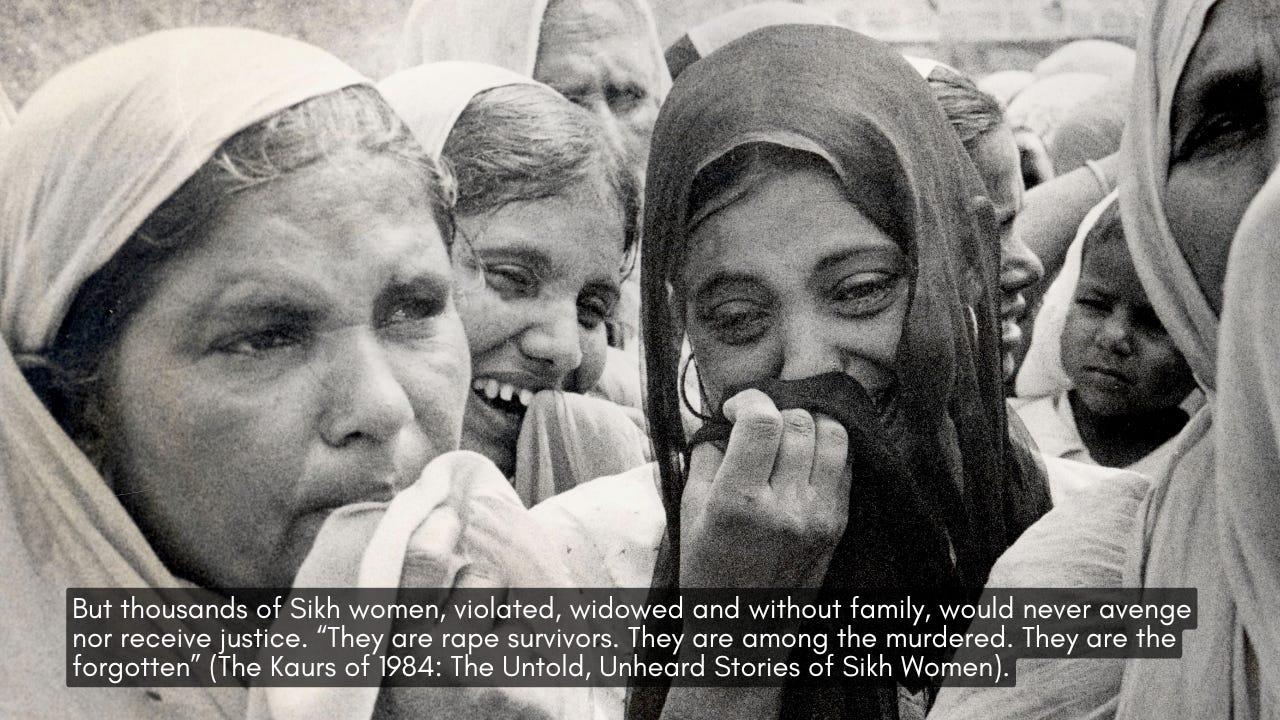
The horrors unleashed by Indira Gandhi’s closest rank-and-file leaders manifested as ethnic cleansing, sectarian violence yet with ritual blowback. In July 1985, Lalit Maken and his wife Gitanjali, the daughter of the president Shankar Dayal Sharma, were gunned down by ‘Bhai’ Sukhwinder Singh Shindu in Kalkaji. Mayor Krishan Sood gunned down by Sikh gang-men in March 1986. Hindu pilgrims were gunned down in Himachal Pradesh (August 1987). The “Market Blasts” of 1986 in Jaipur, New Delhi, Amritsar and Chandigarh. But thousands of Sikh women, violated, widowed and without family would never avenge nor receive justice. “They are rape survivors. They have missing limbs. They are among the murdered. They are the forgotten” (The Kaurs of 1984: The Untold, Unheard Stories of Sikh Women).
As means to frame the entire collapse of law and order, the Supreme Court Of India dealt with the matter of assassination as: “the motive for the crime was not personal, but the consequences of the action taken by the Government in the exercise of constitutional powers and duties, that necessitated military intervention.” (SC Ruling, 1995). A separate verdict convicted Kehar Singh, sentenced to death, for his “role” in making sure Satwant Singh and Beant Singh “would be as close as possible to their target”. Satwant Singh never pleaded guilty and was sentenced to death on 6th January 1989. In 2014 a movie was made about Satwant’s mission as a “valiant martyr” titled Kaum De Heere (Diamonds Of The Community). It was banned by the Indian Film Board in 2019.
Four decades later, the Home Ministry continues to insist that the number of Sikhs killed in Delhi during November 1984 “riots” was 2,146. The figure is absolutely false, outnumbered by over “11,000 pending cases of mob violence during 1984” (Sikhs for Justice - SFJ U.S.-based secessionist group). Highly contested or sometimes inflated, one can approximate 20,000 Sikhs killed between 1st to 6th November 1984 in New Delhi alone. According to ENSAAF (Sikh rights group) about 6000+ homes and shop were looted and burned — 580 buses burned — 1900+ cars and vans destroyed — 43 banks looted — 5 hospitals burned. Figures of up to 60,000 Sikhs are believed to have been displaced, as an aftermath of the assassination of Indira Gandhi. “A calculated assault which carved a path of devastation and sorrow in its wake.” (restlessbeings.org). Good for nothing was the Misra Commission Report (1985) on behalf of the Delhi Administration, that framed the massacre and persecution of Sikhs “as a sudden and spontaneous national outburst”.
Most obviously as consequence, the flight of Sikhs towards North America, Middle East and Europe shot up, as much as the formation of dissident groups within Sikh diaspora. Reformation of the Akal Takht, both inside and outside Punjab (2001) also coincides with new militant groups such as Sikhs For Justice, Waris Punjab De, World Sikh Organization, Council of Khalistan and Dal Khalsa to name the most prominent. Based predominantly in Canada, U.S. and the U.K. these organizations are not just an outcome of militancy but also serve as a base for “future referendums… based on several ethnicities and nations that have achieved independence”. The pending mission to achieve “nationhood” using whatever “call to action” — a spirit that could not be crushed by Indira Gandhi nor by the proceeding regimes of India.
The modern making of India, as a historic process has to include the legacy of “punishing the minority” (Kancha Ilaiah). Time and again, the ruling elite and sufficiently riled up mobs have inflicted terror and violence upon the minorities of India. Not just Sikhs, but also Muslims, Christians and Dalits (lower caste Hindus). The “Seven Days of 1984” with all the unrestrained carnage and violence, also dealt with the matter of survival and flight. Sikh writer Jaspreet Singh captures the contradiction as to “who is willing to help and give us shelter”. And many Sikhs were able to save their lives purely as a matter of human solidarity, for those “rescued and protected by people of all religions and backgrounds…”
Yet what about the silent spectators of such insanity? Events which went undocumented and never dealt by so called law and justice? On 3rd November, as mobs scattered allover New Delhi were busy hunting Sikhs, my grandmother and aunt witnessed something truly horrible from their apartment — a story both of them narrated many times, on occasion. “They threw a tire around his neck and filled it with kerosene… they pulled his turban off and tied his hands… his wife and children ran away and a part of the mob chased them… someone lit a match and tossed it on the shivering terrified man… he instantly caught fire… he yelled in a way I had never heard before… the mob went silent as he burned”.
Survivor interviews today corroborate the “extreme localized violence” that my grandmother and aunt witnessed in Patel Nagar. 4th November, my father declared “no one is going out of the house at any hour”. Rumors, hearsay, bits of information, short phone calls, all added up to collective hysteria. Yet the state was still broadcasting mournful, classical music, intermittent with religious chants by priests of Hindu, Sikh, Muslim and Christian variety. The audible reality, in the capital of India was filled with the sound-track of ethnic cleansing and riots.
Tanzania declared 7 days of mourning. Uganda declared 5 days, Fidel Castro declared 5 days of mourning. Pakistan, Vietnam, Brazil, Nicaragua and Gabon declared 3 days of mourning. But to be very clear, these nations were not mourning the death, torture, humiliation, rape, pillaging and ethnic cleansing of Sikhs. The epicenter of the Sikh massacre was Tilak Nagar in north Delhi. Probably the biggest concentration of Sikhs, about 250,000 were permanently evicted, over days and nights of mob violence, looting, pillaging and burning.
Indira Gandhi was cremated “with full state honors” on 3 November near Raj Ghat, at new spot called “Shakti Sthal”. Her elder son and successor to the throne, Rajiv Gandhi lit the pyre. “When a giant tree falls, the earth below shakes” said Rajeev Gandhi. In 1991 Rajiv Gandhi was assassinated by a Sri Lankan suicide bomber, as yet another “act of avenging”. A veritable closure, for the various military interventions initiated earlier by his mother Indira Gandhi, that resulted in the death of more than 12,000 Tamil separatists in Sri Lanka, during 1979-83. Rajeev Gandhi’s younger brother, Sanjay Gandhi had died in a plane-crash under “mysterious circumstances” earlier in June 1980. Sanjay’s short-lived political career included the forced sterilization of men, sacking petrol pumps to fund election campaigns and distribution of alcohol as “return gifts” for voters.
Back to the question of “Sikh ethnic cleansing or the possibility of genocide” — is still raging, revitalizing, reaffirming, but not so much within India as in countries like Canada and the U.K. New Democratic Party leader Jagmeet Singh declared “1984 was a genocide” in the House of Commons on Parliament Hill in Ottawa (2023). Yet Jagmeet Singh’s call to hold “responsible for this violence to justice” is of no consequence to the departed, desecrated and dispossessed in India. At best, after a very long drawn legal battle, it was Sajjan Kumar who was sentenced to life imprisonment by the Delhi High Court in 2018 for “his primary role in providing weapons and vehicles during the 1984 anti-Sikh pogroms”.
The “Seven Days” came to an end with military intervention on the 7th of November. Several tanks and military battalions entered New Delhi and some of them even rolled by right in front of our houses. The moment in hindsight appears as a mix of shock and awe (of a child) to see a tank pass by, while being pulled away by my mom ushering me and my brother to get inside. The marks left by the tank upon the tar was a source of awe, for months to come. We could not wait for the “normal” to return. Someone turned on the television, and the mournful sickening music had stopped and regular programming had resumed. “The milkman is back” someone shouted!
Somehow the mutilated Sikh community, a divided and wounded society and all the vicious criminals, went back into “the void of national censorship and shame” (Ramchandra Guha). The requiem for the dead and the undone would go on for decades — via thousands of court-cases, police tribunals, truth-finding-commissions, media investigations, films, documentaries, books, conferences, fund raisers and the likes. “I cannot talk about it and is why I talk less… and the alcohol and drugs help me not think about it” (Baljinder Singh, Ballu). Emotionally displaced for life, Baljinder was witness to the killing of both his parents by an anti-Sikh mob, aged 6 in 1984.
Once the schools reopened, I found out that some of my Sikh friends were never coming back yet the rest had “made it through somehow”. What followed for months and years would be recurring snapshots of those “Seven Days” pieced together again and again, by friends, family, neighbors, stories, conspiracy theories, news and scandalous revelations. Burned and abandoned buildings, schools and markets gradually faded into the past or were demolished entirely. Bit by bit, many traumatized broken communities pieced back their sense of stability, for the time being.
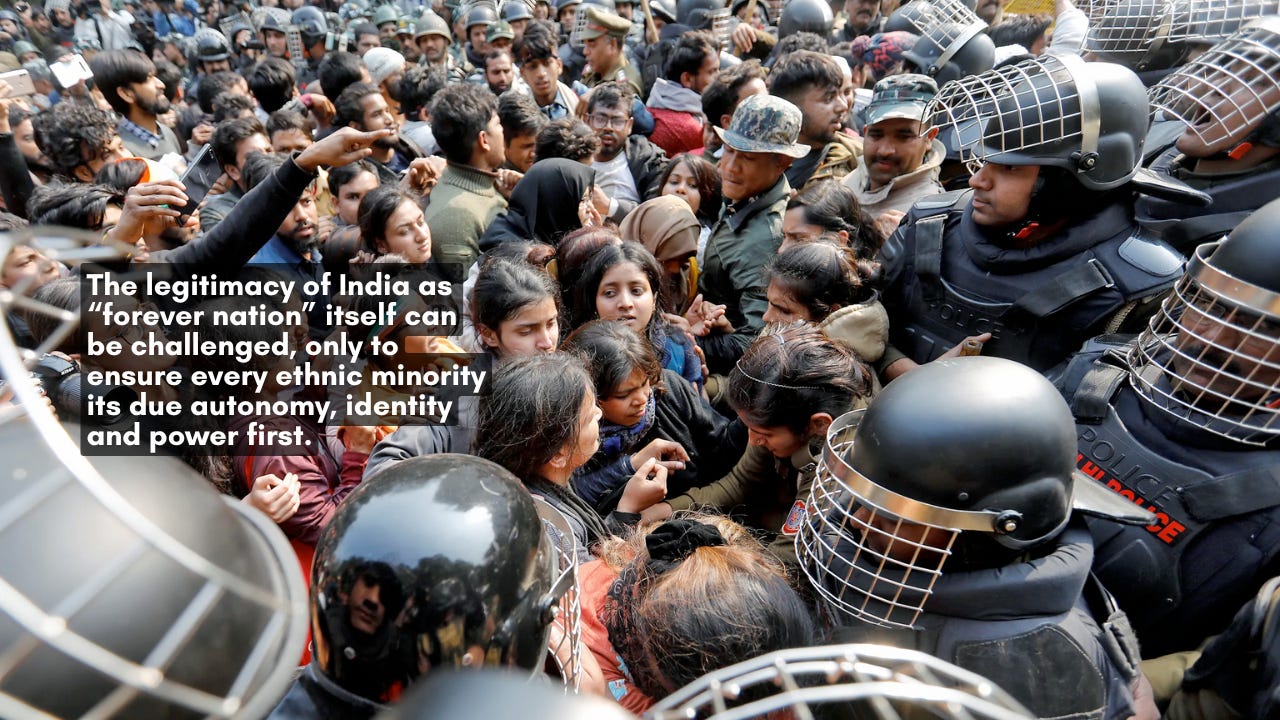
The matter of justice, reparations and “due punishment” is yet to be achieved. Highly unlikely in the future too. Why? To state it crudely, nations that came about as a process divided along religious lines, like India as well as Pakistan, where the former is framed as “a Hindu majority nation” and the latter as “a Muslim majority”. Much like that flawed anti-democratic basis, the Sikh question of “nationhood” remains unresolved, however fanatic and fundamentalist. The legitimacy of India as “forever nation” itself can be challenged, only to ensure every ethnic minority its due autonomy, identity and power first.
🧒🏾🌛🧒🏻🍄🌲🦔
In case you wish to pledge support with a paid subscription 😌 CLICK HERE 🙏🏽
(yes it helps a lot )
Comments
Nothing yet. Say the first thing.
Sign in to join the conversation.