
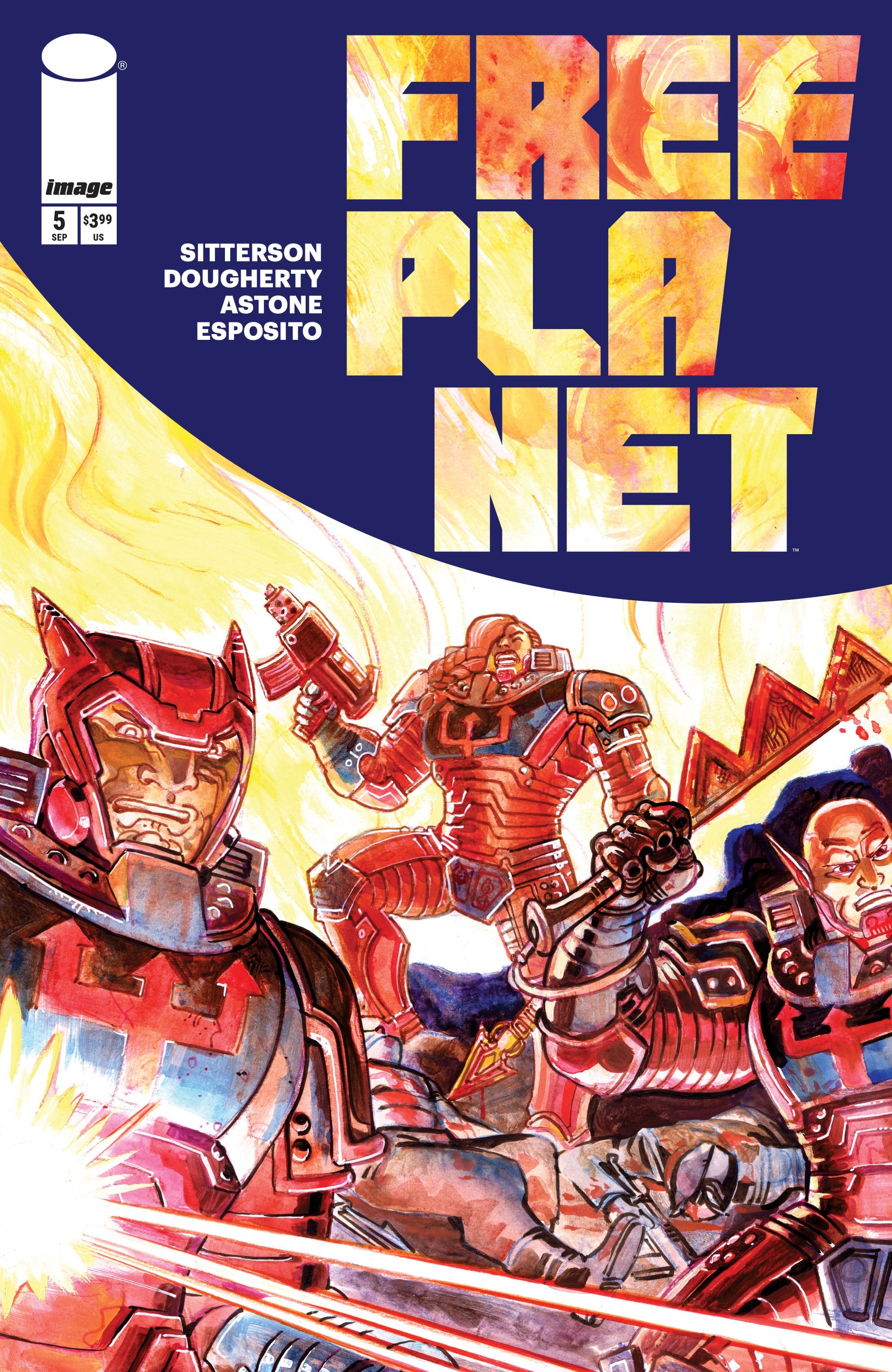
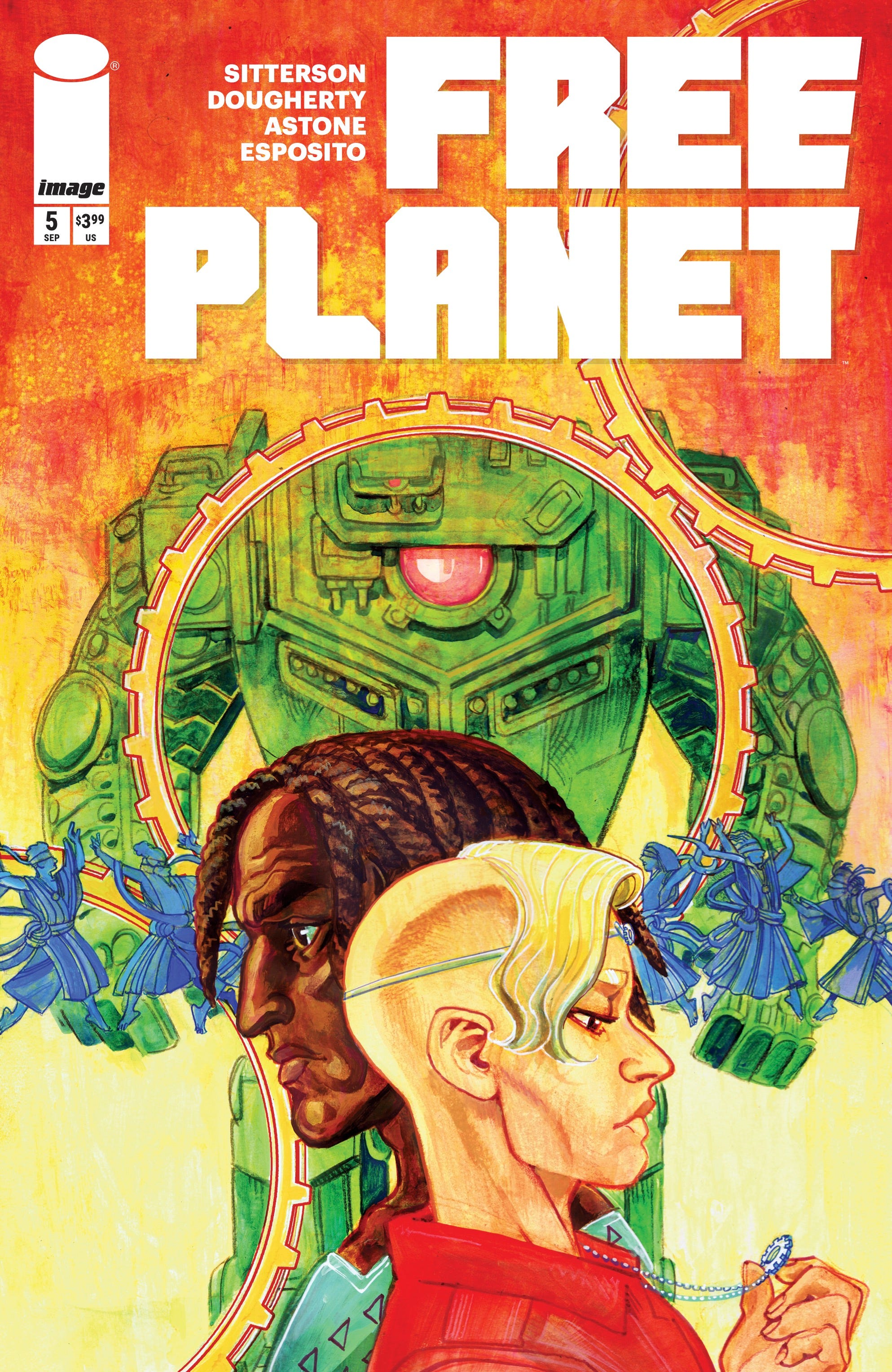
So as not to bury the lede: Free Planet #5 is in comic shops right this very moment. Set up a subscription at your local comic shop or get the series mail order from my friends at Collector’s Paradise. Whatever you do: Do not miss a single issue of the Shape of Comics to Come.
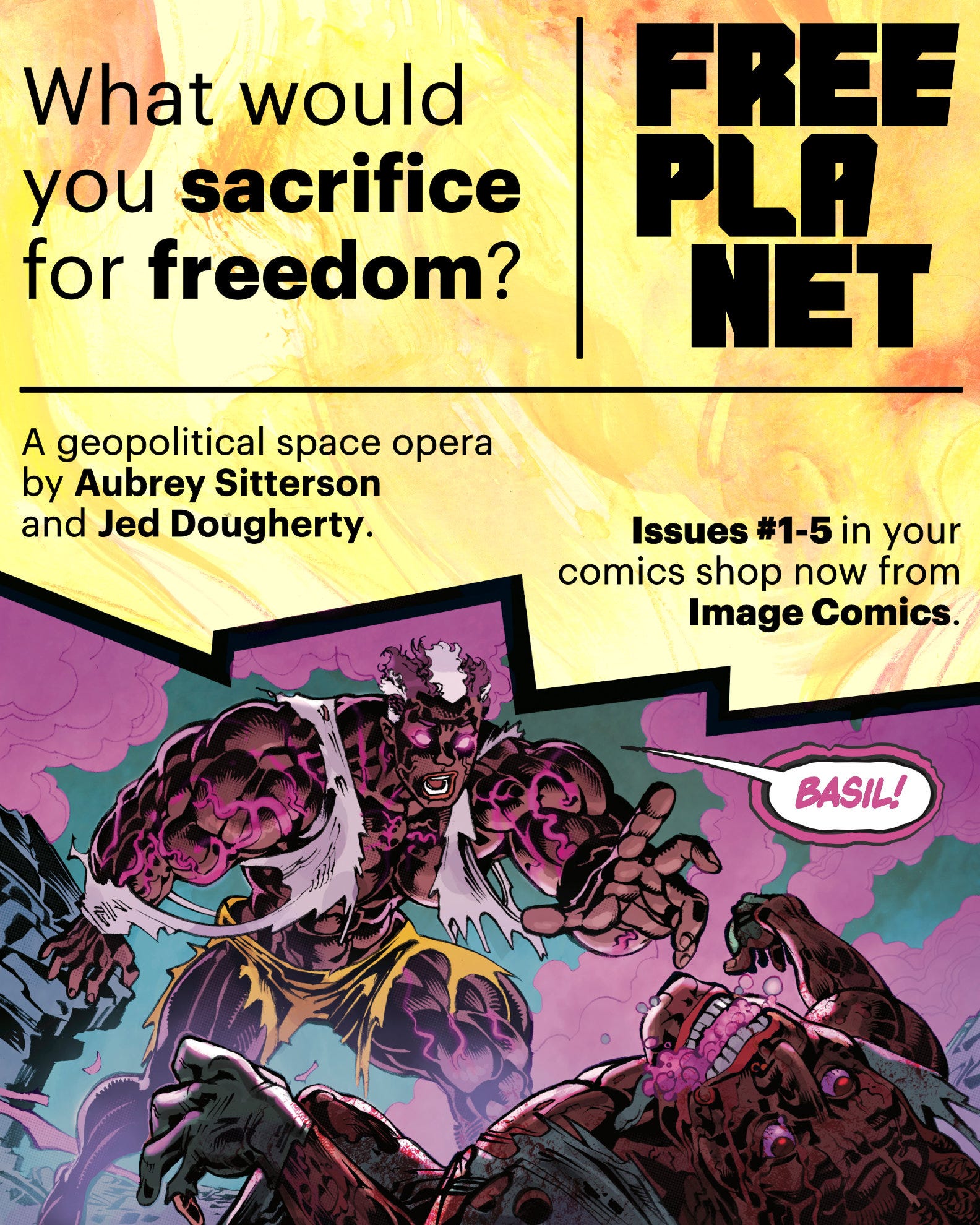
Before we dive into things: A special welcome to all the folks who signed up for this newsletter at Long Beach Comic Con! Chances are, I told you about my ongoing exploration of Free Planet’s bibliography, which you can find below:
Free Planet bibliography
·
May 9, 2025
My work on Free Planet has been heavily informed by extensive research, primarily focused on real-world revolutions and civil wars. In my weekly newsletter, I regularly delve into my bibliography, discussing how various works have informed Jed Dougherty and my ongoing geopolitical space opera:
I’m a Classics enthusiast: I’ve had an abiding interest in the Ancient Greek philosophers since high school, studied Ancient Greek in college and have long fantasized about the alternate universe in which, instead of accepting an internship at Marvel Comics, I continued on with this other passion.
As it is my most personal and idiosyncratic project to date, it should come as no surprise that Free Planet is informed on a fundamental level by Ancient Greece. This fact is borne out by my current research read: Polis: A New History of the Ancient Greek City-State from the Early Iron Age to the End of Antiquity by John Ma. It’s excellent and has already been extremely influential on Free Planet’s third arc; thank you to my friend Dan for the recommendation.
Over the past few years, I’ve returned to Homer, reading the Robert Fagles and Emily Wilson translations of my perennial favorite, The Odyssey, as well as The Iliad. Perhaps because I’d never spent as much time with it, I found myself struck by The Iliad, particularly one aspect: Its characters’ willingness to grind everything to a halt mid-battle to deliver a righteous monologue.
The trope is striking, even reading as distractingly unrealistic to contemporary eyes, though classicists and anthropologists have theories regarding how similar actions might have played out as part of highly ritualized personal combat. What fascinated me most, however, was how at odds this technique is with a contemporary approach that prioritizes literalism and adherence to film/television “realism.” So much did I love its deployment in The Iliad that I immediately started thinking about how to adapt it to Free Planet.
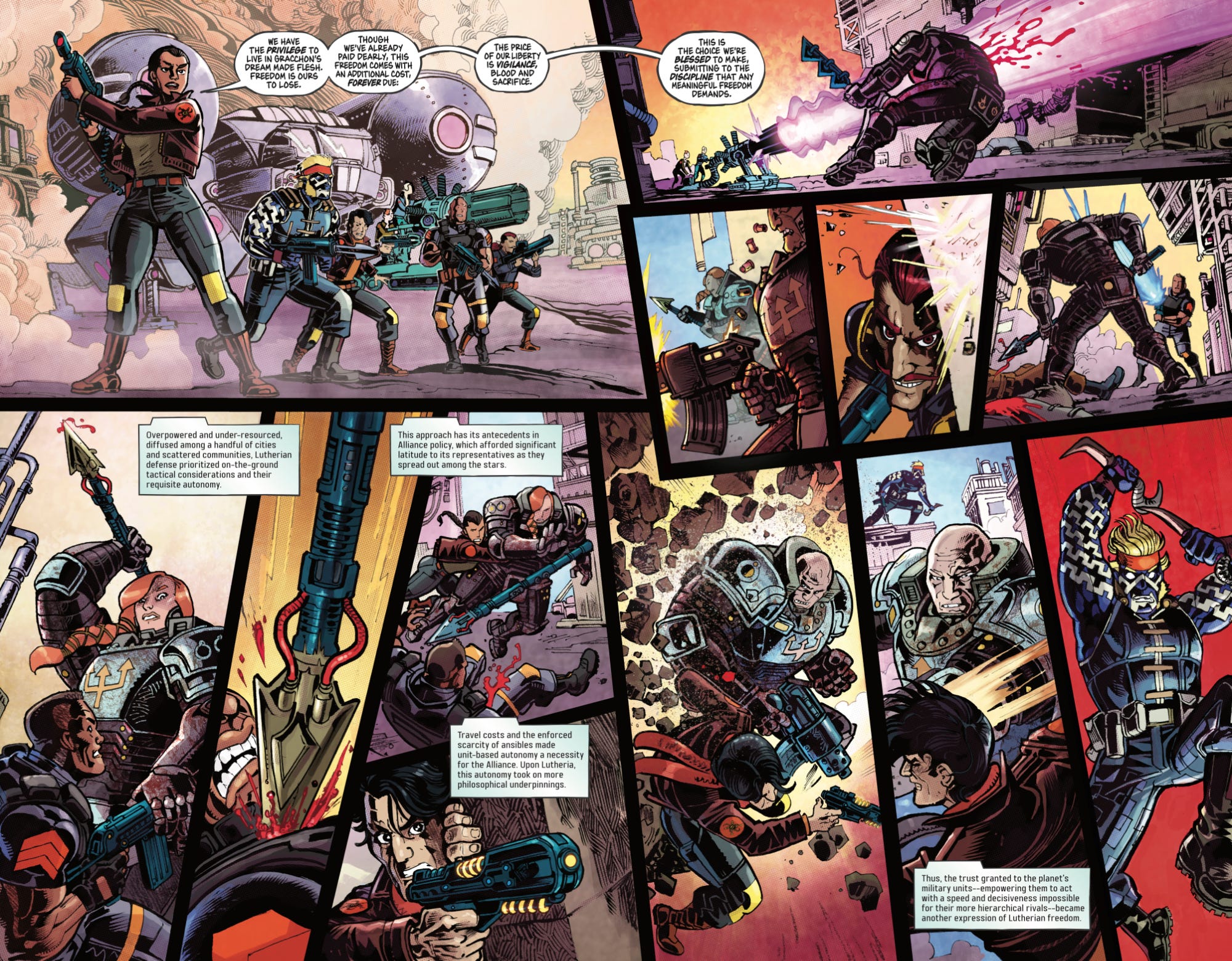
Fortunately, comics has a long history of this type of thing, with superheroes delivering a series of quips or a full-on oration while landing a single punch. Unfortunately, the technique has fallen out of favor with the 21st century turn toward film/television-style pacing. This is a shame because comics – with its vast potential regarding deviation from strictly linear storytelling – is the rare visual medium in which a lengthy speech, rather than derailing an action scene’s momentum, can imbue it with additional meaning and depth.
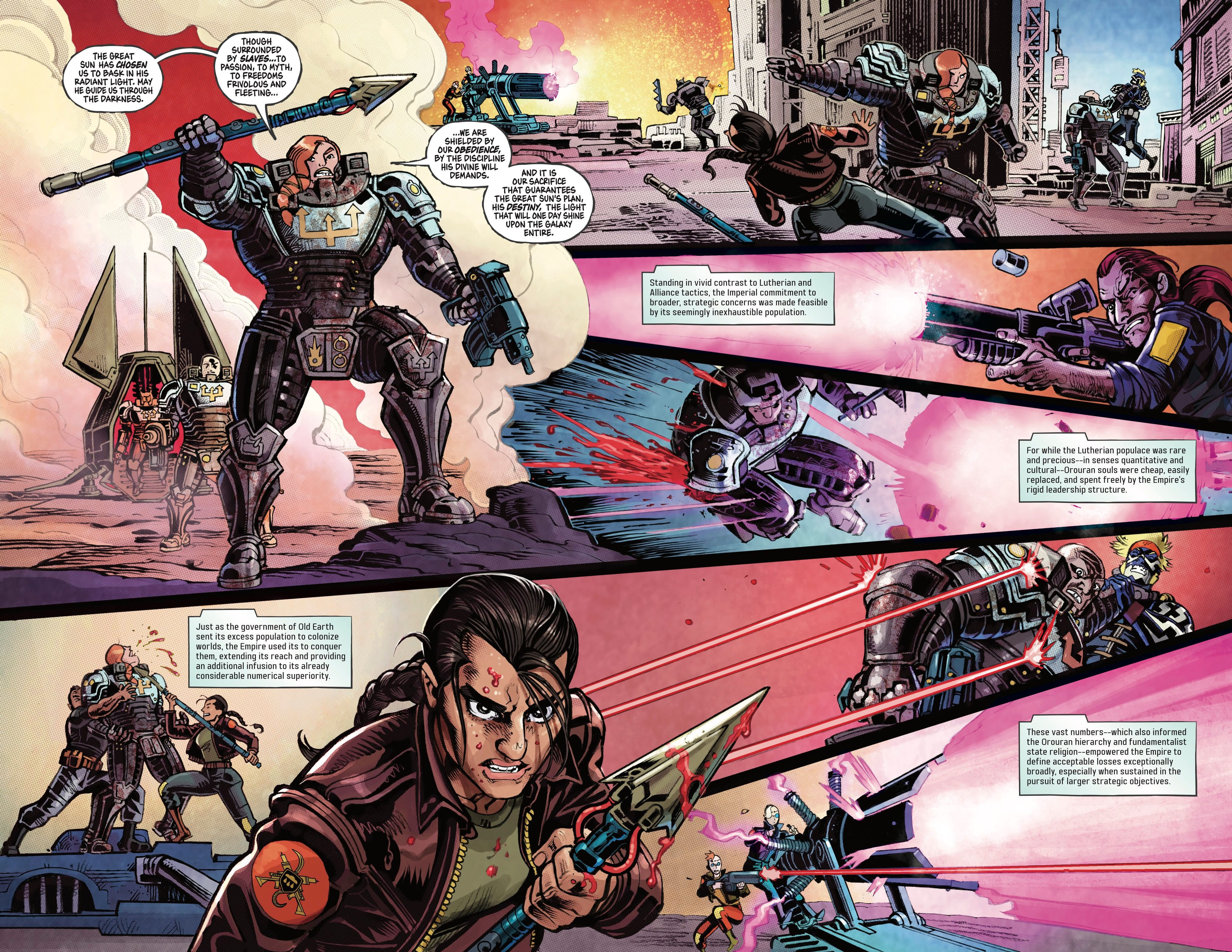
In consideration of the above, I identified Free Planet #5 – with its intense combat between the Freedom Guard and a squadron of Orouran space marines – as an ideal opportunity to explore this technique. The issue opens with a pair of spreads depicting brutal action accompanied by speeches from rivals across the battlefield.
Is it realistic, whatever that means? Not particularly. But it’s exciting and interesting, which count for immeasurably more.
I’ve previously discussed Ralph Bakshi’s exhortations that creators take influence from outside their chosen medium and this is certainly an example. But I’m also reminded of Wassily Kandinsky’s Concerning the Spiritual in Art, which – paraphrasing liberally and from imperfect memory – stated that, while lifting from other mediums is to be encouraged, it requires a full understanding of how techniques work on a foundational level, such that they can be properly incorporated into a wholly different medium with its own unique requirements.
This, to me, is a crucial distinction. It is wholly insufficient to simply lift techniques and approaches form other mediums; that’s exactly how we got stuck in the current moment; so many comics read as failed teleplays, adhering to pacing and approaches that don’t fully engage with the medium. Finding inspiration in other mediums requires that we not only understand the medium from which we are pulling but take up the difficult task of discovering ways of achieving the same effect but filtered through comics’ unique traits, strengths and weaknesses.
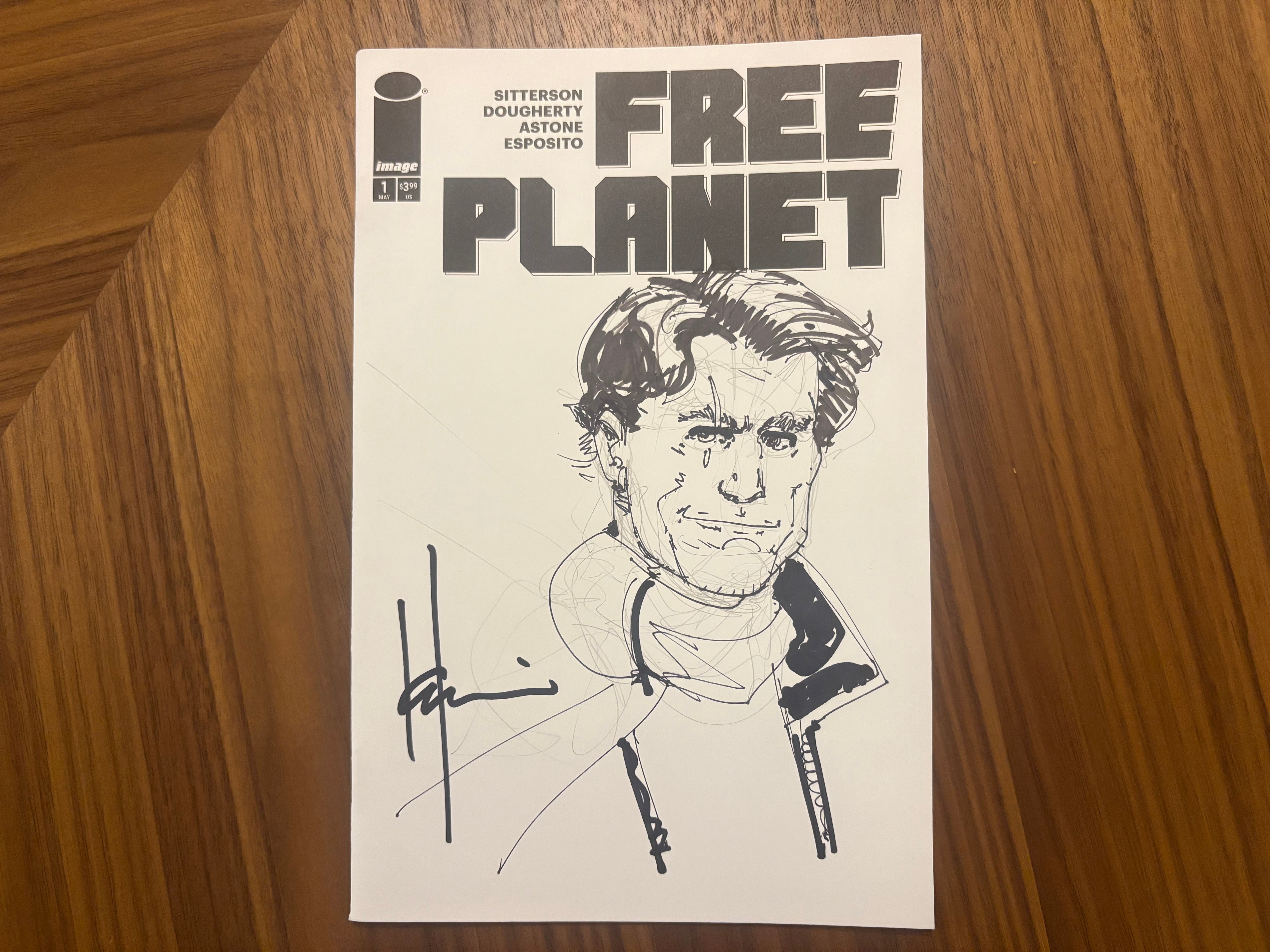
Bakshi’s admonitions notwithstanding, I do not think it advisable for a creator to swear off consuming work in their own medium. However, in searching for inspiration or studying techniques (I refuse to call it “research”), care must be taken to ensure that one is actually engaging with craft, not merely reacting to surface-level elements in the manner of a consumer. Enter my uncle, the Architect of the Modern Comic Book, Howard Chaykin.
Howard has been enormously influential on my career broadly, but particularly Free Planet. While the space opera genre is one in which Howard worked extensively, this is merely surface-level similarity. What is more significant and impactful is Howard’s approach to the page and innovations with regard to comic book formalism and semiotics. Because of this (and my overwhelming fondness for the man), I was thrilled to table next to Howard at Long Beach Comic Con and tickled pink that he let me cajole him into doing this sketch of arrogant, swashbuckling, Chaykinian hero Victor MacLiu.
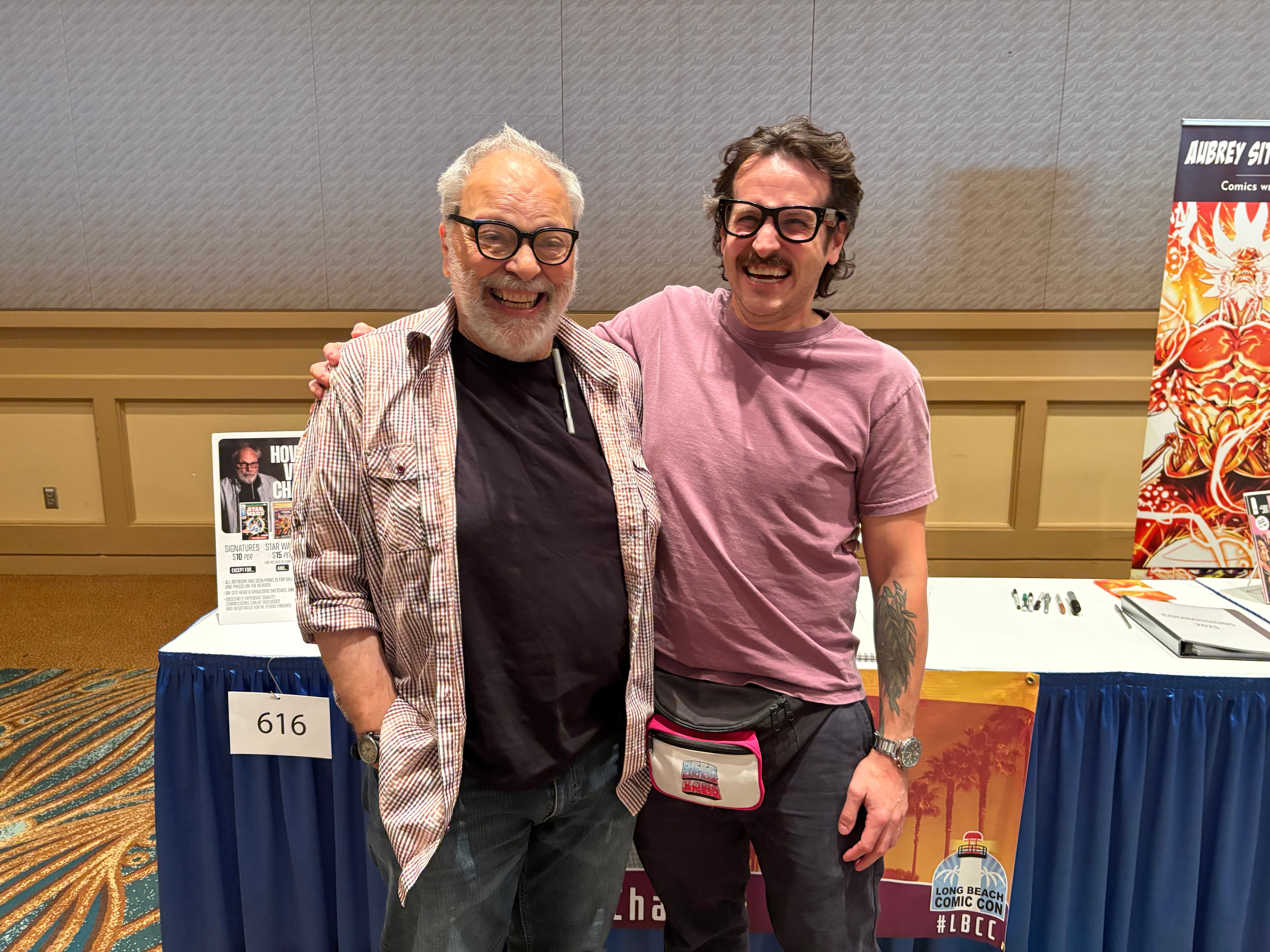
Speaking of Long Beach Comic Con: It was tremendous. To be fair: With Howard on one side of me and my brother Chris Robinson on the other, it would have been riotously difficult for me to have a bad time. But Long Beach Comic Con still exceeded my expectations, particularly with regard to Free Planet.
As such a unique, specific, demanding project, many of my peers expressed doubts regarding Free Planet being able to find an audience. I’m delighted to report that they’re all eating crow because as soon as readers flip through a physical copy of Free Planet, they are instantly sold on the approach and material. Audiences are ready for something richer and more complex, that engages deeply with the comics medium, functioning as both literature and art object, and the entire Free Planet teams stands ready, willing and able to deliver it on a monthly basis.
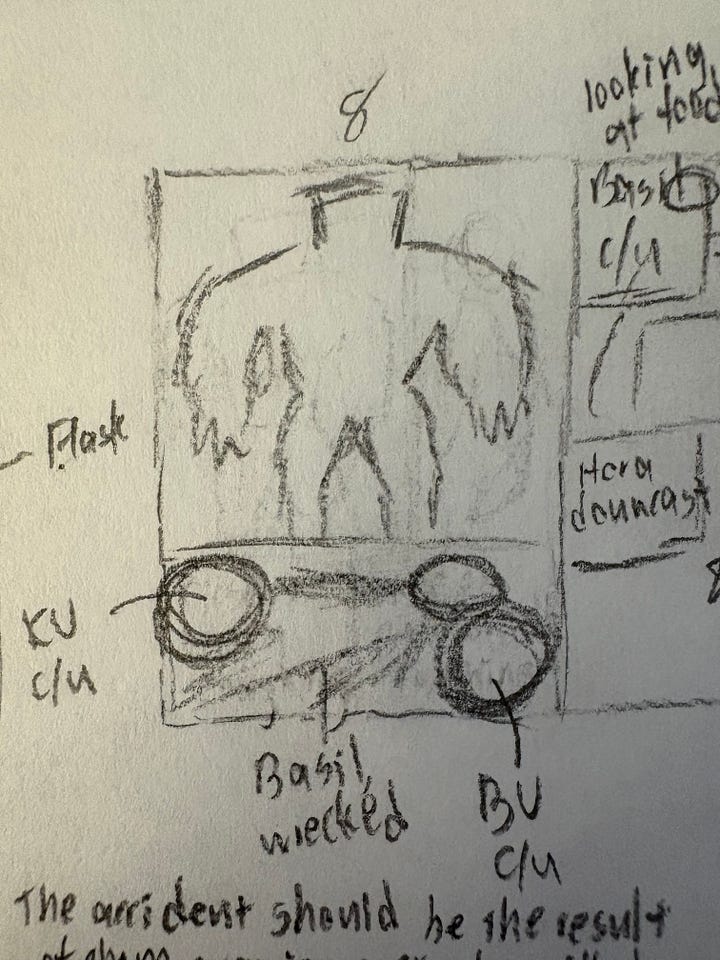
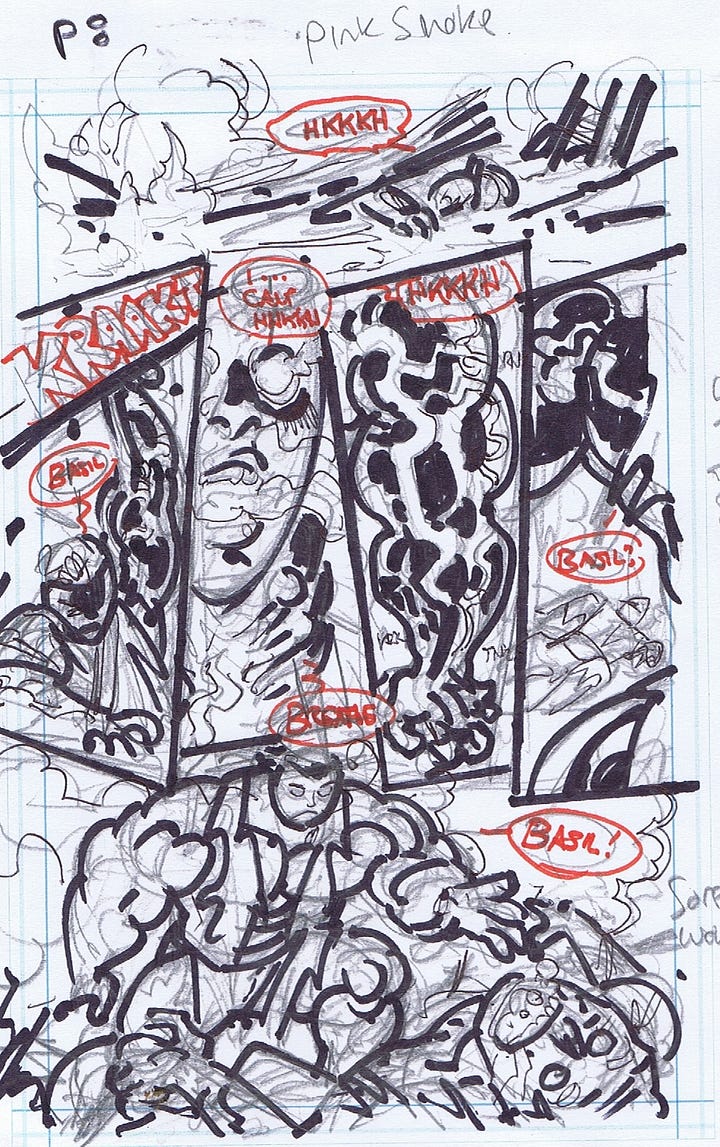
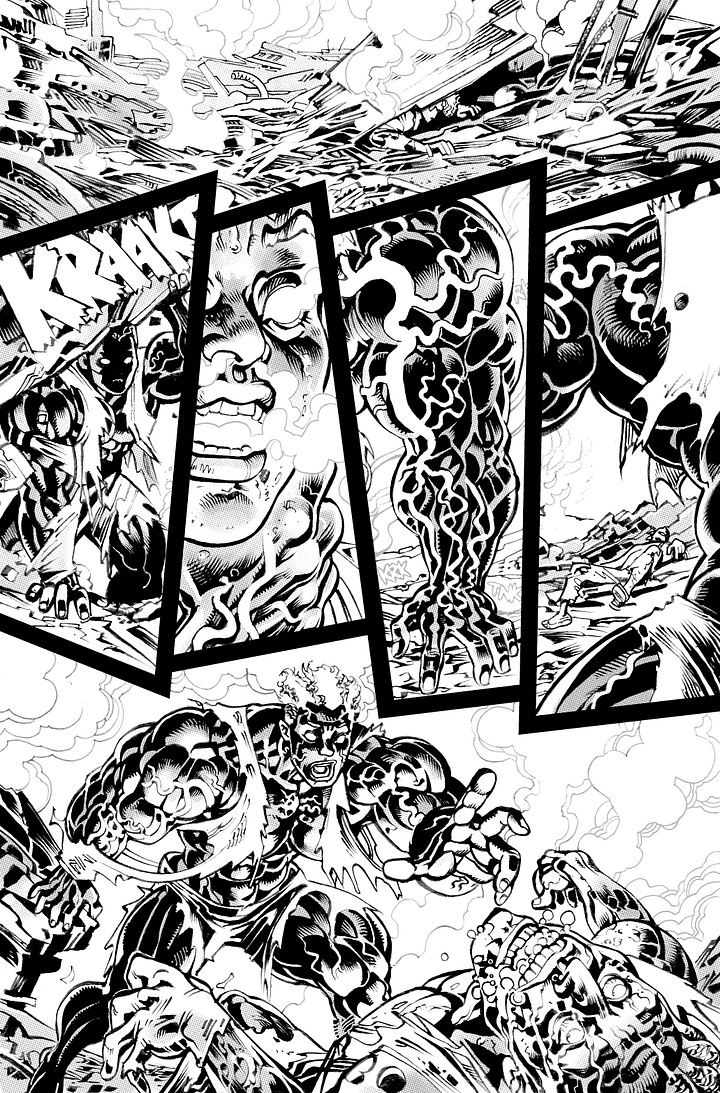
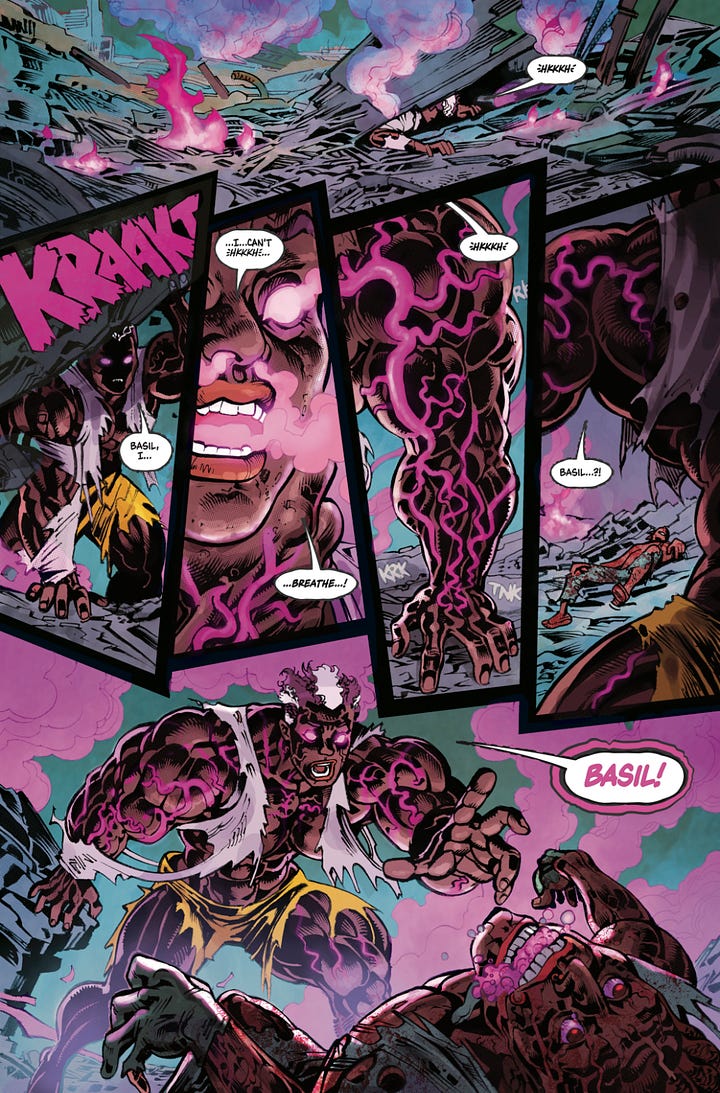
Whether you call them Amazons, muscle mommies or Crumb girls, the truth is this: Jed Dougherty is the best in the business when it comes to big, powerful women (and countless other things besides). If you don’t believe me, you clearly aren’t following the man’s Instagram. Resultingly, when putting together Free Planet, we made sure to include a musclebound female character, science officer Katja Usmansen.
From jump, the plan was always to do a flashback detailing how Katja packed on so much mass, banking on our confidence that Jed’s incredible designs for her and husband Basil would be enough to keep folks intrigued until we revealed their backstory. My original plan entailed a single, massive, Miura-esque near-splash of Katja following her transformation, followed by a view of Basil’s ruined body and a pair of close-ups.
As per usual though, Jed took my original idea and made it a million times better. Here, it was achieved through jagged panels and a stuttering pace, building to the full, simultaneous review of both Usmansens. Yet another example of how THE APPROACH, doing thumbnails prior to scripting, pays dividends not by micromanaging Jed but by putting him in a position to excel, expanding and improving upon my own visual ideas.
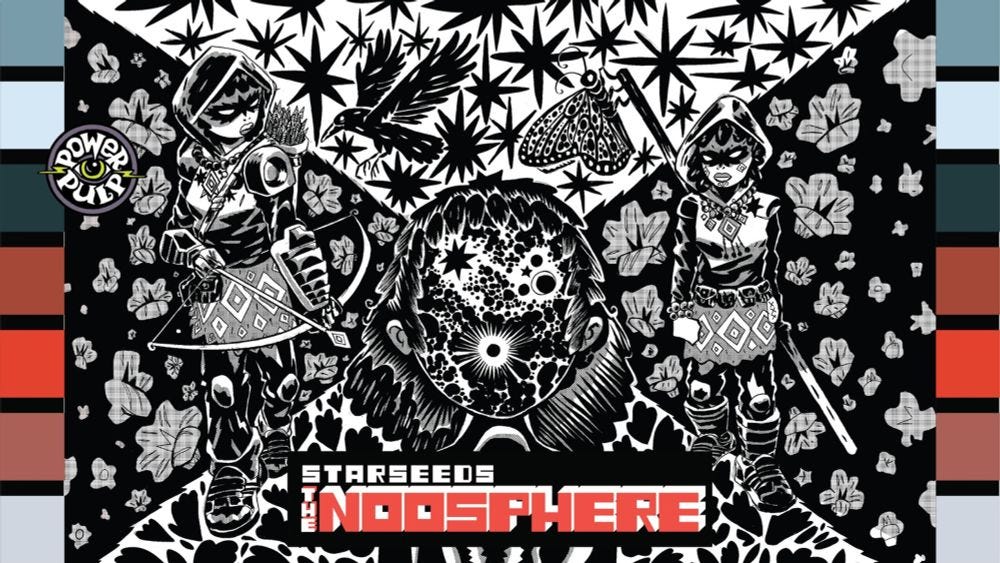
I found Charles Glaubitz’s Starseeds graphic novel to be absolutely breathtaking, blending together art comics pacing, Charles Burns inking, classic mainstream cosmic comics, and innovative page layouts into something entirely new. So, I was thrilled to learn that the story will be continuing via Kickstarter.
Head over and back the project right now. My suggestion is to get the issues #1 and #2 physical copy bundle; like any comic worth reading, you don’t want to be stuck reading Starseeds digitally.
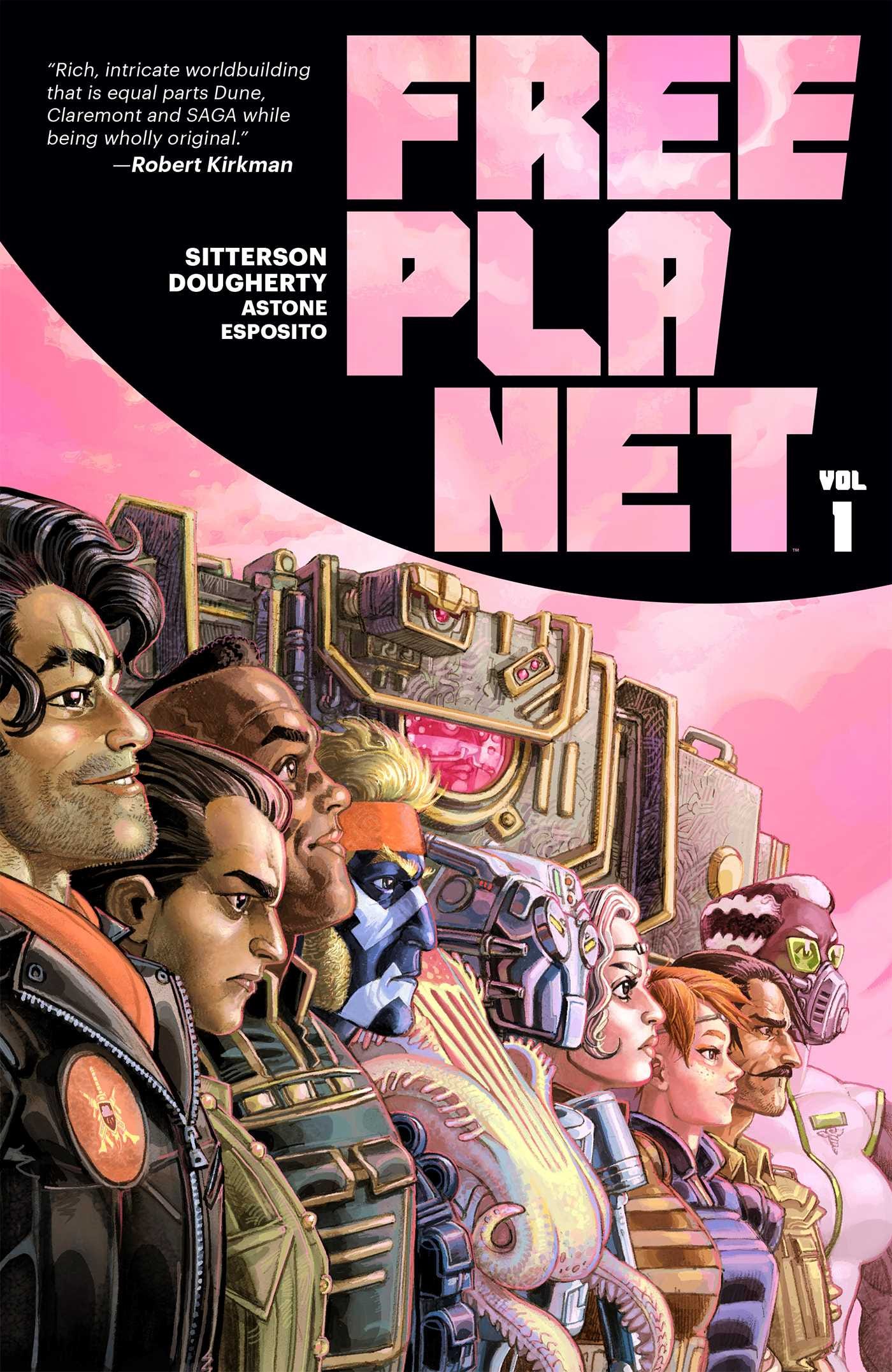
As promised, I am once again reminding you to preorder Free Planet volume 1; doing so not only ensures you’ll get a copy on release date but signals to comic shops and independent bookstores that they should stock additional copies for their shelves.
While Free Planet will always be best enjoyed in the print periodical format and the trade will not include our fan-favorite letters pages, we have some special surprises in store for you, including some all-new material written by renowned historian Dr. Aldous Foyroushi.
You can preorder anywhere books are sold but the most impactful way to preorder Free Planet is to do so through a comic shop or independent bookstore.
Before I get out of here, a reminder that Dr. Aldous Foyroushi is standing by to answer your questions about Lutherian history and the broader universe of Free Planet. This is your opportunity to participate in The Shape of Comics to Come and Free Planet’s critically acclaimed worldbuilding; email the good doctor at DrAldousFoyroushi@AtlantisStillSunk.com.
And finally, just as I do for every new issue of Free Planet, I’ve made a promo video to talk people into the tent. Enjoy it below or go find it plastered all over social media.
Aubrey
Comments
Nothing yet. Say the first thing.
Sign in to join the conversation.