

If you study news coverage at scale, you almost certainly classify articles by topic. It’s a foundational step for all sorts of analyses: tracking the balance of political coverage across outlets, measuring how health stories spread on social media, filtering a massive corpus down to a relevant subset. And in most cases, this kind of classification requires the text of each article.
That requirement is becoming a problem. Paywalls block full-text access for an increasing share of news websites. Publishers are tightening their scraping policies in response to AI companies harvesting training data. The robots.txt restrictions that once applied mainly to search engine crawlers now routinely block researchers, too.
In a new paper published in Computational Communication Research, I explored one way that researchers might move forward in this more restrictive data environment. The core question: Can you classify news articles by topic using only their URLs?
URLs are easy to overlook as a data source. They’re short, idiosyncratic, and inconsistently structured. But they often contain real semantic information—a URL with /politics/senate-budget-vote-2024 tells you something meaningful, even without the article it points to. Prior work in web classification has leveraged this kind of signal for tasks like detecting malicious websites, but it hasn’t been systematically applied to news topic classification.
I fine-tuned DistilBERT—a compact transformer model—on the raw URL paths of news articles from three benchmark datasets, spanning over 660,000 articles and more than 11,000 news domains. The datasets cover multiple languages and topic schemes.
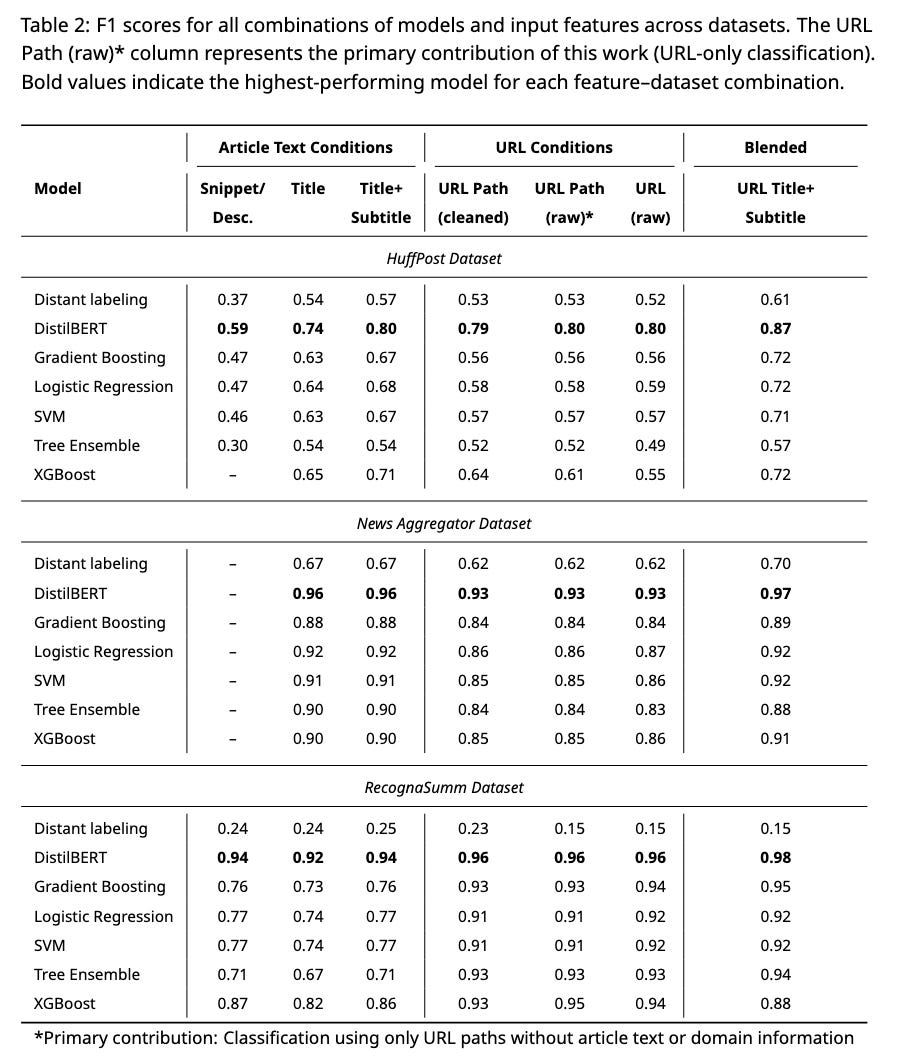
The URL-based classifier outperformed every other model I tested—including traditional machine learning approaches trained on article text. Across all three datasets, fine-tuned DistilBERT achieved the highest F1 scores regardless of input feature, which speaks to the general strength of the architecture. But the URL-only models were remarkably competitive with their text-based counterparts, trailing the best-performing configurations by an average F1 of just 0.04.
The compact text in a URL path can rival—and in some cases outperform—classification based on headlines, snippets, or article excerpts. And this isn’t an artifact of the model memorizing domain-to-topic associations; adding domain names to the URL input produced virtually no change in performance. The signal lives in the path itself—the section labels, slugs, and keywords that publishers embed in their URL structures.
There is a compute trade-off worth noting. DistilBERT processes 200–600 records per second, compared to 20,000–50,000 for simpler models like logistic regression. For researchers who need speed over accuracy gains, traditional models trained on URL text still offer strong performance.
The practical upside is straightforward: data collection becomes dramatically simpler. If you’re building a news analysis pipeline, you may not need to scrape, parse, and store article text at all—at least not for the classification step. URLs are available in link-sharing data, social media posts, web archives, and browser histories, all without triggering the access restrictions that complicate text collection.
There are caveats. The method works best when URLs contain semantically meaningful text—section names, topic keywords, descriptive slugs. It struggles with URLs that are mostly numeric identifiers or random strings, though these account for only about 1% of the data I analyzed. And it requires labeled training data, though ablation tests showed competitive performance with as few as 3,000 training examples on datasets with a manageable number of categories.
From a broader methodological perspective, this work highlights an underexplored trade-off in computational communication research: data efficiency versus compute efficiency. Much of the field has focused on making models lighter and faster, which is valuable. But as data access becomes the binding constraint—not processing power—there’s a case for investing more compute in exchange for needing less data. A fine-tuned transformer applied to minimal input features is one version of what that looks like.
As data access becomes harder—and there’s little reason to think the trend will reverse—methods that work with less data are going to matter more. URLs are just one minimal input feature, and topic classification is just one task. The broader question is what other kinds of research problems can be solved with the metadata we already have.
The paper, data, and code are available open-access at Computational Communication Research.
No posts
Comments
Nothing yet. Say the first thing.
Sign in to join the conversation.