
ATP is presented by:

Welcome back to The Asia Tech Podcast. Today we discussed Tencent’s move to acquire Manus AI, the future of AI governance inside enterprises, tokenized real estate, AI-powered cybersecurity, stablecoins and crypto maturation, and the digitization of global trade.
• Daniel Chow - Principal at Arthur D. Little
• Chris Jordan - Regional Vice President SEA and Country Manager, Singapore at monday.com
• Esmar Mesic - Head of Product at PRYPCO
• Alice Li - Partner at Foresight Ventures
• Gal Malachi - CTO and Co-Founder at Terra Security
• Brandon Wolfe - Global Field CTO at Tanium
• Steven Zhou - Executive Director at TradeGo
Here is an overview of the topics we discussed today:
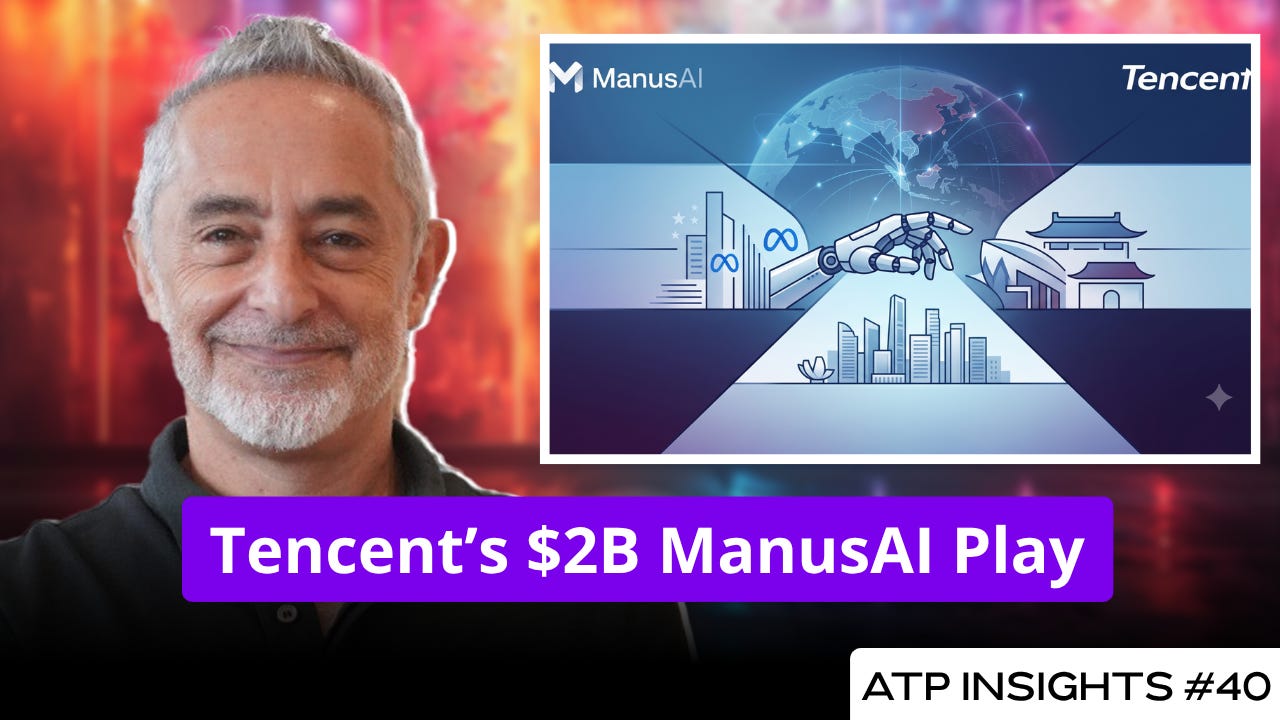
Tencent is leading a consortium to buy Manus AI back from Meta for at least $2 billion. Beijing blocked Meta’s original acquisition because China views Manus — despite its Singapore headquarters — as a strategic AI asset. The deal took months to form, which tells you a lot about how Beijing operates: slowly, deliberately, with patience as the strategic advantage. What’s striking is that Manus isn’t being brought back to China. It’s expected to remain independent and Singapore-based. Its ARR reportedly grew from $125M to nearly $500M during all of this — proving Beijing’s intervention didn’t destroy confidence in the product.
What does this mean for Singapore’s neutrality? It gets complicated, but probably not broken. Singapore has spent decades building a reputation as the place where everyone can do business. Allowing Manus to stay while a Chinese-backed consortium takes the largest stake is a balancing act — but Singapore has been doing this kind of balancing for 60 years.
Daniel from Arthur D. Little consults across transportation in Southeast Asia and sees AI making its biggest mark in three areas: better decisions, better asset utilization, and better customer experiences. The main barrier isn’t the technology — it’s moving from sandbox pilots into production at scale. Airlines have used AI for revenue management for years, but data still sits in silos between airlines, hotels, and transit systems. Premium travelers are increasingly demanding predictability above everything else. Daniel’s view: the asset owners who get their data sharing right will start to pull value back from the OTAs.
Chris from monday.com put a sharp lens on something companies are quietly struggling with: as AI agents run real workflows around the clock, costs shift from fixed to variable. An employee using Excel doesn’t cost the company more than the person next to them. An AI agent running 24/7 consumes tokens constantly — so suddenly, the CFO is in the room. Chris made the case that three groups have to be aligned for AI to work: finance needs to see the spend, IT needs to see the risk, and leadership needs to see the value. If any leg of that stool is missing, the whole thing falls. His advice: treat AI agents like employees — give them a goal, a KPI, an owner, and an audit trail.
Esmar from PRYPCO has a simple pitch: anyone with $100 can invest in Dubai real estate. PRYPCO tokenizes residential properties, splits them into fractional ownership, and pays out monthly rent proportionally. The innovation isn’t just the technology — it’s the regulatory framework. PRYPCO worked directly with Dubai’s DIFC and VARA from day one, building trust instead of workarounds. The token price follows the underlying property value, updated quarterly by independent valuation. Who are your co-investors? You don’t get to know — regulators keep that private — but your own tokens are yours to trade regardless.
Gal from Terra Security is building something that didn’t exist two years ago: an AI agent that continuously tries to break into your systems. The old model was pen testing once a year for compliance. The new model runs 24/7, understands your source code and infrastructure, and when it finds a real vulnerability, it doesn’t just flag it — it measures the impact, suggests a fix, and can apply and retest the fix automatically. What does this shift? An engagement that used to take months of back-and-forth now takes hours. Gal’s core point: the attack surface isn’t static, so your testing can’t be either.
Brandon from Tanium arrived straight off a flight from New York and made the clearest case for why visibility matters more than detection. Everyone can detect now — that’s not the bottleneck. The scarcity is how fast you can act. The window from discovery to exploitation has collapsed from months to minutes. And the economic barrier to attack has dropped: a 15-year-old with a $200 laptop and access to a frontier model can launch a sophisticated attack in hours. His research found that 43% of organizations in Southeast Asia lack visibility into at least 10% of their endpoints. The only real defense against autonomous attacks is autonomous defense.
Alice from Foresight Ventures runs a $400M fund that started in crypto and has been shifting toward real world assets and AI. Her observation: the typical crypto user is getting older and more mainstream — taxi drivers in the US now casually mention their Bitcoin positions. The next wave needs regulation to unlock it. The US Genius Act on stablecoins is a start. Alice’s vision is a world where you hold USDC the way you hold a bank account, and AI agents handle transactions directly. Visa and MasterCard still provide the “layer of trust” for now — but that layer could thin very quickly as the next generation matures.
Steven from TradeGo is digitizing a problem that sounds mundane until you understand the scale: international trade still runs on paper bills of lading. TradeGo — backed by Saudi Aramco, PetroChina, Bank of China, Macquarie, and others — is building the infrastructure to replace them with electronic bills of lading. Singapore and China have already passed laws giving these full legal recognition. The electronic bill of lading shortens document processing time, cuts errors, and makes end-to-end digital trade possible. It took an industry consortium to build this because no single startup could earn the trust of shippers, banks, and carriers all at once.
Watch the full episode here:

Twilio is the secure and scalable platform to build amazing customer engagement without the complexity, with the AI-driven workflows you need to connect.
Visit Twilio.com to start building today

Boomi, the data activation company for AI, powers the agentic enterprise by bringing data to life across the business. Trusted by over 30,000 customers and supported by a network of 800+ partners, Boomi helps organizations of all sizes achieve agility, efficiency, and innovation at scale.
Visit www.boomi.com to learn more
No posts
Comments
Nothing yet. Say the first thing.
Sign in to join the conversation.