
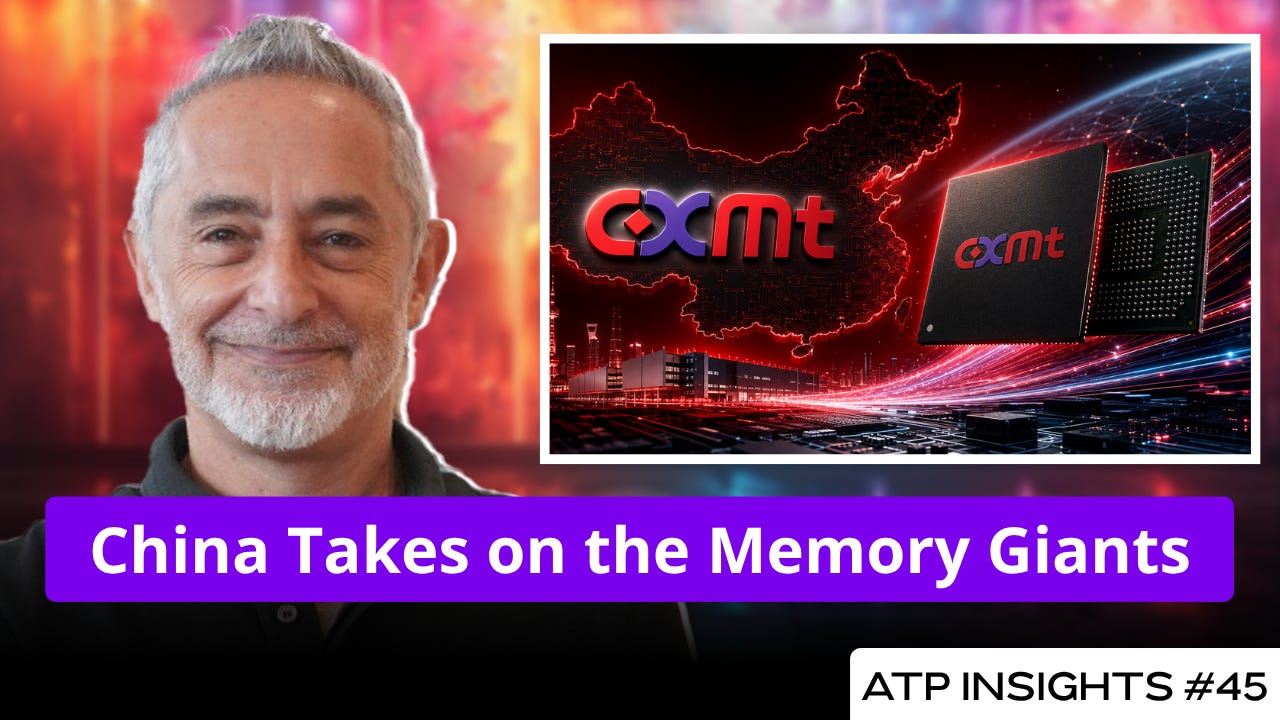
ATP is presented by:

Welcome back to The Asia Tech Podcast. Today we discussed China’s blockbuster CXMT IPO, the growing debate over AI guardrails, personalized learning at scale, real-time visibility for physical commodities, Hong Kong’s push into AI and stablecoins, the infrastructure behind smart devices, and how founder-led businesses can grow without burning out the founder.
• 31:47 Geoffrey Handley - Founder, Investor, Mentor, Author at ZeroTo1Accelerator BKK
• 48:23 Kirk Pathumanun - CEO at QUEST EDTECH
• 1:04:10 David Thambiratnam - CEO at Veridapt
• 1:33:58 King Leung - Global Head of Financial Services, FinTech & Sustainability at InvestHK
• 2:06:03 Alex Yang - Co-Founder, COO & CFO at Tuya Smart
• 2:25:08 Muks Syed - Founder and CEO at HookedGrowth
Here is an overview of the topics we discussed today:
Geoffrey has spent his career as a technology optimist, so why does he now sound worried? He told us the scariest part of today’s AI boom isn’t the models themselves, it’s how few founders have anyone on their team who’s even asked what values or “constitution” their AI is being built on. Geoffrey compared the current free-for-all to nuclear power before global oversight existed: no shared rulebook, just kids coding powerful systems from their bedrooms. If a single teenager can build something that shuts down a power grid, who’s actually in charge of stopping that?
Kirk’s company builds AI-powered learning tools, so we asked him about Korea’s expensive national AI textbook program. He admitted it had to be scaled back within a year, hallucinations and all, but insists the answer isn’t ditching AI, it’s blending it with human judgment. At Chulalongkorn University, Kirk now grades students on whether their AI-built startups attract real users, not on how well-written their papers are. So what actually counts as cheating when knowing how to use AI well is the skill being tested?
David’s company helps track fuel and commodities for massive industrial fleets, and he described a client whose books were off from their actual inventory by $300 million. Most of the physical commodities world still relies on someone walking out once a month with a dipstick, leaving huge gaps that quietly get written off as losses. He explained how surging oil prices, and even conflicts overseas, are suddenly pushing boards to demand the real-time visibility they’d resisted paying for before. Once companies get that visibility, David says they never go back, so why does it always take a crisis to get there?
King argues Hong Kong’s biggest AI opportunity isn’t chatbots, it’s building the payment rails that let machines transact with each other in fractions of a cent. He explained why stablecoins, not credit cards, are what these “agentic payments” actually need, and why Hong Kong’s regulatory framework is what makes big companies comfortable using them. With $5.4 trillion in assets under management flowing through the city, King says AI is already letting one financial advisor serve ten times as many clients. Could this quiet infrastructure shift end up mattering more than any flashy new app?
Alex has spent 12 years building infrastructure behind more than 3,000 device categories and a million product models, covering smart homes, energy, and robots. He describes his platform like a body: a “brain” that makes decisions, a “nerve” network that carries signals, and “muscle” devices that actually take action. Alex says the hardest problem isn’t the AI models, it’s fragmentation, getting thousands of different devices to speak the same language. How do you build one system flexible enough to run a robot, a thermostat, and an energy grid at once?
Muks works with small, founder-led companies and says most of them aren’t struggling to access AI, they’re struggling to explain what makes their business unique to it. He told us the real bottleneck is that a founder’s instincts, values, and decisions usually live only in their head, never written down anywhere AI can use. Muks borrows from old-school performance management to turn that hidden knowledge into something an AI agent can actually act on. If AI is only as useful as the context you feed it, how much of your own business could you actually put into words?
Want to hear the full conversations? Watch the entire episode here:
Twilio is the secure and scalable platform to build amazing customer engagement without the complexity, with the AI-driven workflows you need to connect.
Visit Twilio.com to start building today

Boomi, the data activation company for AI, powers the agentic enterprise by bringing data to life across the business. Trusted by over 30,000 customers and supported by a network of 800+ partners, Boomi helps organizations of all sizes achieve agility, efficiency, and innovation at scale.
Visit www.boomi.com to learn more
Download Boomi’s latest market research: AI Ambition Meets Data Reality: APAC Technology Priorities and Challenges 2026
HCLTech is supercharging progress with AI that moves beyond ambition and delivers real business impact. A recognized AI leader, trusted by global enterprises to turn technology into transformation. HCLTech: Supercharging Progress
Visit https://www.hcltech.com/ai to learn more
No posts
Comments
Nothing yet. Say the first thing.
Sign in to join the conversation.