
A developer with 10 years of experience recently posted on Reddit about something many of us recognize, the soul-crushing reality of "just build what's in the ticket" culture.
"I genuinely care about whether what I'm building actually solves user problems," they wrote, "but I often feel like I'm swimming upstream."
The responses revealed something we hadn’t fully grasped at Atono until recently: product engineers aren’t just frustrated by lack of autonomy. They’re looking for visibility into whether their work is making a difference.
The invisible feedback loop
The real issue isn't that engineers want more autonomy, it's that traditional handoff models prevent them from owning the full product lifecycle.
Product engineers should be involved from discovery and validation through building, deployment, and impact measurement. They need ownership of both the "why" (the problem) and the "how" (the solution), focusing on outcomes rather than just feature delivery.
Engineers need visibility into whether the features they build drive real user behavior. Without that feedback loop, even the most context-rich requirements feel like busy work, especially when AI acceleration compresses the time available for deeper understanding.
One Reddit commenter captured it perfectly: "I've seen so many features get built, deployed, and then barely used. It's soul-crushing to spend weeks on something that adds zero value."
The pattern is everywhere. Features ship with fanfare, then disappear into the void. Engineers move on to the next ticket, never knowing if their careful implementation of those acceptance criteria actually changed how users behave.
What happens when engineers can see impact
We've built feature engagement tracking directly into stories in Atono, allowing engineers to see usage graphs that show how frequently features are used over time across different environments. They can even filter by customer segments and locations to understand adoption patterns and identify which features drive real user behavior.
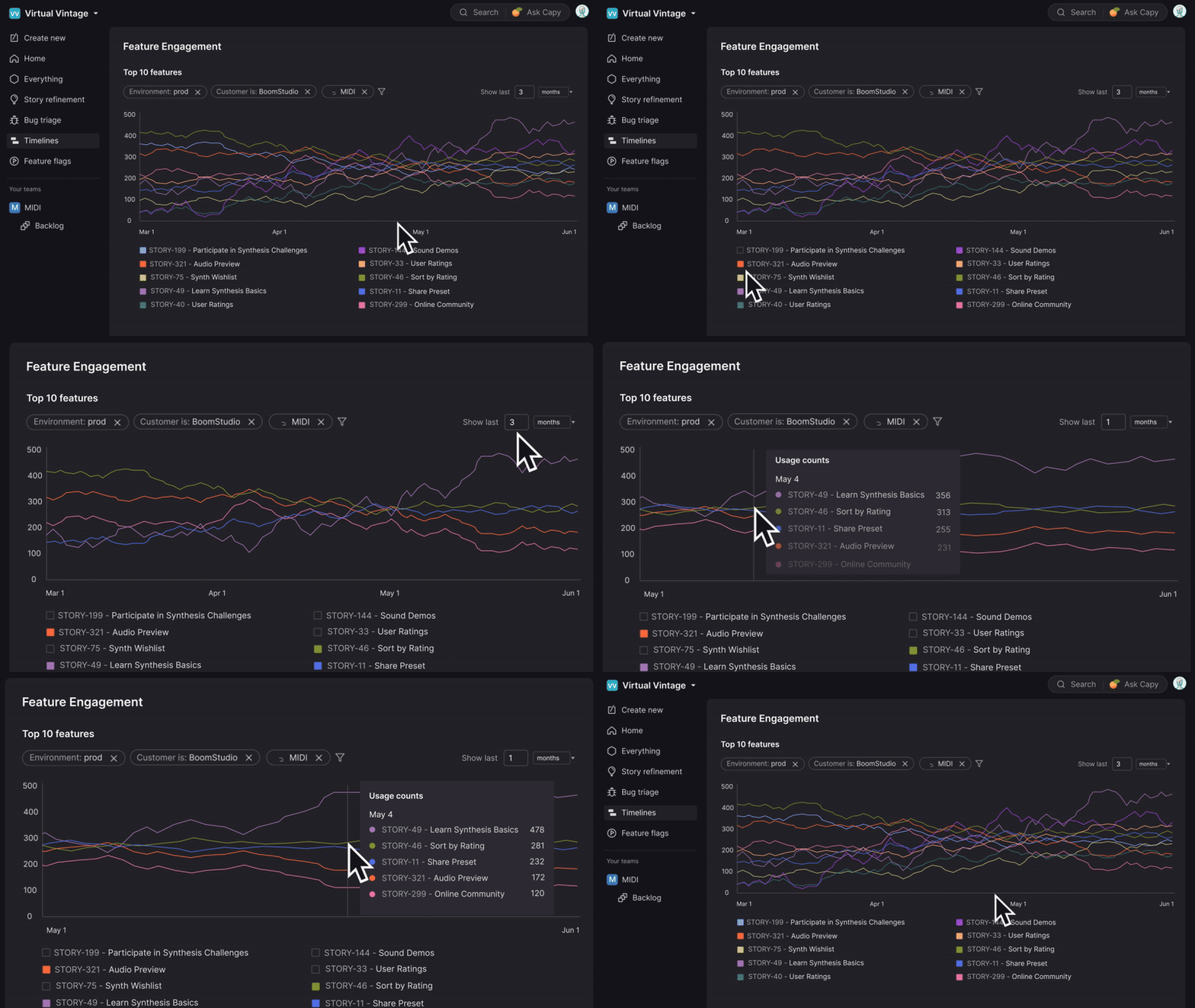
The change in behavior was immediate. During story sizing, engineers started asking different questions: "What happens if adoption stays below 10%?" "Should we build the full feature or test a simpler version first?"
When our frontend engineer saw that a complex filtering feature had 3% adoption while a simple search had 67%, she didn't just implement the next filter request. She suggested we first understand why users weren't engaging with the existing functionality.
That kind of product thinking doesn't happen when engineers work in the dark.
The real cost of feature factories
When you treat engineers like code factories, you pay hidden costs that don't show up in sprint reports.
Technical debt accumulates faster. Engineers without visibility into feature performance make conservative choices. Why optimize for scale when you don't know if anyone will use it? Why invest in maintainability when the feature might get abandoned?
Innovation dies. The best product insights often come from implementation. Engineers spot edge cases, identify user flow problems, and see optimization opportunities that requirements documents miss. But only if they understand what success looks like.
Your best talent leaves. As one developer put it: "When I have no ownership I just do bare minimum to not get fired." Engineers who care about outcomes will find environments where their input matters.
These hidden costs are patterns we've seen at companies we've worked with, but at Atono we've intentionally chosen to go the other way. Our most engaged engineers don't just implement features, they use engagement data to validate assumptions, analyze usage patterns to optimize performance, and push back on requirements that don't align with user behavior patterns they can actually observe.
Breaking the cycle
The solution is complex, and the expectation that AI fixes everything makes it even more challenging. People are working to help us all break this cycle, but it requires changing how we think about engineering work in an AI-accelerated environment.
Engineers need three things: context about what problem they're solving, visibility into whether their solution worked, and permission to adjust course based on what they learn.
Here's what this looks like in practice:
Ask different questions during planning. Instead of "How long will this take?" try "How will we know if this feature succeeds?" "What user behavior are we trying to change?" "What's our backup plan if adoption is low?"
Make impact visible after launch. Whether it's usage analytics, customer feedback, or support ticket volume—engineers need to see the consequences of their work. Even simple metrics like "users who tried this feature" and "users who used it more than once" change how engineers approach implementation.
Create space for course correction. The best teams treat initial requirements as hypotheses, not mandates. When usage data shows a feature isn't working as expected, engineers should have permission to suggest changes rather than moving to the next ticket.
The shift we're seeing
Teams that give engineers visibility into feature impact see a fundamental shift. Engineers start thinking like product owners. They question assumptions, suggest experiments, and take ownership of outcomes rather than just outputs.
At Atono, this showed up in unexpected ways. Our engineers started using feature flags more strategically, rolling out changes to small user groups first. They began linking related stories together to track broader feature performance. They even started suggesting which features should be retired when usage data showed they weren't adding value.
This isn't about giving engineers veto power over product decisions. It's about recognizing that the people building your features have valuable insights about what's working and what isn't—but only if they can see the results of their work.
The missing piece
The Reddit developer who started this discussion isn't just asking for proof their work matters, they're asking for a seat at the table to help shape product decisions. They want to be treated as a product engineer, not a code factory.
Teams that provide that proof—through usage data, user feedback, and clear success metrics—unlock something powerful: engineers who think like owners, not contractors.
The difference between a feature factory and a product organization isn't the process or the tools. It's whether the people building your product can participate in defining success and see the impact they're making.
Thanks for reading! Subscribe for free to receive new posts.
Comments
Nothing yet. Say the first thing.
Sign in to join the conversation.