

I was reading a discussion on engineering-led teams in the r/ExperiencedDevs subreddit which talked about an emerging pattern: technically excellent teams that struggle to ship meaningful value. The difference isn’t about technical capability—it’s about how product teams approach building software differently than engineering teams.
I’ve been thinking about this dynamic a lot lately—not because one approach is inherently better, but because understanding the tradeoffs helps teams make more intentional choices about how they work.
This shift represents a natural evolution in software development. As Tobias, our CTO, explained on a recent podcast, earlier eras separated disciplines like dev and testing until shared goals made integration inevitable. The same evolution is now happening between product and engineering.
Engineering teams optimize for technical excellence. Product teams optimize for customer outcomes. This isn’t a criticism of either approach—both have their place. But when you’re building software that needs to solve real problems for real users, the product mindset creates fundamentally different workflows and outcomes.
Engineering teams often focus on: “How do we build what we’re asked to build?”
Product teams focus on: “How do we solve a real customer problem?”
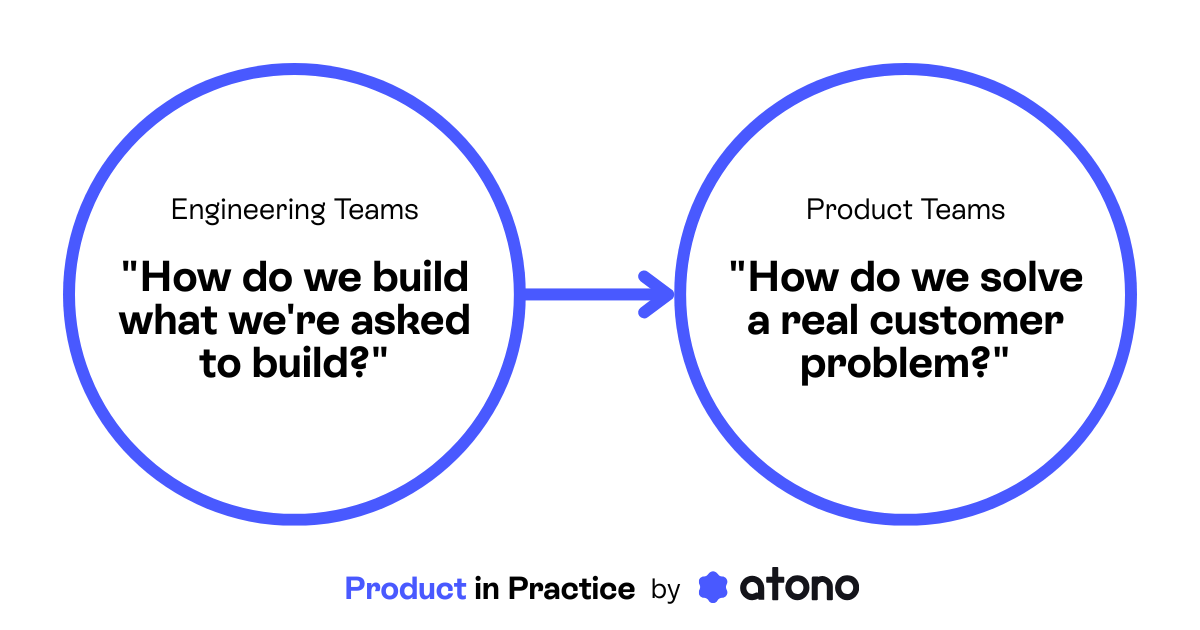
This shift in questioning often changes what follows. Engineering teams start with defining the technical requirements to implement the solutions they were told to build to solve a problem. Product teams start with the problem and define a solution before they begin implementing. The difference is subtle, but it can significantly impact team empowerment.
The cultural impact runs deeper than process differences. Too often, engineers aren’t empowered to be part of the design process from the start. When they’re excluded, teams lose valuable technical perspective and engineers lose connection to the purpose of their work.
As one developer noted in the Reddit thread: “I worked on a platform team where for about a year we were without any PM. I was the most senior engineer, who ended up taking on the ‘PM work’ that needed to be done... Best year I’ve had. Close to zero overhead, absolute clarity on what needs to be done and why, everyone rowing in the same direction.”
The key phrase here: “absolute clarity on what needs to be done and why.” In many cases, this clarity comes from product discipline applied collaboratively rather than purely engineering practices.
Engineering-led teams often follow this pattern:
Requirements gathering: Stakeholders provide specifications
Technical design: Engineers architect the solution
Implementation: Team builds according to specs
Testing: QA validates technical functionality
Deployment: Code ships when technically ready
This workflow optimizes for predictable delivery of specified features. It works well when requirements are clear and stable, which is why it’s effective for internal tools, platform work, or maintenance projects.
Product teams work differently:
Problem validation: What specific problem needs solving?
Solution exploration: What’s the simplest way to test our hypothesis?
MVP development: Build the minimum needed to learn
User feedback: Does this actually solve the problem?
Iterate or pivot: Refine based on real usage data
This workflow optimizes for learning and customer value. It accepts that initial requirements will be wrong and builds that assumption into the process. As Tobias explains: “Stories can’t be accurately sized without a design, so the design is pushed further to the front of the process by default.”
This highlights a workflow problem that goes beyond individual roles. Engineering-led teams often suffer from what we might call “specification handoffs”—requirements get passed between roles without shared context. The problem compounds when each role operates in its own tools, splintering context and creating endless back-and-forth.
Consider a typical scenario: A PM writes a ticket requesting a “user dashboard with key metrics.” The engineer builds what they think the PM meant. QA tests the technical functionality. Then the PM reviews and realizes it’s missing the filtering capabilities users actually need. The engineer goes back to add filters, but the design was never meant to support this behavior, so the designer creates a whole new design. The engineer has to start from scratch to write all new code that has to be QA’d, so on and so forth. Very inefficient. Product teams often catch these inconsistencies earlier in the problem solving process, causing fewer re-writes and wasted cycles.
We’ve seen product teams solve this through continuous collaboration. Instead of:
PM writes spec → Engineer codes → QA tests → Designer reviews
They work with:
Cross-functional team discusses problem → Collaboratively explores solutions → Builds and tests together
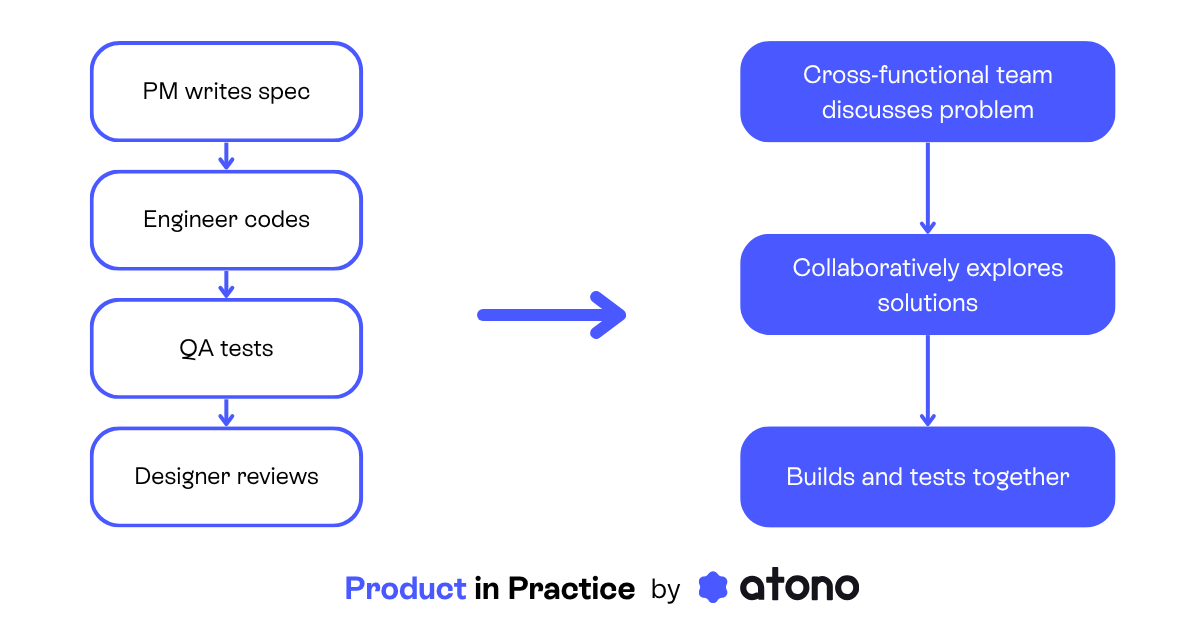
This goes beyond just having better meetings—it’s about maintaining shared context throughout the development process, which dramatically reduces the back-and-forth that kills velocity.
Focus on user problems first: Before writing any code, establish clarity on who has this problem, how often they experience it, what’s the cost of not solving it, and how you’ll know if you’ve solved it.
Adopt an MVP mindset: Product teams gravitate toward the simplest version that provides value and generates learning. This means defining success metrics before building, identifying the riskiest assumptions to test first, and building only what’s necessary to validate or invalidate those assumptions. Instead of perfecting features before release, they release imperfect features to perfect their understanding of user needs.
Maintain cross-functional context: Instead of handoffs between roles, these teams create shared understanding. That means connecting technical implementation directly to business context, so engineers understand not just what they’re building, but why it matters.
Track outcomes alongside outputs: Engineering teams naturally track technical metrics: code quality, deployment frequency, system uptime. Product teams also track user metrics: adoption rates, customer satisfaction, business impact. Both sets of metrics matter, but outcome metrics help engineering teams stay connected to the value they’re creating beyond technical excellence. Successful teams often start their weekly standups by reviewing both code commits and user engagement metrics. Some teams use built-in feature engagement tracking in Atono to see usage directly in the story it came from, making it easier to connect engineering work with customer value. Of course, we’re biased—we built Atono to solve these problems—but we’ve seen this pattern across many teams regardless of tooling.
Engineering-led teams excel in specific contexts:
Internal tooling where engineers are the primary users
Platform development where technical requirements are well-understood
Maintenance and optimization of existing systems
Deep technical problems that require specialized engineering solutions
But engineering-led approaches struggle when building for users who aren’t engineers, when requirements change frequently based on market feedback, when success depends on user adoption rather than technical functionality, or when the team needs to prioritize between multiple possible features.
As one experienced developer noted: “Engineering without a business case is a pet project.” Even technically excellent work can become irrelevant if it doesn’t address real user needs.
Moving from engineering-led to product-led isn’t just about changing processes—it requires cultural adaptation. Some engineers thrive with additional product context and user feedback. Others prefer focusing purely on technical challenges.
Many effective teams find balance, though the right mix varies by context. They maintain engineering excellence while integrating product discipline. They use engineering judgment for technical decisions and product judgment for feature decisions.
Technical excellence becomes most valuable when it serves a clear user need. Even the most elegant code can become irrelevant if it doesn’t address real problems that people are willing to pay to solve.
The goal is creating teams where engineers feel like they’re part of something bigger as opposed to a bunch of mercenaries that chuck some code out the door and never see it again.
If your team is building technically excellent software that sits unused, it’s worth examining whether product discipline might be the missing piece rather than engineering capability. Adding product thinking to engineering workflows doesn’t diminish technical excellence. It ensures that technical excellence serves a larger purpose.
The goal isn’t to choose between engineering excellence and product discipline. It’s to combine both into teams that can build the right things well.
Building cross-functional teams that balance engineering excellence with product discipline? See how Atono keeps technical work connected to business context.
Comments
Nothing yet. Say the first thing.
Sign in to join the conversation.