

Software teams commonly experience significant velocity drops as they scale. What starts as a team shipping features in days can slow to weeks as headcount grows.
More people should mean more output. Instead, velocity flatlines. Sometimes it drops.
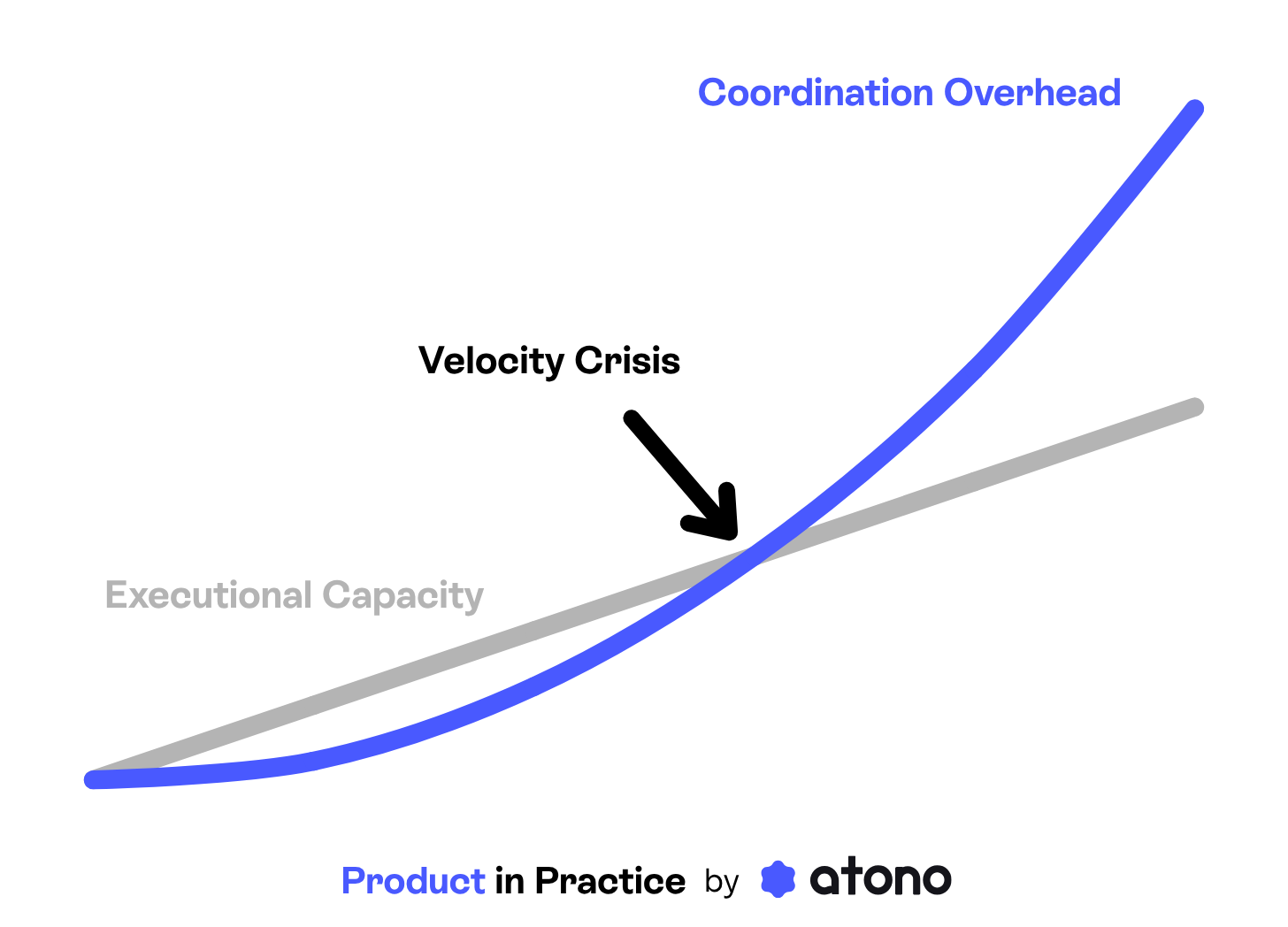
This isn’t about hiring the wrong people or working less hard. It’s about hitting the Velocity Crisis—the inflection point where coordination overhead begins to outpace execution capacity.
It’s not your people who changed. It’s the physics of your system.
And like technical debt, it compounds quietly until it breaks something important.
The Velocity Crisis isn’t random, it’s predictable. The math explains why.
Brooks’ Law famously states that adding people to a late project makes it later, but the principle applies to any growing team. Communication overhead grows faster than execution capacity.
Here’s the formula: team communication paths grow at n(n-1)/2.
A 10-person team: 45 potential communication paths
A 50-person team: 1,225 paths
A 27x increase in coordination complexity while execution capacity only grew 5x.
Execution capacity grows linearly. Coordination overhead grows exponentially. Eventually, the curves cross.
That’s the Velocity Crisis.
Understanding the math is one thing. Identifying where teams actually lose velocity is another.
The drag doesn’t come from one big problem. It accumulates in specific, predictable places.
Tool fragmentation compounds exponentially. A PM maps out this quarter’s roadmap in Aha! Engineers implement the new features following the ACs in Jira. QA turns on feature flags to test in LaunchDarkly. The entire product team reviews usage analytics in Amplitude. Each boundary creates information loss and context reconstruction cost. At scale, the numbers get brutal. Research shows it takes developers an average of 23 minutes to regain focus after each context switch between tools. For a team switching tools even 5 times per day, that’s nearly 2 hours of lost productivity per developer daily. Scale that to a 50-person engineering team, and you’re losing 100 hours every single day—the equivalent of 12 full-time engineers wasted on tool overhead alone.
Invisible dependencies create systematic blockages. As teams specialize, work becomes interdependent. A feature requires backend API, frontend integration, design review, analytics instrumentation, and QA validation. Any blockage stops everyone downstream. The design flaw in most tools is subtle but critical, they assume clear boundaries between roles when modern cross-functional teams work simultaneously across functions. The result is 58% of developers cite dependencies as their primary productivity blocker.
Context disappears across tool boundaries. Every handoff compresses information—”Why did we build it this way?” becomes tribal knowledge that vanishes when people leave. When someone asks “why does this work this way?” teams waste time on reconstruction archaeology instead of accessing clear history.
The Velocity Crisis isn’t fixed by working harder or hiring more people. It requires redesigning your system around different principles that reduce friction instead of adding coordination layers. At our previous company we experienced this friction first hand. The more we scaled, the more friction we experienced. Now we’re building Atono to help organizations escape the velocity crisis using these principles.
Reduce information loss at boundaries. Every handoff is a compression event where context gets lost between tools, people, and phases. The solution is to keep context connected to work throughout its lifecycle. Requirements, implementation notes, QA findings, and discussions should live in the same workspace—not scattered across five different tools. When flags, stories, and bugs live in one workspace, developers don’t lose context between building and testing.
Make dependencies visible before they block. Hidden dependencies become surprise blockers halfway through sprints. The solution is explicit linking between related work across teams. When one team’s story is linked as a blocker for another team’s work, both teams see it. No surprise blockages. No last-minute replanning. Teams can plan around dependencies instead of discovering them too late.
Automate coordination overhead. Manual coordination doesn’t scale. Atono uses AI-powered suggestions to speed up workflows right where teams already work—eliminating the wait for PM responses or time spent hunting through disconnected documentation. Story suggestions help teams write better acceptance criteria and identify missing edge cases before implementation begins. The goal isn’t to replace human judgment, but rather to reduce repetitive research and reduce the cognitive load of context reconstruction, letting teams focus on building instead of searching.
Design for continuous evolution, not static planning. Work changes as teams learn. Requirements aren’t complete on day one, they evolve as edge cases surface and constraints become clear. The solution is to treat stories as living documents, not frozen specifications. Editable acceptance criteria with persistent URLs mean context evolves alongside implementation. Persistent URLs mean references stay valid even when criteria are reordered—no more broken links in code comments or Slack threads.
When teams escape the Velocity Crisis, the shift isn’t dramatic at first. It’s gradual, then sudden.
The first month is about small wins. Fewer “where is this?” questions. Less time hunting for context. The friction decreases in ways that are hard to quantify but easy to feel.
The second month sees process improvements become visible. Standup time cuts in half because people already know status. PR review cycles speed up because context is accessible. The compound effect starts showing up in metrics.
Month three, and velocity metrics start climbing. Story points per sprint increase. Cycle time decreases. The team ships more without working longer hours.
After six months the team operates at a fundamentally different cadence. What used to take weeks now takes days. Cross-team coordination that used to stall projects now flows smoothly.
The specific improvements teams report are consistent:
Cycle time decreases 40-60% without working longer hours. The same features ship faster because friction disappeared from the system.
Onboarding time for new engineers drops from weeks to days. Context is accessible instead of tribal. New team members ramp up by reading stories and following links instead of interrupting senior engineers with questions.
Bug resolution accelerates because context is preserved. When bugs link back to original stories and implementation notes, developers don’t waste time reconstructing “what was this supposed to do?”
The compound effect is real. Removing one handoff eliminates multiple downstream delays. Each percentage point of reduced friction compounds across hundreds of daily actions. This isn’t about heroic effort. Teams that escape the Velocity Crisis work in better-designed systems that remove friction from every interaction.
The Velocity Crisis is a design problem—and design problems have design solutions.
If you’re seeing flatlined velocity despite stable headcount, if onboarding takes weeks instead of days, if your team spends more time coordinating than executing—you’re experiencing predictable physics, not personal failure.
The good news is these physics are reversible.
The teams that escape don’t just work differently. They build differently. They choose tools and processes that reduce friction instead of adding it. They design for flow instead of control.
When coordination overhead outpaces execution capacity, the answer isn’t more process. It’s better architecture.
Because velocity doesn’t come from pushing harder. It comes from removing the drag that’s been slowing you down all along.
Ready to escape the Velocity Crisis?
Learn how connected workflows restore flow →
Thanks for reading Building Atono! This post is public so feel free to share it.
Comments
Nothing yet. Say the first thing.
Sign in to join the conversation.