
In my last piece, I argued that the real white space in “longevity” isn’t at the top with marble clinics and peptides. It’s in the middle: a serious prevention and diagnostics layer for people who are still mostly well, still working hard, and don’t want their 50s and 60s to depend on luck.
That article triggered a lot of input. Clinicians wrote about what actually happens in 10-minute primary-care visits. Operators asked where their projects fit. Founders asked if this “missing middle” was just a nice story, or a category you could actually build.
The same questions kept coming up:
What exactly do you mean by Tier-2?
Isn’t concierge already doing this?
If demand is real, why doesn’t the market already look like this?
This piece answers those three questions and explains why I walked away from building a Tier-1 luxury clinic and chose to build Tier-2 instead.
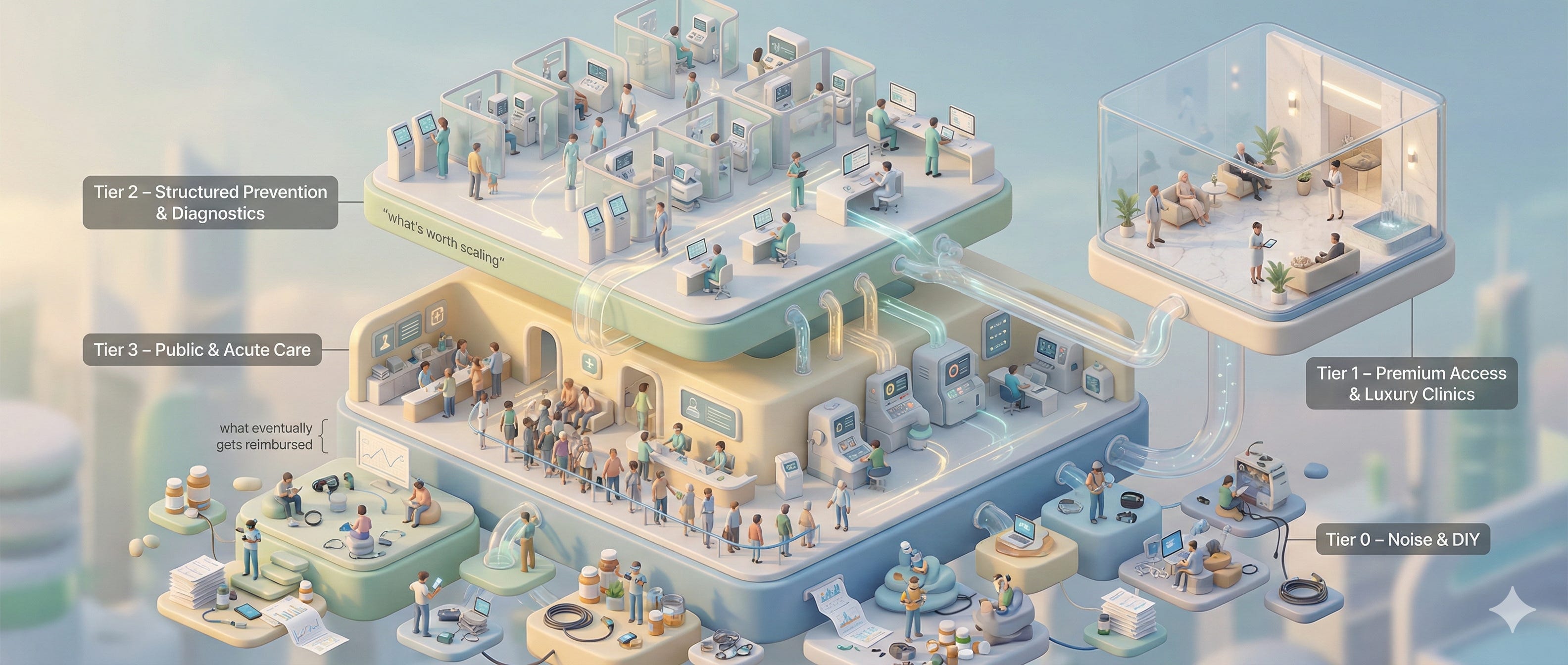
First, a clean map. I think about health for working adults in four layers, always in order: 0, 1, 2, 3.
Tier-0: noise and DIY
Where most health-literate adults actually live.
Podcasts. Twitter threads. YouTube protocols. A supplement drawer that looks like a small pharmacy. Wearables buzzing your wrist. Panic blood panels “to check everything”.
On their own, most of these tools are fine. In theory they could be Tier-2 inputs. In practice, the data lives on apps and anxiety, not in a structured medical plan.
Tier-1: premium access and theatre
Concierge practices. “Membership” primary care. Executive check-ups. Luxury “longevity” clinics.
You pay for smaller patient panels, longer visits, easier access, nicer surroundings. There are excellent clinicians in Tier-1. But structurally, most offers still behave like upgraded GP: same architecture, more time and tests.
The product is access, not prevention as a system.
Tier-2: structured prevention and diagnostics
This is the missing layer.
One-liner: Tier-2 is serious, evidence-aligned prevention and early detection for high-functioning adults, outside hospitals, built as a repeatable programme instead of a one-off event.
Tier-2 is not an inspirational retreat or a PDF with 60 lifestyle tips. It’s an operating system and programme for staying out of Tier-3:
structured pre-work
deep in-person diagnostics
a defined protocol, not a random assortment of tests
months of follow-through that fit around real work and family life
Think: the layer that turns “I’ll get around to it” into “this is my annual health strategy”.
Tier-3: acute and complex care
Hospitals, emergency departments, oncology, cardiology, ICUs.
The layer that tries to stop you dying or losing major function once something serious is already happening.
If you treat your health like capital, Tier-3 is the only layer that truly has to exist. You don’t want to live in Tier-0 noise. You don’t want to become a full-time Tier-1 tourist. And you’d like to meet Tier-3 as late and as rarely as possible.
Tier-2 is the layer that makes that more likely.
On paper, every advanced health system is “shifting to prevention”. There are national plans for cancer and cardiovascular disease. The language is always the same: early detection, risk stratification, lifestyle change, health checks.
In real life, almost all of this is dropped on one layer: primary care.
In Portugal, over a million people registered in the national system don’t have a family doctor assigned at all. Those who do often share that doctor with thousands of others. Consultations are short, lists are long, and a lot of time is eaten by forms, renewals, and acute problems.
This isn’t a criticism of clinicians. It’s geometry. You can’t run deep, personalised prevention through ten-minute slots, overflowing lists, and reimbursement designed for acute care.
Meanwhile, if you follow what people do with their own money, you see something else:
private diagnostics and “health screens” are expanding
concierge and “direct” care are normalising at the top end
health and wellness-motivated travel is a standard category, not a curiosity
On the slide deck, prevention is covered. In real life, serious adults are often opting out and improvising. That gap between the prevention story and the behaviour is where Tier-2 belongs.
Here is the working definition I use:
Tier-2 is a structured journey that maps your cardiometabolic risk, functional capacity, sleep, mental load, and relevant cancer risk, and then runs you through a defined programme with enough depth to change risk and enough discipline to be safe.
In practice, that means:
Mapping what truly matters
Cardio-metabolic risk, functional capacity, sleep, mental health, and specific cancer risks based on age, sex, and family history – using tests that have real human evidence behind them.Running a designed process
Not “whatever diagnostics we can bill” and not a random buffet of scans. A protocol that fits your constraints: flights, kids, deadlines, not a fantasy retreat version of you.Owning follow-through
Clear hand-offs. Structured coaching and habit change where it actually matters. Knowing who acts on the data, what happens when something concerning shows up, and how escalation works.
Just as important is what Tier-2 is not.
not a spa with a lab invoice
not a mini-hospital managing serious disease in a boutique wrapper
not “GP plus slightly longer slots”
not “longevity content” plus a supplement upsell
The people I’m designing this for have three simple filters:
Don’t waste my time.
Don’t talk nonsense.
Don’t pretend I live like a monk or a pro athlete.
Tier-2 is being built to clear that bar by design, not by accident.
I didn’t start out wanting to build Tier-2. I started obsessed with Tier-1.
I had moodboards of Swiss and Austrian clinics. For a while, my plan was simple: build that in Portugal. Beautiful building, frontier tools, Michelin-level food, the whole script.
Three things changed that.
On paper, a single, hyper-premium Tier-1 clinic in Portugal can work.
But when I modelled that same clinic across cities and countries, it looked slow and brittle. You end up with a small fleet of very expensive boxes that only a tiny group of people can afford.
My goal isn’t to own “the nicest clinic in X”. It’s to shift the health trajectory of a meaningful number of working adults. You don’t do that with one marble box and a waitlist.
Once I admitted that, Tier-1 started to look like a brand asset, not system infrastructure.
Longevity’s “wow” elements are seductive: IV drips, exotic compounds, stacks of supplements, experimental protocols.
Some are genuinely useful in specific contexts. Some are promising. A lot is still mechanistic reasoning, small uncontrolled studies, or marketing dressed up as evidence.
I ran a simple filter: strip out anything I couldn’t defend in front of a tough clinician or a serious investor.
What remained looked a lot like Tier-2: diagnostics, structured programmes, behaviour, environment, follow-through. Less magic. More engineering.
That’s a spine I can build on.
I’ve worked hard, built a career, and earned well. I’m also a mother and not in the ultra-high-net-worth group.
I can’t justify dropping €20k every year or two on a reset week as my core health strategy, even if I could stretch to it occasionally. It doesn’t fit how I think about risk, money, or fairness.
I don’t want to build something I wouldn’t buy regularly, with a straight face. I want to build something someone like me can access as a rational line item, not a one-off splurge.
Taken together, these three filters pushed me in one direction:
a model that can scale across locations and cohorts
a core product built on decent (or better) evidence
a price point and format that people like me would use repeatedly
When you apply those filters, you land in Tier-2: scalable, repeatable, less flashy — and exactly what’s missing.
Short answer: it’s close, but it mostly stops halfway.
Concierge and membership models usually offer:
smaller patient panels
longer visits
easier access
Direct primary care removes some billing distortions. Executive programmes bundle tests and consultations into “deep dives”.
These are real improvements on standard Tier-3 and Tier-1. They prove there is willingness to pay for better access and more attention.
But structurally, most of what I see looks like:
Access and time as the main product, not prevention as the organising principle.
Opportunistic prevention (“while you’re here, let’s also check…”) instead of prevention as a defined, repeatable programme.
Test menus that mix guideline-based screening with not-recommended scans and panels, increasing noise and overdiagnosis risk.
Limited outcome data: better uptake of preventive services and higher satisfaction, but not strong, consistent signals of fewer strokes, fewer late-stage cancers, or more functional years.
So yes, there are Tier-2-shaped fragments in the wild. They validate parts of the demand.
But “expensive GP plus extras” is not the same as a Tier-2 system designed from day one to move risk at scale.
That is the gap I’m targeting.
If Tier-2 sounds so obvious, why doesn’t it already show up as a clear category?
Because you can’t just decorate Tier-1 with prevention language and expect it to survive contact with reality.
A serious Tier-2 build has to clear four constraints at once:
Regulators care what you do, not what you call yourself.
Bring certain diagnostics or therapies in-house and, on paper, you start to look like a hospital. That triggers hospital-grade facility, staffing, and oversight requirements.
That’s appropriate for Tier-3. It’s lethal for a small Tier-2 clinic that didn’t design for it.
So Tier-2 has to pick an altitude on purpose: define what never happens under your roof, what only happens via formal partners, and exactly where your responsibility stops.
Tier-2’s value is in integration and programmes. That doesn’t map cleanly onto most fee schedules.
Parts may be billable. The whole product usually isn’t.
That’s why I’m treating Tier-2, at least initially, as cash-pay aimed at people who already treat health as a deliberate budget line, not as an afterthought.
If Tier-2 proves its value, other funding models can follow. But you can’t rely on reimbursement to carry the model from day one.
Physician time is the binding constraint in most systems.
If your model implicitly assumes unlimited doctor hours, it will fail. Doctors have to be reserved for decisions: risk classification, interpretation, escalation, de-escalation.
Everything else — data gathering, education, habit change, monitoring — has to be handled by other humans and systems.
Tier-2 only works if you design around this from the start.
More testing means more findings, and more responsibility.
If you don’t know exactly what you’ll do with the results, you’re lighting a fuse.
Tier-2 has to be conservative about which tests it uses, why, and who owns the next step if something serious appears. That’s less marketable than “full body scanning”, but it’s also where the moat is: a disciplined, defensible testing and escalation strategy is hard to copy quickly and hard to fake.
These constraints aren’t reasons not to build Tier-2.
They’re exactly why most glossy concepts haven’t survived, and exactly where the long-term defensibility lives.
Once you respect the friction stack, “Tier-2 for everyone” disappears. You’re left with a smaller, sharper, but very real segment.
For me, there are two engines and three groups.
Group 1: health-literate professionals in Tier-1 cities
They already pay for executive check-ups, private imaging, advanced blood work, some form of concierge or direct care. They’ve opted out of pure Tier-3 reliance.
What they lack is a coherent risk story over time and a plan that fits their actual constraints.
Group 2: burnt-out executives and remote workers who already travel for health
They’re already booking weeks in Swiss, Spanish, or Middle Eastern clinics “to reset”. They’re used to spending meaningfully on health.
The blocker isn’t willingness; it’s realism and repeatability. Tier-2, done properly, is a clear upgrade on what they’re already buying: serious, structured, annual, and actually connected back to their normal life.
For both groups, an annual or biennial Tier-2 programme at a mid-four-figure price is a rational business and life decision, not a fantasy spend.
Group 3: local professionals as a designed constraint
I’m not imagining the average Portuguese household buying Tier-2.
I care about a narrower group: Lisbon/Porto founders, senior operators, and professionals who already pay for private insurance, gyms, and some diagnostics — and are willing to allocate a rational annual amount to staying functional.
I don’t need most locals. I care whether a few hundred serious people will:
commit to a clear, structured prevention product
at a non-Swiss price
more than once
They force pricing sanity, smooth seasonality, and act as clinical truth-serum. You can fake it for tourists. You can’t fake it for people who live nearby and come back.
If Tier-2 works for these three groups, it’s not a niche. It’s a template.
Portugal isn’t just “where I happen to be”. It’s part of the strategy.

Economically, Portugal has been growing faster than the euro-area average in recent years, with budget surpluses and public debt back under 100% of GDP. It’s not a perfect system, but it has some headroom and momentum.
On the healthcare side:
The public system provides broad coverage.
The private sector delivers good quality at lower price points than many Western European countries.
There’s already a blend of medical and wellness tourism — especially around Lisbon, Cascais, and the Algarve.
On the travel side:
direct flights to New York in roughly seven to eight hours
frequent connections to major European capitals
you can leave New York in the evening, land in Lisbon in the morning, and start a structured programme the same day
Add to that:
lower operating costs than London, Zurich, or New York
a strong tourism brand that isn’t only about cheap breaks
a growing population of founders and remote workers who’ve already chosen to live here
Put it together and Portugal isn’t a lifestyle choice. It’s a disciplined test environment:
big enough and growing enough to matter
under-built in exactly the category I care about
convenient enough that global clients don’t have to contort their lives to get here
If we make Tier-2 work here under sober assumptions, the playbook is exportable: replicate in similar markets, partner with employers and insurers who need credible prevention, and layer software on top of a proven workflow.
This is not a one-clinic story. It’s an infrastructure pattern that can sit between Tier-1 and Tier-3 in many countries.
The business is still in stealth, so I’m not going to publish the full blueprint.
But I can be clear about the bet.
I’m betting that:
There is a real structural gap between Tier-0/Tier-1 noise and Tier-3 reality.
Demand already exists in behaviour, not just surveys or slide decks.
Existing “Tier-2-ish” models mostly stop at better access, not at programmes that are engineered for outcomes and scale.
A model that respects regulation, clinician time, and liability can work if you choose your segment and geography carefully.
Portugal is a rational first place to prove this in practice.
I don’t see this as a vague hypothesis. The behaviour, the incentives, and the current patchwork of half-solutions all point in the same direction: this middle layer will develop.
My job is to turn that inevitability into a disciplined, working template — not a moodboard.
There are plenty of ways to get execution wrong. That’s where I expect to learn. The category itself is not optional.
To keep this grounded, I use a simple internal stack:
Biology – what actually moves disease risk and function.
Friction – regulation, reimbursement, workforce, liability.
Experience – how it feels and whether people come back.
Capital – who pays, how much, and what story they think they’re buying.
Tier-0 mostly ignores this stack and hopes something sticks.
Tier-1 optimises experience and capital, gestures at biology, and often hand-waves friction.
Tier-3 is deep in biology and friction and has to fight hard for experience and capital.
Tier-2, done properly, is engineered from all four from the start. That’s the work. Not the marble. Not the sauna. Not the supplement stack.
I’m convinced enough of that, and of my three realisations about Tier-1, evidence, and my own role as a customer, to put my time and capital into building Tier-2, quietly, in Portugal.
Executed well, this doesn’t just avoid failure. It becomes the obvious standard for how prevention should look for working adults.
In ten years, I expect “Tier-2” to be a normal phrase in health-system decks — whether or not they use that exact label. My goal is to make sure the underlying template is disciplined, humane, and boringly repeatable.
If you’re building, funding, or practising anywhere near this missing middle, I’d like to compare notes.
This is an educational and strategic perspective, not personal medical advice.
Comments
Nothing yet. Say the first thing.
Sign in to join the conversation.