
Ironman series, part two. Part one argued that the number at the top of your dashboard does not decide a long day, and that durability does; this one asks what actually keeps a body durable across years, before part three takes on lactate and the forty years the sport spent blaming it.
“You’re going to tear yourself apart doing it like that.”
A man I used to run with on Sundays said that to me in a car park, and he meant it kindly. He’d watched me finish, sit down on the kerb, pull my shoes off and get straight into the car, and at no point had I stretched a single thing. He’d been running since before I was born. No slogan in it either. He was telling me what nearly everyone in the sport believes, with about thirty years of coaching orthodoxy standing behind him.
He was wrong on the specific claim. That took me a while to say out loud, because he had the majority position and the good intentions, and I had a hunch and a vague memory of a review paper.
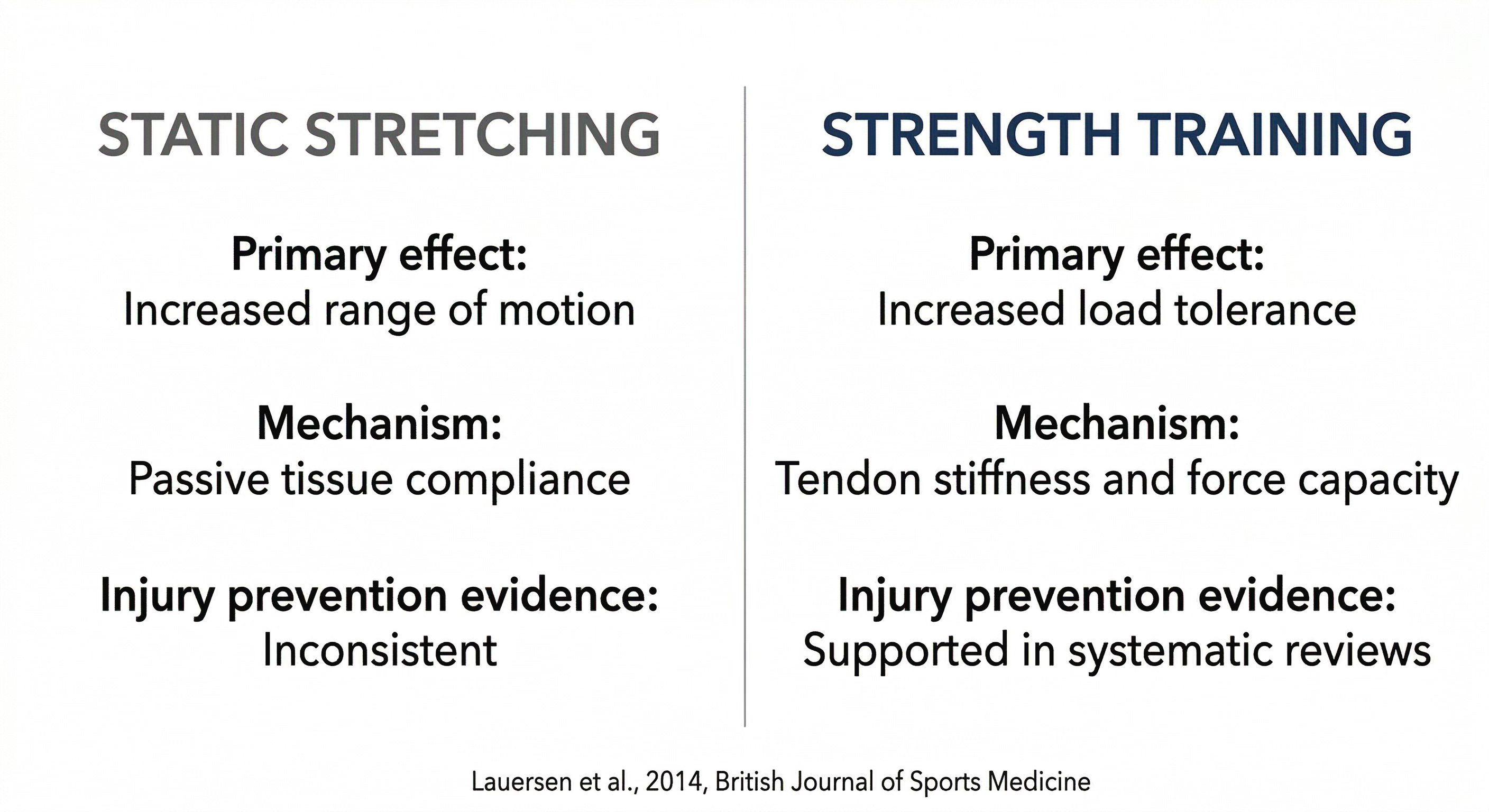
So here is that claim, kept small. Static stretching earns its keep for range and for coming down after a hard day. What it has never really shown is that it keeps healthy athletes off the injury list, and that is the exact job most people adopted it for.
That gap matters most for whoever has the fewest spare hours.
This is an educational and strategic perspective, not personal medical advice. The views are the author’s own and not statements by Atlas Cove Lda.
Thirty years of orthodoxy, and a thin file behind it
The story is easy to picture, and that is why it stuck: a short muscle tugs a joint out of line, tissue further down the chain absorbs force in a direction it was never built for, and lengthening the muscle puts the geometry back where it belongs. Joint angles really do change when you stretch. That part is real. What doesn’t follow is the bit the story promises, once you stop measuring degrees and start counting injuries.
Thacker and colleagues went through the literature on stretching and injury risk and found no reliable drop in injury rates from stretching before or after exercise, in every group they could look at (Thacker et al., 2004). A broader review a decade later arrived from a different angle. Static stretching genuinely does buy a short-term increase in available range, that increase doesn’t turn into fewer injuries in healthy active people, and a long passive hold immediately before a hard effort can temporarily cost you force and power (Behm et al., 2016).
Read that carefully, because the sloppy version of this argument has done real damage to how it lands. Nothing in there says stretching hurts you. Nothing says flexibility is pointless, and nothing says the person who enjoys ten quiet minutes on the floor is wasting their evening. One narrow claim comes apart, which is the idea that holding a muscle long keeps an otherwise healthy athlete intact, and that’s a far smaller statement than the one people usually hear, because nearly all the useful judgement here lives in the space between the two.
Where a stiff hip actually shows up
Some cases need no argument at all. The first is a sport-specific shortfall in range, meaning a movement your sport genuinely demands and your body can’t currently produce. A runner whose ankle won’t dorsiflex. A swimmer whose shoulder won’t rotate through the arc the stroke asks for. That’s a measurable gap sitting directly in the path of something they’ll repeat a few thousand times before lunch, and working on that one joint removes a real limit rather than chasing general suppleness and hoping it helps somewhere.
The second is compensation, where one stiff joint quietly gets paid for by a neighbour badly designed to cover the bill, so that limited hip extension while running tends to get settled by the lumbar spine and the pain then turns up some distance away from whatever caused it. Giving the hip its range back there has nothing to do with being bendy. It switches off a repeated overload upstream of something fragile. And if you sit for nine hours and then run for one, that description fits you far better than it fits whoever is racing next weekend.
There’s also a distinction that gets lost constantly, between a dynamic warm-up and a long passive hold. A dynamic warm-up moves a joint through its working range at rising intensity, in patterns that resemble the session about to happen, and it warms the tissue and wakes the nervous system up for what’s coming. It belongs in anyone’s week. Sitting in a stretched position for sixty seconds beforehand is a different animal, and the passive holding is the part the literature treats with caution. Warming up was never in question. (The foam roller sits somewhere in between and I genuinely don’t have a strong view on it.)
None of which is an argument against mobility work as a category. The argument is narrower and it’s about several undirected hours a week that fix no shortfall you can name and build no capacity, while you go on counting them as insurance.
The Achilles that grumbles for the first ten minutes
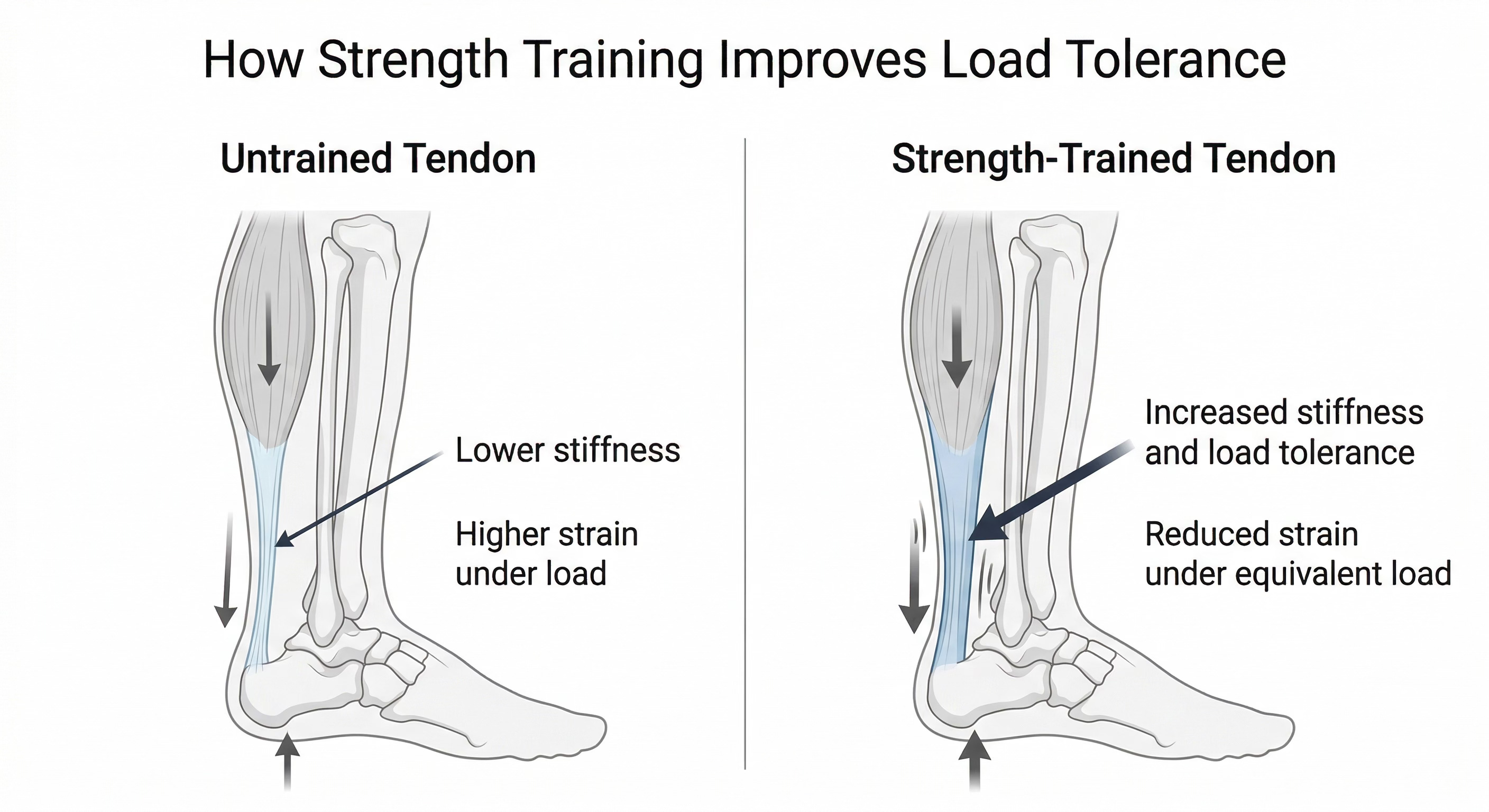
To see why loading beats lengthening, be exact about how these injuries turn up. Almost all of them are failures of load tolerance. A tissue got asked, over and over, to absorb more mechanical stress than its current structure could handle, until the accumulated demand found the weakest link in the chain. Running is a long sequence of ground-reaction forces, each footstrike a brief instruction to absorb energy and give it back, and the stretch-shortening cycle that makes this cheap depends on tendon and muscle working as a spring, loaded and released several thousand times an hour. Downhill running raises the eccentric share of that, meaning the muscle produces force while it lengthens under load, and that is exactly the pattern under which tendons accumulate stress.
Seen that way, the complaints you hear in every running club read differently. The Achilles that grumbles for the first ten minutes. The patellar tendon that flares after a hard block. Neither is really a stiffness story. Both are a body handed more than it was ready to carry.
If that reading holds, the thing that answers the problem raises what the tissue can take rather than how long it is, and here the evidence separates most cleanly. Lauersen and colleagues pooled randomised trials of exercise programmes aimed at preventing injury and found the strength-based ones cut injury rates substantially, while the stretching ones managed nothing comparable (Lauersen et al., 2014). That split is hard to explain unless load tolerance is the variable doing the work, and it holds even where people stuck to both equally well.
The mechanism is reasonably well described. Load a tendon progressively and it changes as a structure. It gets stiffer, and it absorbs and returns more force before it starts accruing damage, which is a genuine material change rather than a passing sense of looseness (Bohm et al., 2015). Eccentric work in particular, the controlled lowering under tension that heavy squats and Romanian deadlifts hand you by their nature, is what loading-based rehab for Achilles and patellar tendinopathy is built on (Malliaras et al., 2013). Which is to say it’s already the standard care for precisely the problems endurance athletes most want to avoid.
Stretching changes how compliant a tissue feels this afternoon. Loading changes what it can carry six months out.
Carrying more muscle up the hill
If strength work only kept you intact it would already earn a slot in a crowded week, and it also tends to make you faster, which tips the trade a long way further.
The standing objection is straightforward enough. Muscle is mass, and power to weight is what endurance performance runs on. I believed it for years. Beattie and colleagues pooled the strength training work in endurance athletes and found close to the opposite, with resistance training improving running economy and the related measures while maximal oxygen uptake and body composition stayed essentially where they started (Beattie et al., 2014).
Running economy is doing most of the work in that result. It’s worth understanding rather than quoting. Economy is the oxygen cost of holding a given pace. It improves for two connected reasons: a stiffer tendon gives back a bigger share of the elastic energy stored at each footstrike instead of losing it, and a stronger muscle works at a smaller fraction of its maximum to make the same force. A tighter meta-analysis in highly trained runners found a large benefit to economy from lifting and plyometric work done a few times a week over a couple of months (Balsalobre-Fernández et al., 2016).
In the last hour of a long race, better economy is fuel and time handed back for nothing, at the one moment neither is available by any other route. If you never race, the same change shows up as an ordinary Tuesday that leaves more in the tank by six.
The first thing off the board
For nearly everyone reading this, the binding limit is neither knowledge nor motivation. It’s hours. Training for a long event already eats most of the discretionary time an adult with a job and a family can find, two or three lifting sessions add to that, and once several more hours of undirected mobility work go on top, something has to give.
I know exactly which thing gives, because for years it was me. Through most of the decade I spent working up to long-distance racing, the gym was the first item off the board whenever a week went sideways. Nothing in my training log went red when I skipped it, so it kept getting skipped, and I filed the whole pattern as a scheduling problem when it was a decision.
What changed my mind was going and reading the thing properly, which is a duller story than a blown Achilles and happens to be the true one. For years I had been disciplined about the hours with the thinnest evidence behind them and casual with the hour carrying the most, and I had never once sat down and worked out which was which, which is a fairly stupid way to spend a decade of Sunday mornings. That one still irritates me.
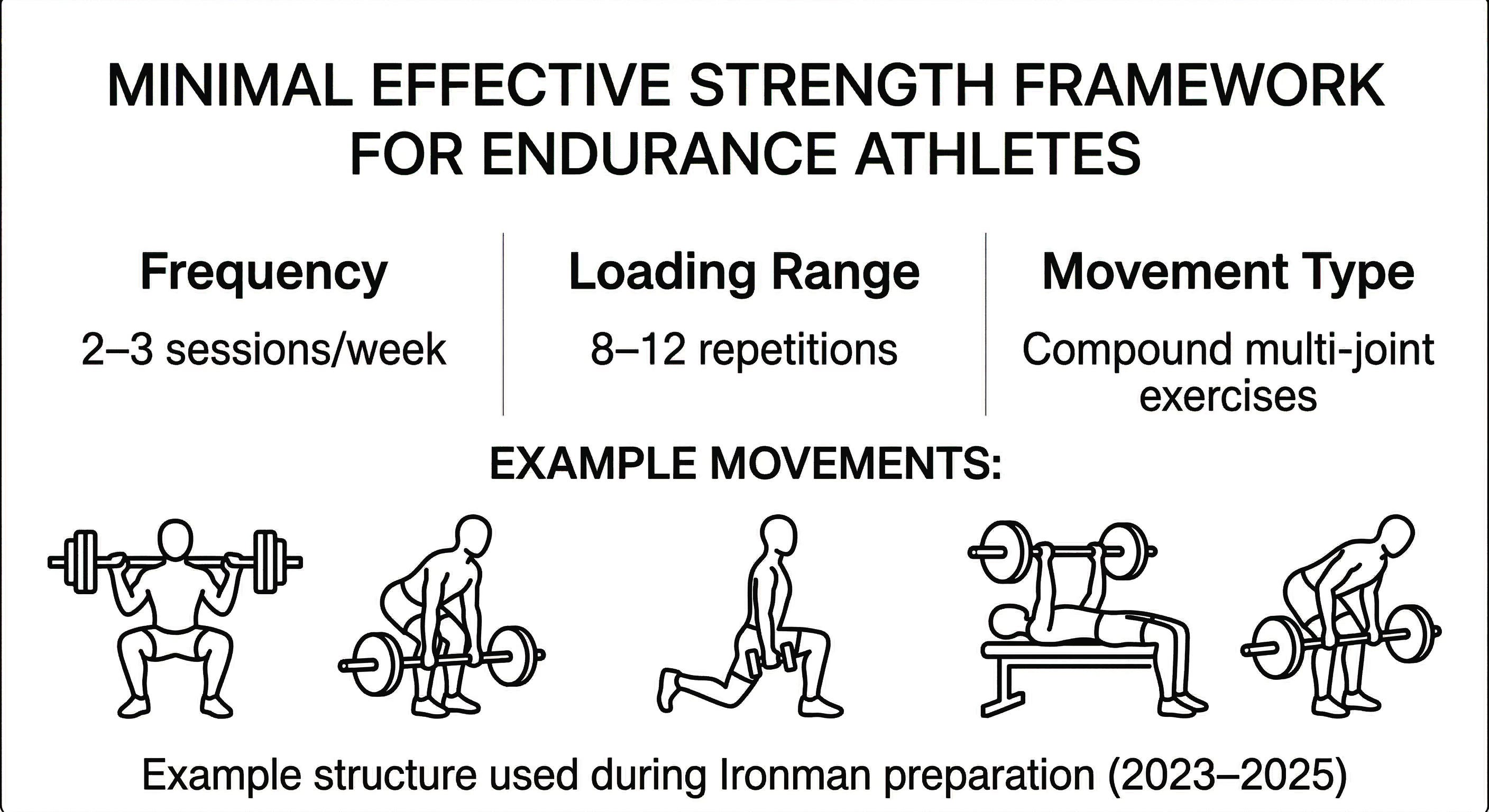
What came after is the part I would defend. Once the loading stopped being negotiable, the two Ironman builds that followed looked different: three sessions a week at 8 to 12 reps, held in place through the heaviest endurance blocks, zero static stretching, and no overuse injury at either end. Twelve years of consistent training by then, two Ironman finishes and six marathons.
Now the part where I have to be careful with my own story. That’s an n of 1. It proves nothing. It happens to point the same way the pooled literature points, which is a coincidence I enjoy and would not want anyone to lean on, and if I let a personal anecdote stand in for evidence here I’d be making the exact mistake the stretching habit is made of.
Why the pleasant option wins the last free hour is entirely human, by the way. A long hold drops the felt tightness straight away and leaves you calmer than you were, while heavy loading leaves you tired and competes for the same recovery your endurance work is already spending. Low risk feels reassuring right up to the moment you notice it’s also low return for the one job you took it on to do.
One percent a year, and where you notice it
Everything above is about a single goal, which is staying uninjured while training a lot on very little time, and it shouldn’t be allowed to grow into a verdict on mobility in general. Range of motion has value with nothing to do with running injuries at all.
It declines across adult life, unevenly between joints and reliably enough to measure. Araújo went through around 6,000 Flexitest results and found flexibility falling in the region of 1 percent a year, with the hips and ankles among the first to stiffen (Araújo, 2013). None of that turns up in a race result. It turns up in whether you can sit on the floor with your kids without your back filing a complaint, or get off the ground unassisted at seventy. Those are closer to the point of the whole exercise than any finish time I’ve ever recorded. So a working range is a legitimate goal on its own terms, kept for the quality of the next few decades.
The recovery argument deserves the same honesty. A gentle stretch does lower the immediate feeling of tightness, and there’s a real shift toward parasympathetic activity available in a slow, well-breathed few minutes before bed, which sits comfortably beside the case for taking rest as seriously as output. It just shouldn’t be defended as injury prevention. Or rather, it shouldn’t need defending at all, because helping you come down off a day is a good enough reason on its own.
Strength and mobility answer different questions. Both are worth having. Loading raises how much stress a tissue tolerates, mobility keeps the range the joint can move through, and a body that intends to train for another twenty years wants a supply of both. The two only ever conflict when the hours run out.
How to split the hours you’ve got
The division follows without much strain. The dynamic warm-up stays, because preparing tissue for the work about to be done is straightforwardly sensible. Targeted mobility work stays as well, for a sport-specific shortfall or a compensation pattern you can name out loud. Keep some undirected mobility work too, for range and for the wind-down, as long as you’re honest with yourself that this is where its value sits. Then the strength training, two or three sessions a week of compound movements with the load creeping up over the months, and that one isn’t available for trading.
It carries the strongest evidence both for staying intact and for getting faster, and it’s reliably the first thing to vanish when the calendar tightens. I know. I did it for years.
An Atlas Cove week gets built on the same division of hours, so what a particular body is short of gets established before the scarce time gets assigned. A habit can’t do that reading for you.
The man in that car park wasn’t wrong about much. He was wrong about one thing, and it was the thing he was surest of. Stretching isn’t worthless, and if you finish a long ride with fifteen quiet minutes on the floor you’re doing yourself no harm at all. The correction is smaller and more useful than that. Mobility work has good justifications, and staying uninjured isn’t among them, so when time is genuinely short the hour that most keeps you from breaking down is the hour you spend loading the tissue.
This is an educational and strategic perspective, not personal medical advice. The views are the author’s own and not statements by Atlas Cove Lda.
Thanks for reading Atlas Cove Health! It is a reader-supported publication. To receive new posts and support my work, consider becoming a free or paid subscriber.
Sources
Thacker, S. B., Gilchrist, J., Stroup, D. F., & Kimsey, C. D. (2004). The impact of stretching on sports injury risk: a systematic review of the literature. Medicine & Science in Sports & Exercise, 36(3), 371-378. DOI: 10.1249/01.MSS.0000117134.83018.F7
Behm, D. G., Blazevich, A. J., Kay, A. D., & McHugh, M. (2016). Acute effects of muscle stretching on physical performance, range of motion, and injury incidence in healthy active individuals: a systematic review. Applied Physiology, Nutrition, and Metabolism, 41(1), 1-11. DOI: 10.1139/apnm-2015-0235
Lauersen, J. B., Bertelsen, D. M., & Andersen, L. B. (2014). The effectiveness of exercise interventions to prevent sports injuries: a systematic review and meta-analysis of randomised controlled trials. British Journal of Sports Medicine, 48(11), 871-877. DOI: 10.1136/bjsports-2013-092538
Bohm, S., Mersmann, F., & Arampatzis, A. (2015). Human tendon adaptation in response to mechanical loading: a systematic review and meta-analysis of exercise intervention studies on healthy adults. Sports Medicine - Open, 1(1), 7. DOI: 10.1186/s40798-015-0009-9
Malliaras, P., Barton, C. J., Reeves, N. D., & Langberg, H. (2013). Achilles and patellar tendinopathy loading programmes: a systematic review comparing clinical outcomes and identifying potential mechanisms for effectiveness. Sports Medicine, 43(4), 267-286. DOI: 10.1007/s40279-013-0019-z
Beattie, K., Kenny, I. C., Lyons, M., & Carson, B. P. (2014). The effect of strength training on performance in endurance athletes. Sports Medicine, 44(6), 845-865. DOI: 10.1007/s40279-014-0157-y
Balsalobre-Fernández, C., Santos-Concejero, J., & Grivas, G. V. (2016). Effects of strength training on running economy in highly trained runners: a systematic review with meta-analysis of controlled trials. Journal of Strength and Conditioning Research, 30(8), 2361-2368. DOI: 10.1519/JSC.0000000000001316
Araújo, C. G. S. (2013). Age-related mobility loss is joint-specific: an analysis from 6,000 Flexitest results. GeroScience (AGE), 35(6), 2399-2407. DOI: 10.1007/s11357-013-9525-z
Comments
Nothing yet. Say the first thing.
Sign in to join the conversation.