
Ironman series, part three. Part one questioned the number everyone trains for and part two asked what mobility work is really for; this one takes on the molecule endurance culture has blamed for forty years, before part four looks at heat and the limits of pushing through.
On two of the hardest stages of this year’s Tour, riders on UAE Team Emirates-XRG drank sodium lactate. Deliberately, stirred into their carbohydrate, confirmed by their own nutritionist while the race was still running. The scientist behind the drink is George Brooks, who has spent most of a career arguing that lactate was filed wrong from the beginning.
Now think about what you were taught. Lactate is the waste. It’s what stings in the last thirty seconds of an interval, it’s what the cool-down is for, it’s the thing an ice bath supposedly chases out of your legs. That story sat in textbooks for decades and the people teaching it weren’t being sloppy. It’s still wrong where it counts.
Lactate is a fuel. Your body is making it right now, sitting still, with plenty of oxygen around, and trading it between cells so your heart and your slow fibres and your brain can burn it. It also carries information, changing which genes a muscle cell switches on.
The narrow claim: lactate doesn’t cause the burn, it isn’t evidence that anything failed, and the threshold everyone trains against is a reading rather than a wall.
This is an educational and strategic perspective, not personal medical advice. The views are the author’s own and not statements by Atlas Cove Lda.
Oxygen gave the old story its trigger. Muscle runs clean, demand outruns supply, an emergency pathway opens, lactate spills out as the residue. Tidy. It explains the sting and it certifies that you went past something.
The measurements don’t cooperate. Lactate turns over continuously across all sorts of cell types with oxygen everywhere and nothing failing anywhere (Brooks, 2018), which means the millimole per litre circulating in you as you read this isn’t left over from anything you did earlier in the week, it’s the standing balance of a system that has been making the stuff and burning it every minute you’ve been alive.
What’s actually going on is duller. Breaking down glucose gives you pyruvate, the enzyme that carries pyruvate to lactate is quick and sits close to equilibrium, so lactate turns up whenever glucose is going through fast, oxygen or no oxygen. A rising lactate number tells you how fast you’re burning carbohydrate, not the moment your oxygen ran short.Those two happen to move together when you go hard. That’s the whole reason a wrong explanation lasted so long.
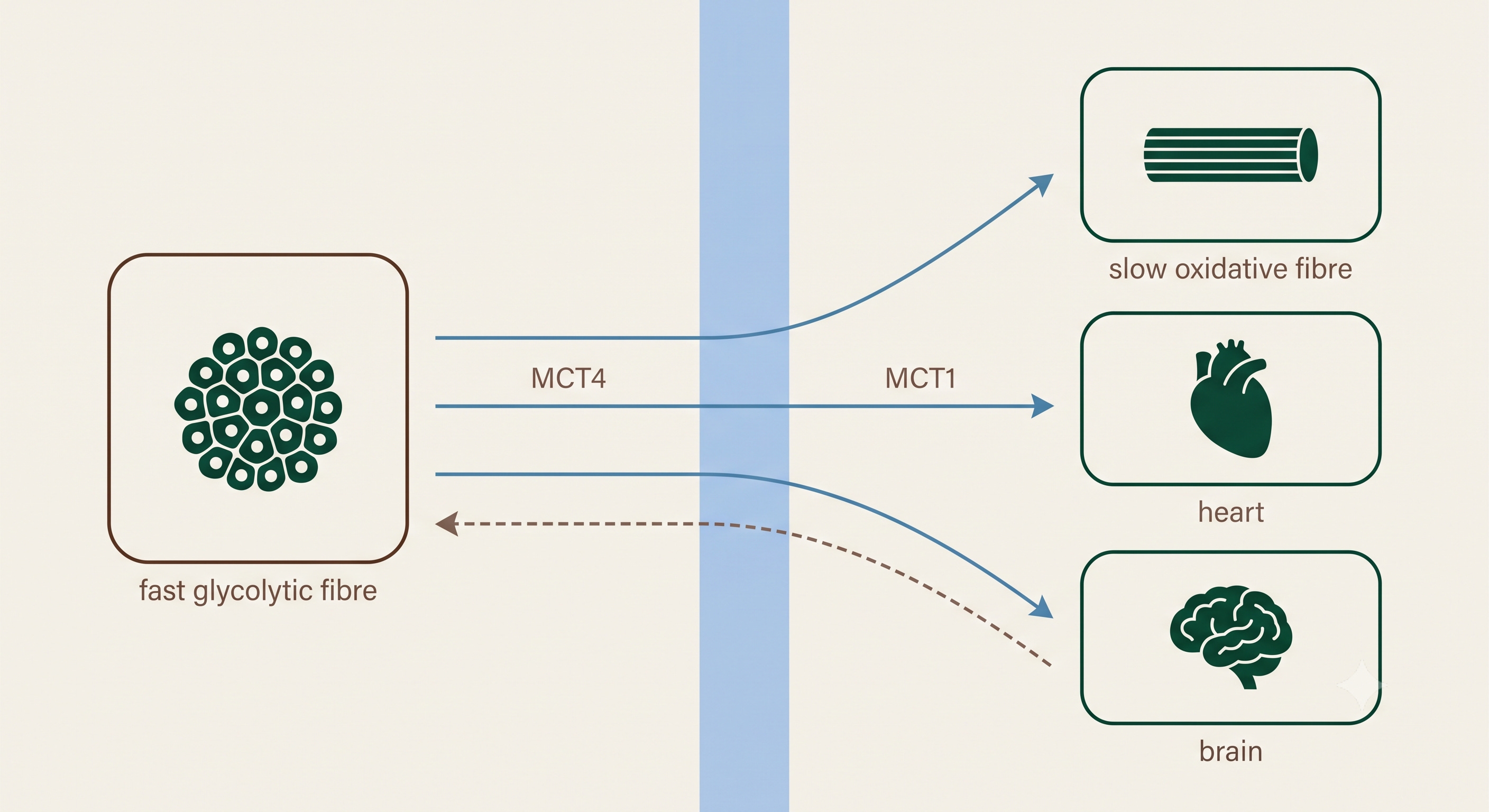
Lactate becomes an economy because it moves. Cells push it across their membranes through the monocarboxylate transporters, and the two that matter here have opposite jobs. MCT4 holds lactate loosely and shifts a lot of it, which suits a fast glycolytic fibre making more than it can use. MCT1 sits in oxidative tissue, the slow fibres and the heart muscle, where lactate gets pulled in to be burned instead. Neither door runs one way. The same muscle can be selling one minute and buying the next (Brooks, 2018).
Under exercise that becomes constant trade, with a fast fibre letting go of it, the slow fibre next door taking it up and oxidising it, your heart burning it in preference to glucose, and your liver quietly rebuilding a share of it back into glucose again. Three quarters to four fifths of production never accumulates anywhere.
The brain is the part people refuse to believe. Van Hall and colleagues infused labelled lactate into six healthy volunteers and got most of the label back as labelled carbon dioxide, which is what oxidation looks like when you can follow the atoms. Lactate covered about 8 percent of the brain’s energy at rest, 19 percent once blood lactate was raised, and 27 percent during cycling at 75 percent of maximum oxygen uptake (van Hall et al., 2009). Six people. The lactate came from a drip rather than from effort. So treat the figures as indicative and the direction as solid: when you’re working hard, better than a quarter of what runs your brain is the stuff you were told to clear out.
The mistake lives inside one expression. Nobody argues about the burn, and the acidity of hard work is real and measurable. What “lactic acid” does is settle the question of cause by grammar, welding an acid and a lactate ion into a single object and handing you a suspect before anyone has looked at any evidence.
Follow the protons instead. Acidity comes overwhelmingly from spending ATP, because a proton gets released every time a cell splits ATP for energy, and hard work has the cell turning ATP over outside the mitochondria at a furious rate. The reaction that makes lactate does the opposite of what its name implies. Converting pyruvate to lactate takes a proton out of solution, which makes that step mildly alkalising (Robergs et al., 2004). Both things are true at once. That’s why the shorthand lasted.
Here’s the part that usually gets skipped. This correction gets overstated nearly every time somebody repeats it. Böning and Maassen have argued in print that “lactic acid” survives as a fair summary, since one lactate ion and roughly one proton come out of the same overall process, and they agree explicitly on the mechanism, that the proton only shows up when the fresh ATP gets spent (Böning and Maassen, 2008). Robergs has revised his own arithmetic since 2004.
So the defensible version is narrower than the popular one and quite a lot more interesting. Lactate isn’t the proton donor, both camps agree where the protons come from, and the argument that remains is about bookkeeping rather than chemistry. Nobody publishing in this field still claims lactate burns your legs. That’s the bit almost everyone got told.
Second charge against lactate: the stiffness that arrives a day or two after unfamiliar work. The clock alone should have cleared it. Lactate is back at resting values inside the hour, and the soreness hasn’t even started yet.
The cleanest evidence here is old. Schwane and colleagues ran people downhill and on the flat and watched the two come apart completely, because flat running drove blood lactate up and left almost no soreness behind it, while downhill running produced pronounced delayed soreness in people whose blood lactate never rose at all (Schwane et al., 1983). The intensities weren’t matched, so this separates the two rather than disproving a link. The condition that hurt for days is the one that never raised lactate.
What downhill running supplies instead is eccentric loading, muscle making force while it lengthens, which is where the mechanical damage and the repair afterwards actually come from. Soreness after a new eccentric stimulus is closer to a receipt than to a warning that something needs clearing. It’s damage you asked for, and the repair is the point.
Lactate’s newer job is carrying information. Hashimoto and colleagues put lactate on cultured muscle cells and watched expression change across six hundred and seventy-three genes, MCT1 up inside an hour, cytochrome c oxidase up inside six, the whole response converging on the machinery that builds mitochondria (Hashimoto et al., 2007).
The limits belong in the same breath, because results shaped like this travel faster than their evidence. Cultured rat cells, not a person. Ten and twenty millimoles per litre, and the higher figure sits above anything you would reach in blood. No exercise anywhere in it.
It doesn’t show that lactate drives your adaptation. What it makes plausible is that part of what a hard session buys you arrives through lactate talking rather than lactate burning, which would put the product of hard work inside the decision to get better at hard work. Still a hypothesis in humans. I like it more than I can currently defend it.
A lactate test is a run of small blood samples taken at rising intensities, and the curve appeals because it looks like it fixes a line you can train against.
The literature is messier than the curve. Faude and colleagues counted twenty-five separate definitions of the lactate threshold, which means one athlete tested on one afternoon can walk out with materially different numbers depending on which convention the lab happens to prefer (Faude et al., 2009). What the physiology holds is a transition with two edges: the point where lactate lifts off baseline, and the hardest intensity at which production and removal still cancel out.
Be fair to the test, though. That same review found thresholds correlate strongly with endurance performance, so they measure something real. The error is reading the number as a wall inside you rather than a report on how the system is running today. A threshold captures the balance between how fast you make lactate and how fast you clear it, and both sides move with training, sleep, heat and what you ate that morning.
I learned that the slow way, and not through sport. For a couple of years I had winter and spring episodes of severe migraine, flu-like aching and a fatigue that took the whole day with it. Every blood marker came back unremarkable. I kept waiting for one of them to go abnormal, because that is how I assumed bodies worked: something breaks, a number moves, you go and fix the thing. Nothing was broken. The problem was regulation, and no single marker reports on regulation. A lactate curve is honest in the same shape. It describes a balance, and it will not tell you which part to blame.
Back to the bottle. If your body already trades lactate, putting some in by mouth looks like a way to add fuel without asking more of a gut that’s already saturated with carbohydrate. That’s the team’s reasoning and it’s a fair hypothesis.
Dose is the problem. Péronnet and colleagues fed people labelled lactate and labelled glucose together and followed both. The ingested lactate supplied about two and a half percent of the energy used. The glucose supplied about eight. The gap is mostly tolerance, because there’s a hard ceiling on how much lactate anyone can swallow before the gut objects (Péronnet et al., 1997).
I know that ceiling from the other side. On race day at Cascais I was taking in roughly 100 grams of carbohydrate an hour, which came out as 8 to 10 bars and 5 gels across the bike leg alone. That is already at the edge of what a stomach will accept while you’re working, and it is not a pleasant thing to do to yourself for five and a half hours. Whatever else you want to add has to fit inside what’s left of that budget. There isn’t much left.
The outcome trials have been cool as well. Sixteen trained cyclists on a race-like protocol got better buffering and lower perceived effort, with performance unchanged (Bordoli et al., 2024). So the reframe stands up and the drink doesn’t, at least not yet. Nobody involved is claiming otherwise, and UAE’s own nutritionist said during the race that the performance effect remains an open question. A better formulation might lift the tolerable dose and change all of this. Worth watching. None of it touches the biology underneath.
You train three or four times a week around a job, and you’re never going to have a needle in your earlobe. So what actually changes?
First, how you read getting fitter. Bergman and colleagues took nine untrained men through nine weeks and then measured lactate kinetics two different ways, and the interesting part is that the two ways disagree: held at the same absolute power as before training, blood lactate fell 41 percent because the men were simply producing less of it with clearance unchanged, while held at the same relative intensity, meaning a harder effort scaled to their new fitness, it was clearance and oxidation that went up instead (Bergman et al., 1999). Nine men, one cycling protocol. Treat the numbers as illustrative. The shape is the point: fitness is two things at once, a production side and a disposal side, and a session improves whichever one you loaded.
Second, how much authority the zones on your watch have earned. Zones are a usable model and I use them, because a continuous variable has to be cut somewhere before anyone can plan a week. Across the months before Cascais mine came out at 72 percent low intensity, 27 percent threshold and 2 percent high, and that distribution did its job. Or rather, the distribution did its job while the boundaries between the zones stayed an estimate the whole time. A line taken off a formula, or off a test you did in March, is a guess about you today.
Two checks beat any single measurement. Has your pace or power at a fixed easy heart rate moved across the last eight weeks? That asks the same question a lactate curve asks, and it costs nothing. Then the one that needs no equipment at all: could you repeat today’s easy session tomorrow without dreading it? An easy day only works if it’s genuinely easy, and the usual way a good week rots is that the bottom end creeps upward while nobody is looking at it.

Which is close to why an Atlas Cove week treats a measurement as something obliged to answer a question you already have, rather than as a score to be collected and filed, because a number earns its place on the page only when you can say in advance what a high reading and a low reading would each make you do differently. A number you can’t act on differently is decoration.
Lactate shows how long a wrong explanation survives when it’s vivid, teachable and roughly lines up with the sensation it claims to explain. Forty years. Plenty of cool-downs are still being done for it.
You’re making some right now. Your heart is buying it. So, apparently, are the fastest cyclists in the world, though on that last one the evidence hasn’t caught up with the enthusiasm yet.
This is an educational and strategic perspective, not personal medical advice. The views are the author’s own and not statements by Atlas Cove Lda.
Brooks, G. A. (2018). The science and translation of lactate shuttle theory. Cell Metabolism, 27(4), 757-785. DOI: 10.1016/j.cmet.2018.03.008
van Hall, G., Strømstad, M., Rasmussen, P., Jans, O., Zaar, M., Gam, C., Quistorff, B., Secher, N. H., & Nielsen, H. B. (2009). Blood lactate is an important energy source for the human brain. Journal of Cerebral Blood Flow & Metabolism, 29(6), 1121-1129. DOI: 10.1038/jcbfm.2009.35
Robergs, R. A., Ghiasvand, F., & Parker, D. (2004). Biochemistry of exercise-induced metabolic acidosis. American Journal of Physiology - Regulatory, Integrative and Comparative Physiology, 287(3), R502-R516. DOI: 10.1152/ajpregu.00114.2004
Böning, D., & Maassen, N. (2008). Point: Lactic acid is the only physicochemical contributor to the acidosis of exercise. Journal of Applied Physiology, 105(1), 358-359. DOI: 10.1152/japplphysiol.00162.2008
Schwane, J. A., Watrous, B. G., Johnson, S. R., & Armstrong, R. B. (1983). Is lactic acid related to delayed-onset muscle soreness? The Physician and Sportsmedicine, 11(3), 124-131. DOI: 10.1080/00913847.1983.11708485
Hashimoto, T., Hussien, R., Oommen, S., Gohil, K., & Brooks, G. A. (2007). Lactate sensitive transcription factor network in L6 cells: activation of MCT1 and mitochondrial biogenesis. The FASEB Journal, 21(10), 2602-2612. DOI: 10.1096/fj.07-8174com
Faude, O., Kindermann, W., & Meyer, T. (2009). Lactate threshold concepts: how valid are they? Sports Medicine, 39(6), 469-490. DOI: 10.2165/00007256-200939060-00003
Péronnet, F., Burelle, Y., Massicotte, D., Lavoie, C., & Hillaire-Marcel, C. (1997). Respective oxidation of 13C-labeled lactate and glucose ingested simultaneously during exercise. Journal of Applied Physiology, 82(2), 440-446. DOI: 10.1152/jappl.1997.82.2.440
Bordoli, C., Varley, I., Sharpe, G. R., Johnson, M. A., & Hennis, P. J. (2024). Effects of oral lactate supplementation on acid-base balance and prolonged high-intensity interval cycling performance. Journal of Functional Morphology and Kinesiology, 9(3), 139. DOI: 10.3390/jfmk9030139
Bergman, B. C., Wolfel, E. E., Butterfield, G. E., Lopaschuk, G. D., Casazza, G. A., Horning, M. A., & Brooks, G. A. (1999). Active muscle and whole body lactate kinetics after endurance training in men. Journal of Applied Physiology, 87(5), 1684-1696. DOI: 10.1152/jappl.1999.87.5.1684
Comments
Nothing yet. Say the first thing.
Sign in to join the conversation.