
ronman series, part one. The series opens on the number sitting at the top of everyone's dashboard, because that is where most people begin; part two turns to keeping the body durable, where mobility work earns its place and where loading the tissue does more.
54.7 in April. 52.4 in July. 51.6 in October.
That’s my own VO2 max across one build, three measurements, and the direction is the one nobody wants. On 18 October 2025 I raced a full-distance Ironman at Cascais, 225.97 km, 11 hours and 8 minutes, at 30 years old, and the day went close to how I’d planned it. Both of those things are true. They sat badly together for a while. I’d spent the summer watching the figure I’d been taught to treat as the headline slide, or rather I’d spent the summer half-ignoring it while quietly assuming I would pay for it in October.
I didn’t. That irritated me more than it should have, because it meant I had been reading the wrong instrument all year.
One build in one 30 year old man establishes nothing, and I want that said before anything else follows, because the case here is the literature and my own numbers are illustration and nothing more. Past roughly ninety minutes of continuous work the height of your aerobic ceiling stops explaining much about what happens, and the property that does explain it has a name and a set of parts you can train.
This is an educational and strategic perspective, not personal medical advice. The views are the author’s own and not statements by Atlas Cove Lda.
The measurement is honest about itself if you read the protocol. You get put on a treadmill or an ergometer, the load rises until you cannot hold it any longer, usually somewhere in the eight to twelve minute range, and the plateau in oxygen uptake at the top is your number. What sets that plateau is mostly central: how much blood the heart can push per minute, and how much oxygen the working muscle can pull out of it on the way past. Both are real physiological traits. Both respond to a few weeks of hard intervals, which is why the number is popular: a figure that moves inside six weeks feels like proof that something is happening.
It is proof that something is happening. What happened is that your ceiling went up, which is a real adaptation and a genuine gain in a laboratory, and it is also the part of your physiology that the long day is least interested in.
Then you go and race for eleven hours and never visit it. My average heart rate across the whole day at Cascais was 143, which is 72 percent of my maximum, and a maximal test has nothing to say about a body held there for eleven hours, because it was never built to. It answers one question, cleanly: how much oxygen can you use when you’re trying as hard as you can, for ten minutes, fresh, while the distance wants to know how economically you run well below that peak, how long that economy survives once you’re tired, and which fuel you’re drawing on in hour five. Two people can walk to a start line with the same maximal figure and finish forty minutes apart. Nothing mysterious about it. They shared a trait the day wasn’t testing.
None of this makes aerobic capacity unimportant, and the case for raising it is strongest exactly where most people are standing, because below a certain level the ceiling really is the binding constraint and lifting it pays back in almost anything lasting longer than a few minutes. If you’re sedentary, or training lightly around a full week, that’s your situation and the standard advice to build aerobic capacity is good advice. I’d take it.
What changes is what sits above that. Among trained endurance athletes, and the level where this sets in seems to sit somewhere in the low fifties in millilitres per kilogram per minute (a working figure picked up from other people’s practice, and I’ll come back to how soft it is), more headroom adds surprisingly little to the pace you can hold for hours, because the question has moved. How high the ceiling reaches stops mattering much. How much of it you can occupy, for how long, with how little decay along the way, starts mattering instead.
Plainly, then: past that point, training weeks spent chasing the number are weeks spent on the wrong thing. That’s an opinion, and it stands until somebody puts long-course results in front of me that track maximal figures better than they track how much each athlete faded.
If your plans contain no start line anywhere, the translation is the same one. Once a reasonable base exists, more maximal capacity is rarely what stands between you and a long coastal walk, or an hour of steady work that doesn’t write off the evening. Those run on sustainable capacity and on how well you hold up under load that has been accumulating, and both of those train separately from the maximum.
The literature gave this a name a few years ago, which helped more than a name usually does. Durability has been defined as how well an athlete’s physiological profile resists deterioration over prolonged exercise, and proposed as a determinant of endurance performance sitting alongside maximal capacity, the sustainable threshold and efficiency (Maunder, Seiler, et al., 2021). What I like about it is that it says out loud the thing laboratory testing structurally cannot do. Any rested measurement, the maximal test included, is a portrait of you at the start, taken under conditions kept deliberately clean of fatigue. Durability asks how much of that portrait is still recognisable in hour six, with glycogen drawn down, core temperature up and the same movement repeated tens of thousands of times.
A profile that decays gently and a profile that falls off a cliff look identical when both are measured fresh.
Here is my own day, broken up. Swim, 1 hour 17, average 143. Bike, 5 hours 40, average 142. Run, 3 hours 55, average 144. Two beats of movement across three disciplines and eleven hours of work.
I’d be overclaiming badly if I called that proof. Heart rate on its own can sit dead flat while pace quietly falls apart, a conservative pacing plan flatters anyone’s numbers, and there’s no control condition here and no second version of me who trained some other way. What it does show is that the system I had trained held its shape for the length of the event, which is the property the event was charging me for. The figure that had been sliding all summer described a ceiling the day never asked about.
This one travels out of sport more cleanly than most training ideas do, because very little of adult life happens rested and under laboratory conditions. What you can still do reliably on the second Thursday of a hard fortnight is a durability question wearing ordinary clothes.
Several separate things do the work a long effort depends on, and each of them responds to a different stimulus than the one that lifts a maximal test. Start in the mitochondria. Endurance training raises both the volume of mitochondria inside muscle and the activity of the oxidative enzymes in them, which is what Holloszy established when the oxidative capacity of trained muscle roughly doubled in response to a programme of running (Holloszy, 1967). That was 1967. Human work since has added a layer, because the density of the internal cristae membranes changes too, running higher in endurance-trained muscle and tracking with whole-body oxygen uptake, so the same volume of mitochondria can present a considerably larger working surface (Nielsen et al., 2017). Between them these set how much sustained aerobic work a muscle can produce at a moderate intensity it can repeat all day.
Then there’s delivery, at the level of the tissue rather than the pump. Sustained easy volume grows the capillary network around each muscle fibre, and the classic human demonstration found capillary density in the quadriceps up by roughly twenty percent after eight weeks of training (Andersen and Henriksson, 1977). A denser network shortens the distance oxygen has to travel into the fibre and metabolites have to travel out of it, which improves the exchange most at submaximal intensities. Peak power is limited by neural recruitment rather than by local oxygen supply. So this particular adaptation does very little for your maximal test and a great deal for a long steady one.
The parts depend on each other. Skip one and the others stop paying: extra mitochondria with no capillary network to feed them sit there limited by supply, and better fuel handling without the recovery to sustain the training that produced it ends up in the same place. They get built together, across months of accumulated aerobic work, and that is the honest reason they attract less attention than a figure capable of moving inside a fortnight.
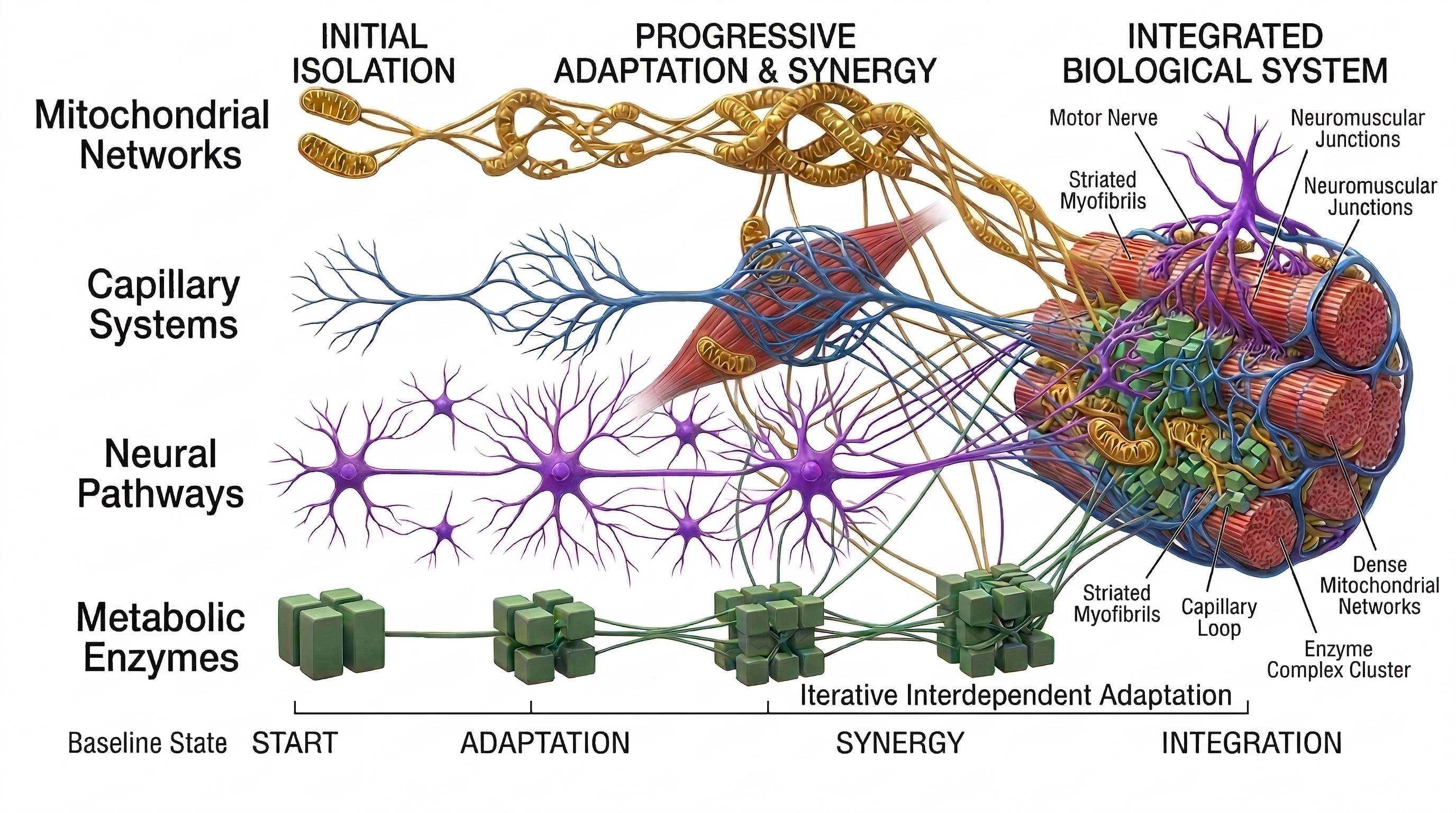
The third adaptation is metabolic, and it decides the most over long durations while sitting furthest outside anything a maximal protocol can observe. Months of consistent aerobic work make the muscle better at oxidising fat and better at clearing lactate, so at any given submaximal intensity a larger share of the demand gets met out of fat stores and a smaller share out of the finite glycogen supply. Comparisons of professional endurance athletes against less-fit individuals show precisely this pattern, with higher rates of fat oxidation and lower blood lactate at matched intensities, which is what metabolic flexibility looks like when measured (San-Millán and Brooks, 2018).
Across many hours that compounds until it is close to determinative. Nothing clever sits underneath that, only the arithmetic of the two tanks: glycogen runs out, and fat, for any practical purpose, does not.
Cover the early hours with a higher share of fat and you reach the closing stages with reserves still there. Cover them leaning harder on carbohydrate and you arrive having spent them. A maximal test, meanwhile, measures you in a state where the body is obliged to run almost entirely on carbohydrate, which is very nearly the opposite of the metabolic state a long day depends on. It’s a good test. It’s aimed elsewhere.
If you’re racing nothing at all, the same flexibility shows up as energy that holds across a long working day, and as a body that isn’t tightly hooked on being fed every two hours. Both are worth having whether or not you ever pin a number to your shirt.
What well-trained endurance athletes actually do turns out to be remarkably consistent, once you look at their logs instead of at training theory. Examined across sports, the distribution settles near eighty percent of sessions at genuinely low intensity, with the remainder concentrated in properly hard work and comparatively little time spent in the moderate band that sits between the two and feels productive while you’re in it (Seiler, 2010). The middle band is the tempting one. The distribution keeps reappearing because it maps onto how the body answers. Easy volume drives the mitochondrial, capillary and metabolic changes above without generating fatigue that has to be repaid afterwards. A small dose of hard work keeps the top end honest. The middle costs a lot of fatigue in exchange for adaptations it doesn’t specifically target, so it gets avoided by default. A controlled nine-week comparison in well-trained athletes pointed the same way, with a polarised model producing greater improvements in the key endurance variables than a threshold-centred, high-intensity or high-volume alternative (Stöggl and Sperlich, 2014).
Anyone fitting real training around a full working life has a sharper version of this problem, because the fatigue budget is shared with everything else the week wants. Read from that angle, the eighty percent principle is a way of accumulating a large amount of useful stimulus at a price the rest of your life can absorb.
Set out in that order, the result stops being a paradox. A block built on easy volume with a modest amount of hard work is not the stimulus that holds a maximal test at its peak, because keeping VO2 max at the top of its range takes regular near-maximal efforts and an endurance block deliberately keeps those scarce. So the figure drifts down across exactly the months in which the systems that carry a long effort are getting stronger. Accumulated fatigue nudges it the same way. So does ordinary day-to-day variation in the test itself.
For a couple of weeks in July I treated my 52.4 as a fault to be found and corrected, went looking for what had gone wrong in the training, and came close to putting intervals back into a plan that had no room for them. Wrong reading, wrong instrument. Had I acted on it, August would have cost me real fatigue in exchange for a number that October never asked to see.
Which brings me back to where this started. Three measurements, one person, one build, no control and no repeat, and the honest weight of that is somewhere near zero. It illustrates a mechanism the literature describes. Take the literature away and what’s left is three numbers off my own body, which would be worth nothing at all to anybody, including me.
The practical consequence lands on what gets tracked rather than on how hard anyone trains, because a maximal test reports a ceiling a long effort rarely approaches, which makes it one input among several and nothing like the headline. Four signals describe sustained capacity better.
How stable heart rate stays across a long effort.
Whether pace at a fixed heart rate improves over a training block.
How efficiently you oxidise fat at the intensity the day will actually be run at.
How well output holds up in the later hours, when it’s under pressure.
The last one is the hardest to get at, and it’s the one closest to what the day charges you for. None of the four collapse into a single tidy figure, which is why they get quietly passed over in favour of one that’s easy to publish and easy to compare. My own posture now is to treat VO2 max as a threshold check. Confirm it’s comfortably high enough. Then stop optimising it and put the attention on the adaptations the distance rewards.
By my own standard I’m the awkward case. 51.6 in October. The line I drew a few sections ago sits in the low fifties, so my own figure is on it rather than comfortably above it. The tidy move would be to shift the threshold down until I cleared it, and the accurate one is to admit that the low fifties is a rule of thumb I’ve absorbed over the years and can’t hand you a citation for, which leaves its edges soft enough that my figure is sitting on one of them. What I’d watch from here is the direction of travel, across years rather than one build.
The same preference runs through how an Atlas Cove week is built. Almost any decent week can produce a peak, so the measurements that matter are the ones taken again in month three, when the conditions have stopped being ideal. Part two picks up the other half of holding together: where mobility work earns its place, and where loading the tissue does more.
A figure that slips while your endurance improves is a bill you paid on purpose. What you bought is the capacity the distance rewards and, as far as I can currently tell, the capacity the decade rewards too.
This is an educational and strategic perspective, not personal medical advice. The views are the author’s own and not statements by Atlas Cove Lda.
Seiler, S. (2010). What is best practice for training intensity and duration distribution in endurance athletes? International Journal of Sports Physiology and Performance, 5(3), 276-291. DOI: 10.1123/ijspp.5.3.276
Stöggl, T., & Sperlich, B. (2014). Polarized training has greater impact on key endurance variables than threshold, high intensity, or high volume training. Frontiers in Physiology, 5, 33. DOI: 10.3389/fphys.2014.00033
Holloszy, J. O. (1967). Biochemical adaptations in muscle. Journal of Biological Chemistry, 242(9), 2278-2282. DOI: 10.1016/S0021-9258(18)96046-1
Nielsen, J., et al. (2017). Plasticity in mitochondrial cristae density allows metabolic capacity modulation in human skeletal muscle. Journal of Physiology, 595(9), 2839-2847. DOI: 10.1113/JP273040
San-Millán, I., & Brooks, G. A. (2018). Assessment of metabolic flexibility by means of measuring blood lactate, fat, and carbohydrate oxidation responses to exercise in professional endurance athletes and less-fit individuals. Sports Medicine, 48(2), 467-479. DOI: 10.1007/s40279-017-0751-x
Andersen, P., & Henriksson, J. (1977). Capillary supply of the quadriceps femoris muscle of man: adaptive response to exercise. Journal of Physiology, 270(3), 677-690. DOI: 10.1113/jphysiol.1977.sp011975
Maunder, E., Seiler, S., et al. (2021). The importance of ‘durability’ in the physiological profiling of endurance athletes. Sports Medicine, 51(8), 1619-1628. DOI: 10.1007/s40279-021-01459-0
Comments
Nothing yet. Say the first thing.
Sign in to join the conversation.