
Someone asked me recently, “I’ve been thinking of starting a newsletter…do you think I should?”
Those of us who have been here—in the newsletter world, not just on Substack—for a very (veryyyyy) long time always have a similar feeling when this question comes up. It usually splits off in two ways:
Run for the hills.
Just start writing.
I started making newsletters in 2005, before we even knew what the internet was or how it would eventually shape our lives, our work, our opinions/desires/habits…and YES, our writing. Maybe “writing” is too limiting a word—how we MAKE things. And while so much has changed over the 20 years I’ve been using a CMS and pressing SEND, a lot hasn’t. People still crave and bond with a lot of the same stuff: community and connections, (fact-based) information, smart (people-made) ideas that help them to see their lives and curiosities in new ways, and, perhaps most importantly, empathy. The ability to feel something real in an ever-more unfeeling soup of society. Lately, AI has its sticky little fingers in everything we read/like/create, so it’s more important than ever that we get closer to what makes US feel really alive and of use in the world—and HOW we want to express it.
And, that goes for what lands in our in-boxes, too.
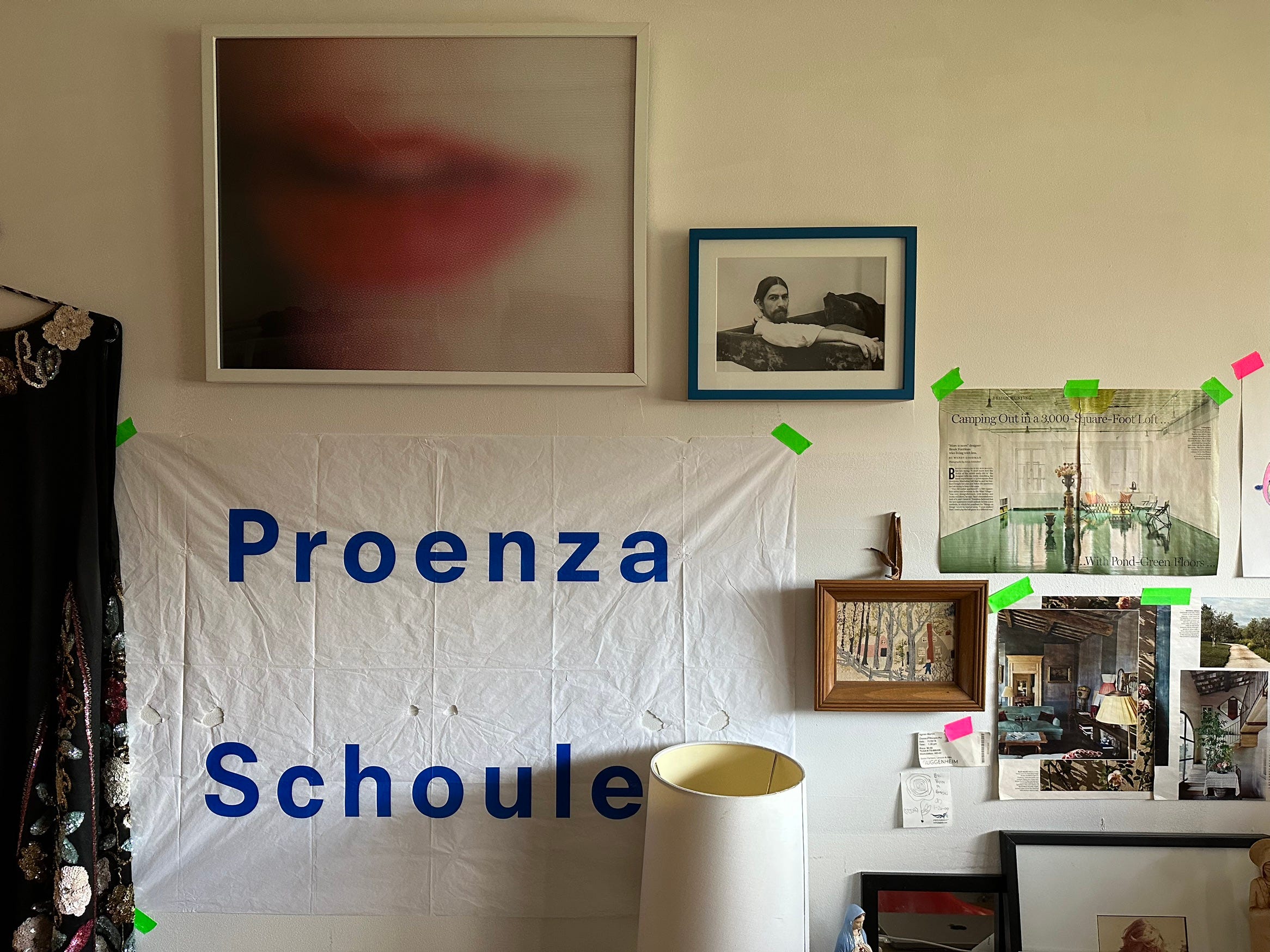
The wall above my desk upstate where I write this newsletter…often!
A newsletter can be many things: a resource, digest, diary, scrapbook, criticism, hybrid model, etc. That’s the beauty (and the curse) of “starting” a newsletter in August 2026. You can do anything you want—ANYTHING—but that doesn’t necessarily mean that anyone is going to read it (especially with how saturated the newsletter universe has become). On the one hand, it’s an incredible new age for the creator economy and a way to fund (or partially fund❤️) a life as a working writer. On the other hand, so many newsletters can make it very hard to discern what is worth paying $80/year for and what is not (at least not for you).
That point in itself is a big reason why I’ve spent the last few months collecting quotes/wisdom about this. How much of wanting and making a newsletter is for YOU, and how much is for the people you want to reach? In my two decades of making these for other people, that inflection point is where the magic and the chaos of making it happens.
“Conventionality is deadness.”
—Lady Ottoline Morrell of the Bloomsbury Group wrote in her journal in the 1920s.
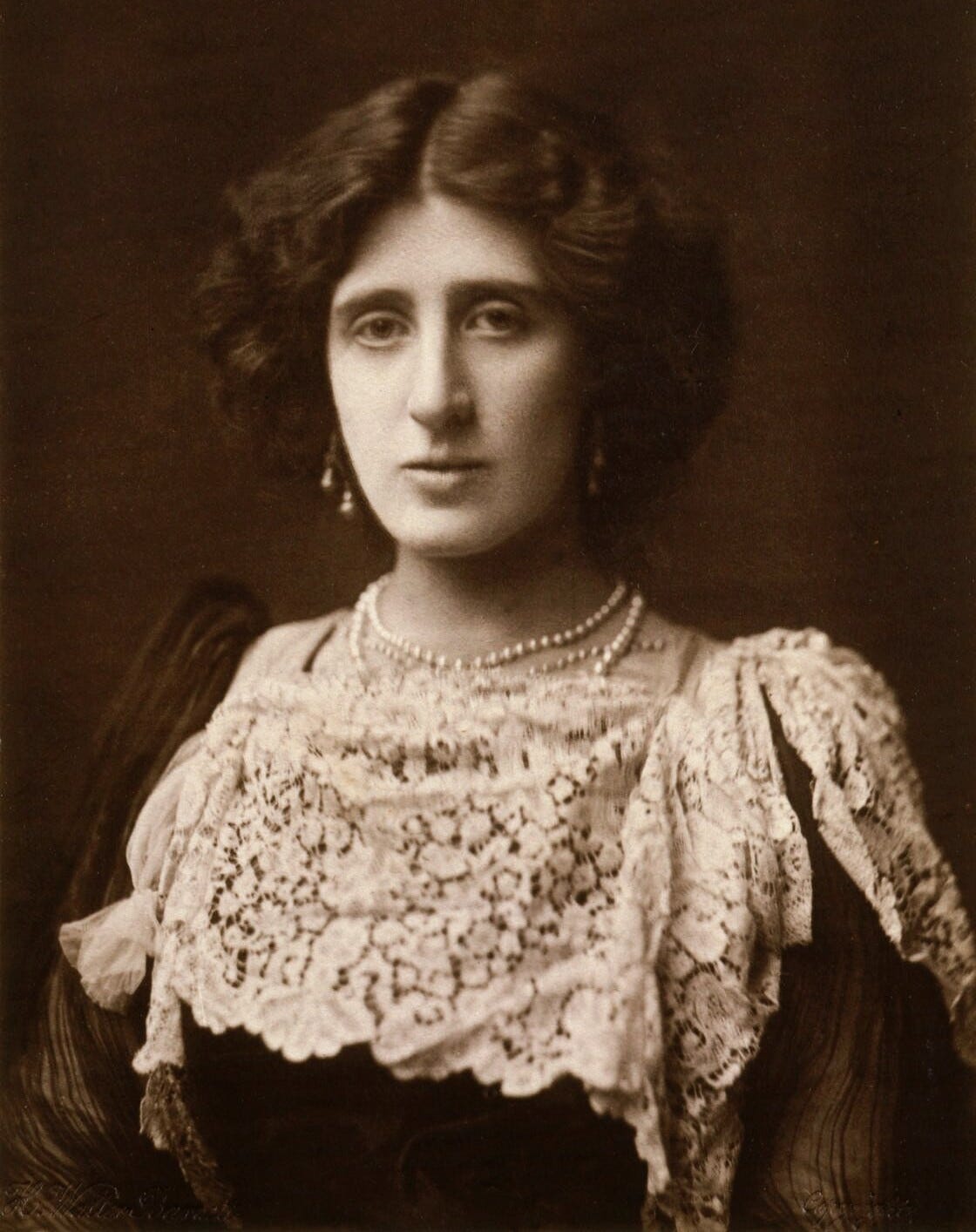
She knew.
For me, making a newsletter every week is like putting together/upgrading a room or just building some fresh seasonal outfits—I need to get everything out of the cabinets and bins to see what materials and moods I’m working with. And, for a little while, shit is a total mess. ↓
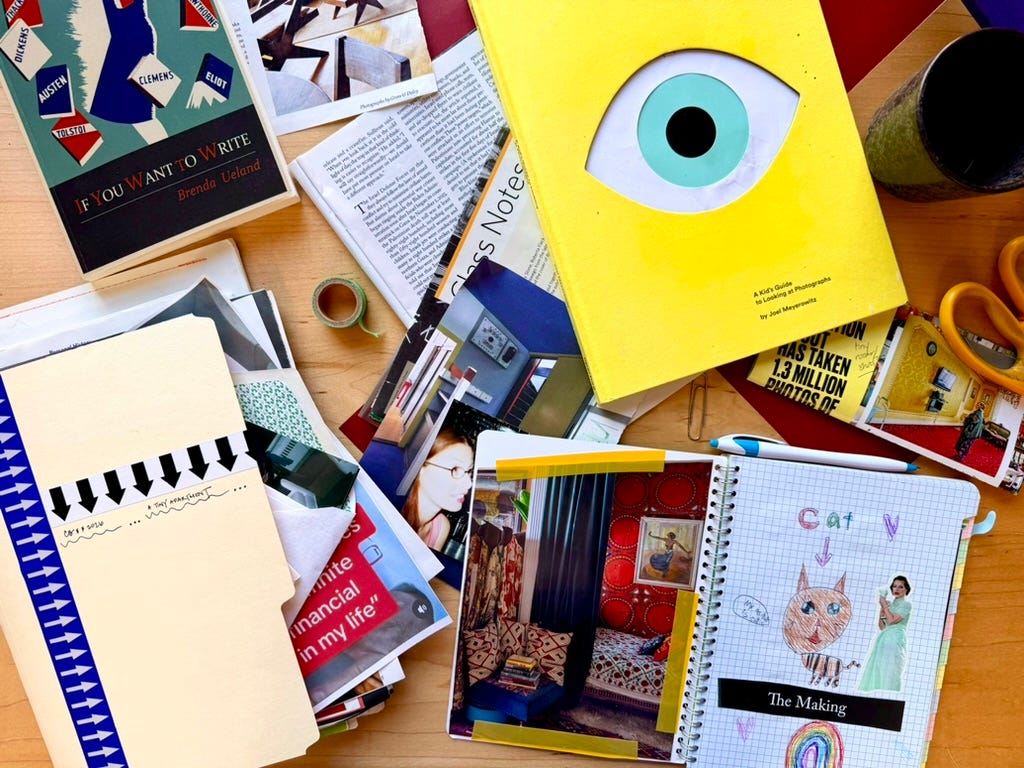
Today’s newsletter in progress. AKA: My version of creative chaos.
Sometimes I know right away the topic of a newsletter I want to make, but when I start writing, something pulls me in a new direction. I never ignore this. I trust the process and know that even if I get sidetracked from my original idea, I’m still discovering something interesting and instinctual. In the early days of Refinery29 (my former company), this process was the absolute JOY and terror of my life. Coming up with a new idea every week in 2005 when we didn’t have nearly as much data and insights as we do now. But you know, that ended up being a REALLY GOOD THING, too…the GOLD of it all. Steering the ship from what we wanted to make, not necessarily what we knew everyone would want to read.
I still listen to those impulses, an idea tugging at me to pay attention, “me me me!” But I also check in regularly with insights, to see which of my newsletters “landed” and which less so: Comments, Likes, DMs, reposts/shares, also, and this is a big one…reads/likes/shares over time. That seems to be a hallmark of A Tiny Apartment readers…saving the newsletter for a time when you know you won’t be interrupted (many of you tell me this, and I love hearing it).
Having learned this about you, I don’t freak out if a newsletter runs a bit long. I try to keep things succinct and do a good job of packaging the best stuff in the right way so you can see it and use it easily. To that point, here are just a few of the things I’ve learned over 20 years of making newsletters…GREAT ones especially.
Create your own guardrails, but keep them “loose.” By this I mean, give yourself/your readers a structure to work within because some restrictions, especially in the beginning, will A) help you focus on what you really love learning about and sharing, and B) will clearly convey what your newsletter is about to potential readers/supporters. And when I say keep them “loose,” I mean go out of bounds when the spirit moves you to. Experiment in your own creative space; just try to bring it back to the main idea or reason you wanted to start your newsletter in the first place.
Settle on a pace that works for YOU. When I made the commitment to start ATA in 2022, I had collected some advice from kindly Substack people who recommended I send a newsletter twice a week to start. When I ran this by my friend who has a wildly successful newsletter (she has since moved off the platform), she practically screamed at me, “Christene! You CANNOT do that! It will kill you creatively!” She wasn’t wrong. I know my capacity to create and make really good CB-specific stuff, and twice a week was just too rigorous a publishing schedule. In fact, ATA at its heart was and IS always about efficiency + drilling things down to their best/most loved. And 1x/week was just right for that (+ me!).
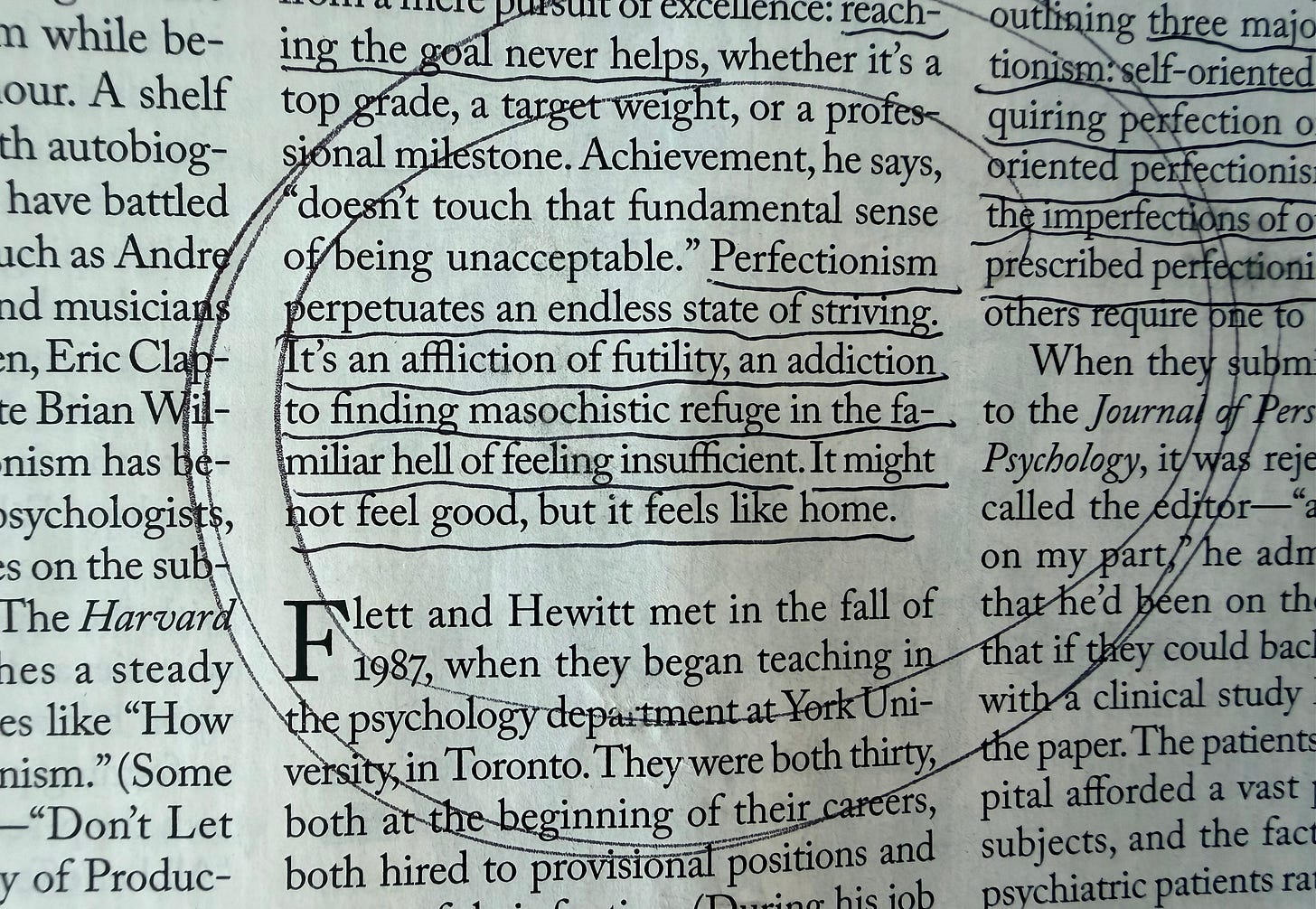
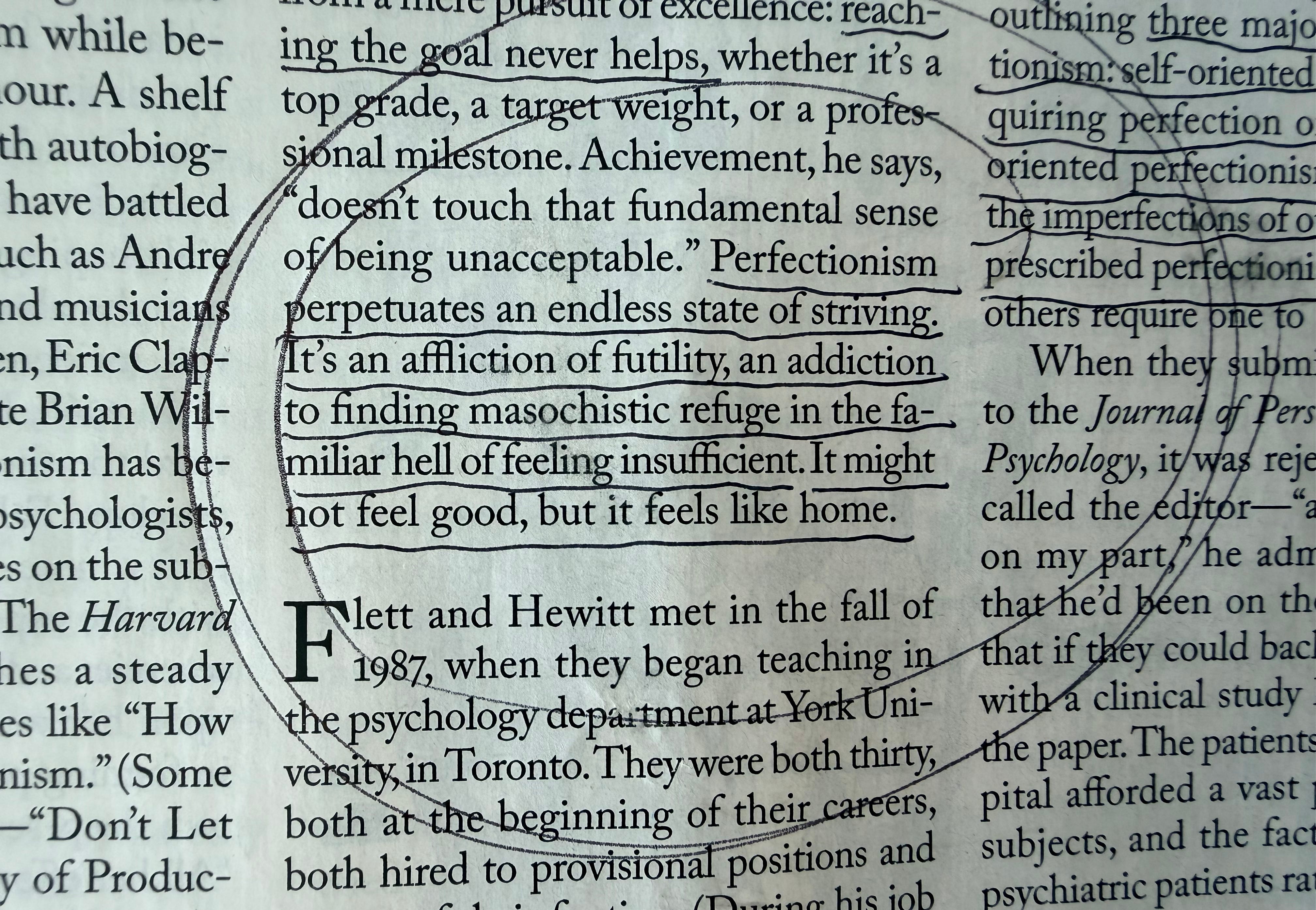
Bypass perfection. A lot of writers and creators can get really stuck on making something “perfect.” The truth is…there is no perfect. The pursuit of perfection is basically the enemy, particularly when you’re trying to make something that doesn’t feel so polished that it locks everyone else out. It’s great to check facts and smooth out your first shitty draft a few good times, but know when to let go. When to add that final period. When to save and send. Pay attention to when the making-magic is real and when it’s getting steamrolled by trying to be something that it’s not. (Below, a blurb that really got me from an article that ran in The New Yorker this time last year on the “Pain of perfectionism.”)
Make an editorial calendar. Your calendar is your body of work in motion (and mocking one is a great exercise if you’re thinking of starting a newsletter). Even if it’s just for you, a calendar is a place to capture ideas in their infancy, plan ahead for seasonal things you/your audience might need/want, and, if you have a mgr like I do, make it easier to see/know if there is potential for a collaborator or brand opportunity. Perhaps the BEST part of having an editorial calendar is paying attention to how you actually feel in your body when you look at the ideas there. Sometimes I will keep pushing a story back, and then I realize that I just feel afraid to write it or research it. Eventually I do, or I just delete it from the schedule. Noodle with your calendar the way you would your own diary/journal. It will tell you a lot about what your newsletter is becoming, especially in the early stages.
Pay attention to stats, but don’t live by them. Substack provides very basic data insights. Occasionally, I want to go deeper into how/what people are engaging with in my newsletter, but this can be dangerous territory. It’s important to want to make a newsletter that other people want, but it’s also important to make a newsletter that YOU want. The two need to go together; otherwise, it’s nearly impossible to sustain the energy, time, and commitment it takes to really get a successful newsletter in the year 2026 off the ground. One that SINGS because your heart is really IN IT.
Do other things. As much as you can. Making a weekly newsletter takes so much more time and experience than just the hours it takes writing/building it. 50% of making a newsletter is being out in the world talking to people, seeing art, walking, reading, sleeping, sitting on park benches, taking the garbage out, showing up for people you love. Most of our best ideas come when we are not making. When we are living. So live your life. Do amazing things and do boring things, too. Both kinds make a newsletter that’s truly addictive to read.
“What is weird about you is what you should be doing more of.” Claire-Louise Bennett said this, and I’m so glad she did. It reminded me why any of us should feel compelled to make something…because when we make from this true source place, it is almost always GREAT.
Okay! before we get into today’s story, which features SO much good advice from all my favorite newsletter makers/writers/teachers/readers, a few tiny bits to kick us off:
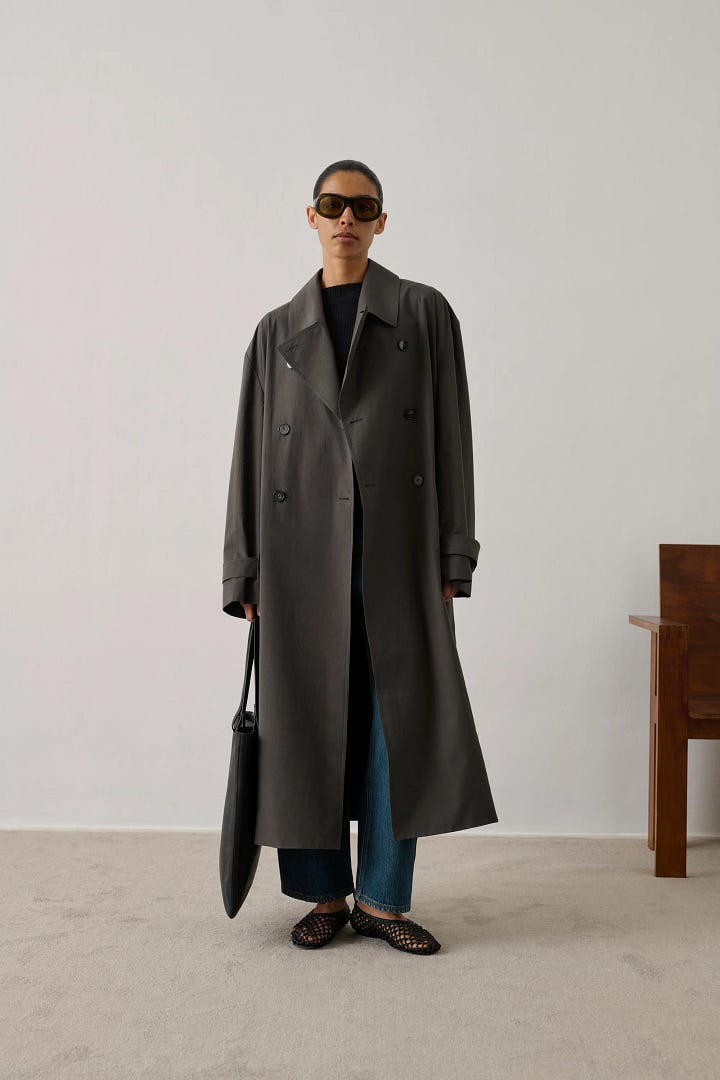

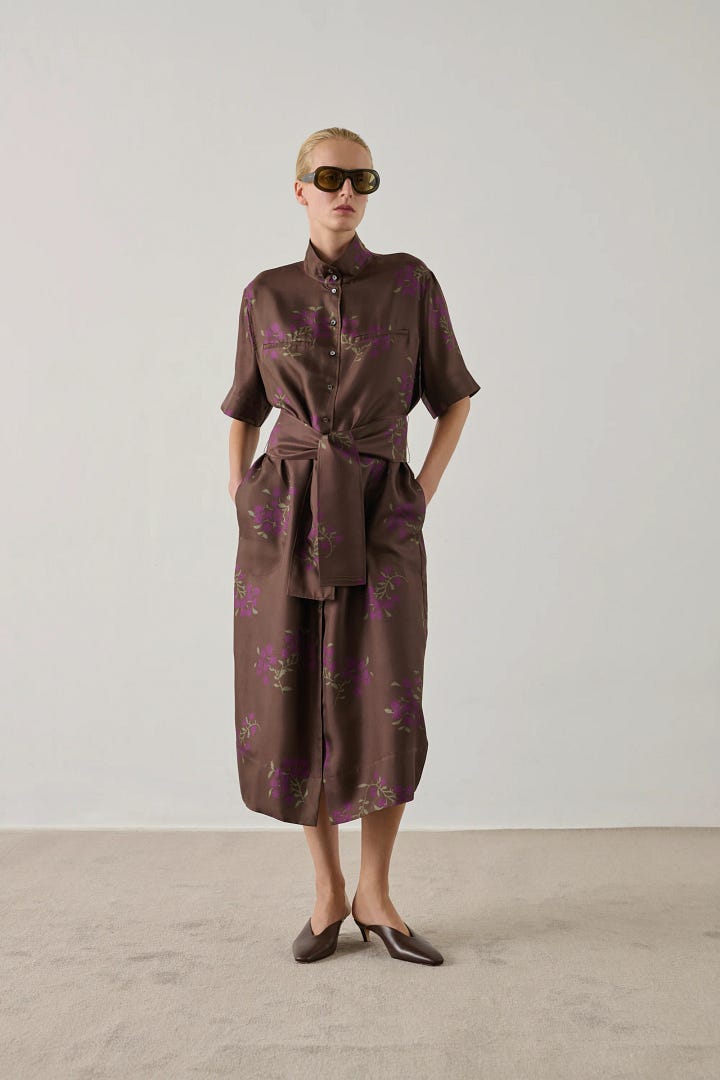
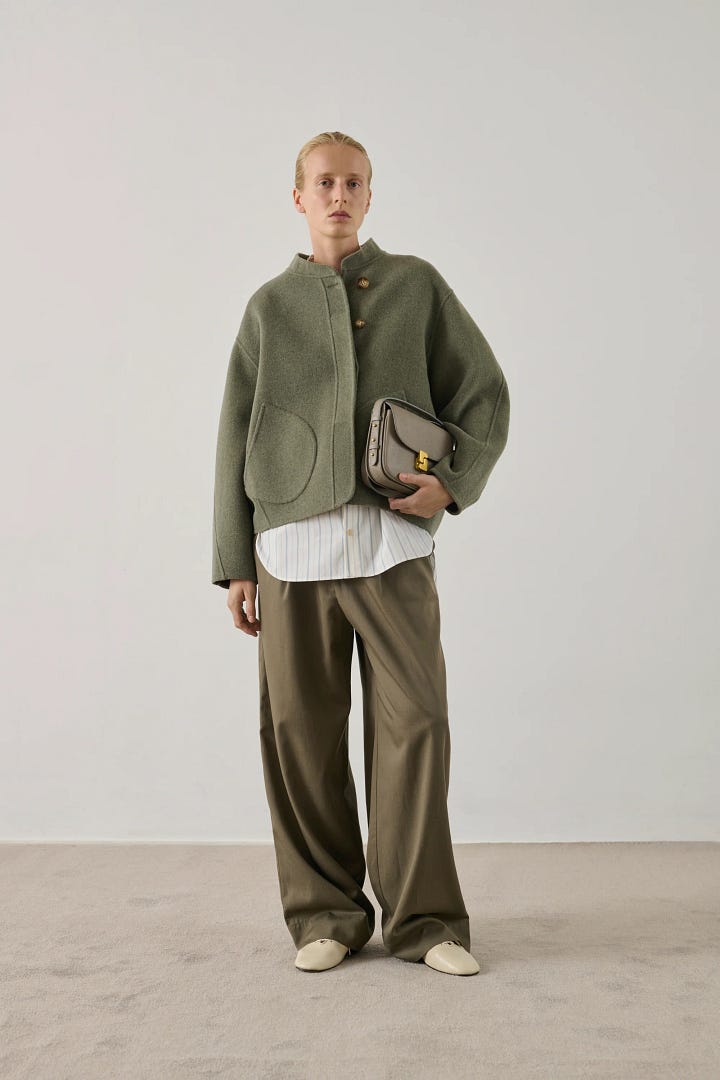
I only own one SOEUR thing, but when I saw my friend Irene (who is one of the people I asked to contribute to today’s newsletter :) of In Moda Veritas wearing these poplin pants, I knew they would be worth the $$. Of course, I couldn’t stop there and noticed they were having an end-of-summer sale, so I took a quick peruse and settled on four perfect things (I mean, I hope they’ll be perfect). My sale selects, from top left: Oversized trench, Hermosa checked blazer, loose trousers, silk shirt-dress (going to wear this over pants this fall).
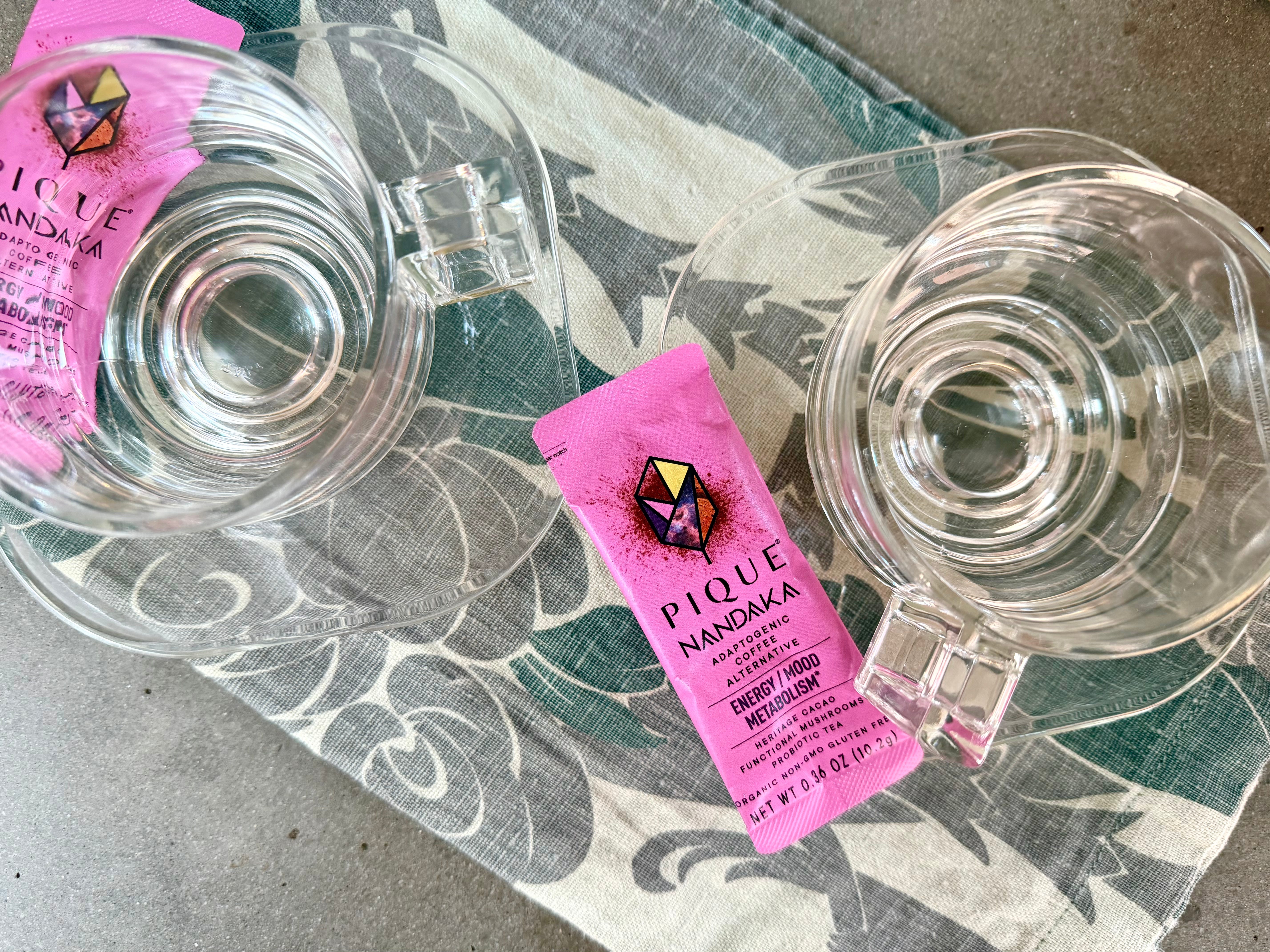
There was SO much brilliant, insightful info to pull together and organize for today’s ATA, and I will tell you my daily Nandaka routine really kept my head in the game. It’s been a month since I’ve been drinking this (w/a touch of honey:) in the afternoons in lieu of a coffee, and I can say with full confidence I am INTO it. As a devoted coffee lover (give me ALL the coffees), I’ve been completely won over by how beautifully Nandaka is crafted. Calling it a mushroom coffee doesn’t do it justice—every cup combines 100% fruiting-body mushrooms as well as ceremonial pre-Inca cacao, and wild Pu’er tea for a rich ritual that delivers smooth, steady energy without the crash. Best part: ATA readers get 20% off for life + some free gifts using my link: piquelife.com/christenenandaka. #piquepartner #nandaka
PS: The vintage Italian coffee cups I thrifted this past weekend for $5 that I wouldn’t mind using for my mini daily Nandaka break. (This vtg set of 6/$15 is LOVELY + would be great for cocktails, too.)
$5!
I recently discovered Kel’s newsletter Popular and have been devouring every edition, which has a real focus on not only prioritizing our creative pursuits but also how we build a creative practice and cultivate our own tastes (a big theme for today’s edition). Also, in a previous post she recommended Brenda Ueland’s book from 1938 If You Want To Write—a Book About Art, Independence, and Spirit, which I bought and have been making notes all over.
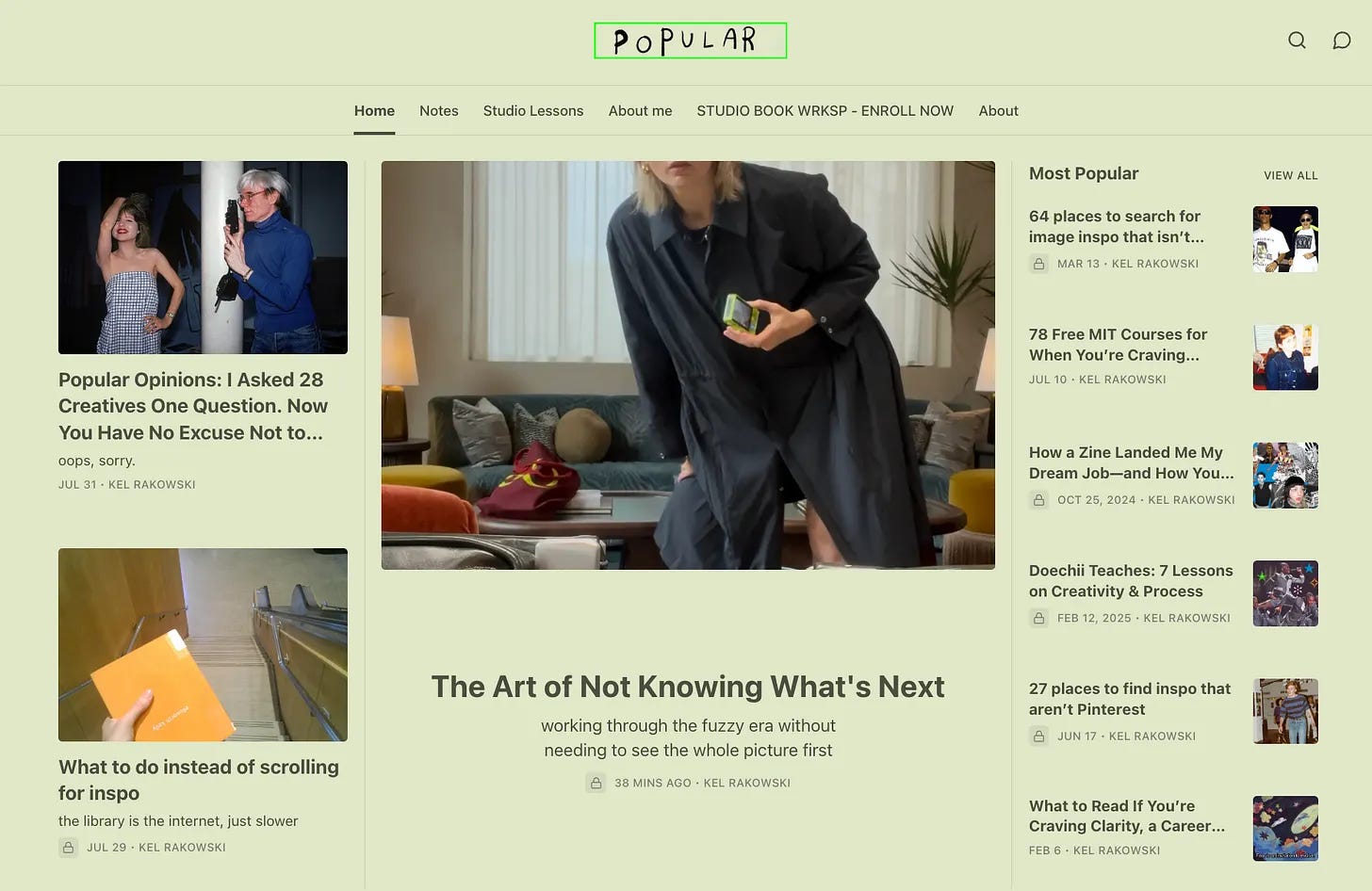
Kel’s GREAT: “What I spend real time pouring over are newsletters that teach me something new—essentially solving a problem or helping me think deeper on something I’m already noodling on. I’m into alternative education right now—the reality is we’re all mostly teaching ourselves everything online: how to interview, how to write, how to land a brand deal. That’s how you start a creative business: sharing and learning from people a year or two or ten ahead of where you are.”
What Kel reads:
Anna Mack’s Stack by Anna Mackenzie: “She writes about building a portfolio career life. I met Anna a few years ago here on Substack; we’re both former startup founders and bonded over that. She was already well on her way, establishing herself as a leader in this niche—since then she’s completely taken off, and I’m a repeat customer. I’ve worked with her 1:1, bought her OS system to help run Popular, and recommend her to my own clients and friends nearly every week.”
Nemesis by Emily Segal and Martti Kalliala: “If you’re a working creative, everything Nemesis does sits at the forefront of cultural (art, design, tech, internet) commentary—they understand trends, strategy, and taste in a way I genuinely trust (I’ve taken a few of their Strategy and Writing workshops). Emily is a force: She’s the strategist version of Chloé Sevigny.”
Comments
Nothing yet. Say the first thing.
Sign in to join the conversation.