
Long before this weekend’s extravaganza at Madison Square Garden (for anyone who’s been asleep for the last few weeks, I’m talking about Taylor and Travis), the 4th of July weekend has summoned memories of weddings. Specifically, mine. Both of which took place on the first weekend of July. Forty years apart.
I was married for the first time forty-nine years ago this week, to the man who would become the father of our three children. I was 23 years old. He was 25. We had met during my brief time at college before I dropped out, but he hadn’t been my boyfriend then. We reconnected six years later in New York City.
At the point our July wedding took place, S. and I had been together, romantically, less than six months. I could say we didn’t truly know each other—not really. More than that, I didn’t know my own self. What I knew about marriage—as a woman whose parents’ marriage had failed early and painfully—was mostly based on movies and bad TV shows.
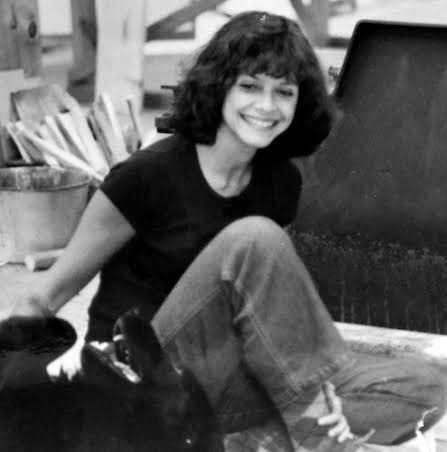
Young bride, in the late 70’s.
But we were young, and (speaking for myself, anyway) in love, not just with each other, but with the dream of love, and the everything that seemed to me at the time go along with that, including marriage…making a home together. Babies. Lots of those. I had a picture in my head of what I wanted my life to look like. Getting married to S. was meant to bring that picture to life.
Young as I was, with all the time in the world, I couldn’t wait to be a mother—an attitude utterly out of step with the thinking of most young women of my age at the time, who, in those early days of second-wave feminism, had set their sights on career, accomplishment, success. I’d known a surprising measure of those things, very young, having published my first book at age 18.
Success –or what was called success--had brought about nothing more than heartbreak and trouble. For the young woman I was at age 23, what I most yearned for—not having known this growing up—was to be part of a happy family. The only way I knew of making that happen: to give birth to one.
At the time I met up with S. again, I was working as a reporter at the New York Times. S. had recently graduated from Yale with a degree in art. These were the days when rent in Soho was sufficiently low that an artist supporting himself as a housepainter could live in a loft in Soho.
Crazy as it sounds now, the first night S. and I met up again, the two of us told each other that we wanted to have children, at which point S. asked me to marry him. Crazier still, I said yes.
A few weeks after this, the managing editor of the New York Times had called me into his office to ask me how I viewed my future at the paper. Foreign correspondent? Film critic? Did I want to cover politics?
“Actually,” I told him, “I want to have children and live in the country.” I told him I’d be leaving my job in a few weeks to move back to New Hampshire.
I might as well have announced I was becoming a nun, or a garbage collector.
Five years before this, I’d gotten a big check for that first book of mine—more money than my father would have earned in five years as an assistant professor of English at the University of New Hampshire. I’d used that money to buy a wonderful old farmhouse on fifty acres at the end of a dead-end dirt road in a very small New Hampshire town. That’s where S. and I moved after I quit my job and left New York City. That’s where our wedding took place, on the 4th of July weekend, in the summer of 1977—in the field behind our house, with daisies the two of us had picked that morning for the bouquet and food for our 100 guests prepared by my mother and me.
The wedding was held outdoors, with no tent and no backup plan if it rained, which it didn’t. My Mexican wedding dress felt a little tight over my two months pregnant belly.
At the time, many people said ours was the most beautiful wedding they’d ever attended. Even now, years later, people I know who were there sometimes tell me this. But a wedding and a marriage are two very different things.
Seven months after that day S and I recited our vows to each other, our daughter was born on our bed in that farmhouse. Already there were signs of fraying around the edges of our relationship—big money trouble, my husband’s migraine headaches as he did the rounds of New York art galleries that didn’t end up representing him, while I took on way too many assignments, writing articles for Family Circle and Woman’s Day magazine and longed to write a novel, instead. In the few articles I published in the New York Times during those years, I used my husband’s last name for my byline.
Two more babies were born on the bed in that New Hampshire farmhouse before the day S. told me he no longer wanted to be married to me. We’d been in trouble for a long time by this point. The fact that he had fallen in love with someone else—painful as this felt to me -- was more a symptom than cause.
I was thirty-five years old when I moved, with our children, from our wonderful old farmhouse. It felt too sad staying there, so S. ended up with the farm.
After that came many years—nearly a quarter century—in which I lived with my children and then, simply, alone. Love affairs came and went. Mostly went.
I was 57 years old, living in Marin County California by this point, when I met Jim online. He was a smart, funny, handsome, kind, bass-playing Eagle Scout attorney with the heart of a rock and roll man, and a brand of tenderness he would never have revealed in the courtroom. Within weeks of our meeting, he told me he loved me, but years of making my own way, and fear of counting on someone who’d end up disappearing, had left me wary of the kind of commitment I’d leapt into with so little deliberation, years before.
When Jim moved into my house, part time, I set a box in the closet for his clothes. I loved him, alright. But the part about getting married—something that mattered a lot to Jim—terrified me. When I was 18, I’d given up a full scholarship at Yale, and pretty much all of my friendships and aspirations, my dream of New York City, to move in with a man I saw as my soul mate and partner for all time. A year later he’d cast me aside in a way that left me shattered.
I hadn’t learned my lesson. When I was 23, I’d walked away from what most young journalists would have called a dream job at the foremost newspaper in the country, doing work I loved, to make a life with my husband. At the age of 58, I said I was done with giving up my personal goals for the dream of marriage. I called myself a solo operator.
Then came Jim, setting a plate of Tomales Bay oysters in front of me, under one of which he had tucked (not particularly inconspicuously) a diamond ring. A few months later, we were married on a hillside in New Hampshire, on a glorious 4th of July weekend, with all three of my grown children in attendance, along with his three, and many friends , one of whom dressed up as Uncle Sam. Jim and I performed a duet on a John Prine song that day—“In Spite of Ourselves”. Oh how we danced.
My younger son, delivering a toast to us that night, began his speech with the words, “My mom has had a lot of boyfriends…” No more of those. Jim and I would live out our days together.
The fire department prohibited us from setting off fireworks, but as it turned out, we didn’t need any. As the party went on into the night, fireworks exploded all around us from small towns below. As was true of my first wedding, people said, of this one, they’d never been part of one that moved them more.
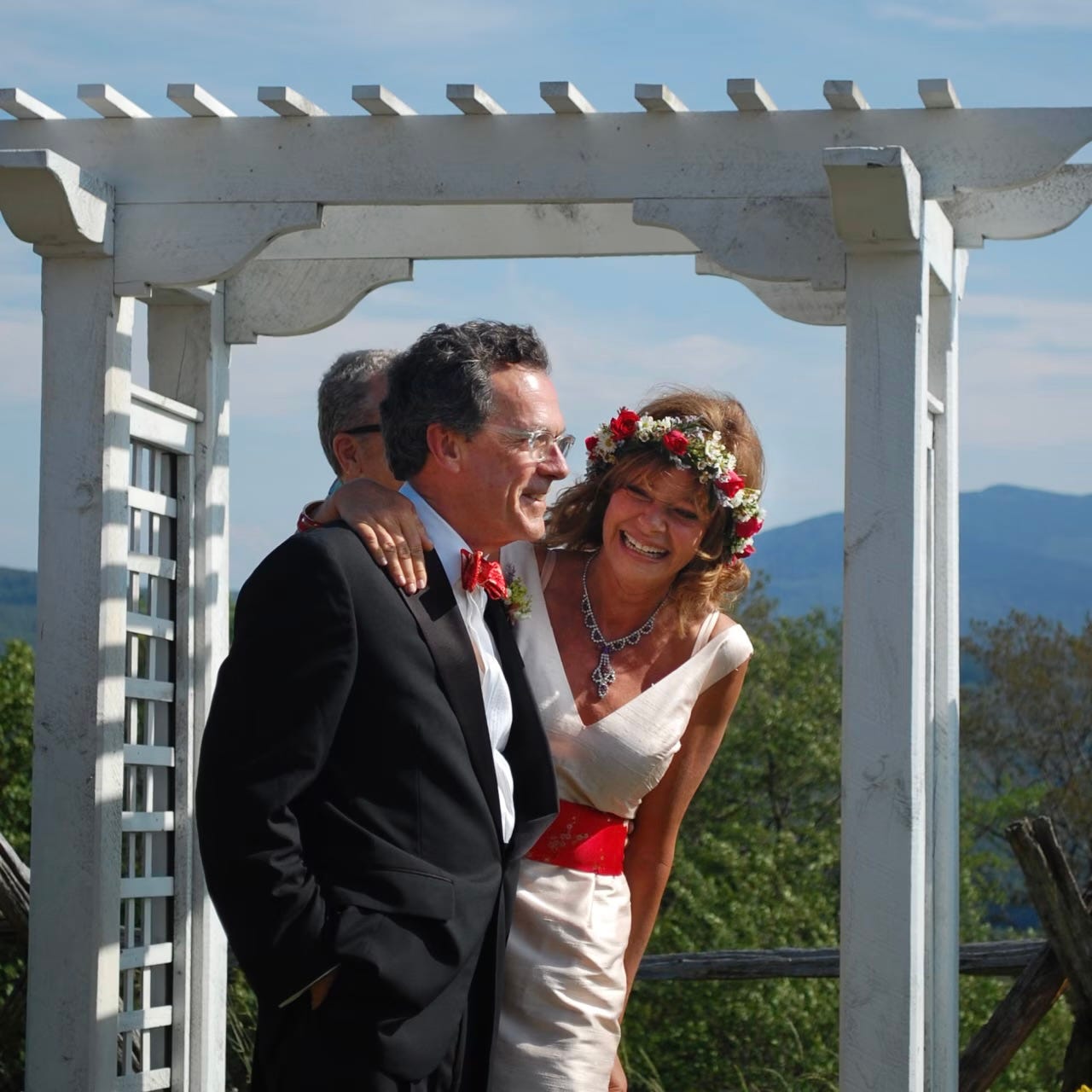
My wedding to Jim, July 2013. I was 59 years old.
Jim and I bought a house together. We planted olive trees, imagined ourselves being grandparents together—though if I’m being honest, and that’s all I mean to do these days, I will tell you that how I lived my life with Jim, over that first year of our marriage, bore little difference from how I’d lived my life in my solo-operator days. I went off by myself for long stretches to write, or teach a memoir workshop, or go on a book tour. I had a hard time identifying myself as a married woman. Relinquishing my sense of my total independence—my sense of responsibility not just for myself, but for the relationship with a man, even one I deeply loved-- did not come easily.
Just over a year after our wedding came the diagnosis, for Jim, of a cancer as devastating as just about any: pancreatic. It was only then, as I took a hard look at the virtual certainty of losing the man I loved, that I was able to speak of him, without that split second of hesitation first, as my husband.
My husband (I speak the word easily now) died ten years ago, after a valiant 19-month struggle to stay alive. Jim died beside me in the bed of that house we’d bought together. That struggle proved to be our most passionately shared endeavor, a stretch of painful but precious months that marks, for me, the true span of my good and brutal second marriage.
After Jim’s death I returned, at the age of 62, to my life as a solo operator, convinced by this point that whatever moments of love and connection I might encounter—and I did encounter those-- I would live alone for the rest of my days.

Alone again at 63. I called myself a solo operator.
A year and a half ago, having my solo breakfast on a book tour in France, within weeks of my 71st birthday—happy with my life, feeling no loneliness or longing—I opened up that old Match.com app.
I did this mostly to entertain myself, I told myself. Clicking through the profiles—one man after another, grinning out at me from the screen of my phone, standing next to his sportscar, or his boat, or a set of golf clubs, mentioning his interest in walking on the beach holding hands, naming the items on his bucket list (parachute jumping, champagne, with me, at the top of the Eiffel Tower) the prospects appeared slim, that I’d find a real partner in the over-65 set. It occurred to me that maybe what I was doing, looking at these profiles, amounted to seeking reinforcement of the position I’d stated clearly by this point, to myself and others, that my solo operator status made the best sense at this point. The only sense.
No more fields of daisies or John Prine duets for me.
Then, clicking through the profiles, one stopped me cold. The face in the picture was nice-looking, but not movie-star handsome. It was H’s smile that got me, and his eyes, and the look he had of being a man totally comfortable in his skin, and one who seemed in possession of a joyful attitude that probably had nothing to do with having avoided hard times in his sixty-some years of life.
He was a woodworker, and a builder, a man who’d worked hard all his life, with his hands, and one for whom the outdoors represented the closest thing he had to a church. He built houses for his clients, and turned wooden burls into bowls for people he loved --the very passion I’d given to a character in a book I’d written a few years earlier.
As crazy as it sounds, I think I knew, that day on my French book tour, as I sipped my coffee and set down my croissant to stare closer at the face on the screen of my phone, that I’d found my partner. Later I’d learn many more reasons to love H.—among these, his big heart, his sense of adventure, his capacity for fun, as well as his strength and his capacity to navigate difficulty, his rock solid integrity and, crucial always, his sense of humor.
I knew, looking at his photograph that first morning, that I could love this man. I think I sensed in him the capacity to love me back.
At the time H. came into my life, he was renting a simple little house in a small town in California a little more than an hour’s drive from the house I’d lived in with Jim, and, after Jim’s death, on my own. The road he lived on was even less traveled than the one I’d known back in my New Hampshire days. He’d made a woodshop for himself in the basement.
H. and I corresponded briefly while I was traveling around France—but he wasn’t really the letter-writing type. Still I realized, early on, how much I looked forward to hearing from him and writing back. We made a date to go on a hike at a place I love, near where he lived, Point Reyes National Seashore, three days after my return from my book tour.
Two days later came the second election of Donald Trump, as well as my 71st birthday. The day after that, I was scheduled to fly to Guatemala to spend a week with a group of friends at the little hotel I run there. I’d hoped this would be a celebration of the election. It wasn’t.
When I got to Guatemala, a single thought overtook me. “I wish H. was coming here.” So I called him up. He was in the middle of building a house, and needed a little time to see if he could arrange to get away. He called me up that night to say he’d bought his plane ticket.
We’ve been together ever since. Oh, not always together, exactly. A few weeks after we met, H. left for a month of hiking with his younger daughter in Patagonia—a trip he’d been planning for years. I had projects of my own to take care of. When two people get together at the ages of 71 and 67, this is not so surprising or worrisome. I knew we’d be together in the way that matters, and we are.
Last year we took a month to drive across the United States together, avoiding big highways and camping much of the way. For those four weeks, I didn’t open my laptop even one time. An unprecedented event, for me.
Once again, this summer, H. and I find ourselves in different places, 3000 miles apart. I’m in New Hampshire for much of the summer. He’s in California.
But there’s a good reason for this. We decided we didn’t want to keep driving that hour-and-a-half between his house on one side of the San Francisco bay and mine on the other. And as much as I loved the place where I lived, it was a home I’d made with Jim. To begin a new chapter I had to turn the page.
I found a piece of property on his side—27 acres in that same wild, undeveloped area where he’s been renting his place for fifteen years. The reason we could afford this place—the last property very high on a steep hill, with no neighbors in sight, and mountains and hillsides as far as the eye can see, along with a few cows, and hawks soaring and mountain lions roming –is because the place is not easily accessible, and hasn’t been lived in for ten years and needed a lot of work.
But the man I love happens to be a man who knows how to fix or build just about anything.
At a time in life when a lot of people I know, my age, are down-sizing to condos, or instructing their realtor to find them a place close to a major medical facility, H. and I have made what might seem like the odd or even crazy choice to make our home together in a house on a road so steep that we needed to hire an excavator to make it passable for my little car to make it to the top. Then there’s the not-so-minor detail that before he can build us kitchen cabinets, H. needs to build himself a pretty major woodshop, and before he could build the woodshop, he needed to rent that excavator again and create a level space. That’s what he’s working on now, which is why he’s 3000 miles away.
We don’t kid ourselves that we’re going to live forever, or that our health will always be as it is now. Just the opposite. The knowledge that far less time lies ahead of us than behind us, and that the gifts we know now could disappear at any moment, informs how we choose to live right now. The losses each of us have known—and they are many—fill us with gratitude for the preciousness of our days. For as much time as we have—or as little— our plan is to live with a sense of optimism and adventure and above all, gratitude.
So while I sit here at my laptop, the man I love is making a home for us. And as much as I wish I could help him, I lack the skills of framing, laying water lines, running a bulldozer, building windows, hauling bags of concrete, hanging drywall or pouring a foundation. The best I can do is to write another book.
I started this story out by talking about weddings, so I’ll mention one thing H. and I don’t have in our plans, which is marriage. But not because of any lack of trust in each other, insufficiency of commitment or love.
We’ve both been married twice. Both of us have known dreams of a life we didn’t end up living. Both of us went into marriages, when we were younger, with unrealistic expectations of how things were going to go. This time, it could be said, we know a lot more about ourselves and each other, and the acceptance of how little we can know about the future. Only that we want to experience it together.
We don’t need a wedding ceremony or a pair of rings to seal the deal this time. Just each other.
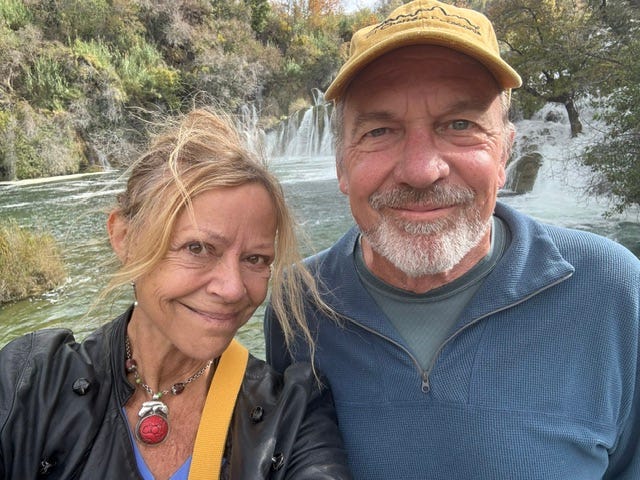
Age 72. Camping somewhere in Idaho. Plenty of love. No need to get married.
@ Home in the World is a reader-supported publication. To receive new posts and support my work, consider becoming a free or paid subscriber. And I hope you’ll check out my new novel, In Wonderland, coming out July 14 and available for preorder now. https://shorturl.at/Fsur5
Comments
Nothing yet. Say the first thing.
Sign in to join the conversation.