
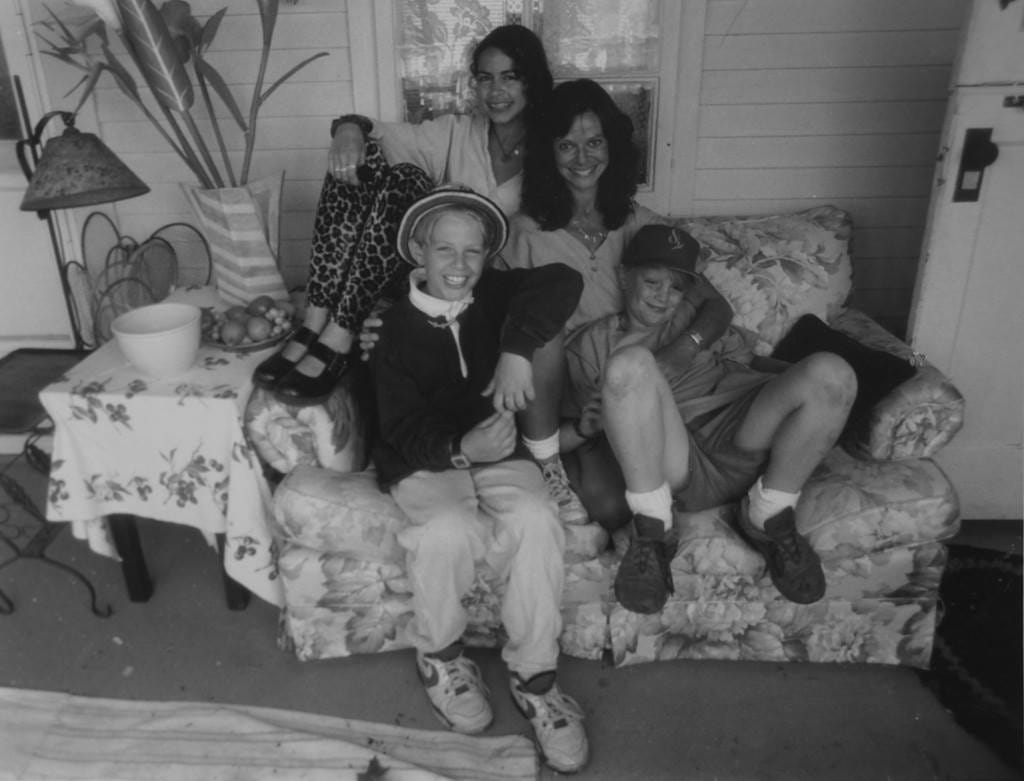
My three children and me, at our home in Keene, NH, circa 1994.
Long ago, when I was raising my three children in the little New Hampshire farmhouse I shared with their father, I was obsessed with sparing my daughter and my sons from the experience of loss or pain. I was working, then, as now, as a writer; he was an artist. We had very little money, so I would never have supposed that I could take my children to Europe, much as I would have loved it. Then one day I saw an ad for a weekend in London for $100.00, including airfare.
“That we can afford,” I said, and I bought three tickets for my children and one for me and we headed out over the ocean, and off we went to discover the city of London in exactly 72 hours.
I told them I’d stake each of them to one special treat. In U.S. dollars, what I gave them amounted to about $10 apiece. At the time, this was a very big deal.
My son Charlie chose a set of brightly colored leather juggling balls. A few minutes later, we descended into the London Tube, where Charlie –-over the moon with happiness over his purchase -- began to toss those wonderful leather balls into the air.
Knowing so well all the dangers that could happen, and endlessly vigilant in my role as Protector Against Sorrow, I called out to my son, “No, Charlie, don’t juggle in the Tube,” but it was too late. One of the balls—I still remember it was purple— fell into the pit. A look of devastation came over my son’s face.
He could have borne the sorrow of losing one of those balls. But I could not.
Then came my moment of madness: I jumped into the subway pit to retrieve the ball. Which I managed to do, as my daughter stood on the edge of the subway platform screaming for me to climb out—with the sound of a distant train approaching the station.
Had I not made it out, I wouldn’t be telling this story now. But the message was clear. My obsession with sparing my children the experience of loss might have killed me.
My marriage was in trouble at this point, for reasons that went well beyond the my fixation with shielding our children from sorrow. Oh, maybe it was my own deep-seated anxiety over my marriage at this stage that led, in part, to the obsessiveness I displayed, protecting our children, or trying to. I wanted everything to be perfect for them. Everything within my control. Good luck with that one.
That Christmas I spent the better part of a day preparing an elaborate Buche de Noel cake, a sheet-pan log filled with whipped cream and covered with buttercream frosting meant to look like tree bark, with hand-formed marzipan mushrooms created out of hand-made marzipan.
Did anybody in our family need marzipan mushrooms that day? My children were all in single-digit ages. My husband favored Oreo cookies. But he liked watching football on television, and that day, as he lay on the couch watching three games in a row, maddeningly oblivious to the wrapping paper and pine needles surrounding him as he lay on the couch, with a turkey in the oven in need of basting, and my daughter distraught over a lost piece to a new Christmas game, and our five-year-old wielding a pair of scissors, suggesting he needed a haircut.
Something took hold of me then. I stomped into the kitchen, picked that Buche de Noel up off the counter and stuffed it into the trash.

0:00
-12:37
Merry Christmas, I said. So much for protecting one’s children.
The following Mother’s Day -- I was 35 years old -- I got a call that my mother had been diagnosed with an inoperable brain tumor. The next day I flew to the city where she lived, to be with her for what proved to be the last weeks of her life.
Before I left home, I sat the children down and I explained to them what had happened, and my youngest son said, “Is Grandma going to die?” and I said, “Yes.” Then he asked the next question, which was an even harder one: “And will you ever die?”
Once again, I had to say, “Yes.” Then came the third question: “And will I ever die?” And I had to say, “Well, not for a very long time.”
There is no protecting one’s children from certain painful truths.
In fact, my mother’s was not the only death that year. My marriage also ended—a death that had been a long time in coming. And after my husband told me he was done with our marriage, I found that although my grief was extreme, it paled beside the extraordinary sorrow I felt over having to deliver this news to our children.
Their father and I brought them into the living room and sat them down. I can still see them very clearly as they were that night, at the ages of 5, 7, and 11--Willy, Charlie, and Audrey, sitting on the couch together, looking as if they expected news of another great adventure coming up.
We told them instead that we were not going to live together as a family anymore. “We’ll always love you,” we said. “We’ll always care about each other.” I might as well have said “Blah, blah, blah.” That’s how much meaning my words held for our children once they’d heard the word “divorce”. They were beyond listening. What they were suffering then was a brand of grief for which I could offer no protection. Not only had I failed to spare them pain. Their father and I had actually caused it.
Each of our children responded in their very different ways to the news we delivered that night. Audrey, the oldest, who had learned by now that I felt her pain on my own nerve endings and no doubt wanted to spare me that, chose not to betray any visible sign of sadness. She formed her mouth into a stiff little smile and said, “I think I’ll go watch Cosby now.” Back in those days, so different from these, that show seemed to exemplify the definition of happy family life.
Willy, the youngest, who never spared anybody anything -- he was 5 -- stood up and let out an animal moan--a sound I had never heard come out of him before or since, thank God . He flung himself against the wall with the force of a grown man, and wailed, “You mean you’ll be divorced for my whole life?” Then he collapsed on the floor, moaning.
Charlie, who was 7, got up silently and went into the kitchen, where the table sat—strewn, as it always was, with art supplies. Very slowly, my son took out the colored pencils . He began to draw.
It was only later, after I’d put the children to bed (no tears, just silence) that I saw what it was the older of our sons had drawn on that single sheet of paper still lying on our kitchen table.
It was a picture of a heart. But not a neat, symmetrical heart, like the kind you’d see in a Valentine card. This heart Charlie had made was irregular, as if he’d labored painstakingly over every centimeter of the lines, and drawn them in blood. After he drew the heart he’d shaded it with little cross-hatched lines, as if this heart were a painting and it was hanging on a wall. In fact, he’d made a line like a piece of picture wire, and a dot, like a nail hammered into the wall, from which the wire was suspended, so the heart resembled an art work hanging there, alongside all the other paintings in the house.
Below this, my son had written a single sentence. The message did not escape me that he had written this for his writer-mother and his artist-father, the two people he loved best in the world, who had told him that night they weren’t going to be married to each other any more.
“Love is the best art of all,” my son had written. He was only in second grade at the time, but even if he’d had more command of spelling, what more was there to say?
I think that was the moment that I recognized the foolishness of ever supposing that I could protect my children from pain, and the folly of all the ways that I had attempted to do so.
For many years after the divorce from my children’s father, our children traveled back and forth between our two houses, with their belongings always in brown paper bags. No doubt we owned suitcases, but the children never seemed to get it together to use them.
They lived through leaving our farmhouse, lived through the interview of the guardian ad litem, asking them which parent they wanted to live with. They lived through breakups and endings of friendships, a case of vocal nodules that nearly robbed my daughter of her voice for close to a year, and a case of malaria on a trip to Africa—a car accident that killed one best friend, a murder that killed another.
My three children are all in their forties now. No doubt they’ve lived through sorrows and struggles I don’t even know about, because I no longer know everything about their lives. Two out of three are parents of young children themselves. I watch them with their own children now, doing the same thing I did when I was a young parent: Trying to spare their children the experience of loss as I tried, fruitlessly, to spare mine.
Here’s what I know now. Although I failed abysmally at protecting my children from pain, I am in fact related by blood to three reasonably happy and well-adjusted human beings. (“Reasonably”. What more can any of us expect?) And what I believe these days—though every parent has to learn this lesson for herself-- is that even if we could protect our children from all of life’s sorrows, it wouldn’t be a great idea. How else but by experiencing pain and loss can a person learn how to survive it? How else can a person locate compassion for the sorrows of others?
Climbing into the subway pit that long ago day to retrieve a lost juggling ball was not just unwise, of course. It was dangerous. Crazy, even. What I have finally realized—and you can call this “locking the barn door after the horses get out”; you won’t be wrong about that—is that real task before a parent is to raise her children so that they will be strong enough that when real hardships and heartbreaks come along—as they invariably will—they possess the strength and resilience to deal with them. You can convey to your child the message that losing a prized leather juggling ball is a tragedy. Or you can teach him that even if he loses that juggling ball—and suffers far greater losses—he will survive.
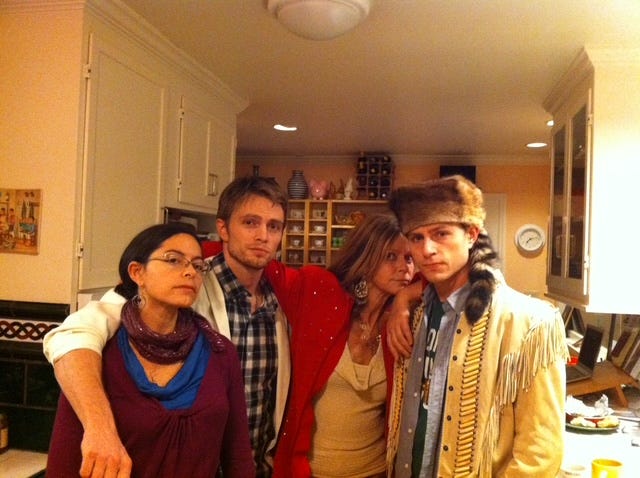
My three children and me, 2011. All still standing.
No posts
Comments
Nothing yet. Say the first thing.
Sign in to join the conversation.