
At Casa Paloma, with some of the art work I commissioned from a local painter whose work I love, Diego Isaias Hernandez. A section of the painting hanging on the wall behind me was used as the cover art for my novel, The Bird Hotel.
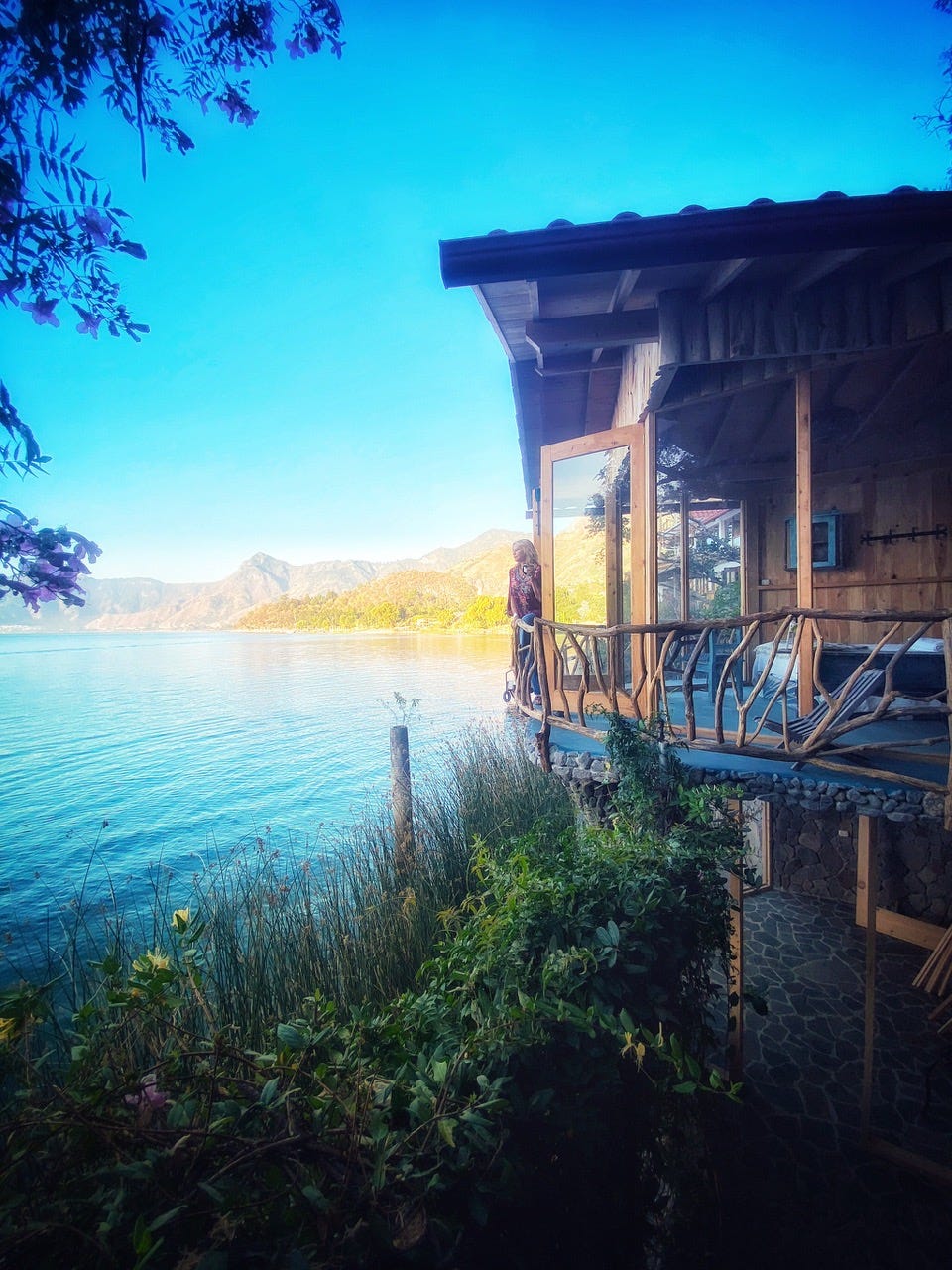
At Casa Paloma…in one of the little casitas we built during the pandemic
It’s close to midnight, two weeks into a precious writing residency in New Hampshire. I came here to be free from distraction with the hope of finishing a new novel.
My telephone rings.
From a few thousand miles away comes the voice of a woman I’ve never met, a guest at the hotel I run in a small Mayan indigenous village on the shores of Lake Atitlan, Guatemala:
“A bird flew into my room,” she says. “Could someone take care of this?”
With my property manager out sick, I’ve been more occupied than usual with overseeing my hotel, which now includes two houses, five smaller casitas, two docks, a fleet of kayaks, a sauna, a yoga platform, a waterfall, a pizza oven (and private chef), a waterfront bamboo massage hut and a wooden fishing boat, suspended from posts, filled with cushions and repurposed as a place for a person to watch the sun go down.
.
For my entire adult life, I’ve been known as a writer. Outside of raising my children, publishing books has been my chief endeavor for over fifty years now. But now—even as I labor over a new manuscript—I find myself with another unlikely identity: I’m also an innkeeper.
Earlier today, I spent an hour on the phone with a plumber discussing –in my imperfect Spanish--the installation of a new Jacuzzi and talking with a local seamstress about making floor cushions out of some antique textiles I’d picked up at the market on my last trip to the lake, reassuring a woman who’d seen a spider outside her room that it wasn’t the poisonous variety, discussing with Miguel, my head gardener, the repositioning of a particular fig tree. The day before, I had arranged for a guide to take two guests on a hike to the cloud forest in search of a rare quetzal (they found one), and the day before that, I oversaw preparations for a romantic dinner on the yoga platform—with rose petals scattered around the table-- for a honeymoon couple from Germany.
This wasn’t my plan. Twenty-six years ago, when I bought a little adobe house on a piece of undeveloped land on the shore of a very beautiful lake in Guatemala, overlooking a volcano (an inexpensive purchase in those days), I envisioned the place as a retreat to go when I needed to be by myself to work on a book. How I got from that point in my life to this one takes some explaining.
My history in Central America began 60 years ago, at age 11, when my mother took my sister and me on a six-week sojourn on buses and a train from the Texas border to San Cristóbal de las Casas, in Mexico. My experience of indigenous culture that summer opened up my world.
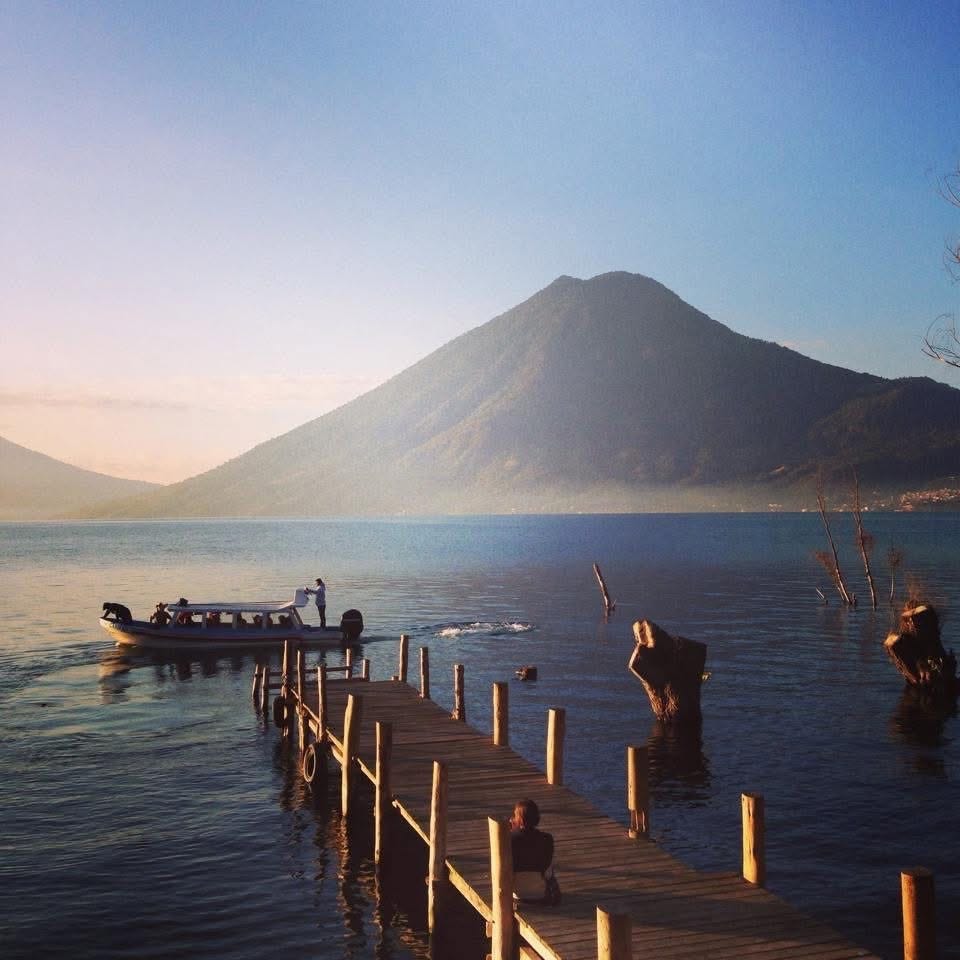
A dock at Lake Atitlan…and the lancha boat that brings a person there. Behind it, Volcan San Pedro.
A decade later, I was invited to join an orchid hunt in the highlands of Guatemala. Never mind that it was rainy season and a civil war was going on. I fell in love with the country — most particularly, the 50 square miles of turquoise Lake Atitlán, and the people who made their homes there, who still dressed in traditional Guatemalan clothing made from hand-woven cloth, cultivated maize on the hillsides and followed the Mayan calendar, based on a belief of the essential connectedness of humans to the natural world. No religion I ever encountered made more sense than this one.
I vowed then that I’d return to the lake, though years passed before I did. By then it was 2001; I was 48 years old. I’d raised three children and watched them head off for adventures of their own. I thought I was paying a ten-day visit to Lake Atitlan to spend time with my daughter, who’d been studying Spanish in Guatemala, but as had been true the first time I came there, the place grabbed hold of my heart.
I cashed in my return plane ticket and stayed. For $250 a month, I rented a little house on the shores of the lake, signed up for Spanish school, wrote a novel and experienced a greater sense of well-being than I’d known in years.
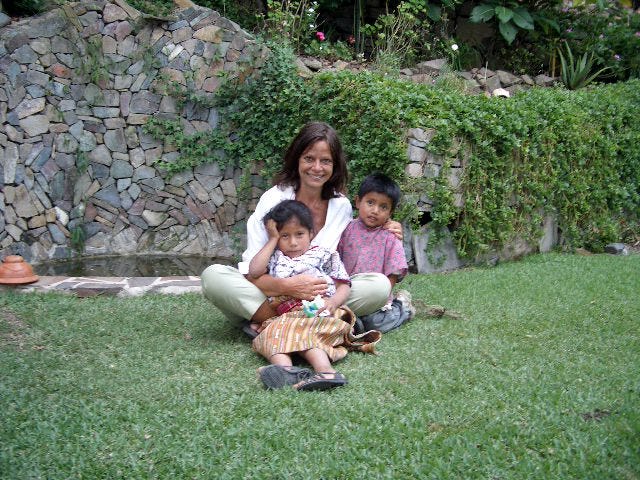
I was 48 years old when this picture was taken, not long after I returned to Lake Atitlan, after a 28-year absence. One of the children photographed here —now grown, with a child of her own—sometimes works for us at Casa Paloma.
I lived alone that year. I had no phone. There was no internet at the time, so every few weeks I took a boat across the lake to look (reluctantly) at my email. At the end of my writing day, I brought my shopping basket to the market to buy vegetables for that night’s dinner. Every morning, I swam a half mile in the lake.
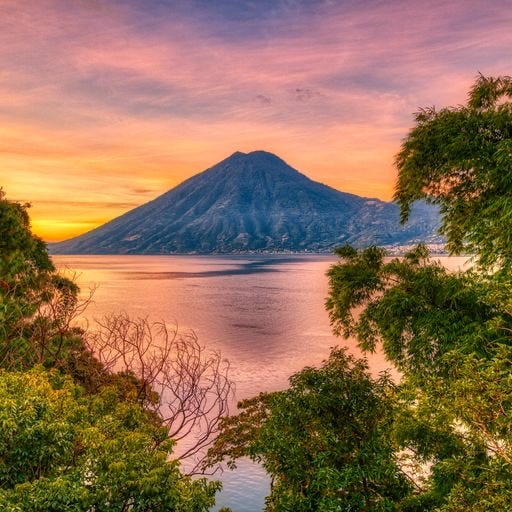
It was on one of my swims that I spotted a sign on the shore: Se Vende. For Sale. The land was wild and steep, covered in brush ;the house was small and rudimentary, but all I needed. A dozen species of birds I’d never seen perched in the trees. Across the water stood one of the five inactive volcanoes that encircle the lake.
These were days when, back in the U.S., a person of limited means could still borrow against her home, which was how I came up with the $85,000 to buy roughly three acres of land on the shores of one of the most beautiful lakes on the planet.
I named the place Casa Paloma. A few times a year, I traveled there to write and swim. It was my private little oasis.
With the help of two young men from the village I hired to work for me, Miguel and Mateo, and an old hippie landscape gardener from Canada, I oversaw construction of a garden, with retaining walls and stone paths winding up the steep hillside. Over the years, the fruit trees we planted matured and roses bloomed — also orchids, Thumbergia vines, figs, lemon trees, avocados, bananas. We built a little writing cabin at the top of the hill, where birds sang outside my open window as I worked.
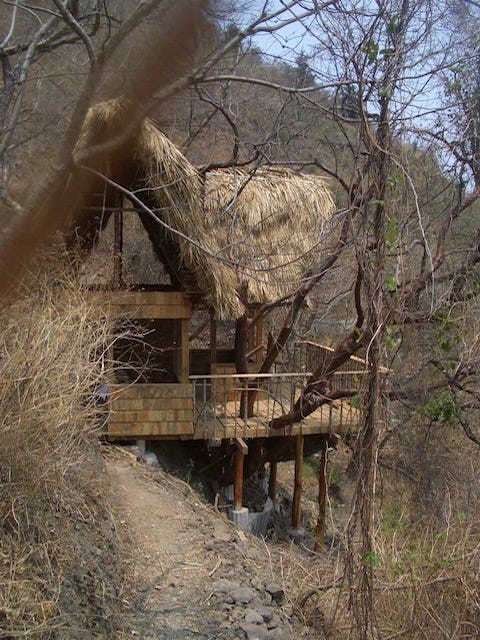
The little Swiss-Family-Robinson-inspired treehouse where I used to write.
I finished half a dozen novels there. Every afternoon, I carried a bowl of popcorn down to my dock for the children who came to swim there, and every morning, I greeted the fisherman who showed up in the little bay in front of my house without fail to harvest crabs just as the sun came up behind the volcano.
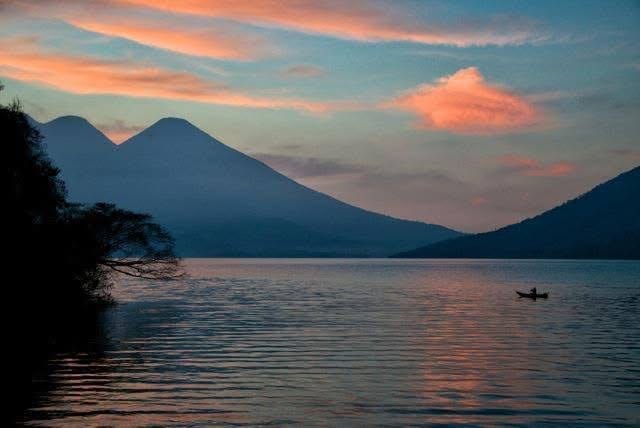
Early morning at the lake. For 25 years, one fisherman, Marcos, has been greeting me at around 6 o’clock every morning, just before I take my first swim.
Having recognized early on that this was a place offering inspiration and peace, I started a writing workshop, hosting a small group of women for a weeklong retreat every winter. For $35 a night, they stayed at a simple hotel in the village but gathered at Casa Paloma every day to work with me on their manuscripts.
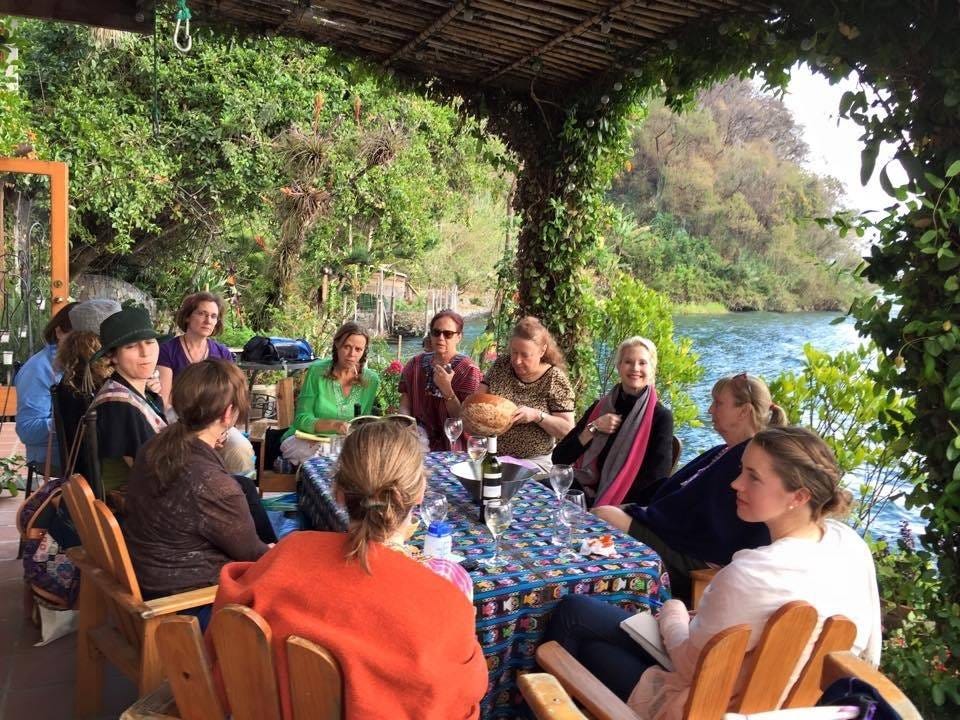
An early memoir retreat. I carry the stories of many women with me and have learned from them all.
Much changed over those years. A hurricane hit, causing a landslide. A giant boulder rolled down from the top of the mountain, crushing everything in its path. Travelers arrived in greater numbers, along with storefronts advertising healers, yoga teachers and gringo cacao ceremonies. I added on to my house, planted more flowers, built a temazcal — a Mayan sauna — and a little treehouse modeled on the one I knew from Disneyland, where I set up my writing desk. I hired a wonderful chef to cook for the guests at my retreat, some of whom returned multiple times to work with me, and eventually published books.
Back in California, I fell in love with my second husband, Jim, and introduced him to the lake. The fact that we were in our late 50s didn’t stop us from climbing the volcano together. We had some of our happiest times sitting on the dock together with a glass of wine.
The year after we married, Jim was diagnosed with pancreatic cancer. The two of us traveled to the lake together again for what turned out to be his last winter. After Jim died, I returned to Lake Atitlan alone. Many times over the years, I’d found solace in those waters. Now I did so again. From the first time I dove into that lake, as a girl, I’d experienced a kind of magic, swimming there, and a sense of well-being. Here comes a word I try not to throw around lightly but it applies. For many decades now, Lake Atitlan has served, for me—and for many others who join me there—as a place of profound healing.
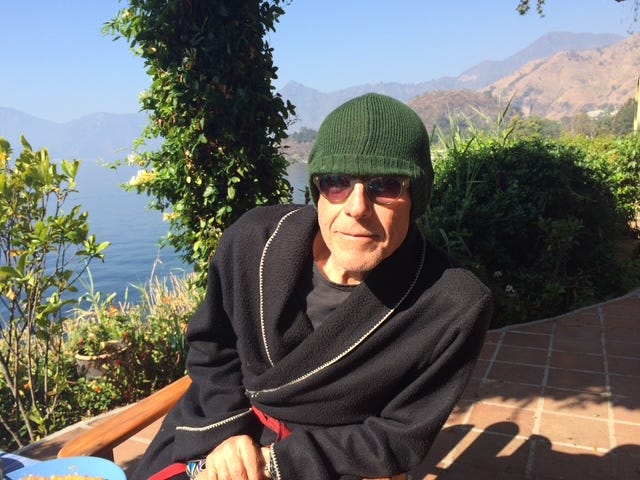
Jim at Casa Paloma, four months before he died.
Years passed. I continued to host my writing retreats. I had scheduled my annual retreat for March 2020, the month the pandemic struck the United States. As always, I’d booked a dozen rooms for my writing students in a small village hotel. Though coronavirus had not been reported in Guatemala, I was uncertain whether anyone would show up, but sixteen women traveled there to work with me.
Two days later, the president of Guatemala announced that the airport was closing, and eight of the women in the workshop flew home. Eight stayed on — and because our chef had to leave, we made do with meals of rice and beans and guacamole as we dove deep into their stories.
As I had anticipated, the State Department provided a plane to take U.S. citizens home. But I decided to remain, and invited the two youngest women from the workshop to stay with me for what I supposed would be a few weeks.
In the end, the three of us remained at the lake for six months—having realized that Casa Paloma was probably the best place to be during a global pandemic. People in the village appeared blessedly free of Covid. But another issue plagued that little Mayan community: With all tourists gone, people in the village had no way of supporting their families.
Some of the expats in town took up a collection to help. I had lived in this place long enough to know what the community needed more: jobs. So I hired a crew of twenty men to undertake building projects on my land. Starting with the construction of a little guest house.
By this point, the two young women I’d invited to stay on with me had become like family to me. I called them “the girls”. The three of us were busy with projects of our own—in my case, work on a novel. At seven o’clock every morning, just at the hour I was climbing the steps to the treehouse to write, the men I’d hired to work for me would be making their way down with their picks and shovels, bags of cement or stones on their backs, along with locally sourced materials: coffee wood for the railings of the balcony, avocado wood for a desk, bamboo and stones from my land… We met each other on the steps.
With the whole world gone silent—except for the birds, and the sound of the men and their picks and shovels—I worked hard all day on my novel, taking a break now and then to dive into the lake. Sometimes a harpoon fisherman stopped by with a fish he’d caught 10 minutes before. That would be dinner, cooked together with the girls and eaten by candlelight. After dinner, I read out loud to them from the chapter I’d written that day.
In the months that followed, I kept working on my book, and coming up with building projects. We bult four more casitas, each one different. One featured stone walls with hand-carved stone heads built into them. In one we built walls using the old methods of adobe construction and a roof made of palm from the Guatemalan coast. I commissioned a local artist to make a giant painting of a volcanic eruption to hang over the bed in of one of the houses, and from a weaver in the village, fabric for bedspreads. One day a local craftsman showed up with a chair on his back, carved out of a single massive avocado tree. This chair must have weighed three hundred pounds, and he’d carried it on his back the mile or so from his home in the hopes that I’d buy it. I did.
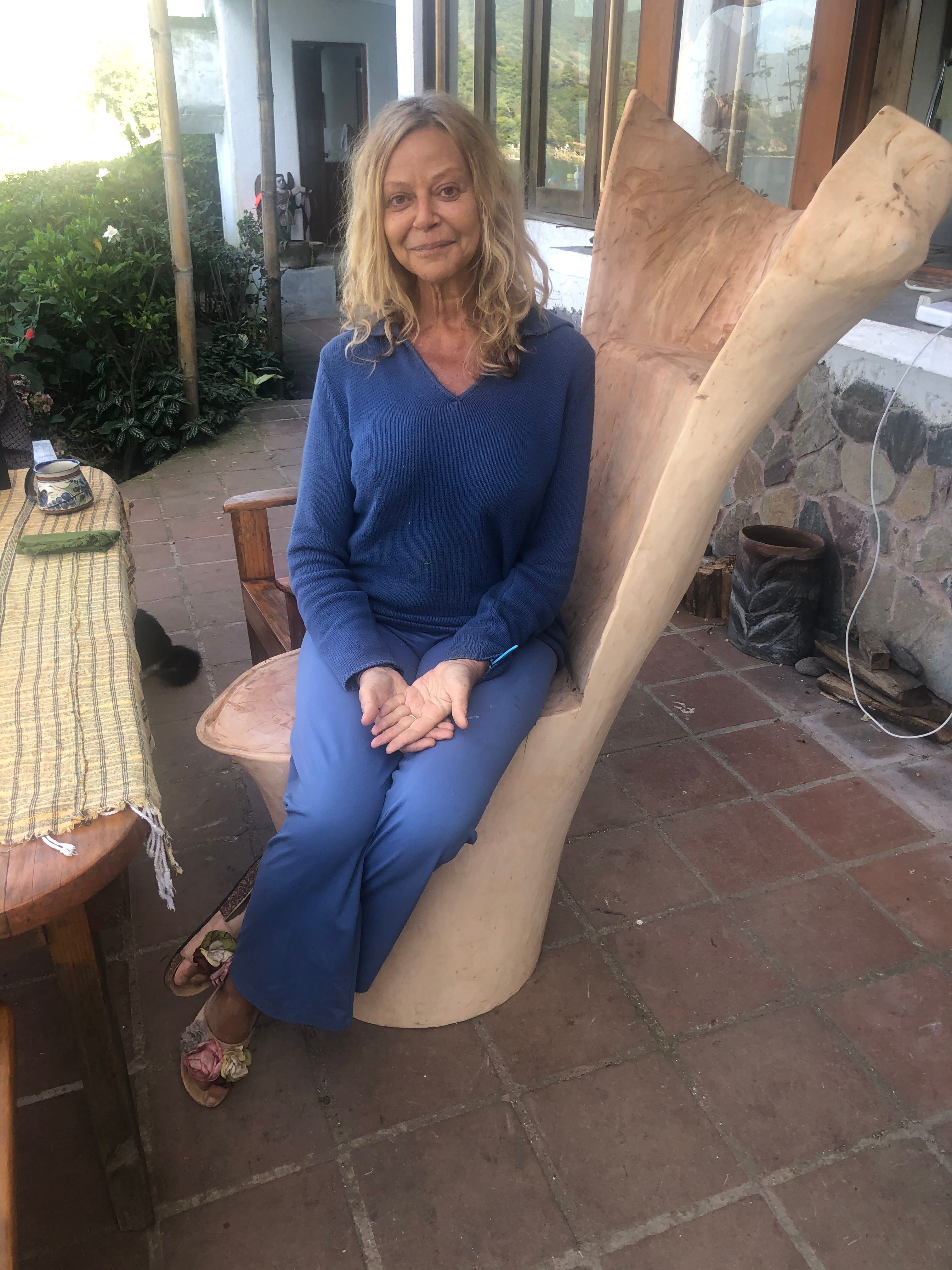
My hand-carved avocado wood chair, carried one mile from the village, on the back of the man who made it.
I am not a wealthy woman. Back home in California, I could never have employed a crew of men as I did during those pandemic months, and even in Guatemala, paying the men a good local wage stretched me to my limits. But I knew this: When you gave a person a job in this village, a family of 10 would eat that night.
The men did beautiful work. Sometimes, checking in with them at the end of the day, I’d discover some detail — a spiral of tiny snail shells cemented into a shower wall, a broken ceramic monkey attached to a twisted piece of wood, with bougainvillea spilling from its head and silver paper from a chocolate bar wrapper for eyes. Miguel and Mateo trained plants to grow in the shapes of a giraffe, a llama, a rabbit and a heart. A carpenter named Ramon built me a table of conacaste wood from the coast—long enough to seat twenty people-- in the style of one I found on Pinterest that was designed by the woodworker George Nakashima.
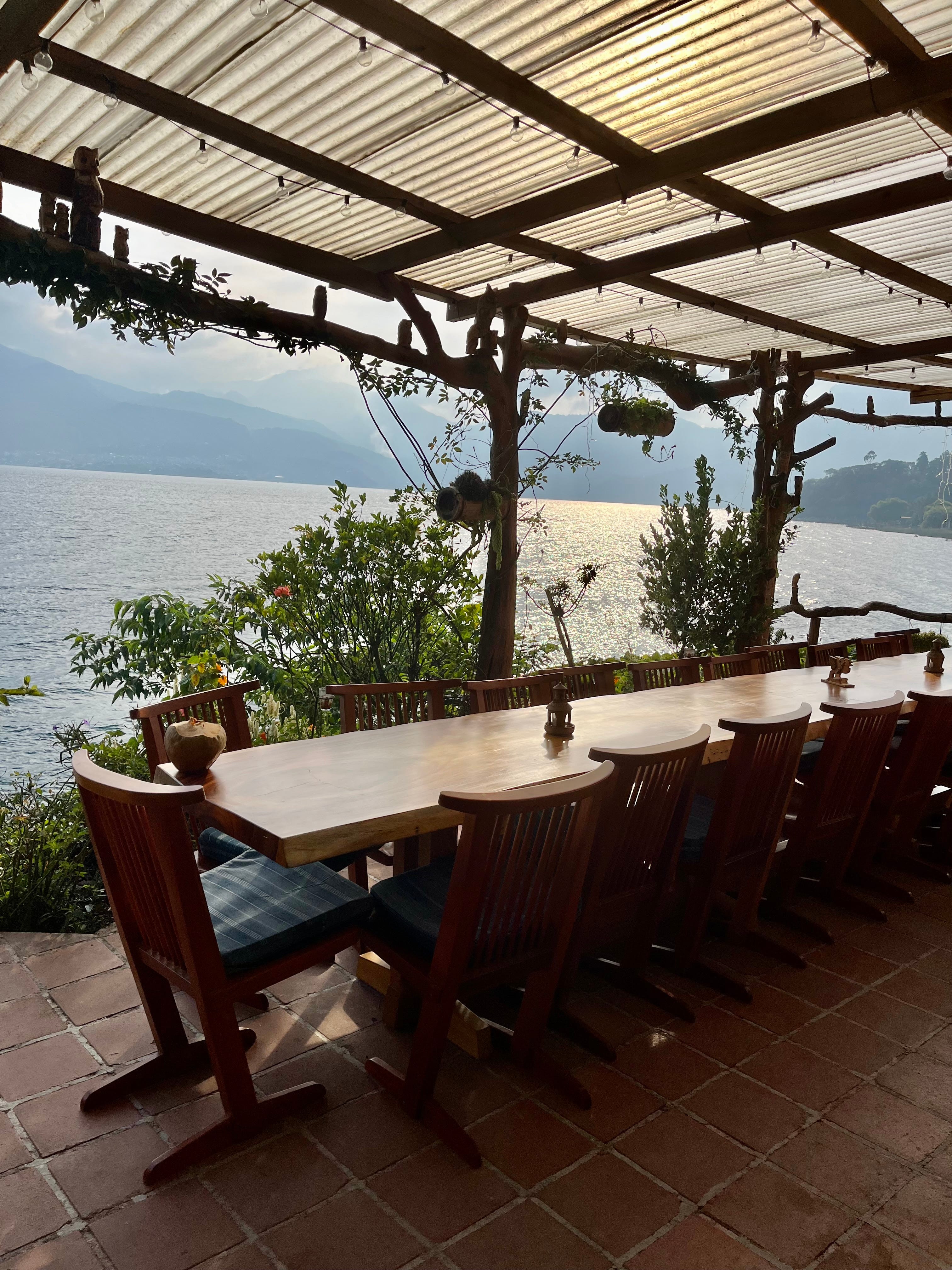
Our days and weeks took on a rhythm. Every morning, as I made my way up the hill to my writing desk with my laptop and my coffee, I’d greet the crew of men coming down. As I sat at my desk, I’d hear the steady beat of the men’s hammers, the sound of rocks emptying from buckets. It came to me that in all my years of writing books — almost half a century, I’d never known such an immediate connection between the stories I made up in my head and the world of physical labor. When the men and I called out our greetings every morning, as we headed off to begin our day of work, we knew that each of us had a job to do. The one supported the other.
By the following winter, just over a year from when the world had shut down--with vaccines available at last--I welcomed 12 writing students to Casa Paloma for another writing retreat. But unlike the previous nineteen years of workshops I’d hosted at Lake Atitlan, this time, the women could stay on my property in the new houses the men had built, sharing meals on the expanded veranda, looking out at the lake, with meals prepared by our wonderful local chef, Rosa. We call her La Reina de la Cocina—the queen of the kitchen. She doesn’t simply feed us. Truly, she nourishes our spirits.
I’m a writer, not a businesswoman, and I had never intended to become one. But somewhere during those months of turning my quiet little writing retreat into a compound of seven houses, it came to me that if a person empties her bank account to build a property with rooms for eighteen guests—a place that requires a crew of eight people to maintain it, sometimes more—that place had better not sit unoccupied.
And that is how I came to be the host of a hotel and retreat center.
The casitas at Casa Paloma bear the names of books I’ve written: To Die For, At Home in the World, Count the Ways. One, Casa Una, designed by my architect daughter-in-law, is named for my newest granddaughter, born not long after the end of the pandemic.
Over the last year, the team we assembled to keep Casa Paloma going, made up almost entirely now of local men and women, has hosted more than 300 groups of guests — yoga practitioners, hikers intent on tackling the volcano, proposals of marriage, families bringing children they had adopted years ago to the country of their birth for the first time. This past high season, we were booked almost every night.
Sometimes Casa Paloma functions as an Airbnb. Sometimes I rent the place to a yoga teacher for a week, to run a retreat. And for six weeks every winter now—not just one, as used to be the case—I host retreats of my own. Two of these retreats are, as was my original intention, for women who come to work with me on writing memoir. But for the other retreat weeks, I am simply, and happily, an innkeeper and host, tasked with introducing travelers from the U.S., and sometimes other countries, to this place, and this culture, that has maintained a hold on my heart for over fifty years.
Now for a post-script: During that stretch of months back in 2020 the world stood still, and I was writing in that little treehouse cabin, and reading my chapters out loud to the two young women who had become like other daughters to me, I experienced a state of such unprecedented concentration and inspiration that I was able to finish a novel. What to do then?
As the men worked hard building those magical little casitas, I started another novel about a woman from the United States who, in the aftermath of a personal tragedy, lands in a small village on the shores of a lake surrounded by volcanoes, in an unnamed Central American country. She finds herself unexpectedly running a magical hotel surrounded by orchids and birds, with a volcano looming over everything
.
At the time I embarked on telling that story, that new novel I was writing was a work of pure fiction, almost a fairy tale. It was only a couple of years later, as Casa Paloma started filling up with guests from all over the world—and just as that novel, The Bird Hotel, was about to be published—that the realization came to me: I’d built a hotel, myself. Together with a team of hard working men and women in my little village, I’d manifested this place

.
I made a promise to myself then, that we’d better figure out how to make my real-life hotel provide, for the guests who came there, the same kind of magical experiences I’d written about in my novel. And though I am not the character I wrote about in that book, I am like her in this way at least. I am an innkeeper.
Here, finally, comes a piece of irony: This past January, I returned to the lake a month before the start of the first of the retreats I host every winter. I came early so I could work on a new novel, a sequel to The Bird Hotel. I knew that to write this book, I had to be at the lake, listening to birds, as I was when I wrote the earlier novel.
But I can no longer write books at Casa Paloma. I’m way too distracted now, by the job of running my hotel. So I rented a friend’s little casita down the road. And finished my new novel there. And once I’d done that, I put away my laptop and made my way by tuk-tuk to the gate of my hotel. Ready to greet my guests.
If you’d like to visit Casa Paloma, there are a few ways of doing so. You can go to casapalomaretreat.com to book a stay, or find out about hosting your own retreat or gathering there. Or you can sign up for one of the retreats I’ll be hosting again next winter: Write by the Lake, Life by the Lake, or Spanish Immersion. To find out more—learn details, see photographs, read what others who’ve attended my Lake Atitlan retreats have to say about their experience—check out https://www.joycemaynard.com/retreats
Here comes a link to my novel , The Bird Hotel, on audiobook. I chose to link to audiobook because this version includes bird songs we recorded at Casa Paloma. To bring you there.
https://www.amazon.com/The-Bird-Hotel-A-Novel/dp/B0C3RR9LBB/ref=sr_1_1?crid=14QELF68L9W6W&dib=eyJ2IjoiMSJ9.L6AlQzcQA4xguvnpmW_4gkDiIQnQYITp8DlVQN6YmpBtDvk_puhreXpwDAS0SfbWVgVgW-iUnZq6hz7_pk2CXwxrT_BxkH8kEKeSXE3bFfqrgAddFKdt1JHjDEszeVeNSmZkabUm11hupPP-ZPZgj8P8TwUM93gYsx4ZhHcnPjb69ogZxqAz1DJVCy59h1MvgPxJfliUk5OCbLgp37rX0TrlbzB5gvSpTKJymK9XS90.CiJMldR4XcPuuxQlQXsBTJhN9n9h8gGNYLjKYTEXrr4&dib_tag=se&keywords=the+bird+hotel+joyce+maynard&qid=1778705846&sprefix=the+bird+hotel%2Caps%2C240&sr=8-1
Comments
Nothing yet. Say the first thing.
Sign in to join the conversation.