
0:00
-15:34
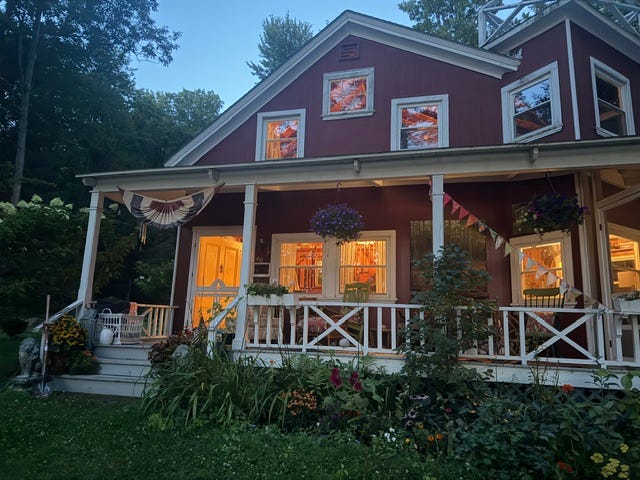
My little New Hampshire lake house, summer 2026
It was the fall of 2015 when I first laid eyes on the little New Hampshire lake house where I’m sitting now, writing this. Born in the Granite State, I’d made my home and raised my children there for many years, but after my divorce I’d moved with them to the other side of the country. On the day that real estate listing popped up on the screen of my laptop I was living in Northern California with my second husband Jim, in the house we’d bought together not far from San Francisco just over a year earlier, shortly after we were married.
Much had changed in the short time since then. Not long after our wedding, Jim had been diagnosed with pancreatic cancer. The autumn day I found myself studying that real estate listing, Jim was dying, though I hadn’t allowed myself to admit this to myself.
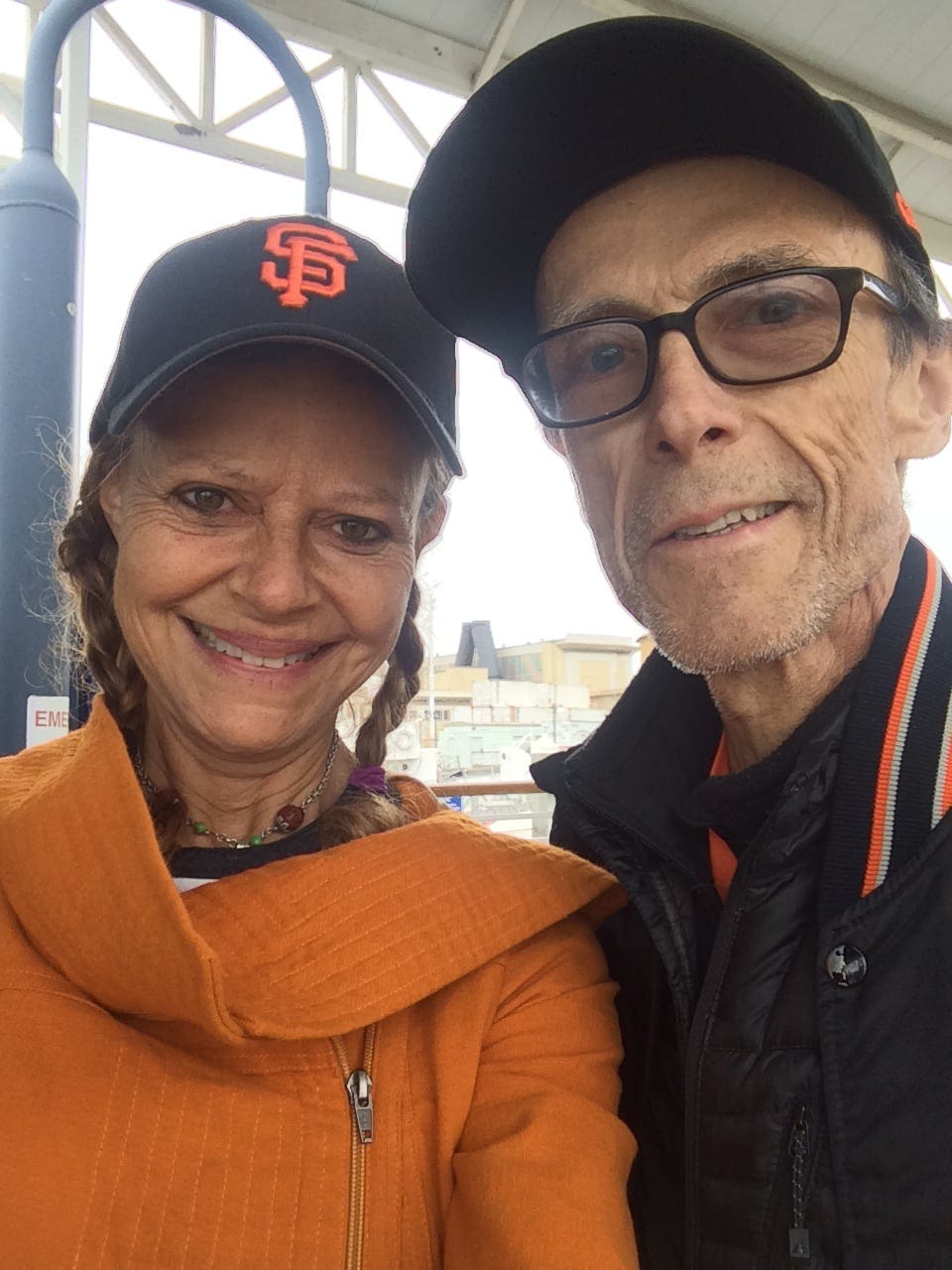
Jim and me, at a SF Giants game. He was trying, valiantly, to live. I wanted badly to believe he would.
It was a time in our lives both brutal and precious. The days were filled with pain, for Jim, and sorrow for me. One day, in search of something that might feel like comfort, or simply escape, I’d typed the words “Lake house, New Hampshire” in my Google search. Though there had been a time when my goal in life was to escape the place I’d come from, at that point I felt a need to return home to the state I had once felt ready to abandon forever.
The real estate listings that began populating my inbox then held no appeal. One after another, what I saw were big, faceless houses on tiny lots looking out over lakes whose names I knew well as tourist destinations—their waters no doubt filled with jet skis and motor boats. The price tags on these houses were way beyond my means, as would have been true even if they cost far, far less. But I wouldn’t have wanted one of those houses even if I could have afforded them.
Then one day, the link to a totally different place appeared in my queue. The house had been built in 1900, and from the looks of the photographs of the rooms, little had been done to change or modernize it. This was strictly a summer place—what’s known, in New England, as “a camp”-- with a screened-in porch and a front porch that looked out to the lake, which—though situated less than ten miles from the town where I raised my children when they were small—had been unknown to me up until now.
The lake was small—no power boats allowed- and not the kind of place city people were likely to choose for their summer getaway, in part no doubt because the town where it was situated had virtually no other city people summering there, and consisted of little more than a tiny library, a garage that did not feature a gas pump, and a restaurant that sold only breakfast and lunch, except times when the owner chose to go fishing.
The house in the real estate listing sat on two and a half acres on a dirt road—the kind of road you might not venture to drive down, if you cared about the underside of your car. It had been built on a rise overlooking the lake, where—just on the edge of the water—there was a boat house, a structure whose construction would no longer be allowed, only this one was grandfathered in.
The images posted on the listing concealed the natural charm of the place—appearing to have been taken so hastily that in one of the photographs, nobody even had bothered making the bed before capturing the image. But I—who had spent more than four decades in the area, in an old farmhouse I dearly loved and had never stopped missing—could recognize what the pictures failed to convey, the presence of what are known in the world of real estate these days as “good bones’.
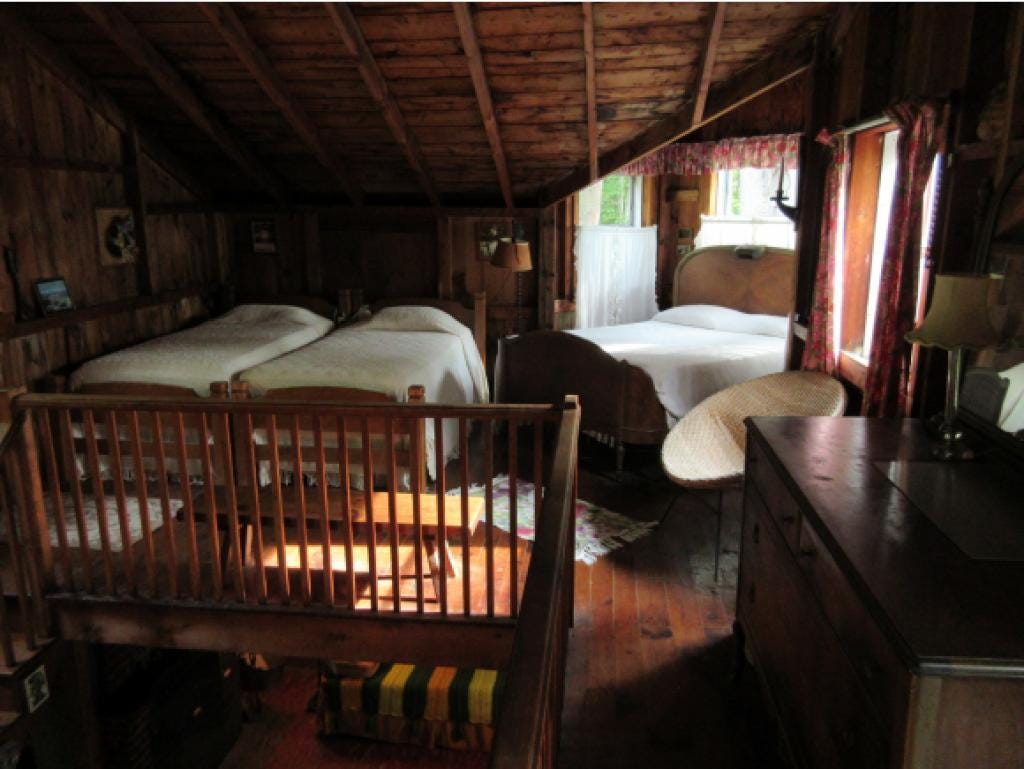
How the house looked in the real estate listing, 2015. (To me, it was perfect.):
The bedroom.
The living room.
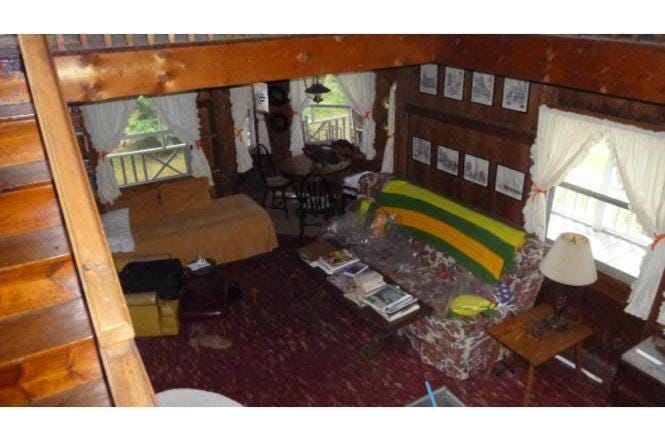
There was a fireplace, and a vaulted ceiling with beams exposed —making the room look cozy in summer, impossible to heat when the weather turned cold. There was an outdoor shower and shelves crammed with board games from a whole other century, mismatched chairs around the kitchen table, a built-in pantry cupboard. There was a wringer washing machine and a window seat looking out to trees (no neighbors in sight) in the kitchen.
Oh, that kitchen. The refrigerator was an old GE of a vintage (1950’s probably; my family had one when I was growing up) that would definitely require defrosting. The cupboards were open, and basic, like everything else.
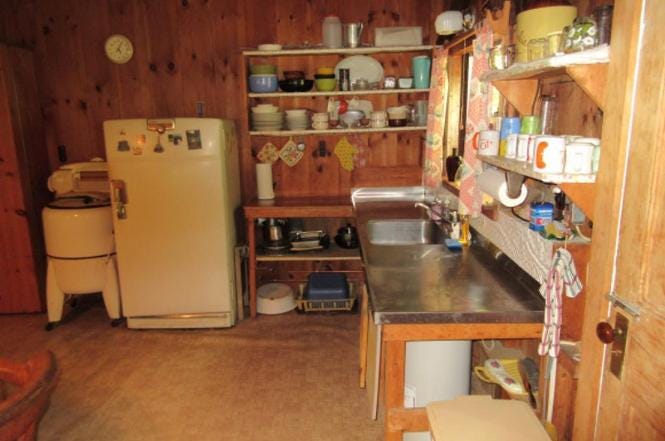
How the kitchen looked in 2015. And for every one of the previous 60 years or so.
The stove was of a similar age to the refrigerator: nothing fancy, but I knew I could bake many pies there. And boil water for corn, naturally. From my days of living one town over, back when I was raising very young children, I knew the farm stand that sold the Silver Queen I loved best, and it was right down the road.
The fall of 2015, when I first spotted the listing for this property, was as hard a time as I have ever known—my husband Jim getting thinner every week, unable to eat more than a bite of the pie I made for him, the two of us driving off to doctors’ appointments daily, except for the weeks he spent in the hospital. His pain got so bad that sometimes , in the hours between midnight and three a.m., the two of us would watch four episodes in a row of Hart of Dixie, the funny, happy, television series in which my son Willy was one of the stars—just to distract ourselves, and because the picture of life it conveyed seemed so uncomplicated, and the problems always resolvable.
Mostly, I stayed at Jim’s side during those months. But I developed a little ritual, usually around five o’clock in the afternoon, when Jim might be resting. I’d sit at the desk in my writing room (more often than not, with a glass of wine) and click on the listing for the New Hampshire lake house that had become my obsession. That listing now provided the one picture I could summon of some future life that wasn’t filled with grief, pain and loss.
Studying those pictures as I did on a daily basis, I knew just where I’d set my rocking chair, and my writing desk. I knew the old metal sink that looked out at the clothesline, and the pattern of the linoleum floor. I had those photographs memorized.
One day, when Jim and I were sitting together on the couch at our house in California—the place we’d dreamed of living out our lives together, making a garden, welcoming grandchildren someday—I showed him the listing for the house I loved, three thousand miles away.
“That looks nice, honey,” he said, then closed his eyes.
The pricetag on this property was low—a few hundred thousand dollars less than any of the fancy lake houses on the market at the time, though those tended to sell quickly, as the house I loved had not. Still, the idea of actually buying the lake house remained a fantasy. In the year since Jim’s diagnosis, neither of us had earned any money. Bills kept piling up. Clicking on that real estate listing was just something I did that helped me get through the days.
Other than Jim, I had told just one friend about my love for this house. This was my friend Danny, who lived one town over. At my request, he drove over one day to check it out, just from the outside and reported back to me in California with his findings. The property had a perfect western exposure, great sunsets.
“There’s not one thing about this house you wouldn’t love, Joyce,” Danny told me.
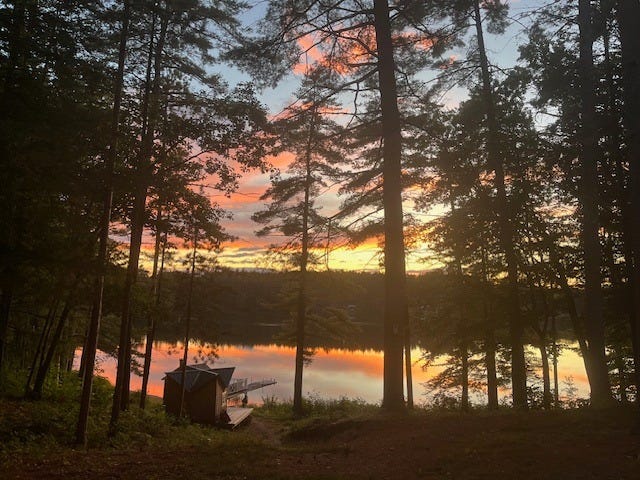
Sunset over the lake. And the boathouse. Loons calling.
It was New Year’s Eve when the thought came to me: What if I clicked on the link to the place I thought by now of as my New Hampshire lake house, and the words “Under contract” popped up? What if somebody else ended up as the one having a beer on that front porch next summer, watching the sunset?
It was past nine o’clock, the last night of the year—close to midnight on the East coast--when I dialed the phone number of the realtor. Until this moment, he would not have known that a woman in northern California had become more intimately acquainted with this listing by now than he was.
With no idea where the money was going to come from, and shaky prospects of qualifying for a mortgage, I made an offer, ridiculously low, with no contingencies.
“I’ll run it by the sellers,” the agent told me. Meaning the family that had owned the house and came there, summers, for well over half a century. The first initial of their last name, cut out in wood, was mounted on the front, just above the porch.
The realtor called me back ten minutes later, just before the start of the new year. My offer had been accepted.
I went back to my place on the couch next to Jim and told him I’d bought a house.
“That’s great, baby,” he said. “Next summer I’ll fish for trout.”
Jim died just as fishing season was getting under way, the following June. Ten days after, I landed at the airport in Manchester, New Hampshire. Danny picked me up and drove me to see my new old house for the first time.
The sun just going down across the lake when we pulled up out front. Once this had been my time of day to click on the familiar real estate listing. Now I opened the door and set foot inside .
I spent that summer clearing away mountains of old junk, making the boat house, that had been used for tool storage and junk, into a work space where I got to work writing my memoir about finding and losing Jim, The Best of Us. Now and then—when the blueberries were in season, and again when it was time for apples, I’d bake a pie in that great old oven—a familiar and comforting ritual, and my offering of love to family and friends.
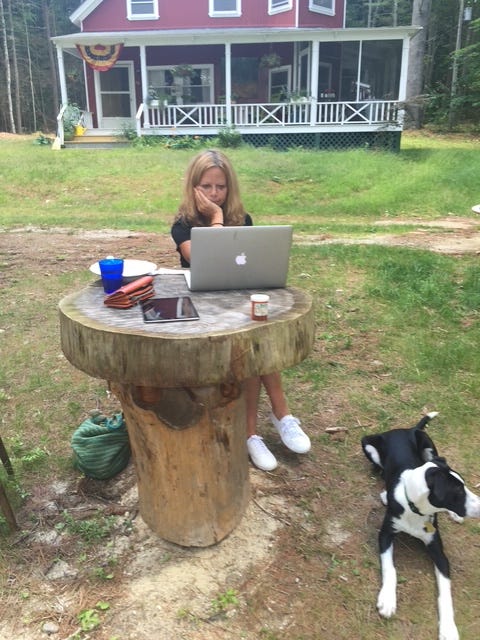
The summer I first moved into my lake house. Working on The Best of Us with my dog, Jojo.
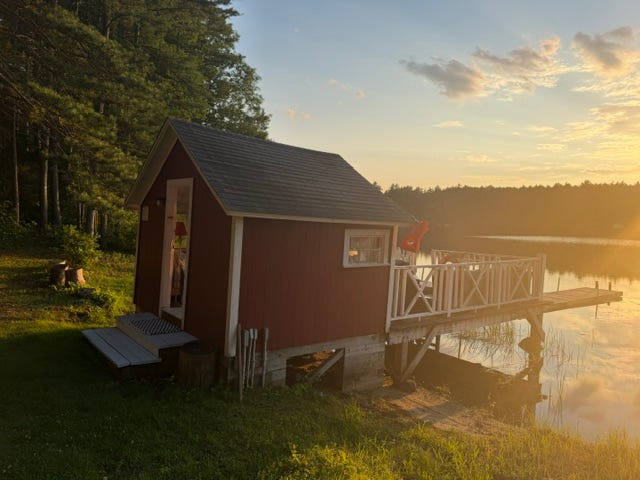
The boat house.
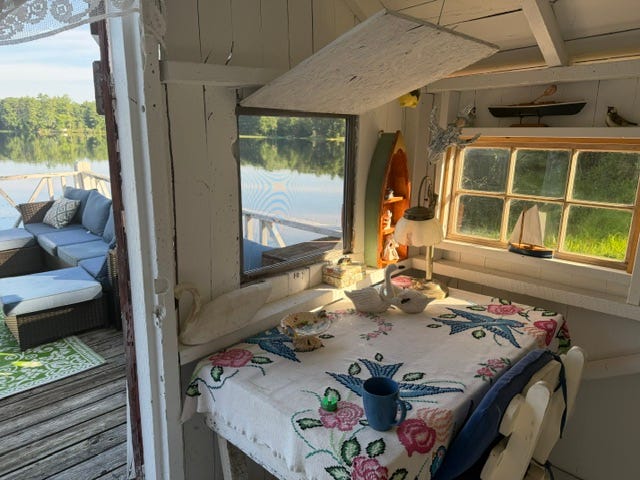
My boathouse desk.
Since then, I’ve spent most of every summer –-starting as early as May, most years --in my little New Hampshire lake house. One year I stayed all the way to the first week of November. It was very chilly by then, and I had only a propane heater and a wood stove and a pair of flannel pajamas to keep warm , but I loved it that by that time of year, the lake –never crowded, even in mid-summer— was totally quiet, with one lone light to be seen, in a single house on the other side of the water. That, and the stars.
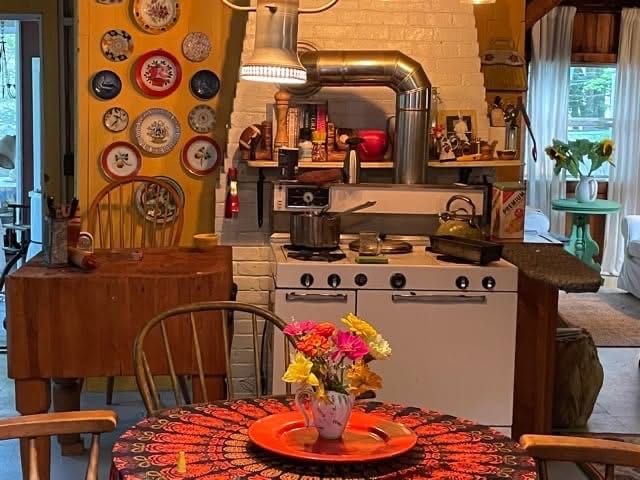
My kitchen, summer 2016. When the oven still worked.
Since that first summer, I have written and revised four books at my desk here. I’ve swum almost every day, served up meals for friends just as I knew I would, that I set out on the porch table, lit by candles alone. A week ago my grandchildren came to visit and we swam off the boathouse dock. After, we gathered around for blueberry pie, followed by a dance performed by my 23-month-old grandson.
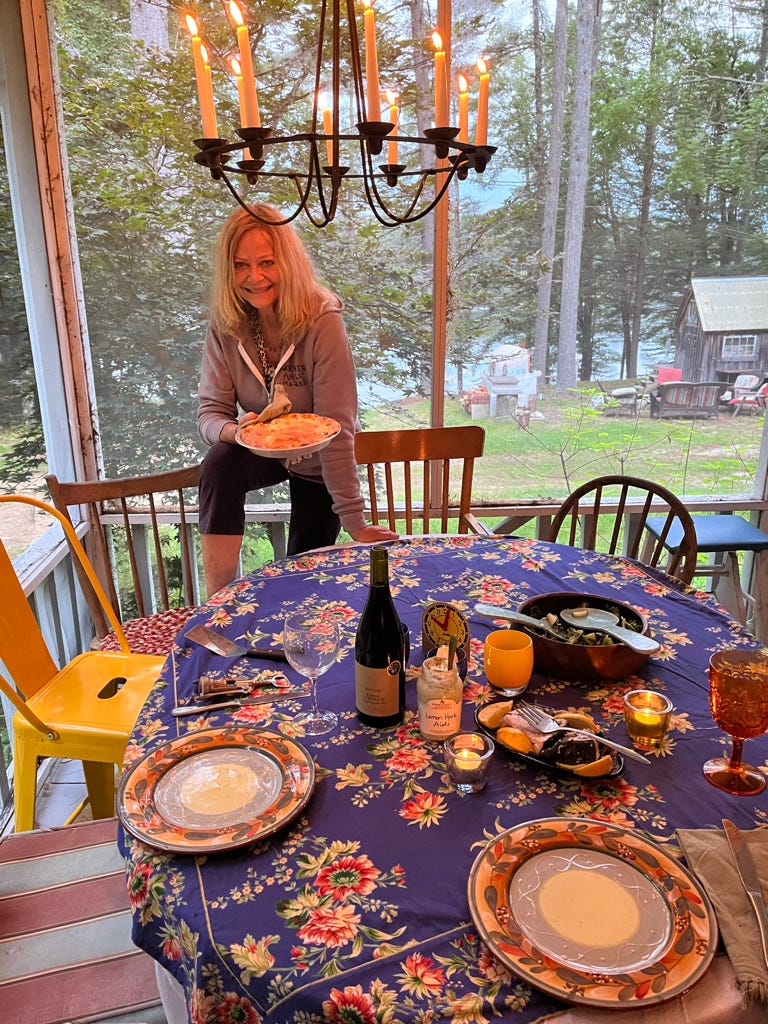
Dinner on the porch, summer 2026
The day after the grandchildren left, I turned on the oven again to make another meal, but no heat came. The appliance repairman who paid a visit to my house the next day diagnosed the situation as possibly repairable, if he could find a certain part—not easy for a 75-year-old stove. But a bigger problem confronted us: the serial number had worn off. There was simply no way to find out the model of my stove, and without that, no way to buy a replacement part.
After he left, I got online—Facebook Marketplace—looking for a replacement for my stove. I wanted an old one. I scoured through every listing, but the only old stoves I found looked beat up, in need of major repairs. Or they were more like museum pieces than stoves you’d actually prepare meals in. Or they were located in places like Pennsylvania. Oklahoma. Oregon.
I could have ordered a new stove from Best Buy of course. Only I couldn’t bring myself to do that. Then, just when the situation was looking hopeless, I found the stove of my dreams on Craigslist. A family who lived an hour and a half’s drive from me were reluctantly parting with their beloved 1939 Magic Chef, not because there was anything wrong with it. They just decided it was time for a bigger and more fuel-efficient unit.
The husband in the family, Pete, delivered my new old stove in his truck two days ago. It’s sitting on my porch now, awaiting what will be a simple hookup from my plumber the day after tomorrow.
“My wife loved this stove so much,” Pete told me, “that she was out in the garage last night with her headlamp on, scrubbing the burners one more time. She wanted it to look its best.”
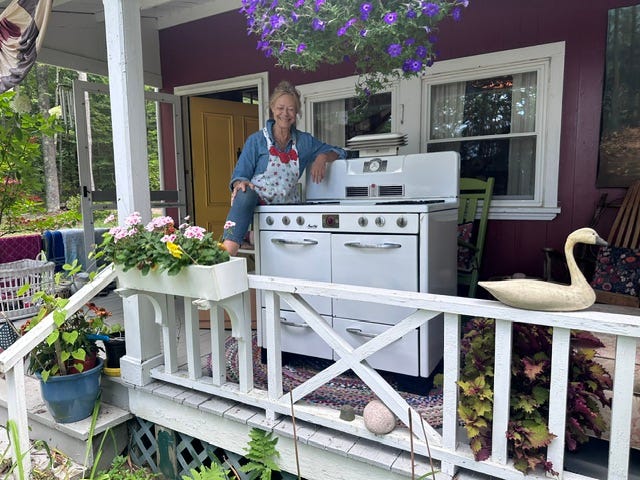
My new old stove. Just delivered. Sitting on the porch waiting for my plumber friend to install it. Three burners work. That’s enough for me.
The new stove cost slightly more than what a new one might have by the way—which, in the world of vintage stoves, might actually be considered a bargain. And of course you could point out that by trading one old stove for another twenty years older, I am placing myself at risk of finding myself right back where I was two weeks ago, with a non-functioning oven and no way to locate parts.
But it turns out that Magic Chef stoves were once so popular—and so long-lasting— that parts remain relatively easy to find, even now. Not only that, but the model number remains easily detectable on this new beauty.
.Really though, it’s about this. Love offers no guarantees. I miss Jim every day, at the same time that I carry on finding joy. I will always love the man I married. And I have learned it’s possible to love deeply again. All the more so, maybe, for what I’ve learned about the preciousness of everything.
I keep swimming as late into the season as possible. I’ll keep making pies and putting them in the oven until I can’t do that any more. With luck, I’ll pass this stove, and the house where it sits, on to my children, and who knows, maybe even their children. One sure thing is that the sun keeps rising on the hill behind the house and setting on the other side of the lake. The loons keep calling out in the night. The stars keep shining. One day I may get myself a fishing pole and learn how to catch a trout.

This is the kind of lake where a person may not feel a need to put on her swimsuit.
LINK TO LOON CALL:
And here’s a link to my memoir about finding and losing my husband Jim. https://acesse.one/p035bh6
No posts
Comments
Nothing yet. Say the first thing.
Sign in to join the conversation.