
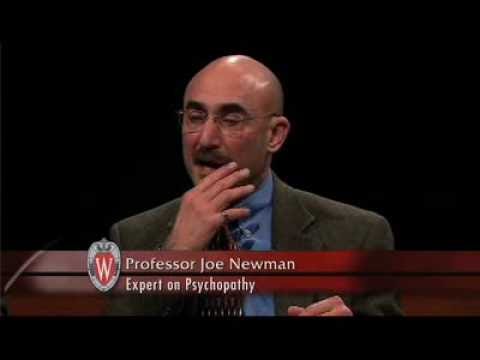
Dr. Newman has a very interesting theory about psychopaths and emotions, and in this post we will go into that a bit, so that part should be really interesting. I am not certain that I totally agree with him, but we shall see as we go how reasonable I think his perspective is.
Interviewer: So you made the point that not everyone in prison is a psychopath, but there’s also lots of people who are psychopaths, lots, you can tell me if that’s correct, who aren’t in prison, who aren’t doing criminal behavior…
Joseph Newman: Right
Interviewer: …which I think is another misconception, right?
Yes, yes it is.
Joseph Newman: Right.
To have this defect in self-regulation, to maybe lack some of the affective responses that other people have, doesn’t mean that you’re going to necessarily be driven to do antisocial behavior. And Cleckley, the person I referred to earlier, went out of his way to try to make clear that psychopaths are not driven by the things that lead to their behavior.
So, not like they’re driven to be especially violent or aggressive. It’s not like they’re so motivated to get money that they’re going to go after it in that way. It’s not that they’re so turned on by sexual things that they do things that are sexually inappropriate.
And he went on and on that and he explicitly notes that if anything their drive for any of those processes for any of those, towards those goals, it may even be less than other people. The only thing is when they even have an ur… whim, just a thought that maybe I could, it might be interesting to try this or do this, they’re likely to act on it. So he talks about very weak urges breaking through even weaker restraints as the hallmark of psychopathy.
So I complain about Cleckley’s work being held aloft for the defining aspects of psychopathy, as it is so old. Things have changed drastically, in terms of understanding and how we look at things that are going on in the brain. Cleckley couldn’t have conceptualized how our brains are fundamentally different, so he couldn’t take that into account.
To him, psychopathic behavior looks like people that are rebelling against the world and its structures, and it likely was a bit baffling as to why. He could only understand things through what he understood people’s behavior to be. Understanding how changes in the brain can and will dramatically affect how a person thinks, feels, and acts, wasn’t too much on his radar.
That said, this is a quote about Cleckley that I agree with. There aren’t strong impulses in psychopathy, it’s the stopgaps that are weak that is the problem. There is no fear to tell us to not have a walk about at four in the morning in an area with mountain lions or something. What stops most doesn’t function in us. So, while Cleckley is out of date in many regards, I will say that he had some insight into how we are and what motivates behavior for us. It’s well stated in that comment.
After this part, the program takes a commercial break, and I am going to skip all that.
Interviewer: Welcome back to Office Hours. So I guess I should have been more clear when I said you were gonna hear from a psychopath. It’s not ,it’s not Joe or me, but we have a quote from someone diagnosed as a psychopath. And let me read this to you, Joe, and then have you react to it or explain to me the relevance of this quote.
Oh this should be interesting. It’s going to be a criminal, so it’s going to be some self-serving whine fest about how it’s not their fault. Watch.
“Imagine if you can, not having a conscience, none at all, no feelings of guilt or remorse no matter what you do, no limiting sense of concern for the well-being of strangers, friends or even family members. Imagine no struggles with shame no matter what kind of selfish, lazy, harmful or immoral action you had taken. And pretend that the concept of responsibility is unknown to you except as a burden others seem to accept without question like gullible fools.”
Oh eye roll. Please. Sure, true, we have no feelings of guilt, no conscience, all of the things that he lists, but then he goes on to say the part about whatever selfish, lazy, harmful or immoral action that he’s taken, and no sense of responsibility.
Let me be clear, this is excuse making. Responsibility is a choice. You make it, or you don’t. It isn’t a feeling, it’s an action. Being a psychopath doesn’t remove the ability to make that choice.
Trying to hide behind psychopathy, and say that’s why he does whatever he does is frankly pathetic. I have done plenty of terrible things in my life, and no, I don’t have any feelings about them. However, I also know that I create the life that I want, and prison doesn’t interest me. I’m spoiled and like the finer things in life, nutraloaf doesn’t suit my palate. This guy wants both. He wants to be able to do whatever he wants, and he also wants people to see it as out of his control. Poor him, he’s a psychopath and just doesn’t have the ability to blah blah blah.
Whiner and weak. That is not a good quote about psychopathy. A great quote about psychopathy is:
“You know, you don’t need to have color vision to see how a traffic light works. You just need to know which bits are lit up.”
Dutton elaborates that this reflects how high-psychopathy individuals process emotions—they detect the “lights” (behavioral/emotional signals) for manipulation or navigation but don’t experience or get caught up in the emotional “color.”
That is an excellent quote. The one by the diagnosed psychopath is just self-serving whinging.
Joseph Newman: I think this quote does a nice job of capturing the processes that people consider to be the essence of psychopathy, that there’s something really missing, there’s something that, the guiding light is not there. So if that’s absent, what I like about this quote is that it doesn’t answer the question what will the person do.
All right, that’s fair. I can see his point about that.
And to answer that question you have to know something about the person’s history, probably something about their age, their gender. And the point that that makes for me that I find so interesting is that I don’t think psychopathy is really defined by the acts or the behavior that people do, you know, punching somebody, defrauding them...
Also fair.
Joseph Newman: Maybe. But I have seen psychopaths in the prison who are very large, threatening men and they can be very effective in using dominance to control people. But I’ve also seen psychopathic people who were very slight and they know they’re not going to be able to dominate people but they may take advantage of them by manipulating them. And then there’s the female side of it or the child side of it, and of course those people are going to do very different behaviors.
All of this is accurate. It is not psychopathy that determines behavior, it determines how the world is viewed. What is done with that information is a choice made by each individual.
So just having these attributes doesn’t tell you exactly what the psychopathic behavior will really be like. The characteristic will be that there won’t be much judgment going on, they’ll be doing whatever they feel like. If they feel like just avoiding responsibility and staying home, psychopathy could be expressed that way.
Interviewer: So, the not having a conscience part is consistent, but then what you do as a result of not having a conscience lands them in one of your studies because they’d be in prison, right?
Joseph Newman: The ones who break the law or who are violent or commit criminal acts, those are the ones that are going to make it into my studies.
All fair and interesting points. I like the breakdown of the different ways psychopathy can be expressed, though he didn’t mention any of the positive ways it can be. However, in fairness, he works with prisoners, and that is where his brain is going to live. So I will let it be.
Interviewer: Do psychopaths experience emotions at all?
Joseph Newman: A lot of people think that they’re incapable of experiencing emotions…
Not incapable, but several are absent. Those that are present are turned way down.
…and among those people some of them make a distinction between a kind of quick peevish emotion like anger or frustration, and then more genui, what they would consider more genuine emotions that are deeper. Psychopaths don’t seem to spend much time dwelling on their emotions and so they’re not very elaborated and so shallow affect is probably the way to describe them.
I think annoyed and irritated are better descriptors for what a psychopath might experience in his example. This is the beginning of what is called, “The Attention Theory”, which is kind of Newman’s take on psychopathy. I think that he is confusing actual emotions with cognitive empathy, but we will see what you guys think.
But when they turn their attention to things, I certainly have done in interviews, and the psychopaths will tell us this themselves they’ll say I don’t know you know when I see somebody that’s suffering I’ll go and help them I’ll do this and that for them, and they’re saying they have emotions and if you look at some of their behaviors they actually go out of their way more than other people would to do something about it…
This is both true and false. It is true that if I see a problem that I can fix, if it costs me nothing, I will fix it. I like to solve things, because solved things can exit stage left, and I don’t have to keep dealing with them. Though, I have noticed that when I solve things for people, then I have to deal with their gratitude, and while it is a nice gesture to thank me, that wasn’t the motive. The motive was to fix things, so everything can go back to space normal. That’s it.
No where in this description does the psychopath actually say that they have emotions about the situation. I will go out of my way more than others, but that isn’t emotionally driven, it’s problem solving driven. That’s it. No emotions, just problem-solved. Reading emotions into it, and even saying that there is a statement of having emotions, without providing that statement, makes me believe he is reading into it. Why else would the psychopath act? He can’t answer that logically, so the emotional route must be the right one. Incorrect.
…and yet people are, because of the negative cruel things that they often do, people are saying the evidence is that those emotions are not genuine, they’re not there. And so it’s a real dilemma to answer the question in a genuine way. Are they having emotional responses or aren’t they?
And I think we’re going to talk about some of the work that I’ve done a little bit later in the show but in this work that I’ve done we measure things that I think correspond to genuine emotions and we find that the psychopaths time and time again is showing us that they’re capable of responding to affective materials...
To be clear, often what is meant when saying that what we do is mean and cruel is that we aren’t catering to neurotypical emotions. Sorry, but other than it creating an easier world for us to live in, why should we? Honest question. Why is this something that we have to care about? We don’t feel them, and we don’t understand hurt feelings. What about the feelings being hurt means that our lack of care about that is being cruel? No one caters to us and our lack of feelings. No one cares that we have to go through our lives faking it so the torches and pitchforks aren’t fished out of the barn. Is that mean and cruel? No, it’s just not kowtowing to us.
It is what it is. People need to stop believing that their emotions are the most valuable things in the world and that everyone needs to handle them with kid gloves. No, we don’t. Doing so is a courtesy, and not doing so is dealing with you as we deal with each other. It isn’t mean, it isn’t cruel, it’s just not placating.
Also, psychopaths are capable of responding to anything, but it isn’t real, Professor. If you think it is, likely that is your wishful thinking at work. Not reality.
Holy lord, it summarized a lot of this one too. I just went through it, and so much got added. I might need to break this into another post.
No posts
Comments
Nothing yet. Say the first thing.
Sign in to join the conversation.