
Five Things I’ve Learned Releasing a Short Documentary
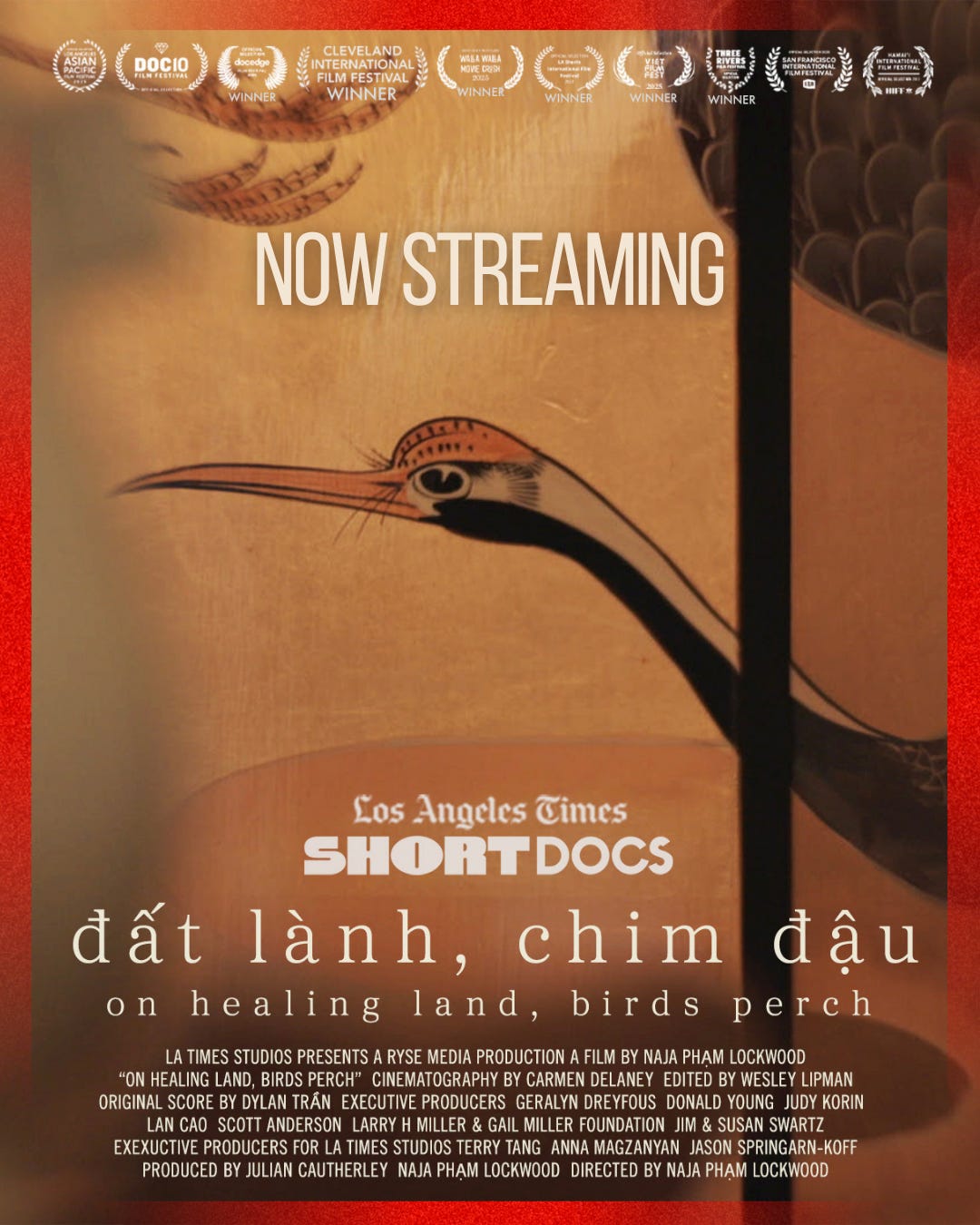
Our short documentary On Healing Land, Birds Perch was published this week via the Los Angeles Times. Centered around an iconic photograph of the Vietnam War titled “Saigon Execution” the film breaks down the story behind the single frame image and looks at the children of those involved in the photograph. It’s a film with healing for future generations at it’s heart. You can watch it at the LA Times Short Docs site (link below cause I want to you read first haha!) and here’s a great convo with that guides you deeper behind the film. This release milestone is part of a long journey that began with our festival premiere in spring 2025.
This isn’t a blow by blow of the journey and instead I wanted to fire off five thoughts.
...because short docs live in a strange place.
1. The Economics Are What They Are
There is no robust acquisition ecosystem for short documentaries.
That’s not news.
Most filmmakers making short docs already know this.
There are only a handful of places that consistently acquire shorts in a meaningful way. A few major platforms like Netflix, HBO and maybe Apple. A few legacy media companies like the New Yorker, the New York Times and the LA Times. Some of the slots are filled by commissioned films and the rest are acquired.
If you are lucky enough to get a traditional license, its basically a 5k tops deal. Which is something, but rarely covers the cost of production unless the film was made very lean, heavily grant funded, or supported through other means.
The larger streamers that pay mid/low six figures for shorts do exist. But the number of films per year that get that are small. Very small.
So if you are making a short documentary expecting recoupment through acquisition, there’s no math for that.
But most filmmakers already know that.
Which raises a more interesting question.
If you already know there are few buyers, what are you building instead? What are your goals? ...more later.
2. The Long Short Doc Problem
There is a quiet structural tension in short documentary filmmaking.
Festivals like shorter shorts. Fifteen minutes or less is infinitely more programmable. It fits nicely into a block. It allows more films to be shown.
Awards bodies and prestige platforms tend to favor longer shorts. Twenty five minutes. Thirty minutes. A lot of times one second shy of forty.
To qualify as a documentary short for the Academy Awards, you can be up to forty minutes. But once you move past twenty five minutes, programming becomes harder. Some festivals simply do not accept films over thirty minutes in their short category. A few have mid-length sections. Most do not.
So you are making decisions about length that directly impact where the film can go.
Too short and it may not be taken as seriously by certain distributors or awards voters.
Too long and it becomes harder to program widely.
Length is not just creative. It is strategic.
That tension is real. And it’s not talked about that much.
For the record our film creatively needed to be a long short doc and landed around 34 mins. I know first hand the length led to festival rejections though we’ve managed 20+ festivals and counting. We did make it onto the 15 film shortlist for the Academy Awards this year. We also picked up 6 major festival awards along the way.
3. Distribution Is Not Just Revenue
For this film, it is funded entirely by grants and donations. There are no investors to repay. That changes the goals.
Our primary public release is through the Los Angeles Times. The film is available for free on their site and YouTube channel.
We also have educational distribution with Collective Eye in Portland, who will work to bring the film into classrooms and institutions.
We are pursuing community screenings. Paid speaking engagements. Corporate screenings. Virtual screenings through platforms like Kinema. Bank of America is making the film available internally. That is a distribution node.
Festivals are another and we are still doing more. We screened at Big Sky Film Festival the same day the film went live with the Times.
Community events are distribution nodes.
None of these alone constitute a traditional success story.
There was no bidding war.
No giant check.
No single defining sale.
But taken together, this is a distribution ecosystem.
The film exists simultaneously in public media, education, corporate spaces, festivals, and community dialogue.
Here are a bunch of audience testimonials we’ve collected and shared so far and with more to come.
4. Free Does Not Mean Finished
One of the more interesting realities is this.
If your film is available for free through a major outlet, does that limit other distribution?
Maybe.
But free does not mean discovered.
Free does not mean contextualized.
Free does not mean activated.
What we are working on now is offering more than the film.
Q and A events (live or pre-recorded)
Supplemental resources.
Facilitated conversations.
Partnerships that allow the film to be a catalyst rather than just a viewing experience.
We have a strand of the impact campaign focused on sparking intergenerational conversations. One strand around photo journalism. One strand around refugee stories, which could not be more needed and relevant in today’s America.
The LA Times release is a powerful access point. But it is not the endpoint.
In an audience forward model, the continuing thought is how does the film move through communities.
How does it create connection and impact.
5. Maybe Short Docs Are Actually Built for Ecosystems
Short documentaries may not have a strong buyer ecosystem.
But they absolutely can have a strong audience ecosystem.
They are nimble.
They are portable.
They can travel into spaces that features sometimes cannot.
They can anchor conversations.
They can be paired with live dialogue.
They can be entry points.
If you are not designing a short documentary around a sale, then you have freedom.
Freedom to think about relationships instead of acquisitions.
Freedom to think about impact and audience design from the beginning.
That does not mean ignoring revenue. It means broadening the definition of distribution.
For us, this film is not about one transaction, one release.
It is about how many meaningful connections it can create over time.
And in this moment, that feels like the more durable metric anyway.
I’d love for you to watch the film and share with someone.
And if you have ideas about how it might live inside your classroom, company, organization, or community, reach out.
We are building the ecosystem as we go.
I’d love to hear from you on your experiences with short docs, what can I learn!
Follow our unfolding journey on the socials.
Comments
Nothing yet. Say the first thing.
Sign in to join the conversation.