
We believe utility restocking is rapidly becoming the central catalyst for the uranium bull case — shifting from mere optionality to a high-probability outcome over the next 3 years.
Ex-China utility uranium inventories are on track to fall to unsustainably low levels (likely below 2 years of forward coverage) by the end of this period, we estimate. In the prior major contracting cycle (2005-2010), utilities added an average of 1.5 years of inventory coverage. Global inventories were higher at the time, yet utilities still contracted aggressively.
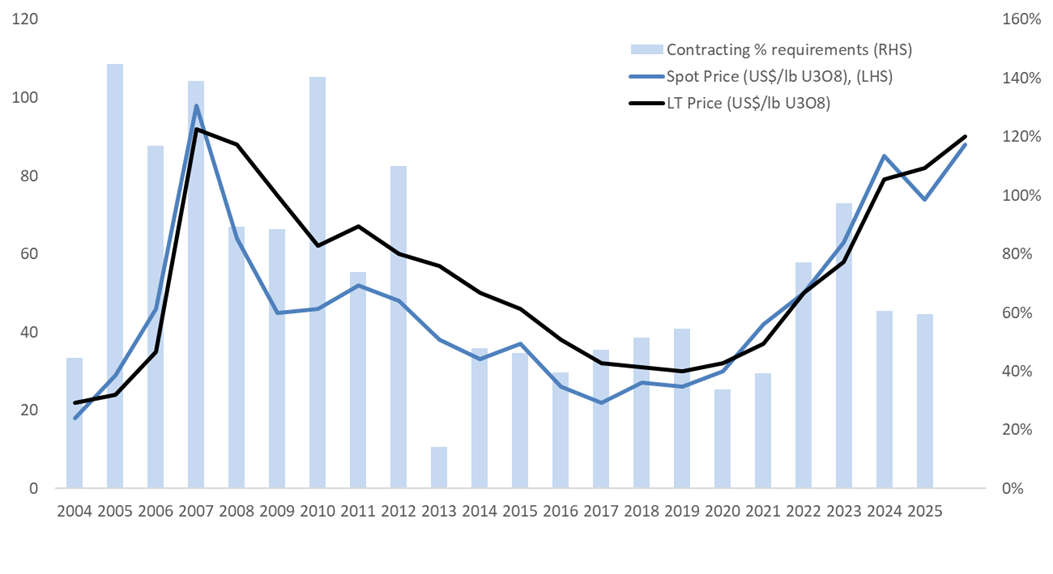
During 2005-2010, annual long-term contracting averaged c120% of reactor requirements, with peaks near 140% in 2005, 2007, and 2010. These levels were 2.0-2.4x higher than 2025’s contracted volumes. At 120% coverage, this implies 40 Mlbs of incremental annual demand above replacement rate — and a potential swing of over 100 Mlbs versus 2025 contracting levels. Notably, contract prices have risen over the past two years despite contracting rates at only c60% of requirements. A new restocking cycle would therefore exert powerful upward pressure on prices.
Prior restocking cycle: U3o8 contracting as % of requirements vs spot and term prices
Source: Asymmetric Research, IAEA, WNA, Cameco
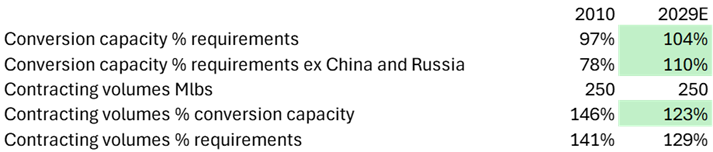
We do not see conversion capacity as a bottleneck for the start of a restocking cycle. In 2010, utilities contracted c250 Mlbs annually - equivalent to over 140% of conversion capacity at the time. By 2029, assuming Westinghouse’s Springfields facility in the UK (5 KtU) returns online, a similar 250 Mlbs contracting volume would represent c130% of requirements but only c120% of conversion capacity — a more comfortable ratio. Western conversion capacity as a percentage of requirements would also improve versus 2010, reflecting European reactor retirements in Germany and the UK.
Conversion capacity vs U3oU requirements and l.t contracting volumes 2010 vs 2029E. (2010 was amongst peak contracting years)
Source: Asymmetric Research
Separately, on the supply side, Kazakhstan’s newly approved Nuclear Industry Development Strategy, which earmarks very significant reserves for a strategic stockpile implies Kazakh production available to the market could run c20% below subsoil levels in the coming years, which utilities are certainly not pricing in.
Then, again on the demand side, in our detailed uranium report last week, we highlighted nuclear power and uranium as key beneficiaries of heightened energy security concerns in the wake of the Iran conflict. Countries such as Pakistan and Bangladesh, which have suffered blackouts, could dramatically reshape the global nuclear growth trajectory if they prioritize energy independence.
Comments
Nothing yet. Say the first thing.
Sign in to join the conversation.