
The Saturn–Neptune conjunction in Aries is an extraordinary astrological event that only happens once every 320 years. Saturn, the planet of structure, responsibility, boundaries, time, and embodiment, requires approximately thirty years to complete its journey through the twelve signs of the zodiac.
The cycle begins in Aries, the sign of ignition and emergence, and concludes in Pisces, the sign of dissolution and return, mirroring the arc of a full human lifetime from first breath to final surrender.
As the ruler of Capricorn and Aquarius, Saturn governs labor, discipline, societal frameworks, and the tension between tradition and disruption, and wherever it enters the zodiac it demands maturity, accountability, and the patient work of building something that can endure within the specific symbolic terrain of that sign.
Neptune, by contrast, is the planet of transcendence, compassion, faith, illusion, and divine consciousness, and as the ruler of Pisces it carries themes of surrender, spiritual permeability, and remembrance of origin. The planet of dreams moves so slowly through the heavens that it takes approximately one hundred and sixty five years to complete a full zodiacal cycle, imprinting entire generations with a shared spiritual mood. Neptune dissolves what has become rigid or ego-bound, inviting humanity to remember its source and to realign its path with something greater than personal ambition, insisting that meaning arises not from control but from attunement to the divine current that flows beneath all forms.
For these two planets to meet at zero degrees of Aries is astrologically extraordinary, as zero Aries represents the pure beginning of the zodiacal cycle, the raw spark of becoming before identity has taken shape. The zodiac itself is a symbolic map of an entire human life and so this conjunction signals not merely a new chapter but the initiation of a new life path for the world itself. Structure and dream, form and spirit, discipline and surrender converge at the very point of emergence, suggesting that the future can no longer be built through force alone nor through escapism, but through a fusion of grounded responsibility and divine vision that must be consciously embodied.
This conjunction unfolded on the eve of Shabbat Parashat Terumah, the Torah portion in which the Jewish people are instructed to build a Mishkan, a sanctuary for the Divine. In this Torah portion, The verse states: “They shall make for Me a sanctuary and I will dwell within them,” a phrasing that the sages famously note does not say within it but within them. This teaching explains that the true dwelling place of the Divine is not a structure of wood and gold but the human heart and consciousness. This mirrors the Saturn–Neptune conjunction precisely, as Saturn the builder and Neptune the dream cannot construct anything external unless the inner sanctuary has first been prepared, activated through the uniquely Aries quality of individual soul spark, courage, and spiritual selfhood.
The word Terumah: “Offering” itself derives from the Hebrew root רום meaning to lift, elevate, or raise upward, and also carries the meaning of separation for the sake of holiness, as something is taken from the mundane and offered upward toward Go-d, reflecting the spiritual work of refining one’s life by elevating material existence toward divine purpose.
HaTerumah, meaning “the offering,” carries a gematria of 656, identical to that of Shushan, the capital of the Persian Empire in the Megillah of Esther.
Shushan serves as the central stage upon which the drama of Purim unfolds, a city of immense power and apparent permanence that quietly becomes the site of hidden Redemption.
It is within Shushan, and specifically within the palace itself, that the deepest expression of HaTerumah: the ultimate offering is revealed. Queen Esther, concealed in position and identity, bears the unbearable weight of deciding whether she will reveal who she truly is and risk everything to save her people.
Her hesitation is shattered by a single piercing question:
“But who knows if you were born for such a moment as this?”
A line that transforms uncertainty into destiny.
Esther’s sovereignty is ultimately revealed when she understands that her power does not lie merely in the title of queen, but in her willingness to step fully into authorship of her own story and take the necessary risk.
Today, Persia once again stands in turmoil, with the Iranian people subjected to oppressive forces reminiscent of the villainy embodied by Haman. Yet astrology reminds us that Mars, the ruler of Aries and thus the energetic activator of the Saturn–Neptune conjunction, currently resides in Aquarius, the sign of collective liberation.
Esther’s declaration, “If I perish, I perish,” encapsulates the essence of Aries courage, the willingness to risk the death of the old self in order to align with truth, and this same inner spark must awaken within each individual now, as personal bravery becomes the catalyst for the collective freedom of Aquarius.
Aquarius, and the month of Shvat which it governs, correspond to the season in which the sap rises within the trees, an invisible yet unstoppable movement of life returning upward.
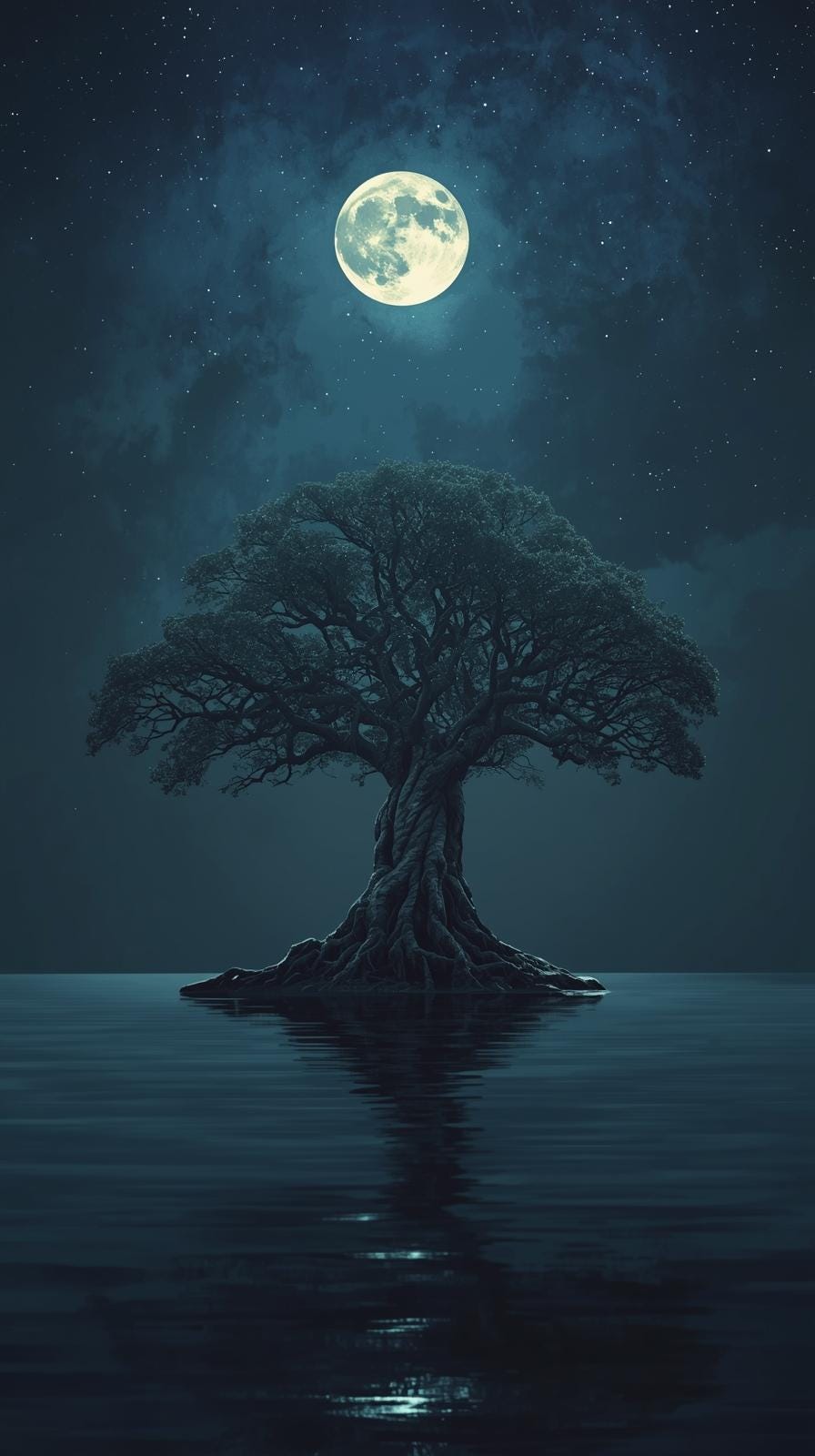
In the story of Purim, the tree holds profound symbolic importance, as through a moment of radical reversal the very gallows that Haman prepared for Mordechai, the jewish advisor, become the instrument of his own downfall. Haman and his ten sons end up hung on The Tree.
“The Tree” is HaEtz in Hebrew and the gematria is 165, the precise number of years it takes Neptune to complete its cycle.
“The Tree” is ultimately the one Tree, the Tree of Life, identified with the Torah, which is likened to water, the medium in which the fish of Pisces swim.
“She is a tree of life to those who hold fast to her”
Pisces energy is unseen yet sustained, reminding us that true life flows through immersion in divine wisdom rather than domination of external reality.
As Neptune, ruler of Pisces, enters a new beginning and Saturn lays the foundations for a new world structure, humanity stands at the threshold of a renewed relationship with the Tree of Life, beginning once again the third day of the Hebrew month of Adar.
The 3rd day is known in Jewish tradition as the day of Chazakah, a term that signifies establishment, confirmation, and the solidification of a spiritual reality through repetition. Three stands for Chazakah as something that occurs three times is no longer accidental but presumed to belong to the fabric of what is unfolding.
On the 3rd day of the month of Adar, we witness the embodiement of Pisces reality: we are closer to the divine than we think and the tide is always turning, the presumption is clear. A flip is set in motion and what is high will be brought low, and what is low will be lifted high.
May we merit to walk this path with courage and humility, building sanctuaries within ourselves where the Divine may dwell, and may the hidden reversals of this season unfold for all beings.
May we witness the ultimate reversal of this exile, where the waters of divine consciousness flow just as the waters of the oceans cover the seabed. May the Saturn-Neptune conjunction in Aries be the catalyst to the full Redemption we have been waiting for. May it happen immediately.
Comments
Nothing yet. Say the first thing.
Sign in to join the conversation.