
3.1 Principles for Selecting Astrological Markers
3.2 The Language of Describing Cycles: Astrological Measures
3.3 The Coordinate System for Deriving Marker Meanings
3.4 The Planetary Markers: From the Moon to Pluto
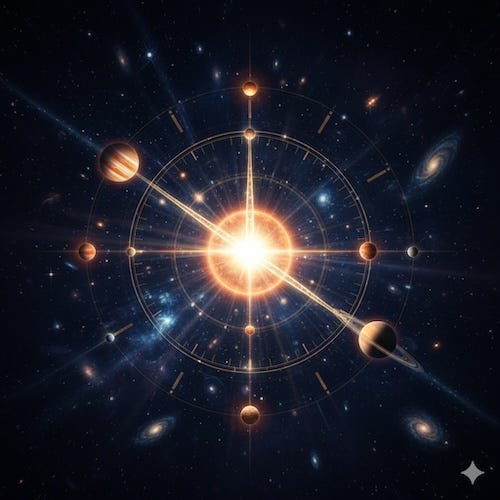
Chapters 1 and 2 established the foundation: we exist within the process of [Field], which develops cyclically in Time (Chapter 1), and we interact with it through a unified mechanism of Synchronization, Resonant Imprint, and Resonance (Chapter 2).
Now a practical question arises: what specific markers do we use to track the rhythms of [The Field]?
We cannot “observe” the process of [Time] directly. But we can observe stable, repeating cycles in the physical world that mark this process. The planets of the Solar System are such ideal markers.
However, two critical objections arise:
Selection: Why these specific objects? Why not stars, asteroids, or comets?
Scale: How can a human being resonate with the cycle of Pluto (~248 years) if our biological lifespan is much shorter?
This chapter answers these questions. We will provide a rigorous justification for the selection of markers and introduce the concept of the Horizon of Perception, showing that planetary meanings are not arbitrary myths, but logical derivatives of their orbital cycles relative to human life.
[MSA] uses only the Sun/Earth, the Moon, and the planets (from Mercury to Pluto) as markers of temporal cycles. This choice follows three strict criteria:
Criterion 1: The Principle of Systemic Integrity Only objects that are stable, integral parts of the gravitationally bound Solar System as a unified whole are considered.
What this excludes: Stars and Comets.
The logic: If [The Field] has a structure, the markers of its rhythms must belong to a single, stable structure.
Criterion 2: The Principle of Cyclical Predictability Only cycles that are long-term stable and mathematically predictable for centuries and millennia are used.
What this excludes: Cycles of solar activity (sunspots) and geomagnetic storms.
The logic: Markers must be reliable “clocks.” Only stable orbital cycles provide the necessary precision.
Criterion 3: The Principle of Hierarchical Significance Only objects that play a key, structure-defining role in the architecture of the Solar System are selected.
What this excludes: Asteroids (they represent a “belt” of small objects rather than a single structurally significant rhythm).
The logic: [MSA] studies the fundamental rhythms of [The Field], not all possible fluctuations.
Traditional astrology appeals to history, but [MSA] provides a strict answer based on The Principle of the Dynamic Boundary.
The MSA Solution: The Principle of the Dynamic Boundary This principle states: the effective boundary of a stable system is defined not by distance, but by the final key mechanism that ensures its long-term structural stability. In our Solar System, this is the stable 2:3 orbital resonance between Neptune and Pluto.
Neptune marks the beginning of the “deep field” of the collective unconscious.
Pluto, as its resonant partner, marks the farthest, yet predictable and stable, rhythm of this structure.
Conclusion: Pluto is not the “last planet,” but the marker of the outer boundary of the Solar System’s stable framework.
In [MSA], each planetary cycle is viewed as a developmental process. To describe this, we use three key measures:
Unit of Time for a Celestial Body: The time interval during which an object moves one degree along its path. This allows us to understand the “resolution” with which each marker reads time.
Planning Horizon: The first, active half of the full cycle (0° to 180°). This corresponds to the period of active realization and external manifestation.
Full Cycle: The total time from one conjunction to the next (360°). It describes the entire process from the birth of an impulse to its complete assimilation.
[MSA] does not borrow meanings from tradition or mythology. Meanings are logically derived from two fundamental coordinates:
The Earth’s orbit serves as a natural threshold of perception, dividing the Solar System into two regions:
Inner Planets (Mercury, Venus): Their orbits lie inside Earth’s. This links them to processes that are internal to our consciousness and precede external action.
The Threshold System (Earth/Sun): Our point of reference. It symbolizes the core of consciousness and will (”I”).
Outer Planets (Mars onward): Their orbits lie outside ours. This links them to the manifestation of will and interaction with the external world.
The duration of each planet’s cycle determines the scale and level of the psychological process—from operational daily reactions to multi-generational transformations.
Any cycle is a process described through a triad of modalities:
[Impulse] (Cardinality): Sudden release of energy; a moment of beginning or crisis.
[Flow] (Fixity): Energy concentrated in sustained movement; stable implementation.
[Accumulation] (Mutability): Transition from movement to potential; adaptation and preparation.
Based on the temporal scale relative to the human lifespan, we divide markers into three zones:
Zone 1: The Zone of Mastery (Moon through Saturn): Cycles repeat multiple times within a life. This is the zone of personal responsibility and mastery.
Zone 2: The Zone of Life Scenario (Uranus): The cycle (~84 years) corresponds to a complete human life. It frames our entire biography; we live it exactly once.
Zone 3: The Zone of the Transpersonal (Neptune and Pluto): Cycles are significantly longer than a human life. This creates the effect of Illusion (Neptune) or Fate (Pluto) because we only see a fragment of the full arc.
When we analyze a planet, we are analyzing the corresponding process in the human psyche, matched by scale.
Unit of Time: ~2 hours | Full Cycle: ~29.5 days
Key Principle: Our interface to the memory of [The Field]. It governs intuitive recognition, automatic reactions, and the primary “safe/dangerous” instinctive response.
Unit of Time: ~6 hours | Full Cycle: ~88 days
Key Principle: Our “operating system” that answers the question “What is this?”. It is the neutral identification and classification of stimuli into a mental map of reality.
Unit of Time: ~15 hours | Full Cycle: ~225 days
Key Principle: Our system of internal evaluation: “Do I like this?”. It translates facts into personal preferences and forms stable values and attachments.
Unit of Time: 1 day | Full Cycle: 1 year
Key Principle: The core of the personality—the fundamental impulse of “I AM!”. It is the center around which all other psychological functions are organized.
Unit of Time: ~2 days | Full Cycle: ~2 years
Key Principle: The “principle of active engagement.” It represents the transition from the inner world to external action, achieving desires, and protecting boundaries.
Unit of Time: ~12 days | Full Cycle: ~12 years
Key Principle: The level of social integration. It governs growth, expansion, and the drive to find one’s authoritative place within a larger social system.
Unit of Time: ~25 days | Full Cycle: ~29.5 years
Key Principle: Crystallizing experience and building reliable systems. It represents frameworks, discipline, and achieving mastery through time and effort.
Unit of Time: ~70 days | Full Cycle: ~84 years
Key Principle: The principle of deviation from the norm. It marks generational cycles of renewal—the process of implementing alternative ideas that “hack” the established order.
Unit of Time: ~138 days | Full Cycle: ~165 years
Key Principle: The complete dissolution of boundaries. It marks the collective unconscious—the dominant ideologies, global faiths, and shared dreams of an era.
Unit of Time: ~207 days | Full Cycle: ~248 years
Key Principle: An instinctive, purifying reaction to what has become non-viable. It marks the rhythm of transformation of deep socio-psychological structures.
We have established that the choice of markers in [MSA] follows strict criteria. These markers are not the causes of events, but the hands on the clock face of the process of [The Field]. Understanding these rhythms is the foundation of astrological navigation.
No posts
Comments
Nothing yet. Say the first thing.
Sign in to join the conversation.