
The Fundamental Theory of Meta-Scientific Astrology [MSA]
1.1 Positioning [MSA]: The Status of the Theory
1.2 The First Principle: From Substance to Process
1.3 Dreams and ASCs: Direct Observation of the Two-Layered Reality
1.4 The Two-Layer Model of [MSA]: A Third Way
1.5 From Observation to Action: Astrology as a Navigational Technology
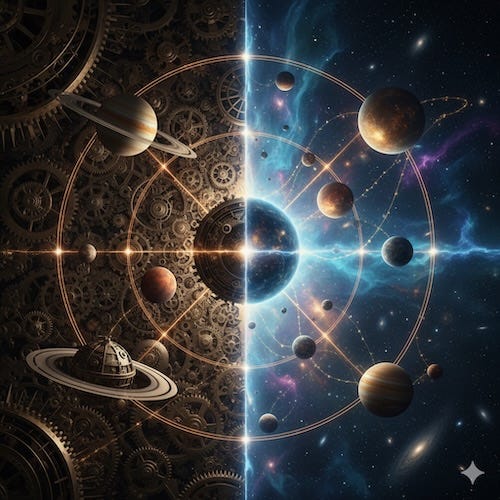
Before we begin studying astrology, we must address the elephant in the room. Traditional astrology relied on myths. Modern attempts often try to clumsily attach astrology to quantum physics, claiming that planets affect us through “entanglement.”
This document takes a different path. We pose a difficult question: If we strip away the mysticism and the bad physics, is there a logical model left?
Modern science has proven that reality at its core is non-local and probabilistic. We don’t claim that astrology is quantum physics. We claim that astrology operates on the same fundamental logic as the quantum world—the logic of probability collapse and observer participation. This chapter outlines the philosophical framework of [MSA], positioning it not as magic, but as a description of the informational structure of reality.
These discoveries aren’t just “interesting”—they fundamentally change the very logic of what is possible. If reality is probabilistic and non-local at its core, the question is no longer “can a non-local connection exist?” but rather “what is its structure?”.
Crucially: [MSA] doesn’t claim that astrology operates through quantum entanglement or subatomic forces in a literal physical sense. We are not attempting to prove astrology by reducing human fate to particle physics.
Instead, [MSA] uses quantum mechanics as a structural analogy (homology). We rely on the Principle of Fractal Similarity: the fundamental logic of how Potential becomes Reality (wave function collapse) is universal across all scales—from micro-particles to macro-destinies.
Therefore, terms like superposition, collapse, and observer are used in this theory as the most precise philosophical and descriptive language for these macro-processes, rather than as claims about the physical properties of biological bodies.
[MSA] positions itself as a proto-scientific theory — a theoretical framework for a future, more holistic science capable of integrating the objective world and subjective experience. Drawing on the insights of process philosophy (Whitehead, Jung, Bohm), [MSA] constructs a logically consistent model of reality as a living, creative process. Within this model, astrology finds its natural place as a language for describing the rhythms and patterns of this interconnected Universe.
Classical science was based on the idea of things as the primary reality. Atoms, particles, objects—everything that “is.” Processes were considered secondary—the result of the interaction of things.
However, quantum mechanics, relativistic physics, and modern cosmology have inverted this logic. It turned out that fields and processes are more fundamental than things. An electron is not a “little ball” but a stable pattern in a quantum field. Spacetime is not a container but a dynamic structure.
[MSA] follows this logic to its conclusion and postulates the existence of a single, dynamic, and informational foundation of all existence, which we will call [The Field].
An Important Clarification on the Term [The Field]:
The term “[The Field]” is used here not in its narrow physical sense (like an “electromagnetic field”) but as a supremely general abstraction—a pointer to the unity and process-based nature of reality. This is a methodological choice to avoid reduction to specific physical models while maintaining conceptual rigor. [The Field] in [MSA] is a philosophical category, close to concepts like Whitehead’s “being-as-becoming” or Bohm’s “holographic universe.”
If [The Field] isn’t static but is a continuous process, a fundamental question arises: what is Time?
In the classical paradigm, Time is an external parameter, a “river” in which events float. But if everything is a process, where does this “external river” come from? [MSA] offers a radical answer: Time as a separate entity does not exist. What we call Time is the very process of [The Field]’s becoming.
Time is not a dimension in which changes occur. Time is change itself, the very fabric of reality in its eternal self-computation. It is the procedural nature of being itself.
Observing the world, we see that this universal process develops not chaotically, but cyclically. Day follows night, seasons repeat, planets return to the same points in the sky. This stable cyclicity is not an accident but a fundamental property of the process of [The Field] itself.
From cyclicity, two key effects logically emerge, forming the basis of the [MSA] astrological model:
[Synchronism]: If everything is part of a single cyclical process, all elements naturally align with its basic, repeating rhythms. This is a direct consequence of the fact that there are no separate, isolated processes—there is only one process of [The Field].
Analogy: The musicians in an orchestra don’t “influence” each other directly, but they are all synchronized with the single rhythm of the conductor. In the same way, all systems in the Universe are instinctively synchronized with the fundamental rhythms of [The Field].
[Resonance]: Every system (be it an atom, an organism, or a person) has its own structure, which determines its unique sensitivity to certain “frequencies” or patterns in the overall process of Time. This is resonance—a selective response to those rhythms that correspond to the internal structure of the system.
A tuning fork vibrates only in response to a sound of its own frequency. Similarly, every living system has its own unique “resonant profile”—a set of patterns in [The Field] to which it responds most strongly.
[Astrology], in this context, is humanity’s natural and inevitable attempt to study this process. It uses the movement of the planets as the most stable and predictable markers for tracking the fundamental cycles of Time.
The planets don’t “influence” us. They mark the objective rhythms of [The Field] with which we are in constant synchronization. A natal chart is a “snapshot” of these cycles at the moment of birth, which describes our unique “resonant profile”—the frequencies of [The Field] to which our system is tuned to resonate most strongly.
Modern quantum physics gives us a language to describe how this process of Time works at the deepest level. It confirms that at its core lies a transition from one state to another:
[Proto-Reality]: The level of pure potential of [The Field], where all outcomes exist as information in a probabilistic state (quantum superposition).
[Consensus-Reality]: The single, actual result of the continuous “collapse” of this potential into the one manifested world that we all share.
This process-oriented model of reality finds profound parallels in the works of a range of thinkers—from Henri Bergson (time as creative duration) and Alfred North Whitehead (reality as process) to David Bohm (quantum potential and the implicate order).
The theoretical model of a two-layered reality—[Proto-Reality] and [Consensus-Reality]—may seem abstract. But we have a natural method, accessible to everyone, for its direct observation: our own consciousness. Every night, we journey between the two layers of reality without even realizing it.
Dreams are not “neural noise.” They are our nightly, natural immersion into the probabilistic layer of [The Field].
The fluid, multivariant, and illogical nature of dreams is a direct experience of the uncollapsed, quantum state of [Proto-Reality], where all possibilities exist simultaneously. In a dream, contradictory states coexist without issue. The physics of dreams is the physics of superposition.
The very act of waking up is a daily demonstration of the collapse process that we all witness.
In a single moment, the infinite multitude of probabilistic dream worlds “collapses” into the single, stable, and unambiguous [Consensus-Reality] of our bedroom. With our awakening, we connect our “observer” to the collective consensus, actively participating in its maintenance.
This explains why waking is often accompanied by the instantaneous loss of dream details: the probabilistic patterns of [Proto-Reality] cannot exist stably within the rigidly determined structure of waking consciousness.
Altered States of Consciousness (ASCs), achieved through meditation and other practices, are a conscious attempt to enter [Proto-Reality] without losing awareness.
The practice of lucid dreaming is a direct attempt to learn how to interact with this probabilistic layer while retaining the ability to observe and choose. It is the art of balancing on the edge between collapse and superposition—the skill that forms the basis for consciously navigating reality.
Section Summary:
The dream is a direct empirical experience of interacting with the probabilistic layer of [The Field]. The fluid, multivariant nature of dreams is precisely what uncollapsed reality looks like. And waking up is a daily demonstration of the collapse process.
This fact is crucial: the two-layer model of [MSA] is not abstract theorizing, but a description of a structure with which we already interact every day.
Modern physics faces a fundamental choice: Quantum mechanics shows reality exists in a probabilistic state “before measurement,” but what happens upon measurement?
The Copenhagen Interpretation (Standard Model):
Reality “collapses” at the moment of observation, and only one world exists.
The problem: It fails to explain the mechanism of collapse and grants the observer a kind of “magical” power.
The Many-Worlds Interpretation (Everett):
No collapse ever occurs. All probabilities are realized simultaneously, and the Universe constantly “branches” into an infinite number of parallel worlds.
The problem: It is ontologically redundant and fails to explain our subjective experience of reality’s singularity.
[MSA] proposes a third way, which synthesizes the strengths of both models:
From Copenhagen: A real collapse occurs into a single, unique [Consensus-Reality].
From Many-Worlds: The probabilistic layer is ontologically real—not just ignorance.
The Key Distinction of MSA:
The second layer is not a set of parallel, stable worlds (Everett’s model), but a single field of uncollapsed potential—[Proto-Reality]. It is the probabilistic matrix of possibilities from which the single [Consensus-Reality] is constantly “crystallizing.”
Analogy: [Proto-Reality] is like a liquid containing all possible forms, while [Consensus-Reality] is the ice, frozen into one specific shape. The shape of the ice is unique, but the liquid from which it arose is real and contains all other potential forms.
If the Many-Worlds Interpretation were literally true, our experience in ASCs and dreams should be a “journey” to other stable worlds with their own consistent physics.
But this does not match observed experience. The worlds of dreams possess fundamentally different properties:
Fluid and ephemeral (not stable).
Illogical and contradictory (lacking consistent physics).
Probabilistic and multivariant (superposition).
These properties perfectly match the theoretical description of an uncollapsed quantum state of superposition, not “another classical universe.”
Furthermore, the transition between dreaming and waking has the character of a collapse (a sharp reduction of multiplicity into singularity), not a switch between two stable worlds.
Our own dream experience serves as a direct empirical argument in favor of the two-layer model of [MSA]. It shows us the structure of reality from the inside:
✓ One manifested, consensus layer exists (waking).
✓ A real, probabilistic layer exists (dreams).
✗ An infinite set of parallel, stable universes does not exist.
Reality consists of two interacting layers of one world—a probabilistic potential and its single actualization.
Thus, our own experience of dreams and ASCs serves as direct empirical evidence for the two-layer model of [MSA]. It shows that reality indeed consists of one manifested, consensus layer and one real, yet probabilistic, proto-layer.
We established that reality is two-layered: a probabilistic potential ([Proto-Reality]) is constantly collapsing into a single manifested reality ([Consensus-Reality]). Our consciousness is capable of interacting with both layers.
Now a practical question arises: can we influence which specific probability “collapses” into our daily lives?
The “Observer Effect,” confirmed by quantum physics, says: “Yes, we can.”
Confidence, purity of intention, focus of attention, and the quality of awareness all influence the process of probability collapse. We are not passive observers of a fixed destiny, but active participants in the process of reality’s formation.
However, we exist within the objective process of [The Field] with its own rhythms. Trying to “manifest” something against the objective current of [The Field] is like trying to swim against a strong current—one can expend enormous effort and achieve nothing.
The synthesis—the combination of ancient knowledge of cosmic cycles with a modern understanding of the role of consciousness in shaping reality—is at the heart of Meta-Scientific Astrology.
It transforms astrology into a technology for conscious interaction with a process-based reality, which gives us three key tools:
A Map of Personal Resonance (the natal chart)
It describes our unique “resonant profile”—the patterns of [The Field] to which our system is tuned to respond most strongly. This is not “fate,” but a map of our innate frequencies.
A Calendar of Objective Cycles (transits)
It tracks the current rhythms of [The Field]. This allows us to understand which potentials are most accessible at a given time, when the “current” favors certain actions.
An Understanding of the Mechanics of Reality Creation
Knowledge of the two-layer structure allows us to use our “rudder”—conscious choice and intention—most effectively. Not against the current, but by harnessing its power.
Imagine an experienced mariner. They cannot control the wind or the ocean currents, but they can:
Know the schedule of high and low tides (cycles of [The Field])
Understand how their ship responds to different types of wind (personal resonance)
Use sails and a rudder (conscious intention) to move toward their goal
This is precisely the approach of [MSA]. We don’t promise “power over fate.” We offer a map and a compass for navigating the living, procedural ocean of reality.
Key Thesis of Chapter 1:
[MSA] Astrology is not fortune-telling or mysticism. It is a technology for navigating a process-based reality that gives us:
A Map of Resonances (natal chart) — what in [The Field] resonates with us.
A Calendar of Cycles (transits) — when certain patterns are active in [The Field].
An Understanding of the Mechanics (the two-layer model) — how the process of probability collapse works.
This is not the prediction of a fixed future, but conscious participation in the process of its formation. [MSA] Astrology is the most precise tool known for navigating the rhythms and currents of the universal [Field].
P.S. Want to test these ideas yourself? I’m building ALFI: Interface (Web/IOS/Android/Windows)
No posts
Comments
Nothing yet. Say the first thing.
Sign in to join the conversation.