
Last week, I shared the manifesto.
All of you subscribed—thank you.
Today, we begin the journey.
This is the first of three acts where I’ll show you:
- Why traditional astrology fails
- What signal persists despite the broken model
- And what mechanism actually works
Let’s start with the evidence.
For a moment, let’s set aside both faith and skepticism. Let’s treat astrology as we would any serious idea: place it on the witness stand and impartially examine the evidence.
This process is neither an attack nor a defense. It is an honest investigation that is long overdue. For millennia, the star chart has been both a sacred text and an object of ridicule for humanity. It’s time to stop the arguments and start asking the right questions. The main one being: what is the natal chart truly capable of, and where do its powers end?
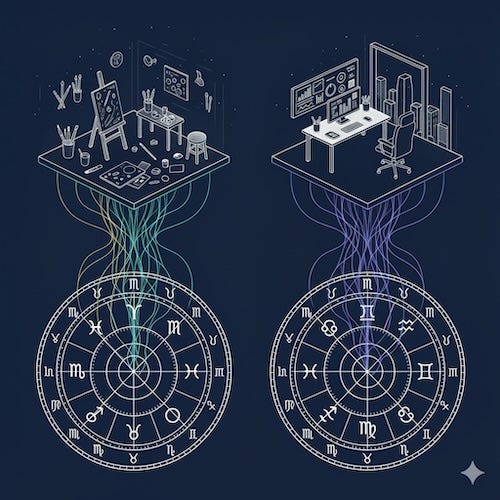
Part 1: The Indictment
Incontrovertible Evidence
Any system that claims to describe reality must withstand the scrutiny of that same reality. Classical astrology, in its predictive form, makes a number of very specific, material claims. And it is here, when confronted with facts, that its case begins to fall apart.
Exhibit A: The Case of the Twins
This is the simplest and most damning argument. Two people are born in the same hospital minutes apart. Their natal charts are virtually identical. According to the logic of predetermination, their lives should be mirror images. But reality shows us otherwise. One becomes a successful entrepreneur, the other a modest teacher. One chart—two completely different destinies. This fact alone deals a fatal blow to any notion of a fatalistic script.
Exhibit B: The Failure at the “Lineup”
Classical astrology claims it can describe a person’s specific, objective characteristics from their chart. But in any large-scale test, this ability proves to be an illusion. Statistics and simple life experience irrefutably prove: the natal chart does not determine:
Appearance: The claim that Venus on the Ascendant grants beauty or Saturn ensures tall stature is nothing more than a myth.
Profession: There is no ‘doctor’s chart,’ or ‘ballerina’s chart.’
Sex, sexual orientation, or gender identity.
Specific events: The chart will not predict the winning lottery ticket number, the date of a wedding, or the outcome of a football match.
But before we continue, let’s listen for a moment to a strange whisper coming from a completely unexpected place—the laboratories of quantum physicists.
In the early 20th century, as physics delved into the world of atoms, it discovered something so absurd that the scientists themselves refused to believe it. An elementary particle, it turned out, exists not in one place, but in many places at once—in a state called “superposition.” This is not a metaphor. It is a mathematically proven fact.
Even stranger: the very act of observation somehow forces this probability, smeared across space, to ‘collapse’ into a single reality. You look—and the particle chooses where to be. You don’t look—and it remains ‘everywhere and nowhere.’
Albert Einstein, one of the greatest minds, called this ‘spooky action at a distance’ and refused to accept it. Niels Bohr, another titan of physics, famously replied: “Anyone who is not shocked by quantum theory has not understood it.”
Why are we talking about this here, in an investigation of astrology?
Because for a hundred years, physicists have been living with a paradox: at the foundation of the ‘solid’ world lies an ocean of pure possibilities. Reality is not fixed—it is procedural. And the observer’s consciousness plays some mysterious, still not understood role in it.
We will not unravel this mystery now. We will simply leave it here, like a seed. Because when we get to the real explanation of how astrology works, this seed will grow into something unexpected.
For now, let’s return to our investigation.
Part 2: The Defense’s Move
The Elegant Maneuver of Astropsychology
When it became clear that astrology as a ‘physics of fate’ was untenable, its main and cleverest defender took the stage: astropsychology.
Its argument was a masterstroke. It went like this: ‘You’ve all misunderstood! Astrology was never about appearance or events. It’s a language for describing the psyche. It’s a map of our soul, our innate talents, our psychological complexes, and our points of growth.’
This elegant maneuver allowed astrology to retreat from the battlefield where it was losing to facts and take refuge in the territory of the subjective, the subtle, and the immeasurable—the depths of human psychology. But is this fortress truly so impregnable?
Part 3: The Cross-Examination
A Double Blow to Subjectivity
It is on the territory of astropsychology that we find the fatal flaw. To see it, let’s conduct a thought experiment. Take one specific placement: Mars in Cancer in the 7th house. The theory describes this as the archetype of a “family protector,” whose energy is directed toward partnership and colored by emotions.
And what do we see in reality?
Person A becomes a brilliant family lawyer.
Person B is a domestic tyrant.
Person C is a chef who pours passion into caring for others.
Person D suppresses this energy and suffers from psychosomatic illnesses.
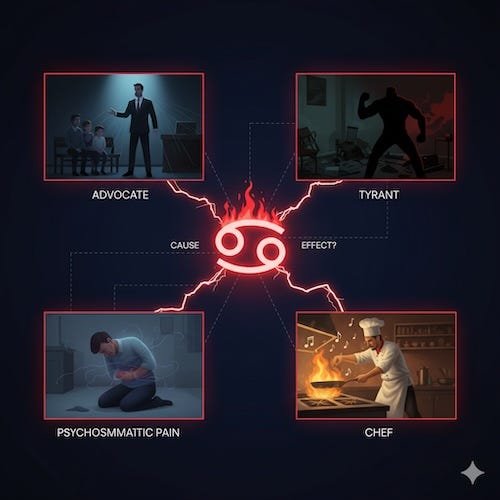
One “recipe”—four completely different “dishes.” This leads us to the first question: if the same astrological “cause” produces mutually exclusive effects, can we even call it a cause?
But the problem is deeper. Let’s invite two astrologers from the same school. One, based on their experience, will see the potential for a strong family in this placement. The other, recalling a different client, will emphasize the risk of passive aggression. Both pieces of advice may be wise, but they are different. This reveals the second problem: the interpretation of the chart is colored by the personality and experience of the astrologer themselves.
The result is a double blow to objectivity: the client can express the energy in countless ways, and the astrologer can interpret it through the lens of their own worldview. This proves that the supposed mechanism of “influence,” as presented by astropsychology, simply does not exist.
The verdict of our investigation is clear: the traditional model, based on the cause-and-effect influence of the planets, is an intellectual dead end. Neither predictive astrology nor its psychological version can withstand a collision with facts and logic. Their foundation crumbles.
It would seem the case could be closed. But this is where the real mystery begins.
Because, despite all its logical inconsistency, astrology stubbornly refuses to die. And the reason is simple: anyone who has seriously engaged with it knows that strange, inexplicable feeling. The feeling when a vague description suddenly hits the mark with pinpoint accuracy. When a prediction that shouldn’t have come true suddenly proves prophetic.
This is the central paradox. On one hand, a broken, non-working mechanism of ‘influence.’ On the other, a persistent, recurring ‘signal in the noise’—moments of astonishing accuracy that occur far more often than simple probability theory would allow.
How is this possible? How can a system with a flawed premise at its core occasionally produce correct results?
It can only mean one thing: there is a grain of truth in astrology. But it is buried so deep under layers of myths and false interpretations that we have ceased to see it. We are trying to start a car by admiring the design of its body, not realizing that its engine is located somewhere else entirely and runs on a different kind of fuel.
To solve this mystery and find the true source of astrology’s power, we can no longer repair the old model. We must do what any good researcher does when they hit a dead end: go back to the very beginning.
We need to rewind the tape thousands of years, before the emergence of gods and psychological interpretations, and see the world through the eyes of the first observer. To understand not what astrology became, but what it was in its essence from the very start.
We’ve seen why the traditional model fails. The twin paradox. The lack of mechanism. The circular reasoning of “free will.” But here’s the paradox: the signal persists. Next week, in Act II, I’ll show you what astrology actually describes—and why your dreams are the proof.
**Every Wednesday at 9 AM EST.**
Don’t miss it.
P.S. Want to test these ideas yourself? I’m building ALFI: Web App
P.P.S. Can’t wait? Full trilogy at https://msa-astrology.com
— but weekly rhythm + discussions = better experience.
No posts
Comments
Nothing yet. Say the first thing.
Sign in to join the conversation.