
Rain hadn’t stopped in three days. It fell like sheets of silver needles, piercing through the village rooftops, hammering the muddy streets until the stones beneath seemed to groan.
It was the summer of 1998, when the Yangtze River floods surged across Hubei, swallowing farmlands, uprooting homes, and leaving entire villages under water. Though the river had swelled in seasons past, this time felt different, heavier. The water churned with a force that seemed to grind the air itself, the wind howling like a beast prowling for prey. The sky hung low and grey, clouds heavy with unshed grief, as if the land itself braced for a tragedy too great to stop.
In a cramped herbal shop near the Yangtze riverbank in Hubei China, the smell of aged bark, crushed leaves, and oil-soaked gauze clung to the air. A candle flickered low on the counter, its light barely holding against the damp. Mei Ling, then 3 years old, sat cross-legged on a woven mat, cradling a cloth pouch stitched with a faded lotus pattern. Inside, dried chrysanthemum blossoms, ginger root, and a sliver of sandalwood — her mother’s medicine, her warmth.
Mei Ling watched the rain, her little mind wandering at the way droplets danced like silver threads across the window frame. She admired the glimmering edges of the storm, the silver linings where light barely pierced through. Even as the winds howled, part of her felt wonder at the sheer power of nature, the way the sky and earth seemed to whisper to each other in water and wind, telling a story too big for her to understand.
Outside, suddenly a wave of voices surged in panic. “The river’s rising again! It’s broken the embankment!”
Her mother darted in, soaked to the bone, her hands trembling as she gathered bundles from the wall shelves. “Ling’er,” she whispered, kneeling down. “Listen to me. Don't be afraid, just hold on to this.” She pressed the pouch back into her daughter’s tiny hands and tied the drawstrings to her wrist. “Papa’s watching from the stars. Mama’s right here.”
Mei Ling nodded, though she couldn’t understand why her mother’s eyes glistened with fear instead of rain. They had weathered floods before — the river had always been wild, but never truly cruel. Yet this time, her mother moved with a sharper urgency, as if some deeper instinct warned her that the waters would not be forgiving. It wasn’t just fear of the river, it was fear of what it had become.
A thunderclap split the sky. The door burst open with a gust of water-laced wind. Villagers were shouting, some carrying what they could, some carrying nothing but dread.
They ran.
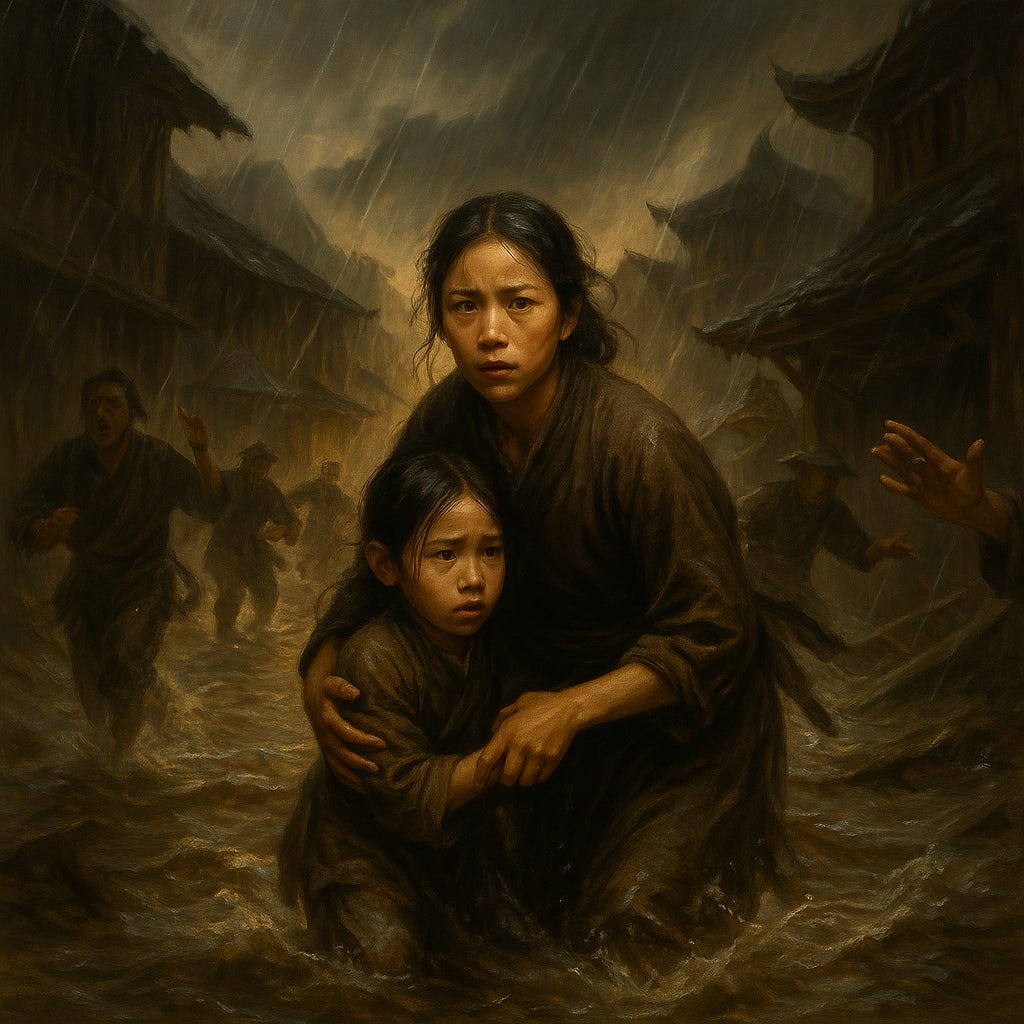
Through the narrow alleyways, they stumbled over slick stones and waded through water rising past their ankles, then knees, then thighs. Her mother clutched Mei Ling tightly, breath ragged, urging her forward with quiet words of reassurance even as her own steps faltered. Villagers pushed past, voices shouting to one another over the roar of the river, the wooden beams of nearby houses groaning as the current battered their foundations. Mei Ling could feel her mother’s heart pounding against her, faster, harder, as though willing them both to outrun the water itself. In a single heartbeat, the wooden walkway under their feet gave way.
Her mother cried out, arms wrapped around her as they fell. The current swallowed the light, the shop, the sky.
And then, silence.
***
The surface of the river calmed by dawn, but it was a hollow kind of stillness, like a song ending mid-note.
A stretch of broken wood floated slowly between uprooted trees and collapsed rooftops. Clinging to it with limp fingers was a lone child — her body curled tight, her breath shallow, the pouch still tied to her wrist. She was the only one left, the sole survivor of the village, carried by chance and water alone. No other cries rose from the ruins, no other hands reached from the flood. The storm had claimed every life but hers, leaving her adrift under the vast, uncaring sky. The sky was colorless. Mist hung above the floodwaters like a breath never exhaled.
On a slope above the village ruins, a figure watched.
He wore robes stained with rain and time, their edges frayed from long roads. His beard, streaked with white, moved faintly in the wind. He carried no umbrella. Only a bamboo staff and a small flask at his waist.
He descended without a word, boots sliding over loose earth until he reached the edge of the water.
The girl lay there, eyes closed, her skin pale beneath mud streaks. The drawstrings had cut lightly into her wrist. The pouch hung beside her like a question waiting to be answered.
The old man placed two fingers against her neck. A pulse — faint, but steady.
He lowered his head, murmuring something no one else could hear. Then, placing one palm above her chest, he exhaled gently, and a quiet warmth bloomed in the air around them. The river beside them rippled, not from wind, but resonance. Mei Ling’s eyelids fluttered.
When she opened them, she saw nothing but the man’s face. His gaze was neither kind nor cold, only calm — like stone warmed by sunlight.
He spoke one sentence.
“天道無親,常與善人。" ( ie. Heaven is impartial, it always sides with the good. )
Then, without explaining further, he lifted her into his arms and began walking.
The orphanage stood on the outskirts of a hill town spared from the river’s fury. Its walls were faded brick, roof tiles chipped and sagging, the scent of boiled cabbage lingering even outdoors. The old man arrived with the girl in his arms, the front gate creaked open slowly. A woman in a coarse apron stepped out, wiping her hands on her sleeves. Her expression tightened the moment she saw them.
“I thought you were one of those monks asking for rice again,” she muttered, looking Mei Ling over. “What’s this? Another flood orphan?”
The man didn’t respond. He simply bent forward, placing the girl gently on a worn straw mat by the gate. Her eyes were closed again, but her fingers still gripped the pouch. The woman crouched to inspect her, then hesitated.
“She’s breathing,” she murmured. “But barely.” She looked up. “You her kin?”
Still no answer. The man reached into his robe, withdrew a single silver coin, and set it beside the girl.
“Care for her,” he said, voice low but certain. “She is meant to live.”
Then he turned, boots crunching on gravel, and walked away without another word. The woman called after him once, twice, but he didn’t stop. Within moments, he vanished into the morning fog.
***
Time passed slowly in the orphanage, as if even the days forgot where they were. Mei Ling grew in silence. She rarely spoke, though she listened to everything — the clatter of bowls at mealtime, the coughs of the younger children at night, the scolding tone of the caretakers. She learned to memorize footsteps, to read moods before a word was said. She moved like wind between cracks. She remembered nothing of that man’s face. Only the weight of the silver coin, the feel of the pouch on her wrist, and the sound of the gate as it creaked closed behind her.
Five years has passed. Mei Ling turned eight, she was neither the smallest nor the strongest, but the others began to notice she never backed away from confrontation. When the older boys fought over scraps of bread, she stepped in. When one child cried because his blanket was stolen, Mei Ling brought it back without asking. She took beatings and bruises, but she never broke. There was one boy, tall for his age, always sneering. He tried to steal her pouch once — the same cloth lotus pouch tied at her waist with fraying threads. She caught his wrist mid-grab, eyes steady.
“Don’t touch that.”
He laughed, calling out in front of the others, "What’s wrong, little ghost girl? You think you’re special?" His words cut sharper than his shove, taunting her as she stumbled but didn’t fall. He raised a hand to strike her again, sneering, his friends jeering from behind him, and then it happened.
A sharp pulse of air burst from her, invisible yet real. The boy’s arm jerked back as if struck by lightning. He tumbled onto the floor, eyes wide, clutching his wrist in shock. Others gasped and scrambled back, some tripping over each other in their rush to distance themselves. One girl cried out, a caretaker rushing in only to freeze at the sight of the toppled boy and the small, trembling figure of Mei Ling. The candle nearby flickered, though there was no wind, and the room held its breath.
That night, no one came near her.
And for the first time, she felt afraid of herself.
After that night, whispers followed her like shadows.
Some children avoided her. Others stared too long, as if waiting for her to do something strange again. The caretakers didn’t ask questions, but one began to make signs with her fingers when Mei Ling passed, gestures meant to ward off spirits. Mei Ling said nothing. She kept to herself, rising before the others, sweeping the courtyard without being told. She took on chores no one else wanted. At night, she sat by the windowsill, watching the wind tug at the old prayer flags left behind by a long-departed monk.
The dreams came more often — dreams of water that didn’t drown, of light shimmering inside her chest, of mountains whose peaks touched the stars.
One evening, as the sky turned from blue to ash, she stood alone behind the orphanage, looking north. The hills in the distance seemed to rise endlessly, layered like waves frozen in stone. Somewhere beyond them, the clouds parted just enough for her to glimpse a jagged summit touched by sunlight.
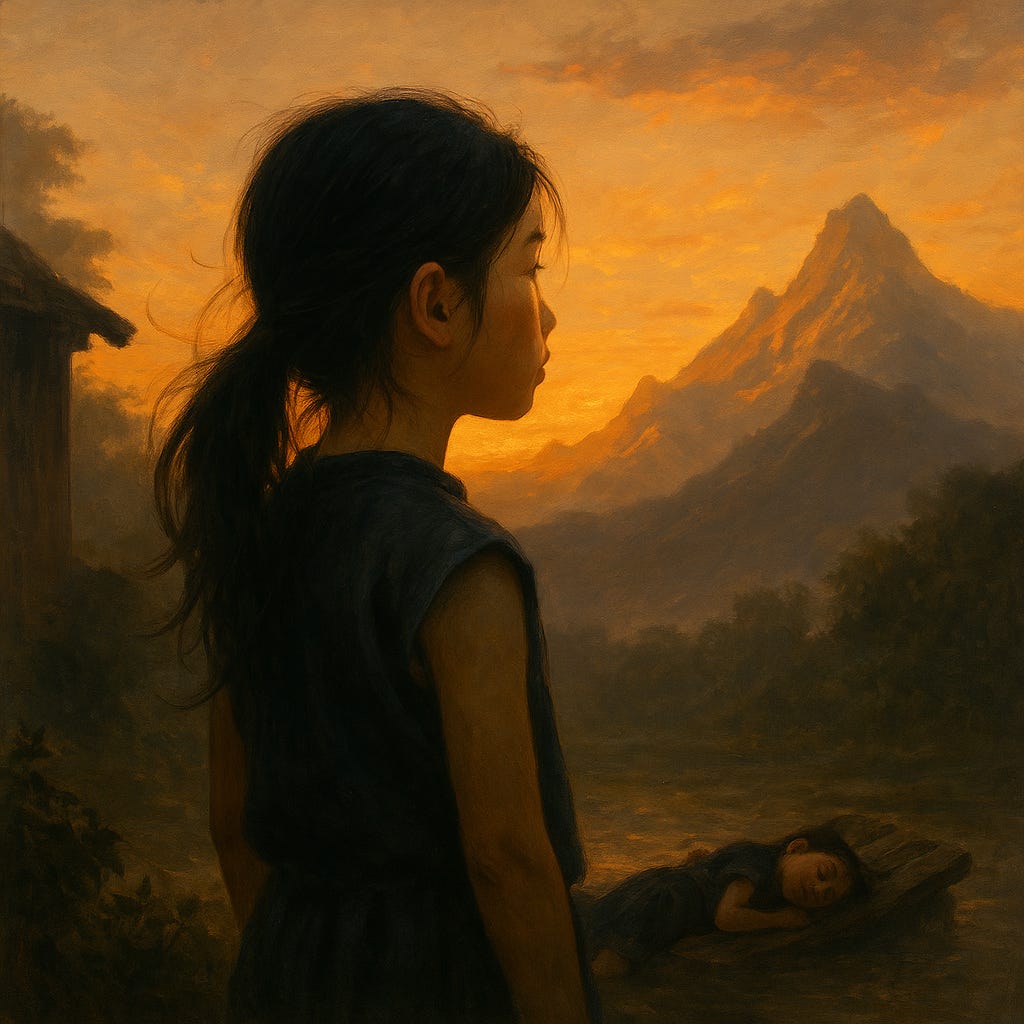
She didn’t know the name of that mountain. But something in her chest stirred when she saw it, a strange familiarity she couldn’t explain, as if that distant peak had been waiting for her all along. It felt like home. A pulse, faint yet steady, like a memory waiting to wake, a pull that told her, even in her small heart, this was where she should be.
Mei Ling tightened the pouch at her side and whispered, “I am going to leave this god-forsaken place, I am heading for the mountain.”
The wind answered softly, brushing her hair across her face.
And far beyond the orphanage, beneath the fading light, the mountain waited.
Comments
Nothing yet. Say the first thing.
Sign in to join the conversation.