
Today’s newsletter is brought to you in partnership with Microsoft Surface
Only yesterday I read an article declaring that young people had traded the “home improvement project” for the gym—an observation that wouldn’t have alarmed me had I not just spent the previous weekend at my in-laws’ family friends’ place, touring their 15-acre state-park-turned-family-estate, now dotted with eclectically designed buildings—an outdoor kitchen, a Japanese garden, a winter house—with a creek running through it somewhere and swings hanging from 100-ft trees. They’d bought the place in their 20s, moved into a garage-sized cabin, and begun to build. It was the ‘70s, and they had skills.
Over dinner, they shared stories of the many parties they’d hosted over the years, many featuring my husband as a precocious prepubescent flapping around in the creek and tying shoelaces under the table. These were my favorite kinds of stories: of septuagenarians and octogenarians, once young, gathering and building and making memories to be parceled out, decades later, as sweet anecdotes to future in-laws.
These were people for whom building a life was literal—hammer to nail. They were also, as my mother-in-law would say, “serious cooks”: people who understood that gathering well was a craft of its own, one made up of seating arrangements, conversation starters, parlor games, and meals that stretched late into the evening. Each gesture seemed insignificant on its own. Together, they carried decades of friendship.
The time for acquiring abandoned state parks before thirty had come and gone, but there were things I could do about seating arrangements and lifelong friendships. As the online were saying, I was in need of a personal syllabus: a self-designed learning plan for becoming the kinds of adults I wanted to be

It was important to me that whatever shape this took gave me more surface area to interact with the world. My work—and, increasingly, my whole life—already required more time behind a screen than I’d like, so this had to function differently:
The world before the internet. My curriculum could begin on a screen, but it couldn’t end there. Research was only useful if it led me somewhere: a cookbook borrowed from the library, a dinner party, a wine tasting, a florist, a conversation with someone who knew more than I did.
Observation as practice. Before I could host well, I wanted to become a better guest. Say yes to invitations. Pay attention to how different people welcomed guests into their homes, moved conversations along, introduced strangers, and made everyone feel looked after. Hospitality, I suspected, was something you learned by watching.
The practical and the pleasurable. I wanted to treat hosting as both craft and creative expression. Learn the mechanics—how to build a menu, pace an evening, and seat a table—but leave room for instinct, whimsy, and the small details that make people remember a night years later.
No grades, only repetition. Seriously, the point was to have fun while becoming the kind of adult I love reading about.
My starting material was small and scattered: a notes dump of thoughts started at 11 p.m. and never finished, a mood board I’d forgotten existed, a group chat asking how anyone learns which wine is any good, cookbooks on hold at the library, and every intention to say yes to more—the necessary field study. Did I feel a little ridiculous making such a fuss over things I assumed people much cooler than me had long since learned instinctively? Yes. Besides the point, though, isn’t it?
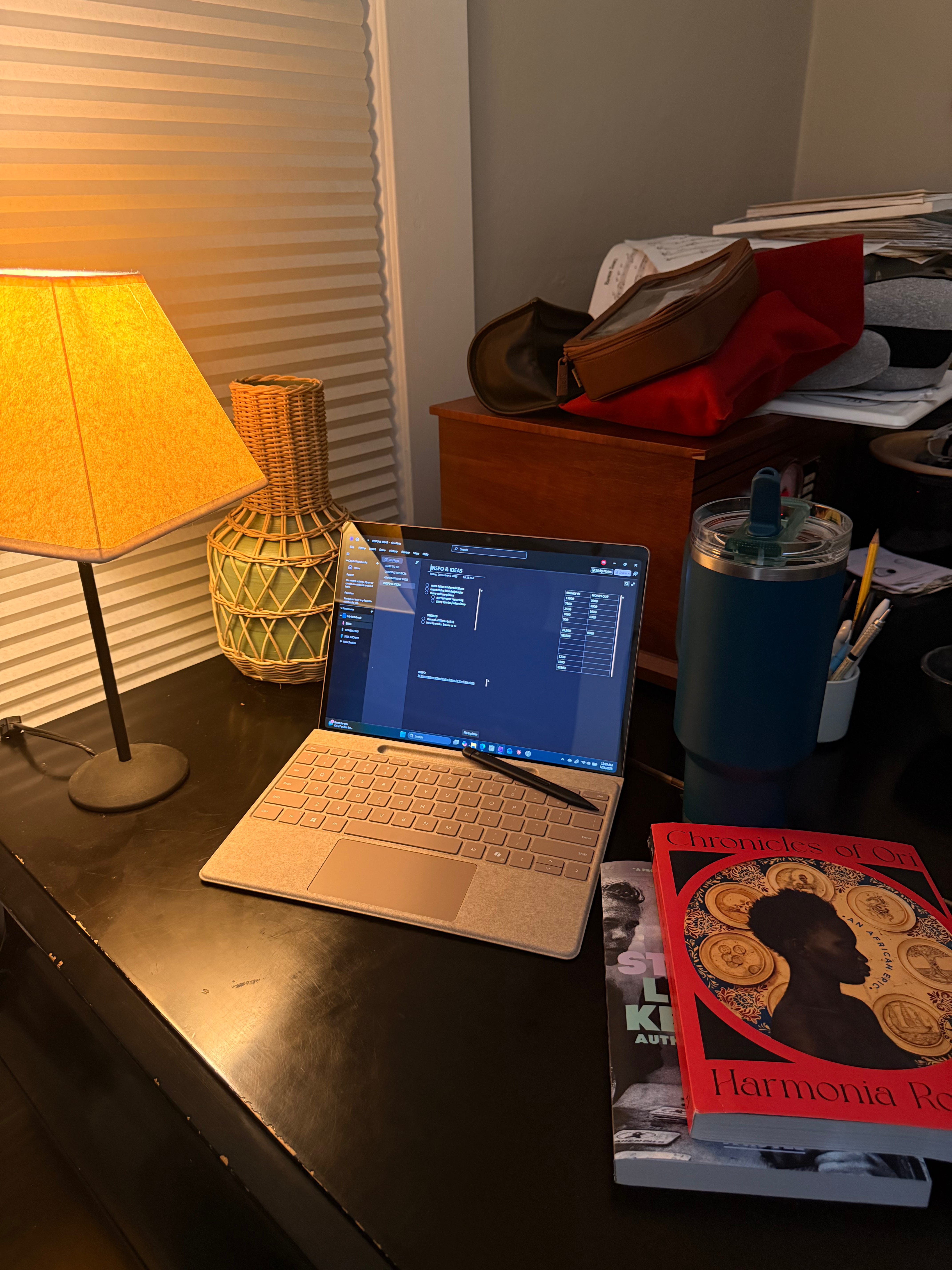
Once I knew what I wanted to learn, I needed somewhere to build the syllabus. My Surface Pro became less a device than a place to think: somewhere to collect recipes, reading lists, dinner party ideas, and all the half-baked questions that eventually turned into something I could actually follow.
Surface Pro as my planning desk. The syllabus itself lived in Word, where a messy collection of ideas slowly became a twelve-week plan. Split screen on the 3:2 display quickly became my default: a cookbook or article on one side, my own notes on the other. At the kitchen counter, I’d flip my Surface Pro into tablet mode and switch to the Slim Pen whenever I wanted to sketch out a menu, seating plan, or thought that felt easier to write than type.
Copilot as a second opinion. I wasn’t looking for it to tell me how to host. I wanted help turning a vague ambition into something I could actually practice. Every section of the syllabus went through several rounds of iteration with Copilot as I refined the results and continued to ideate with Copilot until it became something I genuinely wanted to spend a Saturday doing.
Prompt: Design a twelve-week curriculum for someone who wants to become a better host. Prioritize practical assignments, conversations, workshops, and real-world observation over passive reading.
The first version it gave me was, objectively, pretty good. It also confirmed something I’d already suspected: structure isn’t particularly hard anymore. Deciding what’s actually worth doing is.
OneNote as the messy margin. This is where everything ended up before it earned a place in the syllabus: dinner menus I’d never cook exactly as written, seating arrangements for imaginary parties, notes from books, observations from other people’s homes, and the little details I wanted to steal for myself. Somewhere in there I stopped trying to become “good at hosting” and started paying closer attention to what made people feel at home.
A syllabus that never leaves the screen is just another document. The real assignment begins once the laptop closes: borrowing the cookbook, saying yes to the invitation, paying attention to someone else’s table before setting my own, and eventually hosting dinners that feel less like a performance and more like second nature.
By the end of the day, I had something that looked suspiciously like a university syllabus: reading lists, assignments, space for notes. More importantly, I had somewhere for my curiosity to go. Surface Pro still holds the curriculum, the revisions, and the ever-growing collection of ideas. The learning, I hope, happens around a table.
Over the next two installments, I’ll put the syllabus into practice, sharing what I learn, what changes, and whether any of this actually makes me the kind of host my mother could be proud of.
The Surface Pro is your partner in learning as a practice
Let's talk about personal syllabi, intentional hobbies, learning as an adult, and the surprisingly difficult task of deciding what's actually worth getting good at.
Comments
Nothing yet. Say the first thing.
Sign in to join the conversation.