
In Feynman’s words:
Nature isn’t classical, dammit, and if you want to make a simulation of nature, you’d better make it quantum mechanical.
A drug molecule binding to a protein is quantum mechanical.
A battery material moving ions and electrons is quantum mechanical.
A catalyst breaking and forming chemical bonds is quantum mechanical.
Of course, we do not simulate all of nature exactly. That is not the point. The point is that many of the processes we care about are shaped by quantum effects. Quantum simulations give us a practical way to capture those effects in simplified models, so we can predict things like energies, dynamics, transport, and correlations, and use them to understand what happens in nature.
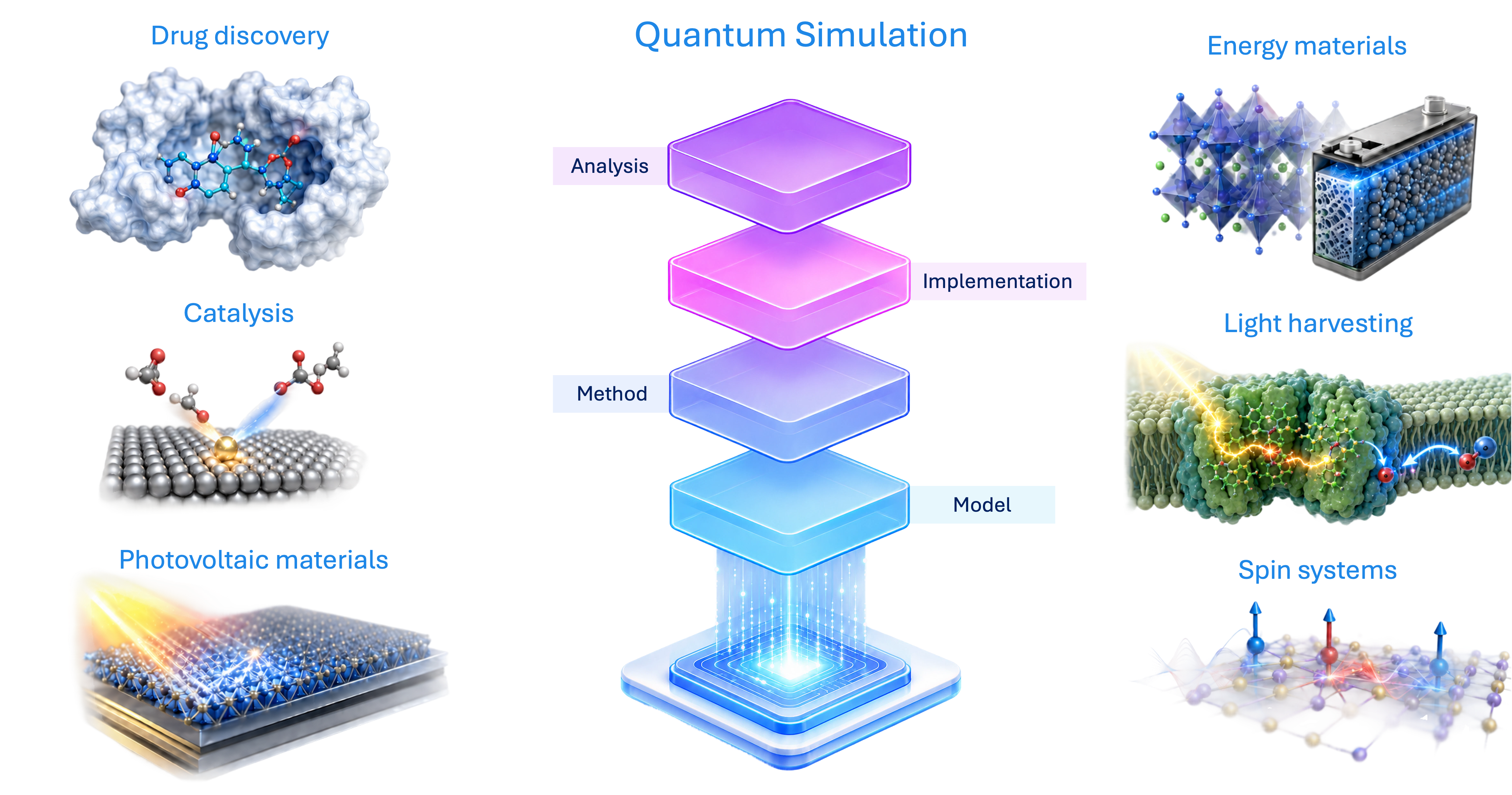
The challenge is well known. Even a few quantum degrees of freedom already require a huge mathematical space, the Hilbert space, to describe quantum phenomena properly. As we add more particles, orbitals, or spins, that space grows extremely fast, often exponentially, quickly making simulations computationally intractable. This is why quantum simulation is so hard, and why it is one of the central motivations for quantum computing.
But there is another cost. One that is less famous, less elegant, and much more annoying.
Imagine we start with a simple question:
How does this excitation move?
Which approximation is good enough?
What would this calculation cost?
Very quickly, the question becomes a full simulation workflow. We need to choose a model, write a Hamiltonian, select a method, find the right software, read the documentation, translate the problem into that package’s conventions, debug the code, check the output, plot the results, and decide whether the answer makes physical sense.
This is the hidden cost of quantum simulation.
It matters because it slows science in three ways.
First, it slows creativity. When every idea requires hours or days of setup, people try fewer ideas. The cost of curiosity becomes too high.
Second, it slows access. Only people who already know the tools, packages, and conventions can move quickly. Everyone else pays a long entry tax before they can even ask the scientific question.
Third, it slows progress. Science advances by iteration: ask, compute, check, revise, ask again. If that loop is slow, the science is slow.
El Agente Cuántico is our attempt to make quantum simulation feel closer to asking the scientific question itself.
The idea is simple. If the hard part of science is asking good questions, then the scientist should spend more time there. Not buried in package conventions. Not stuck debugging syntax. Not rebuilding the same workflow every time a question changes.
We want the scientist closer to the creative loop: ask the question, inspect the assumptions, judge the result, and decide what to try next.
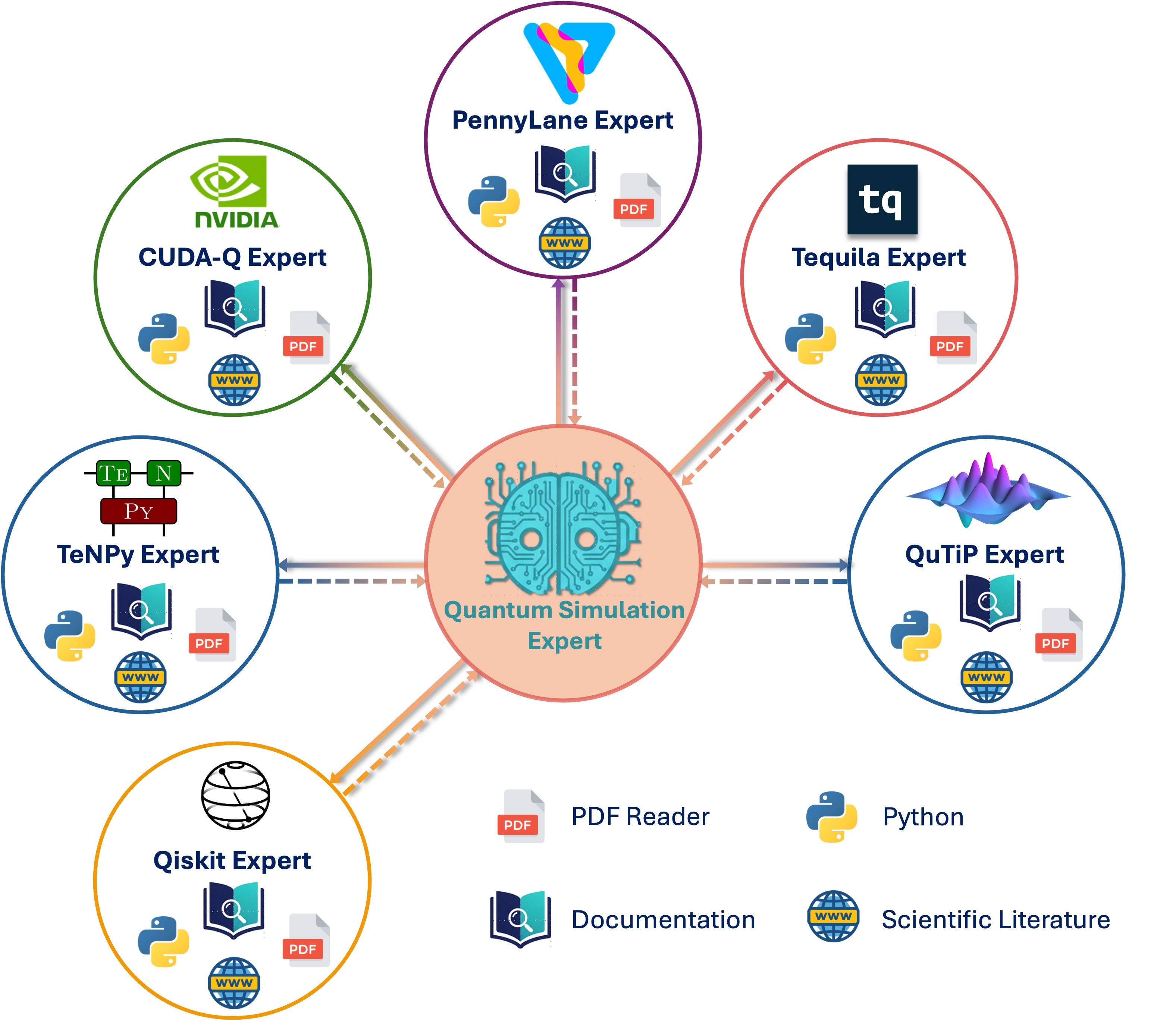
That is what we explore in this paper. Starting from a natural-language scientific goal, El Agente Cuántico can help turn a question into a working quantum simulation: choosing a route, using the right software, running code, fixing errors, and analyzing the output.
What does it actually mean to automate a quantum simulation?
One of our favourite examples began with a three-level quantum system. The goal was to transfer population from an initial state to a target state, even though those two states are not directly connected. The available controls connect the initial state to an intermediate state, and the intermediate state to the target, so the transfer has to be engineered indirectly.
El Agente Cuántico selected the GRAPE quantum-control method, found the relevant QuTiP documentation, constructed the calculation, optimized the control fields, and simulated the resulting dynamics.
The first result looked excellent. The optimizer reported almost perfect transfer to the target state. But when the agent independently simulated the optimized fields, the dynamics did not agree. It traced the mismatch to the way the optimization had been configured, corrected the implementation, and ran the calculation again before accepting the result.
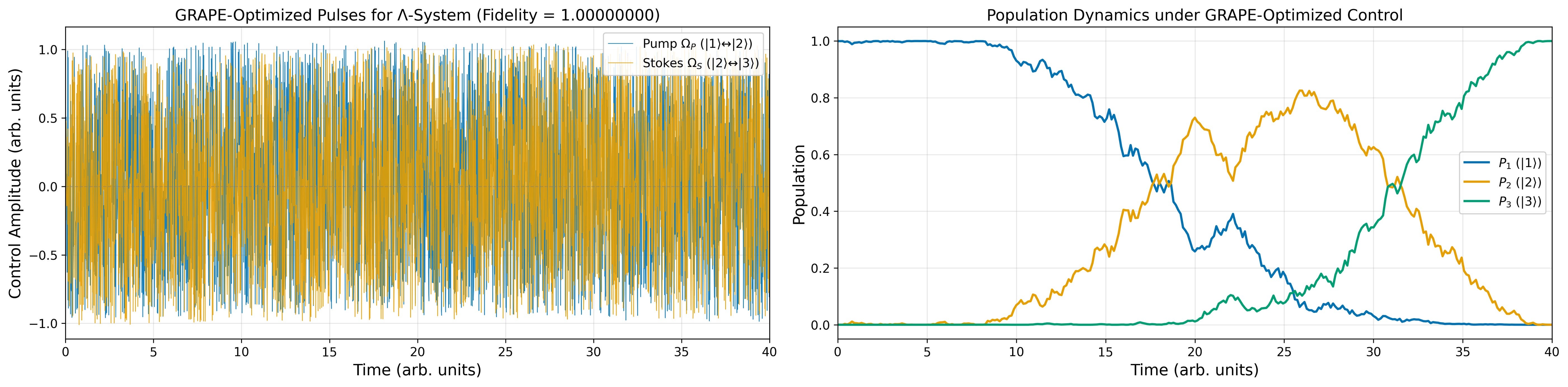
The figure shows population leaving the initial state, passing through the intermediate state, and accumulating in the target state. By the end of the protocol, the transfer is essentially complete.
What matters here is not only that the agent produced working code. It checked the optimized controls with a separate simulation, found that the first implementation was inconsistent, diagnosed the problem, and corrected it. A successful message from an optimizer was not treated as sufficient evidence.
That is the kind of workflow El Agente Cuántico is designed to automate: formulate the calculation, execute it, validate the result, and then interpret the physics.
Scientific agents are stochastic: the same request can lead to different plans, implementations, and outcomes. That makes systematic evaluation essential. We need to know not only what an agent can do, but how consistently it can do it—and how its performance compares with other ways of solving the same task.
We first tested reproducibility. Five representative quantum-simulation problems were each run ten independent times using the same prompt, with no memory shared between runs. Human researchers scored the implementation, the numerical results, and the final analysis.
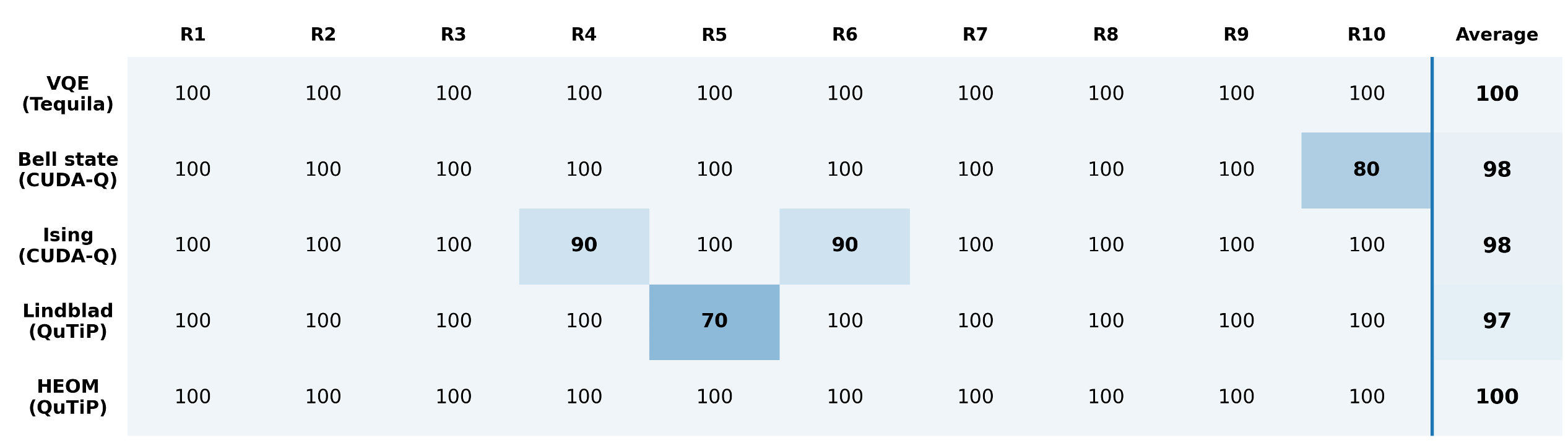
Across the 10 runs, the average scores for the five tasks ranged from 97 to 100 out of 100. The few deductions also gave us a useful map of the remaining weaknesses: one run computed the wrong spin observable, two used random states that were not strictly Haar random, and another produced correct data with a flawed figure.
Reproducibility tells us how stable the system is. A second benchmark asked what the specialized architecture contributes compared with general-purpose coding agents.
For this comparison, we used a quantum phase-estimation problem in Qiskit. Each system had to construct a four-bit circuit and then rewrite it for a backend with a restricted native gate set. The expected phase pattern was known analytically, so we could check both the physical result and whether the rewritten circuit respected the hardware constraint.
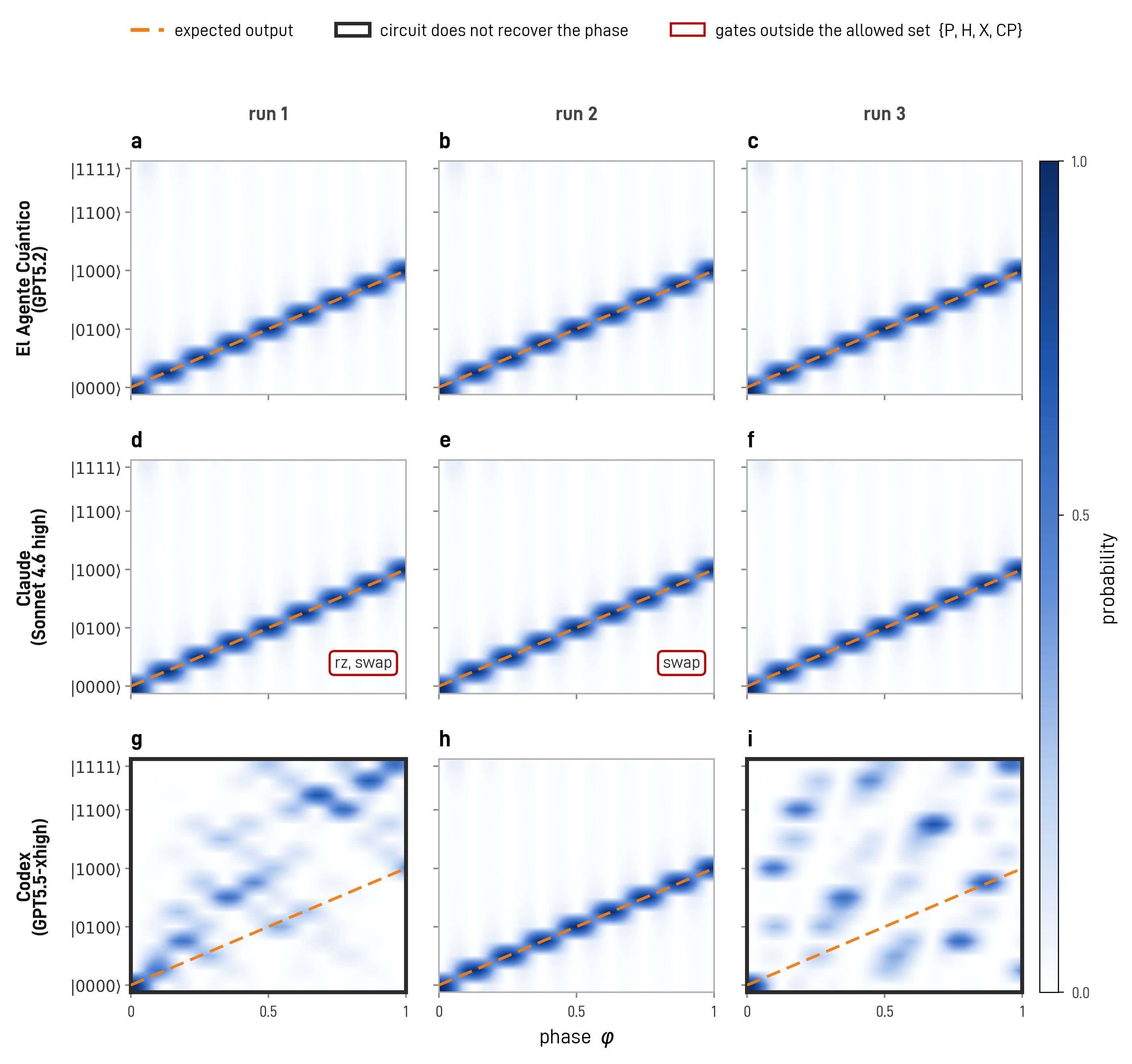
El Agente Cuántico passed both checks in all three independent runs. Claude Code recovered the correct phase pattern in all three runs, but two circuits retained gates excluded by the prompt. Codex satisfied both conditions in one run; the other two lost the expected phase pattern because of readout or bit-ordering errors.
Together, the benchmarks answer two different questions. The reproducibility study measures how stable El Agente Cuántico is across repeated scientific workflows. The phase-estimation comparison tests whether its software grounding and specialist-agent design provide benefits beyond general-purpose code generation.
Many ideas are never tested, not because they are uninteresting, but because turning them into a reliable calculation takes too much time. When that cost falls, the scientist can explore more possibilities, compare more models, and abandon weak ideas sooner. The question shifts from “Can I afford to try this?” to “What is the most revealing thing to try next?”
Easier execution does not make scientific judgment less important. It makes it more important. Every simulation still depends on choices: what model to use, which approximation is justified, what should be measured, and what evidence would make the result believable. A useful scientific agent should not hide those decisions behind automation. It should expose them, help test them, and make it easier to see when they fail.
Science advances when more questions become affordable. Reducing the distance between an idea and a trustworthy simulation means that researchers can follow weaker intuitions, investigate unexpected results, and learn from failure while the question is still alive.
In El jardín de senderos que se bifurcan, Jorge Luis Borges writes:
El tiempo se bifurca perpetuamente hacia innumerables futuros.
(Time forks perpetually toward innumerable futures.)
Quantum science has its own labyrinth. Every model, approximation, and calculation opens one path while leaving countless others unexplored. The limits of our tools do not only determine how quickly we find answers. They shape which branches of possibility we are able to enter at all.
El Agente Cuántico does not make the Hilbert space smaller, and it cannot decide which path is worth following. But it can help turn more of those paths from possibilities we can only imagine into questions we can actually test.
The Hilbert space remains vast. Our scientific horizon does not have to remain narrow.
This post was written by Ignacio Gustin. This science was possible only through the work of many amazing coauthors: Luis Mantilla Calderón, Juan B. Pérez-Sánchez, Chris Crebolder, Jérôme F. Gonthier, Mohammad Ghazi Vakili, Yuma Nakamura, Karthik Panicker, Manav Ramprasad, Aiwei Yin, Zijian Zhang, Yunheng Zou, Varinia Bernales, and Alán Aspuru-Guzik. Paper: Gustin, Ignacio, et al. "El Agente Cuántico: Automating quantum simulations."
No posts
Comments
Nothing yet. Say the first thing.
Sign in to join the conversation.