
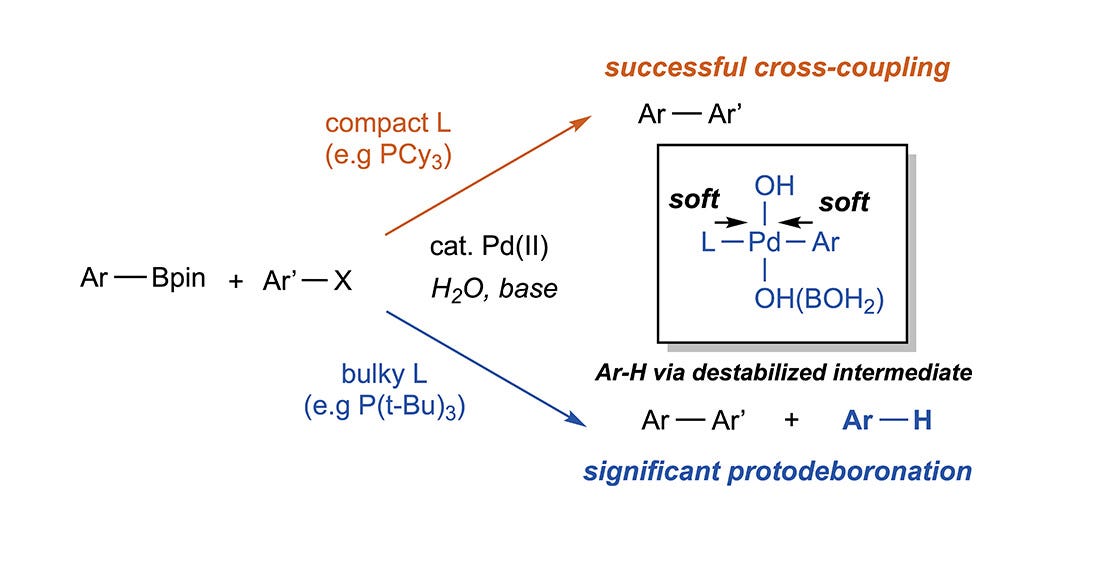
The Suzuki–Miyaura cross‑coupling is one of the most widely used reactions in organic chemistry: a palladium catalyst connects two carbon fragments, often using boronic acids or boronic esters as one of the partners. These boronic species are usually stable and easy to handle, but they can sometimes “fall apart” and lose their boron group via a side reaction called protodeboronation, destroying its capability to participate in the cross-coupling. While we were screening conditions to synthesize organic lasers using the Suzuki-Miyaura cross-coupling, we noticed that we were obtaining large amounts of protodeboronated product.
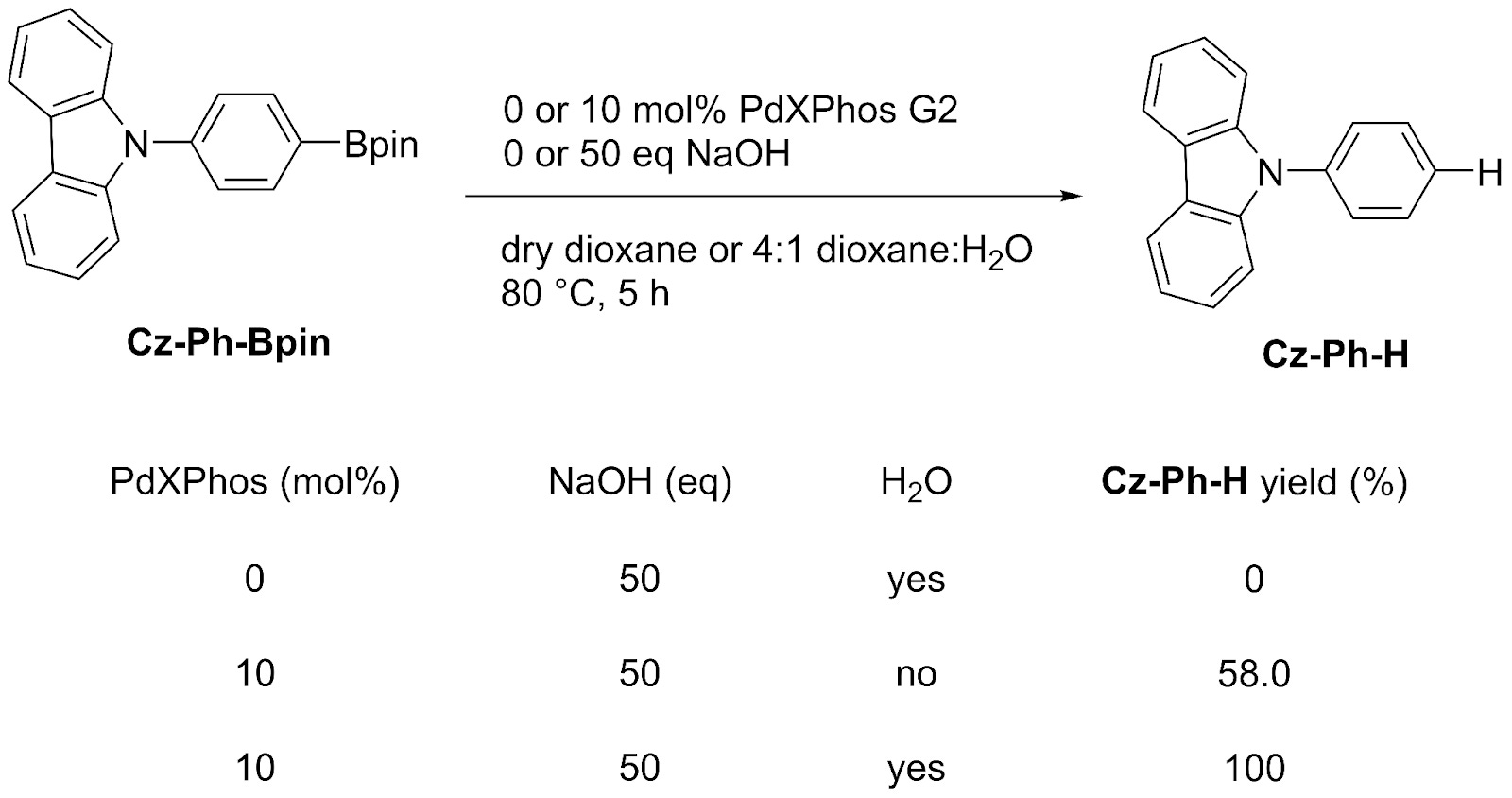
We had initially chalked this up to the well-known base-catalyzed variant of deboronation (see [1], [2], [3], [4]), but Shangyu decided to perform a control study by removing the palladium catalyst while keeping the base present. Surprisingly, there was no deboronation observed, ruling out base-catalyzed PDB for this substrate, and suggesting that palladium-catalyzed protodeboronation could be possible. When we looked into the literature, we found that metal‑catalyzed deboronation was significantly understudied -- especially compared to base‑catalyzed pathways, which are usually assumed to dominate under Suzuki–Miyaura conditions. We saw this as an opportunity to do a deep dive into this reaction, and to understand the factors that control deboronation via palladium catalysis.
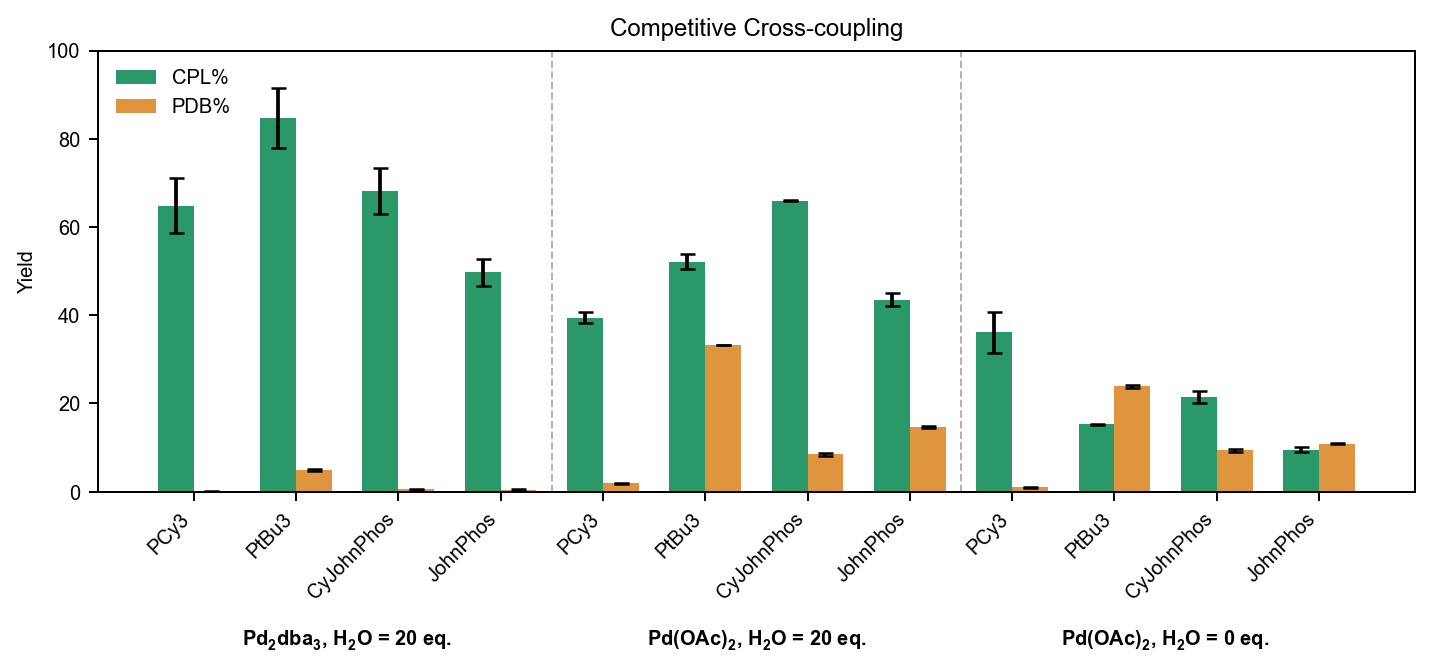
On a model cross-coupling system, we analyzed the relative product distribution of effective cross-coupling and undesired deboronation product and found that:
Bulkier ligands like P(t-Bu)₃ and JohnPhos showed significantly higher protodeboronation compared to their sterically compact cyclohexyl-containing counterparts PCy₃ and CyJohnPhos.
Using Pd(OAc)₂ resulted in significant deboronation, but Pd₂dba₃ showed nearly no deboronation.
The effect of water is complex -- water is necessary to promote cross‑coupling, but it is also required for deboronation. Serendipitous water (from glassware and bases) is enough to cause significant deboronation, and when water is further intentionally added, yields for both products increased, but cross-coupling products outpace the formation of deboronated product.
Given the complexity of the competitive reaction, we decided to focus directly on the deboronation without the aryl halide present. In general, like the competitive cross-coupling model study, the use of palladium(II) pre-catalysts and bulky ligands led to increased protodeboronation yields, while palladium(0) was similarly ineffective. We further screened 27 phosphine ligands with Pd(OAc)₂, and saw the same trends where bulkier ligands resulted in significant protodeboronation compared to their more sterically compact counterparts. Other factors like ligand loading, the choice of base, palladium loading or the electronic nature of the boronic reagent affected yields, but not nearly to the same extent compared to the ligand choice.
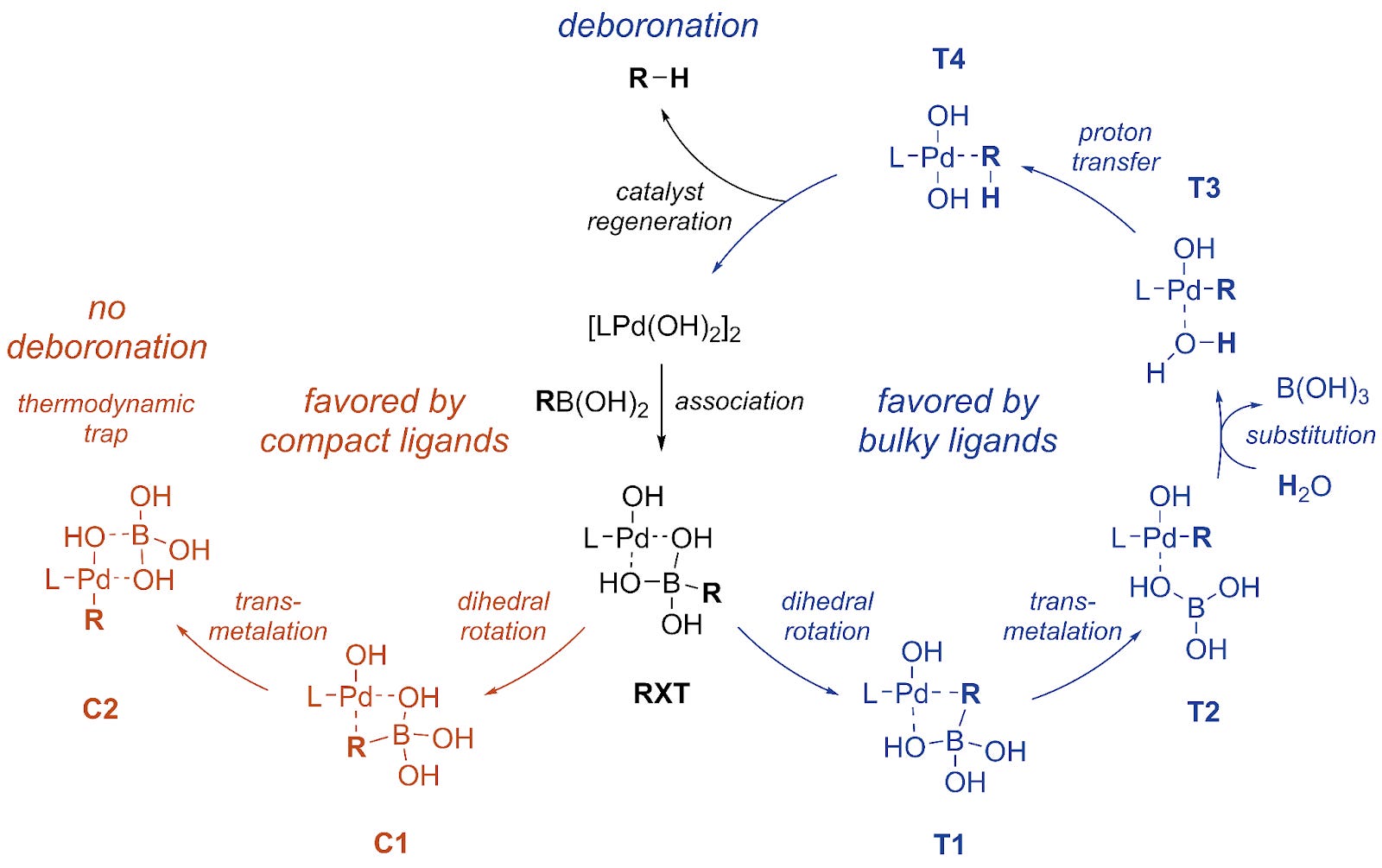
To understand why steric bulk affects protodeboronation to such a large extent, we proposed a mechanism for palladium-catalyzed deboronation and studied it using density functional theory. We found that compact ligands favor the formation of a thermodynamically stable intermediate via a sterically demanding pathway. Bulky ligands however, disfavor this pathway, and instead preferentially form an unstable intermediate (T2) capable of facile proton transfer to the transmetalated aryl group on the palladium center, resulting in protodeboronated product. Particularly, the relative feasibility for these pathways are extremely close to each other (1-2 kcal/mol), and the kinetic models we constructed to predict experimental yields agreed semiquantitatively, lending further veracity to our proposed mechanism.
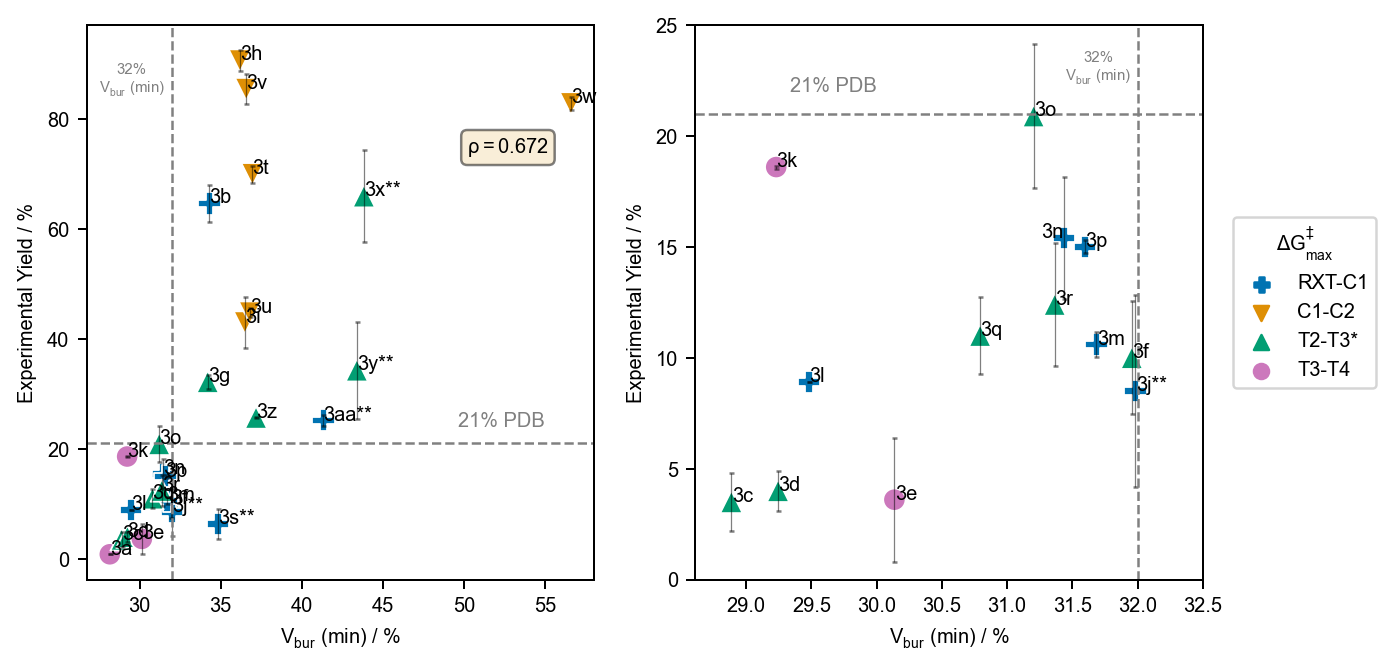
Finally, we correlated our results to ligand descriptors (easily accessible from kraken, described in this paper), and found that the buried volume of the ligand -- a measure of how much space the ligand occupies around the ligands -- was reasonably descriptive of palladium-catalyzed protodeboronation, especially since it accounts for the effects of remote steric bulk in ligands like in JohnPhos or XPhos. For the ligands we screened, we suggest that a threshold of ~32% buried volume is enough to affect significant protodeboronation.
Through this study, we show that there is an additional dimension to consider when using bulky ligands for the Suzuki-Miyaura cross-coupling. Since bulky ligands are often the desirable choice to facilitate difficult cross-couplings, its role in simultaneously catalyzing undesirable protodeboronation must be balanced.
--
This work was the joint efforts of many co-authors across many years: Cher-Tian Ser (me), Han Hao (co-first), Sergio Pablo-García, Kjell Jorner, Shangyu Li, Robert Pollice (co-corresponding), and Alán Aspuru-Guzik (corresponding). Many thanks to everyone for their contributions to this project!
Full paper: https://pubs.acs.org/doi/full/10.1021/jacs.5c14153
Preprint version: https://chemrxiv.org/engage/chemrxiv/article-details/689ec38e728bf9025e8cfcaa
No posts
Comments
Nothing yet. Say the first thing.
Sign in to join the conversation.