
Current AI agents have demonstrated remarkable capabilities in tasks such as software development and information retrieval. However, applying AI to directly advance scientific research remains a significantly under-explored frontier. Quantum computing experiments are a prime example: they still rely heavily on human intuition and require multimodal understanding that current AI systems struggle to provide.
That barrier may have just cracked.
The matter lab, together with the Leek group from Oxford (link), has demonstrated, for the first time, an AI-agent system based on large language models (LLMs) that fully automates real quantum computing experiments—including hours-long calibrations of both single-qubit and two-qubit quantum gates. The work has recently been published on Patterns (paper link).
And the system doesn’t merely follow scripts. It understands natural-language experiment goals, converts them into executable workflows, retrieves and uses scientific knowledge, analyzes multimodal data, and autonomously adjusts parameters in real time.
This is not a lab assistant. This is an experimental scientist implemented as an AI agent.
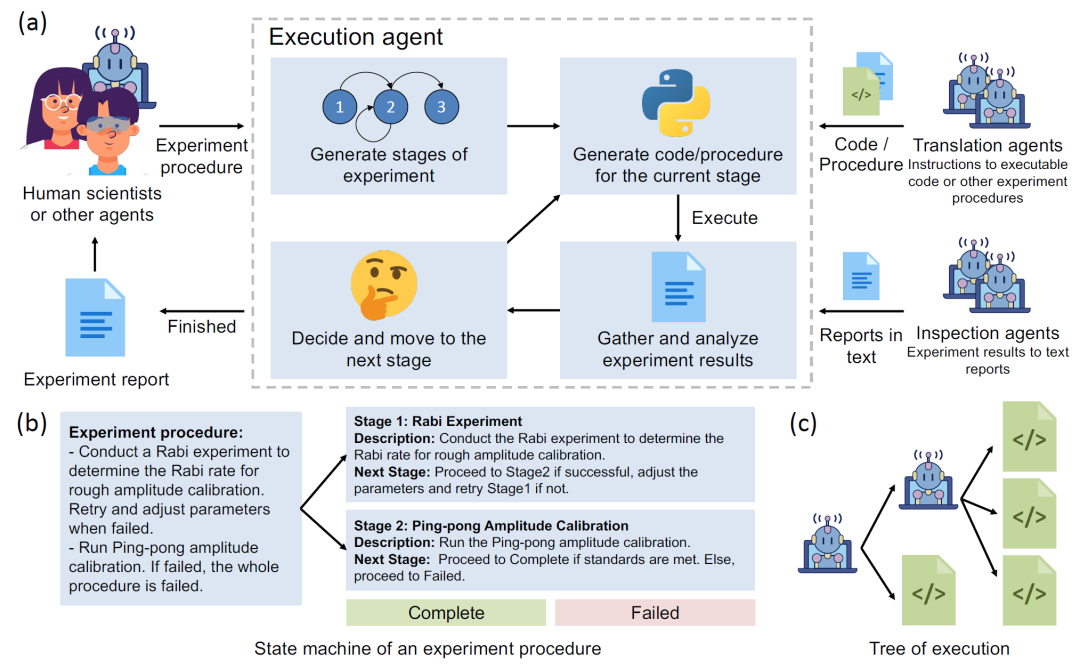
Figure 1: A natural-language experiment description is converted into a state machine. Each step contains: 1. a single experimental command; 2. translation into executable code; 3. transition rules determined by an agent. It’s essentially a dynamic experiment compiler.
Three core innovations make the system stand out:
Researchers can describe their objectives—“calibrate the two-qubit gate between Q3 and Q4”—in plain language. The execution agent converts this into a state machine with well-defined experimental phases, while translation agents generate the executable scripts for each step.
This brings a new level of abstraction into quantum experimentation: humans specify intent, and the system figures out the how.
Quantum labs are full of undocumented expertise scattered across scripts, lab notebooks, and legacy code. The system provides a way to structure this information and makes it searchable—allowing it to autonomously synthesize correct experiment scripts even when details have never been explicitly taught.
This turns a messy lab codebase into a usable scientific knowledge base.
The non-surprising insight: Experiments are easier to judge visually than numerically.
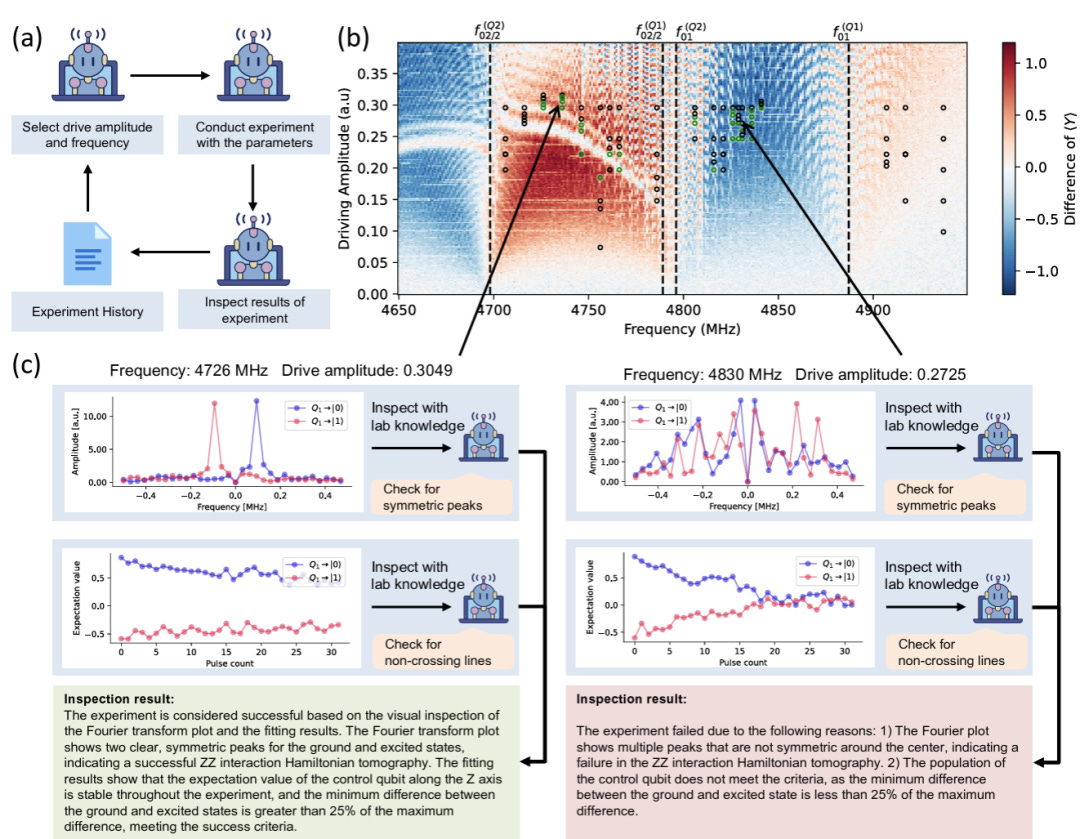
Instead of manually coding data-analysis routines, the team fed the multimodal model with example images of “successful” and “failed” experimental outcomes. From these few examples, the AI learned to recognize features such as resonance peaks or interaction strengths—patterns that human researchers often learn only through experience.
This dramatically improves accuracy and generalization across experiments.
The team validated the framework on a superconducting quantum computing platform, running one of the most challenging tasks in the field: two-qubit gate calibration.
The result: The agent ran completely autonomously for 3 hours and successfully discovered multiple valid parameter sets for the two-qubit gate—without a single human intervention.
This is the first demonstration of a robust, long-running, fully autonomous quantum-lab system. It suggests a future in which the development of quantum hardware can be dramatically accelerated by agent-driven automation.
Figure 2: During calibration, the agent continuously ingests past experiment results and proposes new parameters to test. Subfigure (b) shows the calibration result of the two-qubit gates in the quantum computer, where Green circles = AI-identified valid parameter sets and Black regions = failures. These dots are determined by the agents shown in the subfigure (c), who use multimodal LLMs to check experiment results and give feedback to the execution agents.
The system is generalizable.
Any field that involves iterative experiments—biology, materials, chemistry, industrial testing, robotics—could adopt this framework. By offloading tedious technical steps, AI agents free researchers to focus on ideas, not repetitive execution.
This is not just about automation. It is the blueprint for AI-native experimental science.
Quantum computing remains one of the most complex experimental sciences. If AI agents can autonomously run these experiments, then:
automated labs will become standard,
scientific throughput will accelerate dramatically, and
the nature of scientific work may fundamentally change.
This research is a concrete step toward that future.
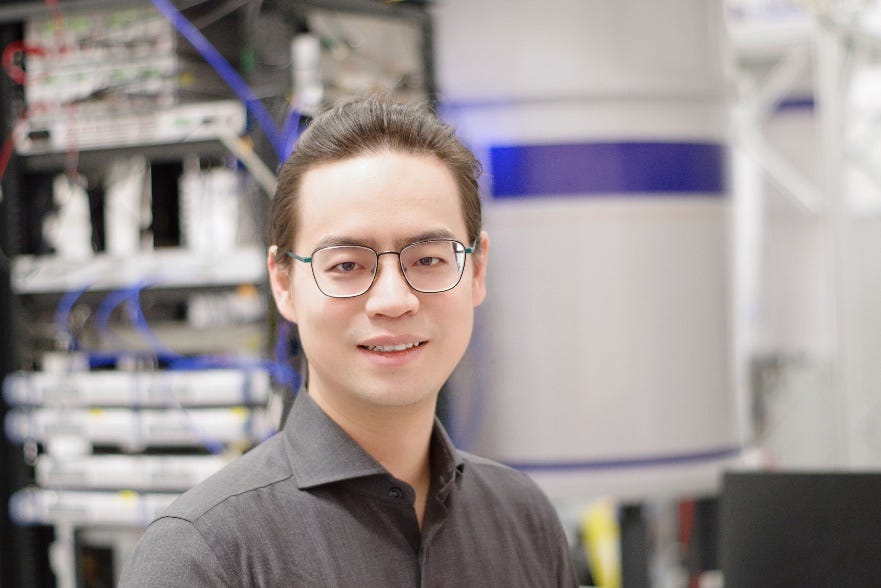
Dr. Shuxiang Cao built the superconducting qubits system and integrated it with the agent system in this work (LinkedIn). He is a Schmidt AI in Science Fellow at the University of Oxford. He completed his undergraduate studies in the Chu Kochen Honors College at Zhejiang University, majoring in Computer Science. During his DPhil at Oxford, he focused primarily on the physical realization of superconducting quantum computing devices. He was also the co-founder of the quantum software company Rahko, which was acquired by Odyssey Therapeutics in 2022. His current research interests center on the applications of AI in scientific research, particularly in laboratory automation and intelligent experimentation.
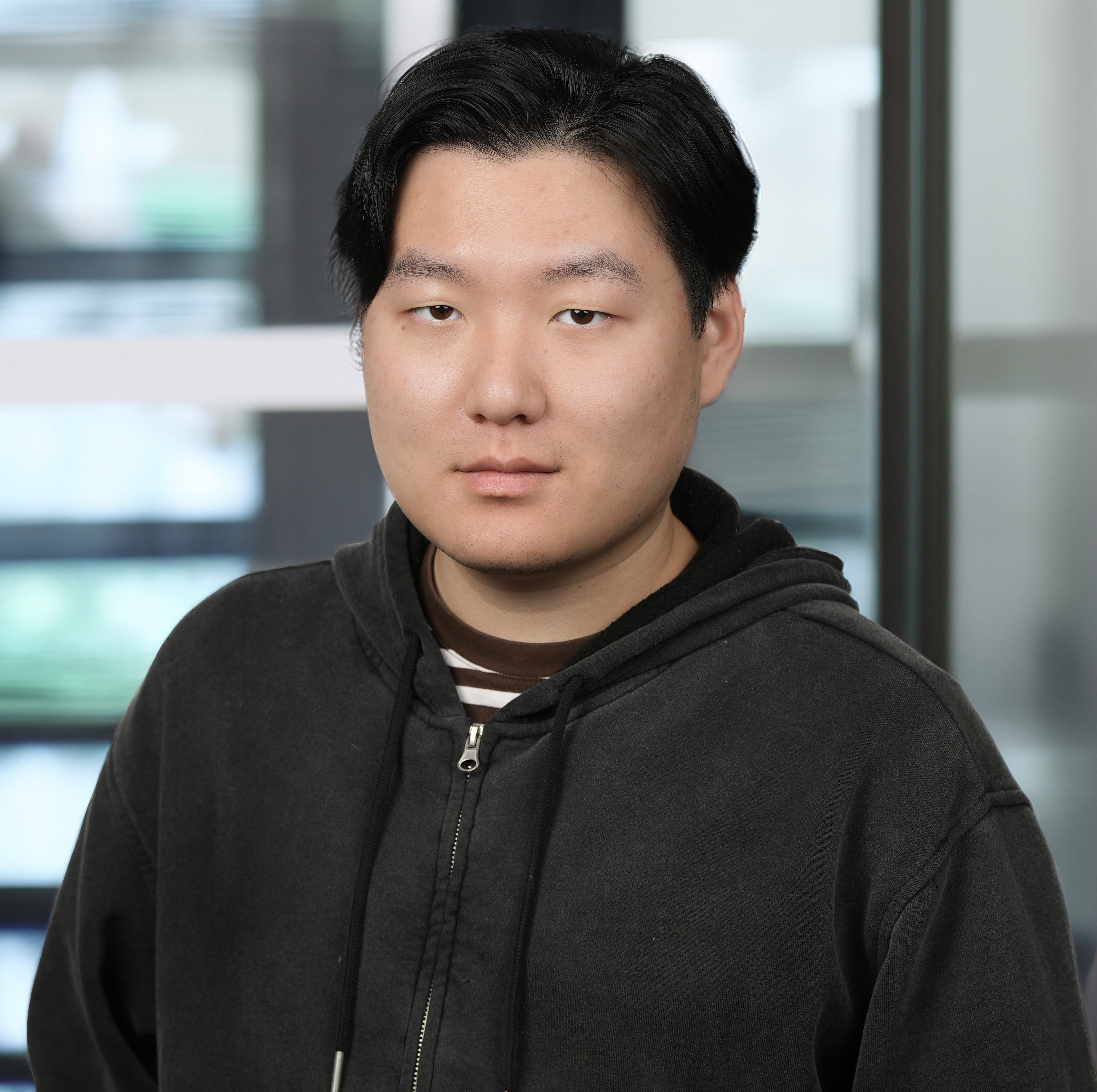
Zijian Zhang is a PhD student at the Matter lab who designed and implemented the agent system in the paper (LinkedIn). He completed his undergraduate degree in the Department of Physics at Southern University of Science and Technology (SUSTech). His research focuses on the application of AI in scientific discovery and on developing novel, efficient modes of human–AI interaction.
Link to Code: https://github.com/EvoEvolver/k_agents
No posts
Comments
Nothing yet. Say the first thing.
Sign in to join the conversation.