
Quotes from recent reads: three for everyone and another three for paid AG supporters.
Generative AI, for all its problems, has one virtue: it forces us to rethink that assumption. The ease with which AI can spit out seemingly coherent text, or help rewrite a few convoluted sentences into elegant prose, has been perceived by some academics as a threat to the very meaning of our professional existence. “I feel like one of those coal miners must have felt when it was already clear that the mines would be closed soon,” a colleague recently said to me.
I want to resist this idea – maybe out of a desperate desire to cling to my professional identity, but with what I have come to think of as an important distinction: texts as products, or texts as means to something very different.
Over the last few centuries, behavioral psychologists have documented all kinds of ways of modifying our actions and the actions of various animals. From the famous Skinner boxes to many modern video game mechanics, animals and humans alike can learn through the addition or subtraction of various rewards and punishments. And it doesn’t only impact simple actions either; [Everything is Hacked] took this idea to the extreme, using painful electric shocks to teach himself to avoid making blunders while playing chess.

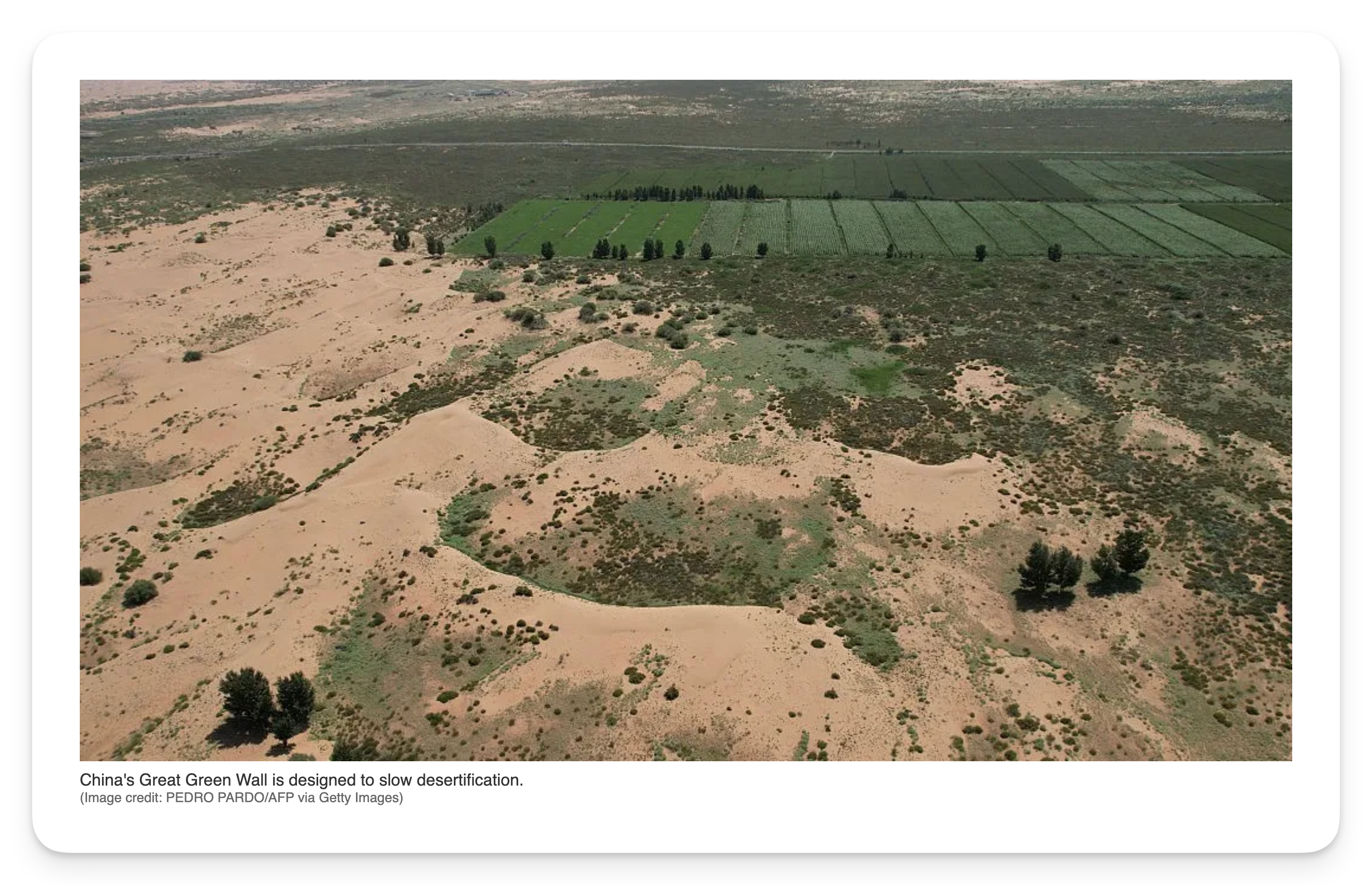
China’s “Great Green Wall” is a huge ecological engineering project to slow the expansion of the Gobi and Taklamakan deserts in the country’s north.
Since 1978, China has planted more than 66 billion trees along its borders with Mongolia, Kazakhstan and Kyrgyzstan — and Chinese authorities plan to plant 34 billion more over the next 25 years. If they succeed, the Great Green Wall will increase Earth’s forest cover by 10% since the late 1970s.
The Great Green Wall, formally known as the Three-North Shelter Forest Program, is designed to slow soil erosion and sand deposition that has been increasing since the 1950s due to huge urbanization and farmland expansion. These changes exacerbated the region’s already dry conditions, which in turn created the conditions for more sandstorms. Sandstorms blow away the top layer of soil and deposit sand, degrading the land and increasing particulate matter pollution in cities.
Comments
Nothing yet. Say the first thing.
Sign in to join the conversation.