
A weekly collection of links to interesting things curated by Colin Wright.
Thunderstorms have captivated humanity for millennia, and yet their inner workings remain deeply mysterious. Storm clouds are opaque. They’re dangerous to approach. And they’re too big to fit in a lab. Inquisitive researchers have been sending kites, balloons, and rockets up into them for nearly three centuries, and they’ve learned a lot. But every time lightning lovers get closer to the action, they discover major gaps in their understanding. For the past 50 years, researchers have focused on one particular gap: How does the jagged channel of white-hot air we call a lightning bolt get started?
Recently, the field has experienced a sort of renaissance as researchers — many of them astrophysics refugees like Dwyer — have devised new ways to pierce the clouds. They’ve taken a slew of instruments built to study violent cosmic events and trained them on the brutality of terrestrial thunderstorms. They’ve seen lightning shooting out X-rays as it zigs and zags, spotted flickering glows of gamma rays coming from thunderclouds, and, very recently, detected hints of bolts traveling in unexpected directions.
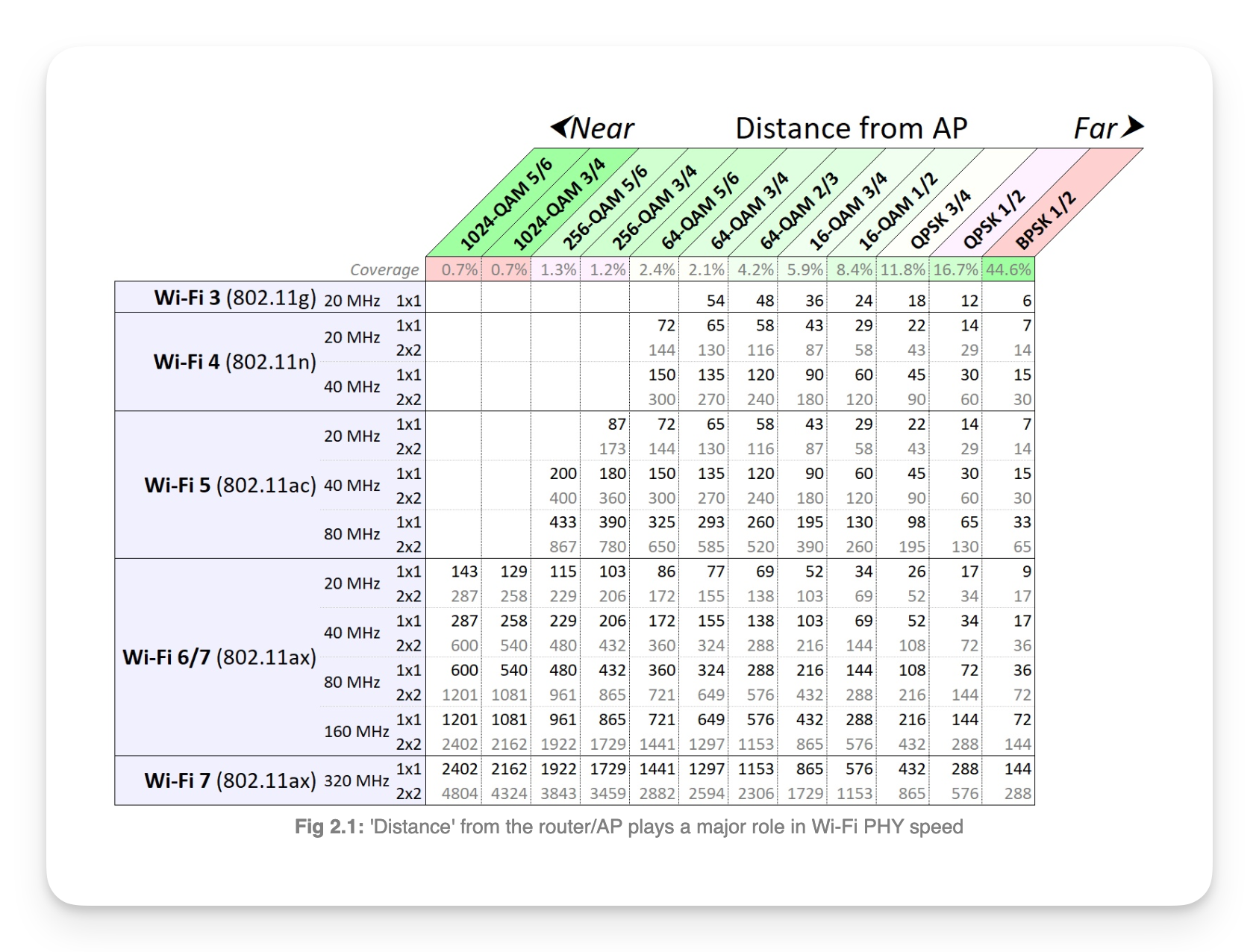
First steps: Wi-Fi 1 came out in 1997 and supported PHY speeds of 1 Mbps to 2 Mbps in the 2.4 GHz band. A couple of years later, in 1999, Wi-Fi 2 increased 2.4 GHz band PHY speeds to 11 Mbps.
The big change in 2002: And then everything changed in 2002, when the new Wi-Fi 3 running in 5 GHz was extended back into the 2.4 GHz band, increasing PHY speeds from 11 Mbps to 54 Mbps. Wi-Fi 3 introduced the core technologies of Wi-Fi that are STILL very much used today, like QAM modulation.
Wi-Fi speeds by Wi-Fi generation: Compare the “Wi-Fi 4 20 MHz 1×1” row to the “Wi-Fi 6/7 20 MHz 1×1” row in table below. ‘At the same distance’ and channel width say the “16-QAM 1/2” column, Wi-Fi PHY speeds have NOT improved that much since 2006 just 19%, from 28.88 to 34.41! An overview of Mbps PHY speed by Wi-Fi generation.
Protectionists love talking about the auto industry. Believing it offers a potent example of the harms of globalization, their arguments have long been politically attractive to politicians on both left and right. Most recently they have justified the Trump administration’s 25 percent tariffs on auto imports by emphasizing the long-term decline of the industry.
It is time to set the record straight.

Apart from whispering “new bikini” into my phone on a seasonal basis, I try my hardest to ignore my targeted ads. But as I hit my mid-late 20s and tentatively googled anti-aging skincare routines, the all-seeing algo caught wind. Algorithms served me age-defying beauty remedies with alarming frequency; my Instagram scroll interrupted by everything from face yoga apps to “preventative” Botox.
I resisted the bulk of these offerings but fell prey to one particular product: a $59 silk sleep mask that promised to dramatically reduce the look of wrinkles, dark circles, and puffiness – all apparently caused by the perils of moisture-sucking cotton pillowcases.
These silk eye masks rippled irresistibly across my screen as fresh-faced influencers spoke sweet promises of getting 10+ hours of sleep each night (or at least looking like you have). I was transfixed.
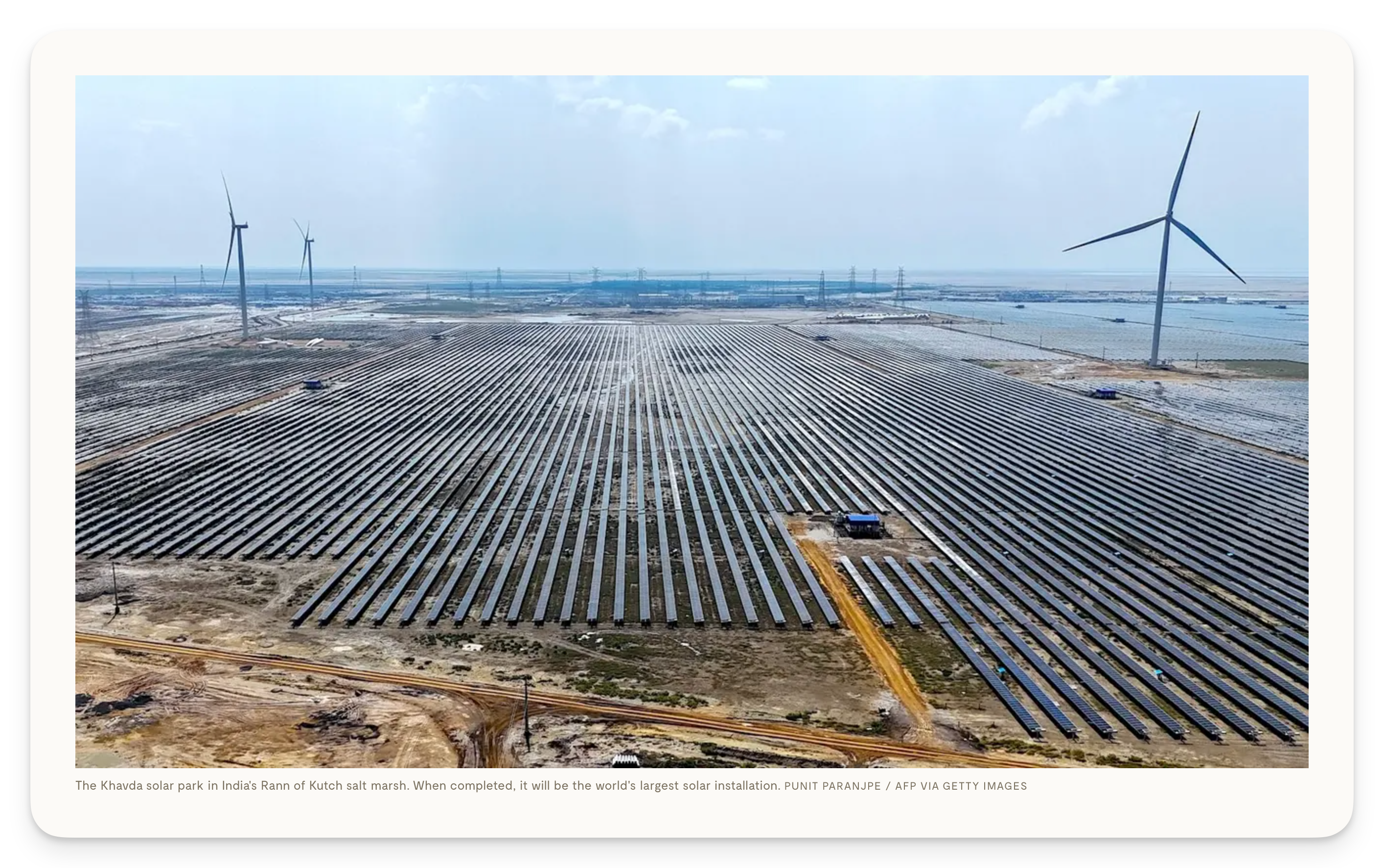
A sea of solar panels is rapidly engulfing one of the world’s largest salt deserts. By 2029, nearly 60 million panels will cover 280 square miles of India’s Rann of Kutch, extending right up to the border with Pakistan. The Khavda solar park is set to be the world’s largest and most powerful supplier of electricity from the sun, with a generating capacity of 30 gigawatts — 30 times the size of a typical coal or nuclear power station and enough to power Austria.
With India’s economy now growing faster than China’s, Khavda epitomizes the country’s breakneck rush to electrify with solar power. Installed solar capacity in India has been growing by 40 percent a year. In March, it passed 150 gigawatts, and by 2030 is set to double again.
Analysts say the world’s most populous nation is on the verge of becoming the first major country to power its industrialization predominantly with solar energy.
Until two years ago, West London’s Greenford Tube station used to flood whenever it rained heavily. The train tracks are aboveground, but the ticket office would often get inundated. Sandbags still line the corridor.
But in October 2023, a new family moved in nearby, determined to halt the water. The family members built their house from scratch with local wood and kept odd hours, sleeping all day and working only at dawn and dusk. They even put their young children to work.
Comments
Nothing yet. Say the first thing.
Sign in to join the conversation.