
It’s no surprise that AI companies - both public and private - have been the darlings of investors this year. The enthusiasm has been so intense that the question “Are we in an AI bubble?” seem to be everywhere.
The bubble debate is, of course, subjective and you’ll get wildly different answers depending on who you ask. But a more interesting question might be: what’s the actual premium for being seen as an “AI company” in today’s market? Because there’s now a clear and widening divide between what investors classify as AI versus non-AI.
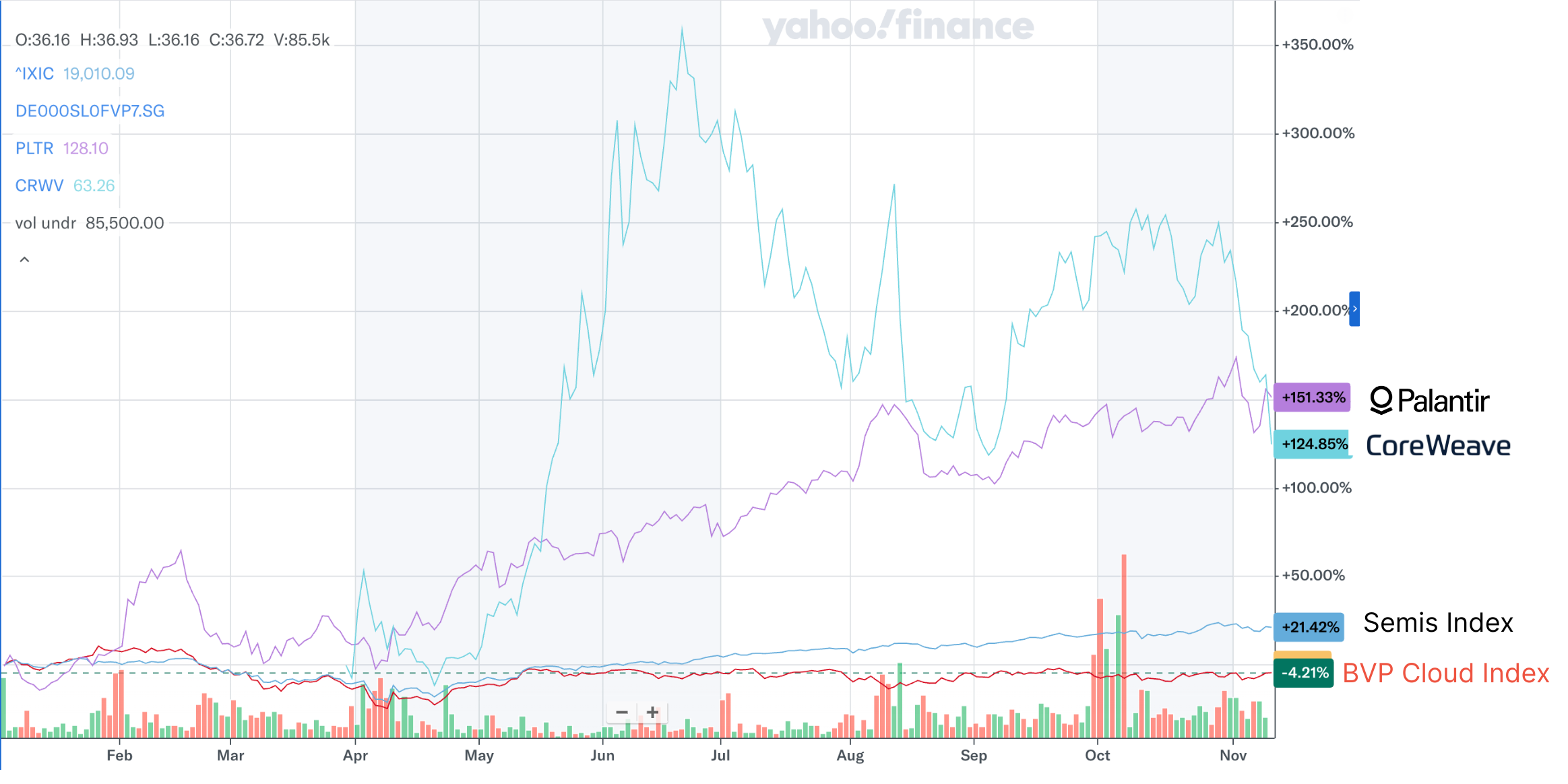
Take Navan, for instance - a travel management SaaS company founded back in 2015 that went public last week (congrats to the team!). The stock is down 11% since its debut. Compare that to CoreWeave, which went public in March 2025 and has more than doubled since then. Two very different businesses, yes—but a great snapshot of the “AI premium” at work.
In this post, we’ll explore how AI companies have traded in the public markets relative to their non-AI peers—and what that same premium looks like in the private markets. It’s a subjective analysis, but the results are compelling nonetheless.
Let’s dig in.
It’s interesting to look at the Top 10 companies by market cap (pulled as of Nov 13th, 2025). First, there is the staggering fact that just to ENTER the Top 10, you need to have a minimum market cap of $1T. To put this in perspective, it was only seven years ago when Apple became the first company to hit $1T in market cap.
Today, the average company in the T10 is worth $2.7T and the aggregate market value of the T10 is a staggering $27 trillion!
And what is a defining feature of many of these companies? You guessed it: AI.
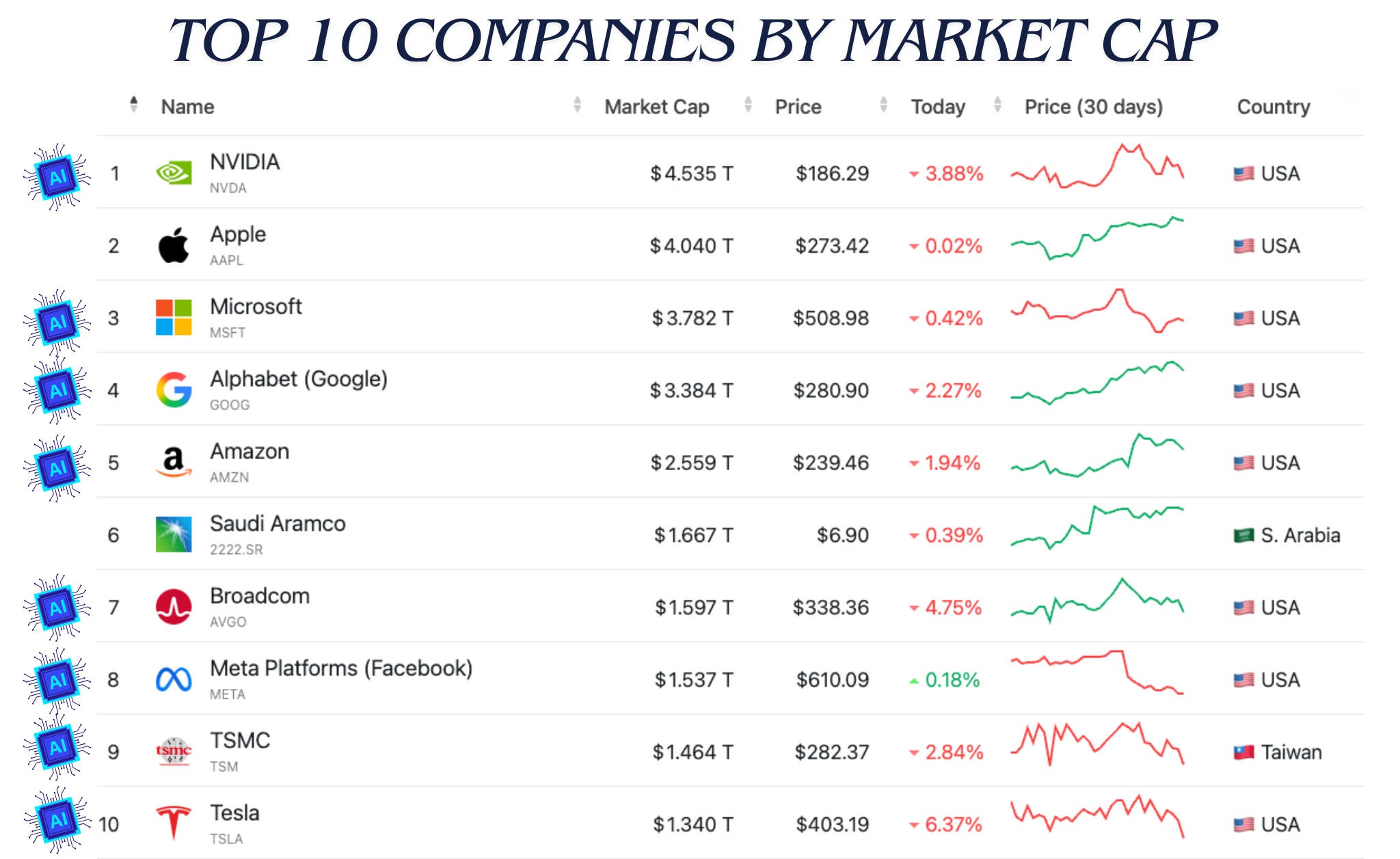
Based on our own definitions, eight of the ten largest companies by market cap is either building for AI or heavily influenced by AI:
Chips & Infrastructure: Nvidia ($4.5T), Broadcom ($1.6T), and TSMC ($1.5T)
AI Hyperscalers: Microsoft ($3.8T), Google ($3.4T), Amazon ($2.6T)
Models & Apps: Meta ($1.5T), Tesla ($1.3T)
In fact the only ones we left off this (very unscientific) list is Apple (which has been famously behind on AI innovation) and Saudi Aramco (which is an oil producer today, but perhaps an AI engine in the future).
Part of the AI premium is driven by the fact that we are in the largest sustained compute supercycle in history. The demand for GPUs, networking, and data-center capacity has created multi-year visibility for infrastructure companies in a way that is almost unheard of in tech.
OpenAI recently announced that it’s committed to spending $1.15 trillion (!) on hardware & cloud infrastructure between 2025 and 2035, with spending going across most hyperscalers. Nvidia, TSMC, Broadcom, Oracle, AMD, Coreweave, and the cloud platforms are the clearest beneficiaries of this spend. Our friend Tomasz Tunguz wrote a nice breakout on OpenAI’s spend here.
It’s also become apparent that infrastructure captures most of the public-market AI value today. The companies providing the “picks and shovels” for AI (chips, networking gear, optical interconnects, data centers) are sitting on unprecedented backlog, pricing power, and supply-driven scarcity. Even in 2025, GPU supply remains constrained enough that customers are signing long-term contracts and prepaying for compute. That scarcity itself becomes a valuation catalyst.
The open question is whether this premium is permanent or whether it normalizes as supply eventually catches up. If GPU availability improves and data-center buildouts plateau, multiples across the stack could compress. But until then, the market is rewarding the companies that sit at the choke points of AI production.
We compiled a list of public companies that are typically billed as “AI” across apps, infrastructure, and semis.
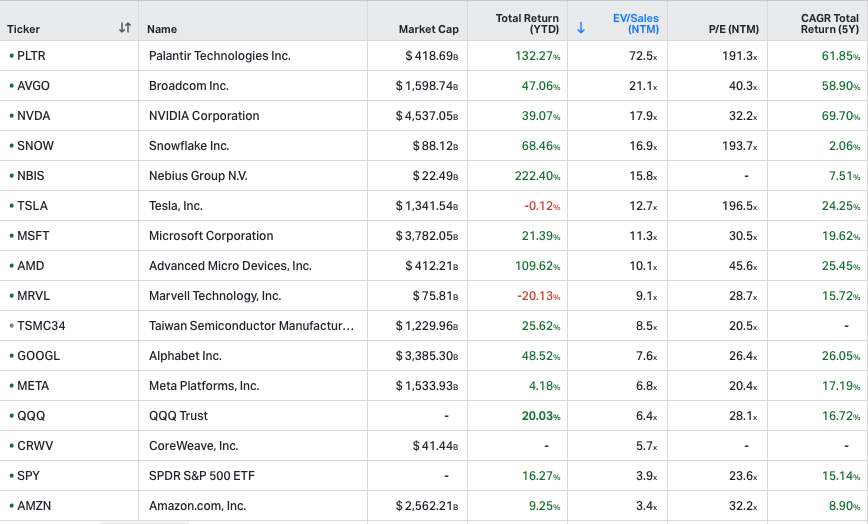
A few interesting callouts on how the market typically trades:
The median SaaS company trades at ~5x NTM Sales per Jamin Ball’s great newsletter.
The SPY, which tracks the S&P 500, trades at ~4x NTM Sales.
The QQQ, which tracks the Nasdaq, trades at ~6x NTM Sales.
By contrast, 90% of AI companies in our index, regardless of sector, are trading ABOVE all three of these averages!
On the “low” end, even Meta and Google which have less recurring, more consumer-oriented revenue trades at 7-8x NTM revenue.
In the “middle”, all the semis companies and infrastructure companies trade at 10-20x revenue.
And on the high end, you have Palantir sitting at a nifty 70x+ revenue multiple, leading many to call it (perhaps unjustifably) as a “meme stock”.
Of course, as you can see in the LTM revenue growth column, many of these AI companies are ripping, particularly the semis companies, largely thanks to massive demand for GPUs.
AI isn’t just boosting multiples anymore, it’s actually showing up directly in earnings. Microsoft, Google, and Amazon have all said that AI now represents a meaningful portion of incremental cloud growth. At the same time, companies like Meta and Google are seeing meaningful efficiency gains from AI-driven ranking, ads, and infra optimizations. Even the biggest platforms are finding real margin upside. Layered on top of that is the AI rebrand effect. Companies that successfully position themselves as AI-first such have all seen noticeable investor enthusiasm and, in many cases significant multiple expansion.
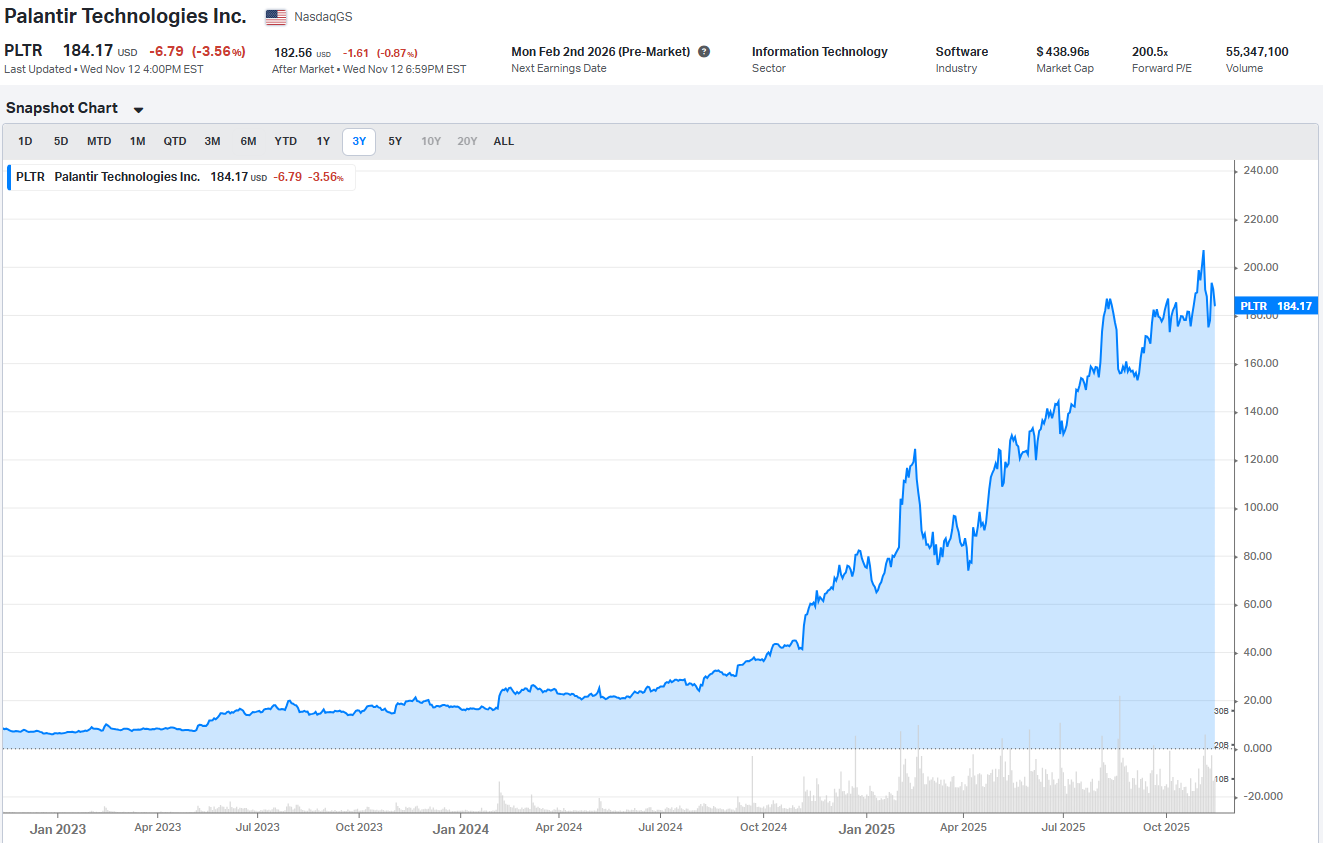
Palantir is one such example. The company grew from $6.39/share on January 3, 2023 to $184.17/share as of 11/12/2025 representing over 2,731% growth, or roughly 27x in three years. For comparison, the NASDAQ has only doubled over the same period at ~100% growth. Palantir’s surge is driven by its shift from a data-analytics platform to launching AIP (Artificial Intelligence Platform), which embeds LLMs, agents, and automation directly into enterprise and government workflows. By integrating AI across Foundry and Gotham, Palantir now enables organizations to safely apply models to real-time data, automate decisions, and power mission-critical operations.
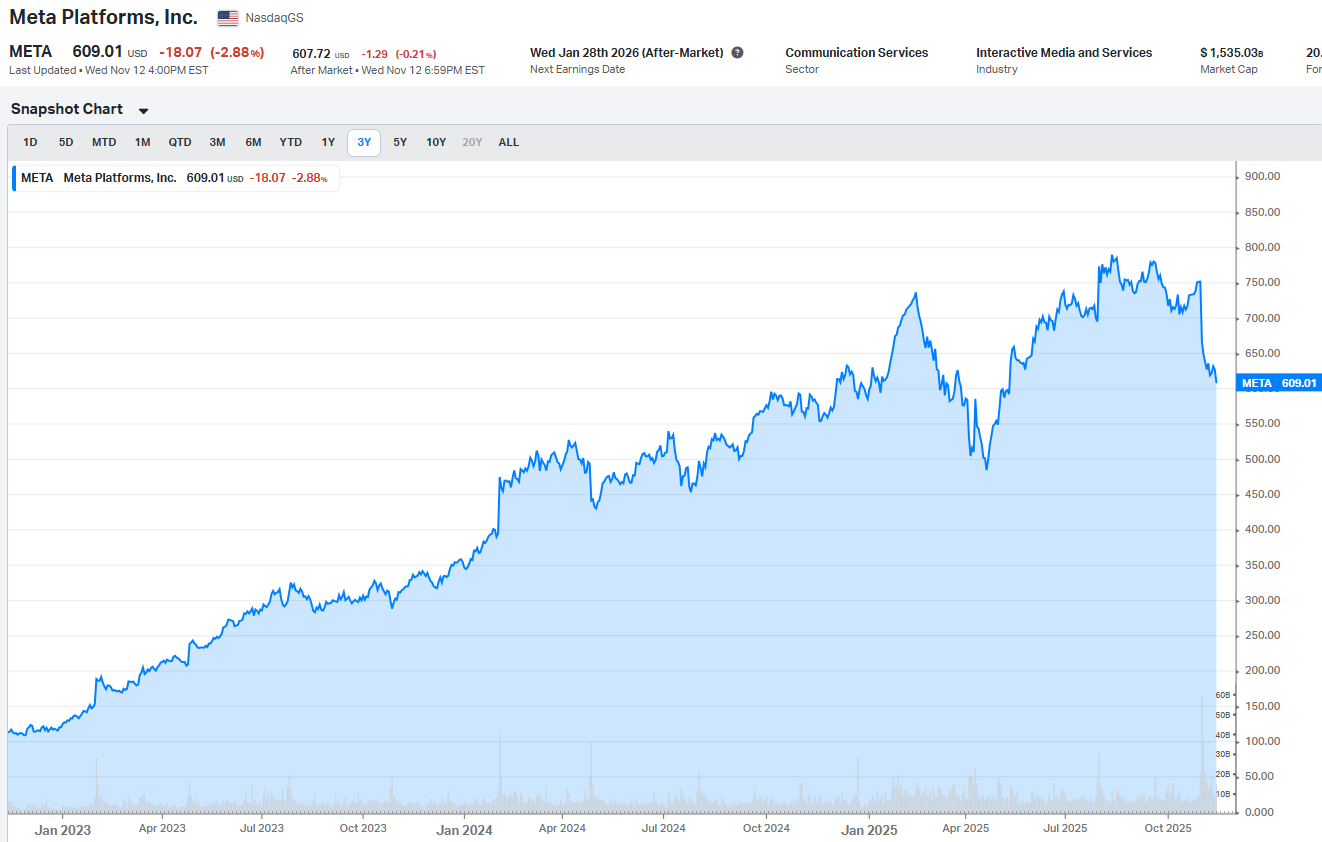
Another example is Meta, which grew from $124.74/share on January 3, 2023 to $609.01/share as of 11/12/2025 representing over 388% growth. Meta has executed a strong AI strategy by open-sourcing large models like Llama, massively scaling its AI infrastructure, and investing ~$14.3 billion for a 49% stake in Scale AI to secure data, talent, and accelerate its push toward superintelligence. After years of prioritizing AR/VR and the metaverse, Meta has decisively shifted its focus toward AI, making it the core driver of product development and long-term strategy.
However, executing on an AI strategy is not always easy. Many established software companies have struggled to adapt, facing pressure from AI-native private competitors. Salesforce, for example, has attempted to build an AI narrative but has fallen short on execution, and the market has reflected that with the stock down ~37% YTD. In our next post, we’ll explore the private markets and how these fast-moving AI startups are putting additional pressure on public companies.
As we near the end of the year, it’s clear that 2025 has been a Tale of Two Cities in the public markets: either you are deemed an “AI winner” and have benefited from exuberant investor demand, or you are not.
Chips, hyperscalers, compute, and AI apps are all the rage, while traditional SaaS has taken a beating. The BVP Cloud Index, which is largely composed of traditional cloud SaaS companies like Salesforce, Asana, etc., is down ~20% from its 2021 highs (which may have been the global maximum for cloud SaaS!). Meanwhile, GPU clouds and semis companies have gained billions in value and dominate the Top 10 Companies by Market Cap.
The question on every investor’s mind is - how long does the AI premium last? Is it sustainable, or will 2026 see multiples and valuations crash down to earth…or on the flip side, continue soaring?
In our next post, we’ll dive into the private markets and see if there has been a similar divide between AI “haves” and AI “have nots”. Let us know what you think!
Thanks for reading Aspiring for Intelligence! This post is public so feel free to share it.
No posts
Comments
Nothing yet. Say the first thing.
Sign in to join the conversation.