
As 2025 comes to a close, it’s always fun to look back on the year and grade our predictions. It’s clear the AI landscape feels meaningfully different than it did in 2023 or 2024. Those earlier years, following the explosive arrival of ChatGPT, were defined by spectacle: models that felt impossibly capable, demos that went viral, and a steady drumbeat of genuinely uncanny moments.
By contrast, 2025 was the year AI started proving itself useful and moving into durable use cases, monetization, and scale. The focus shifted from novelty to integration, as AI became more deeply woven into real workflows, enterprises, and everyday tools.
So, while 2025 wasn’t the most electrifying year in AI in the natural sense — no boardroom drama à la Sam Altman being ousted from his own company or a sudden declaration of AGI — that doesn’t mean the year was dull, in fact far from it. 2025 kicked off in full swing with DeepSeek’s R-1 public launch, which intensified competition among large model providers and reinforced that frontier-level capability is no longer monopolized by U.S. labs. We saw AI-native companies like Cursor reach meaningful scale, OpenAI’s launch of Sora 2, continued momentum in AI infrastructure through custom chips and inference optimization, and the emergence of new, domain-specific models across areas like math, biology, and healthcare.
So, how did we do from a prediction standpoint? Let’s dig in!

Did it happen? Yes
By 2025, it became clear that the center of gravity in model improvement had shifted from pre-training to post-training, particularly toward RL. Since summer, RL has become the topic du jour — from a surge of “RL gyms” and “RL-as-a-service” offerings to startups pivoting their roadmaps to focus almost entirely on post-training techniques. One great example of this is Mira Murati’s Thinking Machines Lab, which raised a $2B Seed round at a reported $50B post-money valuation to focus on closing key gaps in AI development, especially around how models are trained, shaped, and aligned after pre-training.
The importance of post-training became especially visible through reasoning-forward models like DeepSeek’s R-1 and OpenAI’s o1, which demonstrated that many of the most meaningful gains in reasoning quality came not from larger pre-training runs, but from RL-driven post-training that improved long-horizon reasoning and reliability. Concrete examples reinforced this trend throughout the year. Qwen2.5-Math-1.5B, for instance, achieved significant gains on math benchmarks using only RL with verifiable reward optimization. In the physical world, RoboBallet, used RL to coordinate eight robot arms across forty tasks, roughly four times the task complexity of prior systems, highlighting RL’s role in learning coordination, planning, and recovery rather than memorization.
This shift is even more pronounced in the rise of AI agents. Agents require long-horizon planning, exploration, and error recovery — dynamics that supervised fine-tuning alone cannot handle. RL has emerged as a critical tool, enabling models to learn from interaction, simulation, and increasingly rich feedback loops generated by real product usage (edits, clicks, engagement). This emphasis was echoed at NeurIPS, where discussions centered on RL, credit assignment, self-play, curriculum learning, and evaluation. The takeaway is clear — pre-training has become commoditized, while post-training is where strategic alpha now lives. For anyone building AI agents, it’s no longer a question of if post-training matters, but how you leverage different techniques, like RL, as part of your tool kit.

Andrej Karpathy@karpathy
In era of pretraining, what mattered was internet text. You'd primarily want a large, diverse, high quality collection of internet documents to learn from. In era of supervised finetuning, it was conversations. Contract workers are hired to create answers for questions, a bit https://t.co/rR6yYZGgKP

Prime Intellect @PrimeIntellect
Introducing the Environments Hub RL environments are the key bottleneck to the next wave of AI progress, but big labs are locking them down We built a community platform for crowdsourcing open environments, so anyone can contribute to open-source AGI https://t.co/urAv2hGPCQ
8:34 PM · Aug 27, 2025
876 Reposts · 7.38K Likes
Did it happen? Yes
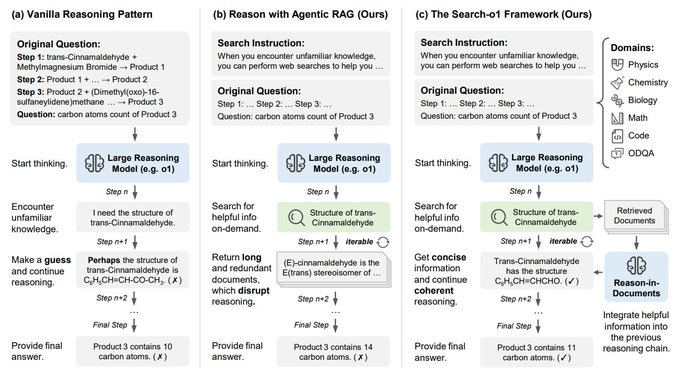
In parallel with the shift toward post-training, 2025 also saw test-time compute emerge as a practical, application-level paradigm. While many companies don’t explicitly use the term, the idea shows up clearly in products that prioritize depth and reliability over raw speed. In math and formal reasoning, coding, legal and research, applications increasingly allow models to think longer on harder problems, running multi-step reasoning, verification passes, or planning loops instead of relying on a single forward pass.
Axiom (which raised a $64M Seed at $300M Post) and Harmonic (which has raised a total of $120M, most recently at $1.45B post) are strong examples of how math-focused AI applications are pushing test-time compute into the foreground. Both are building systems where correctness and reasoning depth matter more than speed, which naturally requires models to spend more compute at inference. Rather than producing single-shot answers, these systems generate step-by-step reasoning, iterate on intermediate results, and verify outputs, often using formal proof systems before progressing.
This pattern is especially visible in agentic applications, where test-time compute is not optional. Agents must plan, execute, observe outcomes, and recover from errors. Longer context windows matter here, but only insofar as models can actively reason over that context, revisiting prior steps and adapting based on intermediate results. In these systems, test-time compute shows up as loops, retries, and dynamic tool use rather than static responses, allowing agents to trade latency for robustness.
Did it happen? Mostly Yes
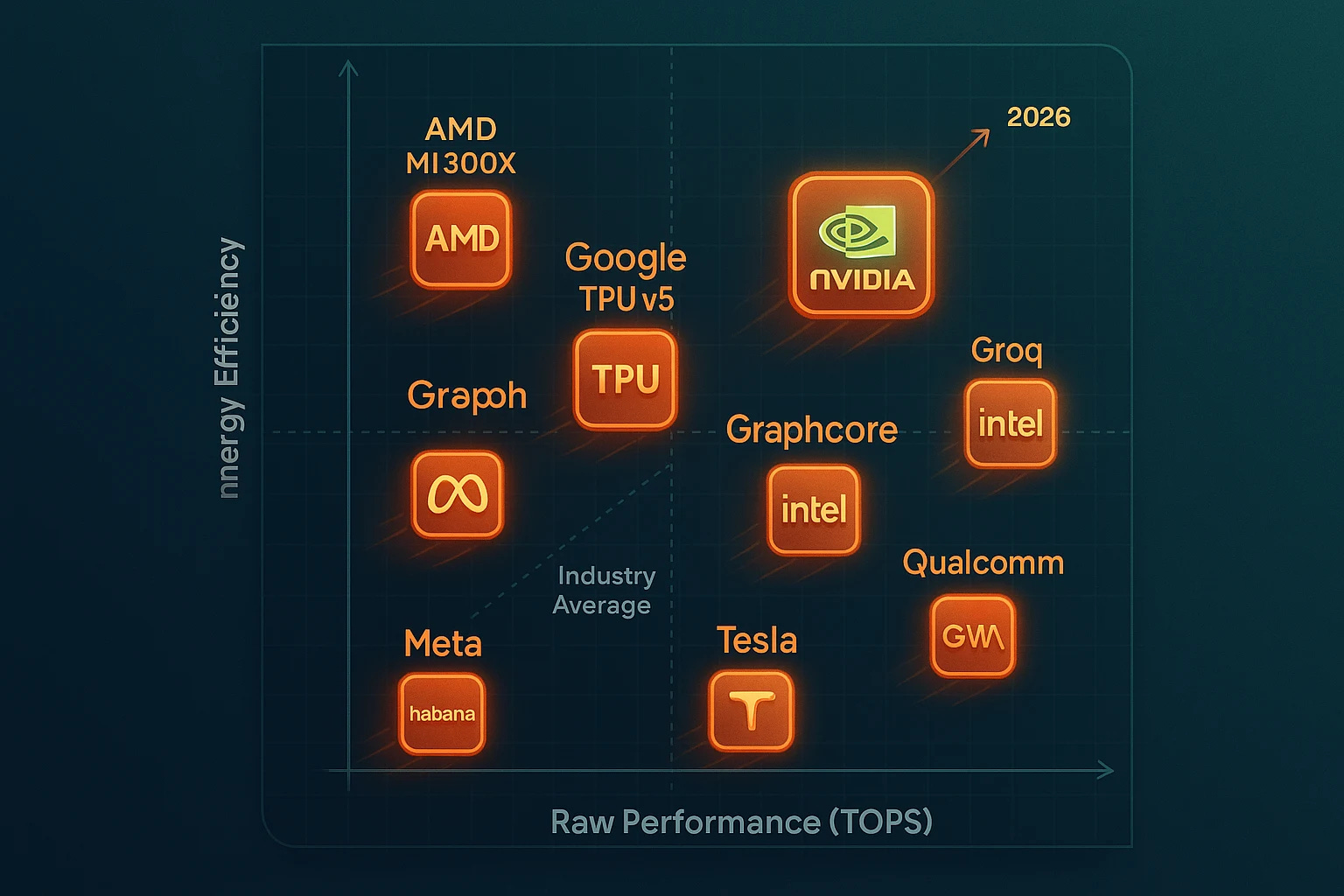
We had expected 2025 would see an “overall shift from training to inference as reasoning became more important, creating heightened demand for inference-based chips.”
The first half of that statement turned out to be very true, while the second half was less so.
Inference and reasoning was a core story in 2025. In August our colleague Matt McIlwain published a piece on “The Reasoning Revolution”, and in the private markets we saw insatiable demand for inference providers like Fireworks, Baseten, and Modal Labs, who collectively raised ~$500M in just the past three months!
Interestingly however that same excitement didn’t make its way to specialized inference chip upstarts. We had expected Nvidia to start seeing displacement from specialized providers like Cerebras and Groq. Instead, Nvidia continued to deliver massive revenue and earnings beats and the stock is up 30% YTD. More importantly they are ramping up production of their H200 chips, which industry experts call a “game changer” in inference at enterprise scale. On the other hand, Cerebras withdrew its IPO in October and shifted its focus more towards providing a cloud service vs. selling systems.
So while it was apparent that inference and reasoning did take center stage in 2025, the company that ended up stealing most of the thunder moving from standard training chips to inference chips was…Nvidia itself.
Did it happen? No
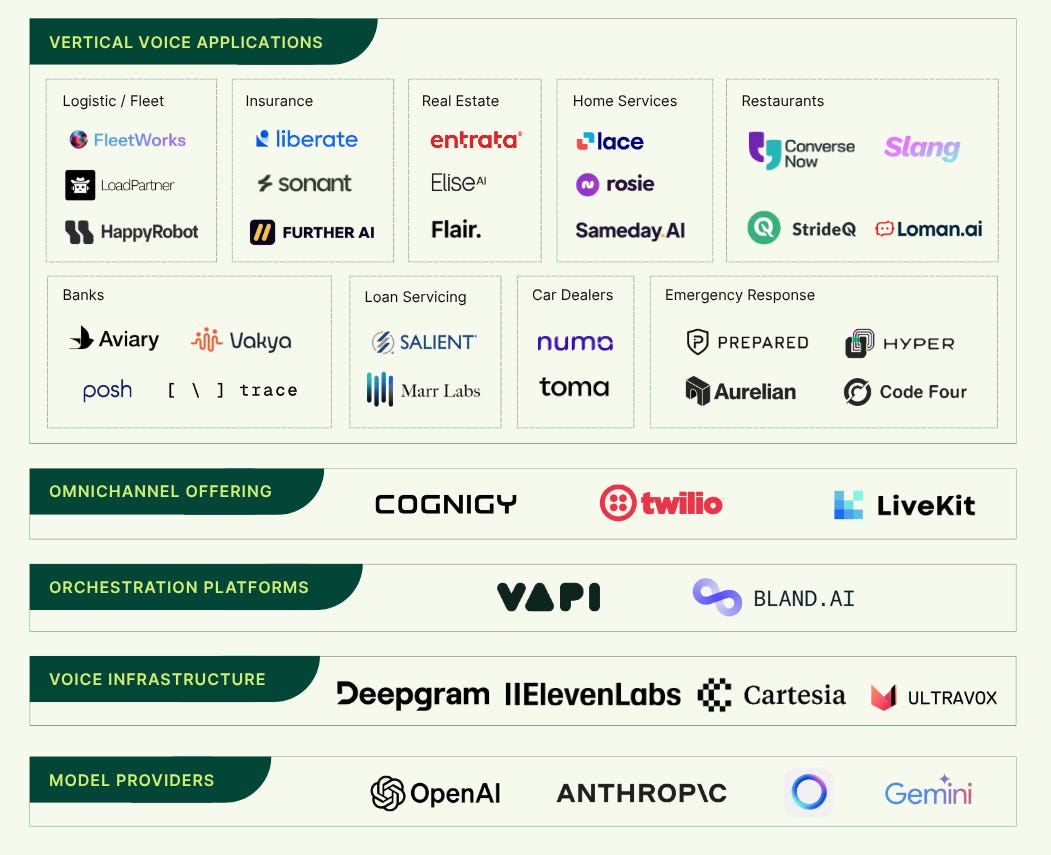
While we were hoping that 2025 would be the year we could finally book a trip from SF to NYC fully through an agent, that wish has not yet been fulfilled.
In hindsight, the core prediction was directionally right but temporally wrong. Agentic ideas clearly permeated the ecosystem in 2025—every major platform talked about agents, demos proliferated, and “agent frameworks” became table stakes in AI tooling. But the leap from impressive prototypes to reliable, end-to-end autonomy largely failed to materialize. For most users, agents still feel like enhanced copilots rather than semi-autonomous actors. The canonical promise - “book me a flight,” handle the edge cases, compare options, authenticate, pay, and recover gracefully when something breaks - remains stubbornly out of reach in production settings.
One major reason is that reasoning and planning improved, but not enough to sustain long-horizon, high-stakes workflows. Agents can decompose tasks and call tools, but they still struggle with brittleness: ambiguous instructions, shifting constraints, partial failures, and real-world messiness. As a result, companies constrained agents to narrow, well-scoped tasks—document processing, internal research, CRM updates—where errors are cheap and humans stay firmly in the loop. This explains why most real traction happened in internal or horizontal use cases, not consumer-facing, fully autonomous ones. The cost of a wrong summary is low; the cost of a wrong flight booking is not.
Finally, the infrastructure stack matured unevenly. API orchestration and multimodal inputs advanced, but security, authentication, and permissioning remained major bottlenecks. Letting an agent act on a user’s behalf across multiple systems—email, payments, travel sites, healthcare records—requires a level of trust, observability, and control that most organizations weren’t ready to grant in 2025.
We are excited by companies like Keycard, TinyFish, and others who are rapidly building the security and infrastructure required for Agents to flourish…hopefully in 2026!
Did it happen? Sort of
We can confidently say the first half of this prediction happened. While we didn’t get the mega IPO year that many had hoped for, the M&A markets ended up being fairly strong for AI companies, large and small alike.
Some of the key M&A activity in AI this year included:
ServiceNow buying Moveworks for $2.9B
Coreweave buying Weights & Biases for $1.7B
OpenAI buying Statsig for $1.1B
Stripe buying Metronome for $1B
And many other smaller acquisitions. Why? Perhaps one reason is that large incumbents are realizing that buying AI tech and talent to bolster their existing product suite is a better strategy than attempting to build it themselves. In a world where the public markets are assigning a significant AI premium, its better for companies to snap up smaller “AI pureplays” to benefit from that premium.
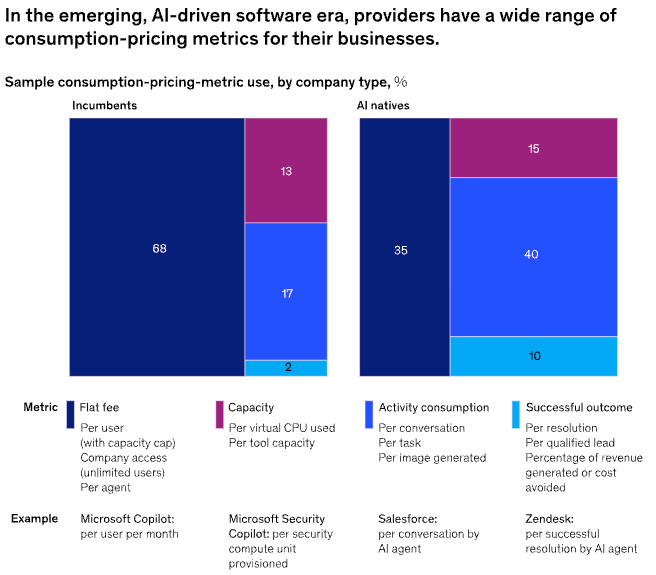
The second half of our prediction that “new business models will emerge” was less apparent. We had expected a wave of AI companies to roll out and implement “outcome-based pricing”, where customers would only pay the AI provider when they saw tangible benefits from the solution. While this is still a worthy goal, only a handful of startups like Sierra have rolled out outcome-based pricing, and most companies are sticking with more “traditional” pricing models like consumption or seat-based. Consumption remains popular as it is easier to track and measure relative to inference and compute COGS.
Perhaps 2026 will see more inroads around new pricing models.
With two “Yes,” two “Sort of,” and one clear “No,” we’ll give ourselves a 3/5 on our 2025 predictions. In a category that moves as fast as AI, we’ll take it! The exercise itself is the point: forcing clarity on what we believed would matter, and just as importantly, understanding why certain shifts took longer or showed up differently than expected.
If 2025 taught us anything, it’s that progress in AI is rarely uniform. Breakthroughs at the model and infrastructure layers can coexist with real friction at the application layer, where reliability, trust, and integration still gate adoption. While every year gets labeled “the most important year in AI,” the reality is more nuanced: these are compounding years, where groundwork laid today quietly determines what becomes possible tomorrow.
We remain deeply excited about the pace of innovation across the ecosystem and optimistic about what’s ahead, even when the hype curve runs ahead of reality. Stay tuned for our 2026 Predictions early in the new year.
Happy Holidays!!
Sora@soraofficialapp
3 new styles, just in time for the holidays: • Handheld • Retro • Festive Now available to all Sora users on web, iOS, and Android.
11:08 PM · Dec 12, 2025
100 Reposts · 698 Likes
No posts
Comments
Nothing yet. Say the first thing.
Sign in to join the conversation.