
Summary
In this week’s issue,
argues that Neurona’s $1.15B exit is less a success story than a testament to surviving CGT’s brutal translational death valley — six years from launch to first patient, across multiple financing rounds, before the science finally had to prove itself in humans.
reflects on the China biotech panel discussion at the 11th UChicago China Forum in the context of the $15.2-billion HengRui-BMS deal and impressive METiS Techbio IPO on HKEX last week.
shares a pessimistic view of the next FDA leadership as both CDER and CBER now have new acting directors following the departure of Dr. Marty Makary.
Last week, gave a short presentation titled “The Current Trends of West-China Biotech Collaborations” in University of Chicago. Paid subscribers can download the presentation in the paid subscribers’ session.
Thanks for reading! Subscribe to join the InScienceWeTrust Community as a free or paid member. Paid subscribers will receive exclusive access to special content, all previous newsletters, invitation-only events, complimentary tickets, and more.
, , and have been the proud writers and editors of this newsletter since 2023.
Email us at contact@iswtc.org to learn how to support or contribute to our newsletter.
From Academic Curiosity to a $1.15B Exit: The Real Lesson Behind Neurona’s Long Journey
For years, CNS cell therapy occupied one of biotech’s most difficult and least trusted corners. The underlying science was compelling, but the field had accumulated decades of disappointment — poor translational reproducibility, unclear mechanisms, manufacturing uncertainty, invasive delivery, and repeated clinical failures.
Against that backdrop, UCB’s agreement to acquire Neurona Therapeutics for up to $1.15 billion may represent more than a successful exit (Press Release). It may be the clearest demonstration yet that CNS regenerative medicine can become a real therapeutic modality — but only through an extraordinarily long and disciplined translational process.
We have been following Neurona closely since its earliest clinical data releases, including in prior newsletter issues such as (Apr 2025).
The most important lesson from Neurona is not simply that cell therapy for epilepsy can work. It is how long it took, how narrowly the company remained focused, and how much unglamorous work was required to get there.
One Disease. One Cell Type. One Hypothesis.
Neurona emerged from more than two decades of neuroscience research at UCSF centered on medial ganglionic eminence (MGE)-derived inhibitory interneurons — GABAergic neurons capable of suppressing pathological neural hyperexcitability. Critically, the company did not launch with a broad “programmable cell platform” ambition. Its 2015 founding announcement already framed the mission around repairing damaged neural circuits in epilepsy using precisely defined neuronal populations.
That focus sharpened over time into a single coherent hypothesis: replacing inhibitory signaling in hyperexcitable neural networks could durably rebalance epileptic circuitry. The target was drug-resistant mesial temporal lobe epilepsy (MTLE) — the most common form of focal epilepsy and a condition that has historically required tissue-destructive interventions like brain resection or laser ablation. The cell type, the disease, the delivery approach, and the clinical endpoint were all defined early and never substantially deviated from.
In hindsight, that discipline may have been one of the company’s most durable competitive advantages.
A Timeline That Tells a Harder Story
The CGT sector tends to compress success stories into a tidy arc: great science → financing → trial → acquisition. Neurona’s actual history tells a much harder story.
The company formally launched in 2015 with a $23.5 million Series A led by The Column Group — at a stage with no IND, no clinical data, and very limited precedent for successful CNS regenerative medicine. What followed was not a rapid sprint to the clinic. By 2017, Neurona received early-stage funding from the California Institute for Regenerative Medicine (CIRM), and in 2019, a $4.8 million CIRM translational grant to advance the epilepsy program toward the pre-IND stage. Even with the scientific thesis established and a committed investor, the company spent those years solving problems that rarely generate external excitement: differentiation reproducibility, cell characterization, biodistribution, long-term safety, seizure modeling, and regulatory alignment.
This is the hidden reality of CGT. The distance between an elegant academic paper and a clinically usable therapeutic product is enormous.
It took until 2021 — six years after launch — for Neurona to receive FDA IND clearance. The company then raised an additional $41.5 million specifically to support the Phase 1/2 trial launch, illustrating just how capital-intensive the “clinical barrier crossing” phase remains for CGT companies, even after the science appears convincing. The first patient was dosed in 2022.
When the Data Finally Arrived
Only then did Neurona confront the defining question of the entire CGT field: can the biology reproduce meaningful benefit in humans?
For CNS cell therapy, that question is particularly difficult. Transplanted cells must survive, integrate into functional circuitry, remain localized, maintain long-term activity, and avoid neurological toxicity. The early clinical results were therefore highly consequential.
At the 2023 AAN meeting, the first two treated patients showed greater than 90% seizure reduction at nine and five months post-treatment, respectively. By late 2023 and into 2024, updated data across the full five-patient low-dose cohort showed a 92% median reduction in disabling seizures during the primary efficacy window of 7–12 months post-treatment, with the earliest patients sustaining greater than 95% seizure reduction at 16–21 months from a single administration. No adverse events were attributed to the cell therapy, and no clinically significant neurocognitive impairments were detected.
At that point, the narrative changed rapidly. RMAT designation followed in June 2024. EMA PRIME designation, crossover financing, and pivotal trial alignment followed. The UCB acquisition agreement was announced in April 2026.
The lesson is direct: human efficacy data remains the true inflection point for value creation in CGT — not platform breadth, not scientific elegance, not theoretical optionality. Clinical validation is what transforms “interesting biology” into a real therapeutic modality.
What Neurona Suggests About the Future of CGT
Neurona’s journey also exposes a structural tension across the field. Research-driven spinouts naturally emerge with broad platform ambitions — multiple cell types, multiple tissues, multiple indications, expansive regenerative narratives. That breadth is scientifically understandable; academic discoveries often appear highly versatile before translational constraints emerge.
But Neurona’s history suggests the industrial reality of CGT may reward the opposite. A company that spent more than a decade advancing a single tightly defined therapeutic concept — inhibitory interneuron replacement for drug-resistant MTLE — still found the path extraordinarily difficult. The implication is uncomfortable: if a highly focused CNS program required roughly twenty years from foundational science, a decade from company formation, multiple financing rounds, years of translational optimization, and prolonged clinical follow-up simply to achieve initial validation, then broad multi-program CGT ambitions may substantially underestimate the true operational burden of therapeutic translation.
This is especially true in CNS, where biology is complex, delivery is invasive, endpoints require extended follow-up, and regulatory tolerability thresholds are exceptionally high.
The Deeper Achievement
The $1.15 billion headline — $650 million upfront plus up to $500 million in milestones — will understandably capture attention. But the deeper achievement was something less visible: Neurona successfully crossed the long and painful translational valley between academic neuroscience and validated human therapeutic biology.
That crossing required focused execution across multiple financing rounds, incremental technical progress through years of regulatory uncertainty, and tolerance for scientific ambiguity with no guarantee of a clinical payoff. Much of the work was operational rather than glamorous, and the company remained remarkably disciplined throughout — one disease, one biologically matched cell type, one coherent clinical strategy.
Regenerative medicine rarely progresses through sudden technological breakthroughs. More often, it advances through long periods of patient, highly focused translational execution — until one day the clinical data become undeniable. For the broader CGT industry, and for CNS-focused programs in particular, that may be the most valuable lesson of all.
, Co-Founder of iSWT Community
Reflections from the UChicago China Forum: Reverse BD, Major TechBio IPO, and the New Era for Chinese American Talents
After co-authoring and hosting more than 140 Asian Biotechies In A Bar newsletters and BioVerse webinars together, and I finally participated in an in-person event together, at the 11th University of Chicago China Forum last week. We are grateful to Chloe Xu, Clarence Li, and August Yu for the invitation.
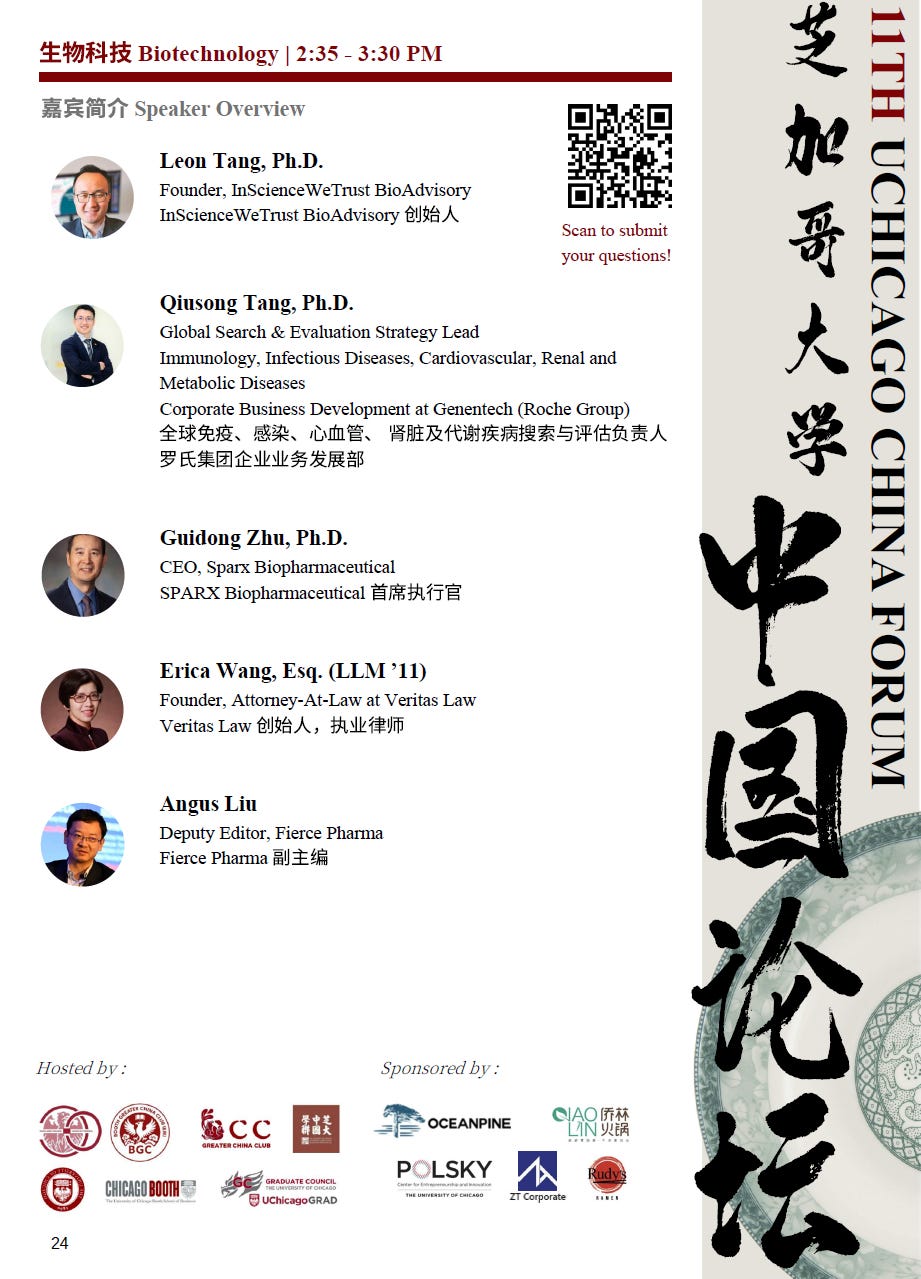
Leading up to our discussion, two major news stories broke: the $15.2 billion licensing/co-development deal between HengRui and BMS, and the IPO of six-year-old METiS Techbio which reached over $3 billion market cap. These occurred against the backdrop of an uneventful Trump-Xi Summit, providing the US-China biotech community with a collective sense of relief.
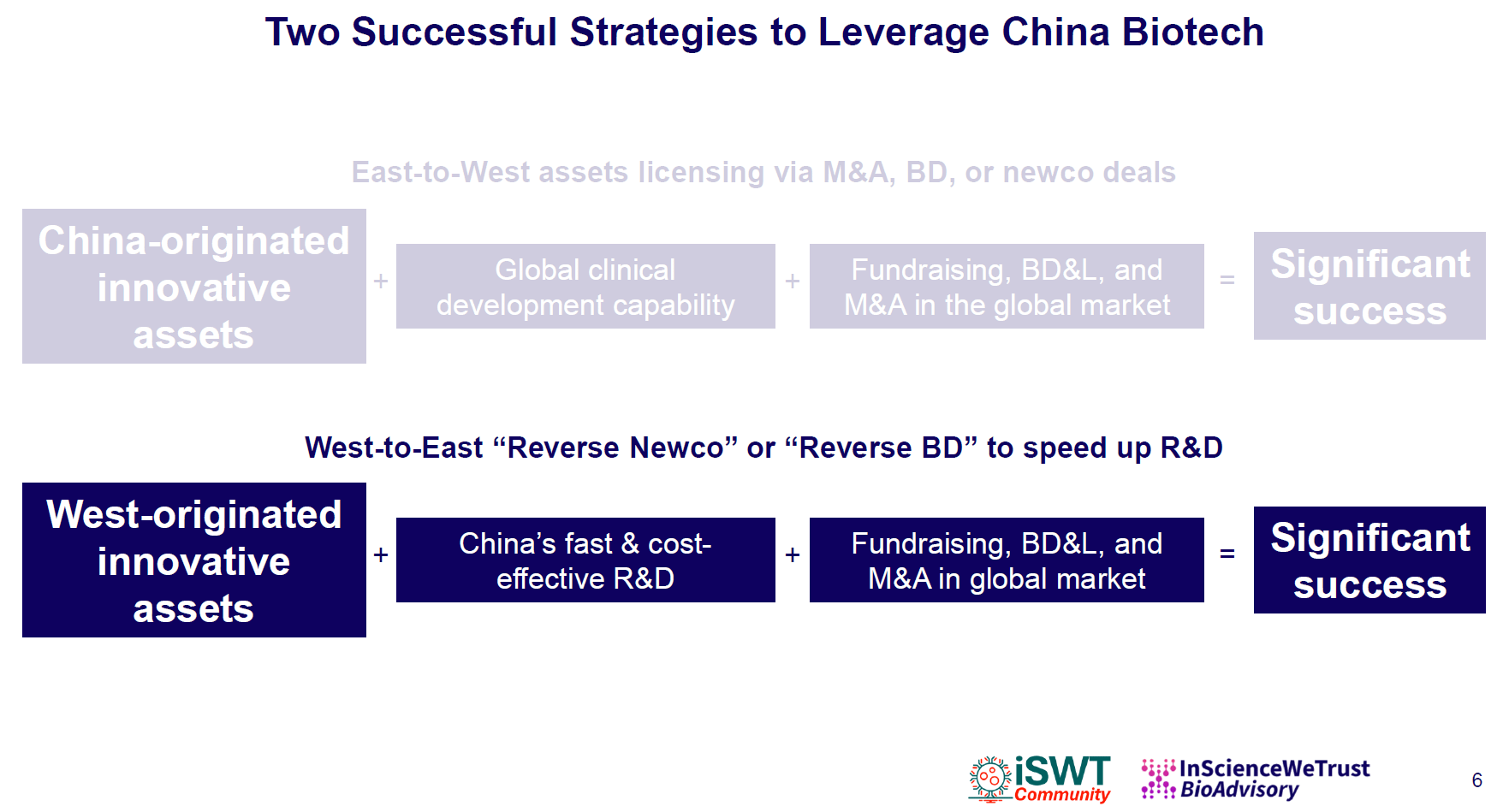
The HengRui-BMS Deal Validates the “Reverse BD” Trend
First, it is the largest deal by asset count, involving 13 distinct products. It is also unique in its structure, featuring four HengRui assets out-licensed to BMS, four BMS assets to be developed by HengRui in China, and an option to co-develop five additional assets.
Furthermore, it highlights a new trend where BMS will leverage HengRui’s speed and cost-efficiency in R&D to advance these assets to clinical proof of concept.
Finally, it stands as the second-largest China-outbound deal by total value, surpassed only by the $18.5 billion AstraZeneca/CSPC agreement.
This deal serves as a major validation of the “West-to-East” innovation flow, often labeled as “reverse BD” (business development) or “reverse Newcos.” Major biopharmas like Gilead, Eli Lilly, AstraZeneca, and BMS have announced similar arrangements, as have biotechs such as Rapport Therapeutics and Crescent Biopharma.
China’s advantages in preclinical and early-stage clinical R&D are undeniable; instead of simply licensing Chinese innovations, Western firms are utilizing China to expedite their own R&D to remain competitive. Industry insiders suggest that more deals similar to the HengRui/BMS and Kelun/Crescent agreements will be announced throughout 2026.
AI-Powered METiS Makes an IPO Splash on the HKEX
Self-described as the “SpaceX of pharmaceuticals,” this six-year-old company has hit several impressive milestones: an innovative nanotechnology platform that has fostered nearly 30 global partnerships; a diverse pipeline of over 10 assets, including a Pre-NDA candidate; and a dual-track strategy that generates predictable revenue as an R&D enabler while pursuing high-reward developments through its own pipeline.
The fusion of nanotechnology innovation and efficient execution exemplifies a new generation of Chinese biotech. These companies fully capitalize on China’s strengths in AI, biotech R&D infrastructures, and an improving capital market.
Opportunities for Chinese Americans in the New Biotech Era
The China Forum took place following a largely uneventful Trump-Xi Summit. Although the CEO of Illumina joined the presidential delegation, the biotech sector was largely excluded from the official agenda. The absence of major pharmaceutical CEOs suggests that US-China biotech competition may currently be a low priority for top government officials.
In the realm of US-China biotech “coopetition”, no news is the best news.
At the China Forum, our panel—including Erica Wang, Gui-Dong Zhu, Qiusong Tang, , and myself—addressed a room of MBA students. We concluded that the cultural intelligence and language skills of Chinese American students will be indispensable in the growing wave of US-China biotech collaboration.
A prime example is METiS CEO Chris Lai. Born in East Asia, educated at MIT, and trained in Western corporations, Chris co-founded METiS in Beijing in 2020. In just over six years, he has led the company to the HKEX and built a techbio firm valued at over $3 billion.
Similarly, many young professionals with roots in both the East and West are playing vital roles as entrepreneurs, executives, and investors. While “sea turtles” with decades of US biopharma experience founded the industry almost 2 decades ago, a new generation of young “Asian biotechies” is now elevating China biotech to a new level with a native global vision that extends far beyond just the US and China.
Our panelists enthusiastically encouraged students with East Asian backgrounds to seize their incredible unique advantages and dive into this booming industry!
There has never been a more thrilling time to be an Asian biotechie!
, Co-Founder of iSWT Community & Founder of ISWT BioAdvisory
A clean slate of FDA leadership
Following the resignation of Dr. Marty Makary as FDA commissioner this week amid reports of a White House plan to fire him, acting director of the FDA’s Center for Drug Evaluation and Research Dr. Tracy Beth Høeg and acting director of the Center for Biologics Evaluation and Research Dr. Katherine Szarama have both stepped down from their posts. On X, Dr. Høeg said she was fired.
According to the FDA’s website, Dr. Michael Daivs, mostly recently deputy CDER director, has become the acting CDER head. Dr. Davis was previously chief medical officer of the Usona Institute, which was one of three recipients of the national priority vouchers (CNPVs) tied to the Trump administration’s executive order over psychedelics.
Karim Mikhail, formerly Amarin CEO who joined the FDA in 2025 as a senior advisor in the Office of The Commissioner, is now the acting CBER director. Meanwhile, earlier this month, Dr. Angelo de Claro shed the “acting” in his title to become the permanent director of the Oncology Center of Excellence.
That means, the FDA will have a clean slate of leadership on the drugs side, leaving more uncertainty for an agency that has already weathered a tumultuous year. The Trump administration hopes to name a new nominee for permanent commissioner in the next few weeks, a senior administration official told CNBC.
The search for Dr. Makary’s replacement is reportedly being led by Chris Klomp, the director of Medicare and senior advisor to HHS Secretary Robert F. Kennedy Jr. The search will prioritize candidates who have proven leadership experience, particularly within large organizations, and can command the respect of FDA officials and Americans, The Washington Post reported, citing a person familiar with the search process. They also hope to find a leader who will carry on some policy changes initiated under Makary, such as expediting some drug approvals.
In an open letter to Trump, a number of biopharma leaders (incl. RA’s Peter Kolchinsky, Seaport’s Daphne Zohar, Nkarta CEO and former BIO Chair Paul Hastings) have thrown their support behind Dr. Richard Pazdur as the new FDA commissioner. However, I view this more as a call for stability at the agency because, in my opinion, the chance of a Pazdur commandership is almost zero.
Like former CBER director Dr. Peter Marks, Dr. Pazdur left the agency in such a high-profile way, and he has since been critical of the agency for politicizing drug decisions. He has publicly questioned the legality of CNPV when the Trump administration is clearly fond of the program and, as mentioned above, is looking for someone who will keep advancing policies to speed some drug approvals.
Dr. Pazdur was also reportedly behind the FDA’s rejection of Replimune’s oncolytic immunotherapy RP1, a case that The Wall Street Journal’s editorial board zeroed in on in its unusually relentless anti-Makary campaign, which apparently played a role in Trump’s decision to fire him.
The FDA commissioner role has effectively become an impossible job, which led me to this pessimistic view that whoever comes after Dr. Makary won’t last long and that the stability and predictability that the biopharma industry longs for will continue to be out of reach.
Career scientists at the agency and the biopharma world would want the agency to stick to science. But that’s basically a pipe dream under the current administration, which favors political interventions and can easily get upset if someone isn’t a “team player.” Dr. Marks was pushed out because of a clash with the administration on vaccine safety, his successor Dr. Vinay Prasad got on the wrong side of the administration over restrictions on Sarepta’s gene therapy Elevidys, and Dr. Makary reached the end of the road after Trump reportedly grew frustrated with him for slow walking approvals of flavored vapes.
— , Deputy Editor at Fierce Pharma and iSWT Community volunteer

Comments
Nothing yet. Say the first thing.
Sign in to join the conversation.