
Summary
In this week’s issue,
Steve Yang from , inspired by a recent China IIT strategy from an early-stage US biotech, shares a framework for western biotechs to choose CRO partners for China first-in-human or proof-of-concept clinical studies.
saw a (perhaps temperary) return to normalcy at the FDA.
moderated a lively and wide-ranging BD panel at the SAPA-NE Annual Conference on June 13th, bringing together voices from global pharma, Chinese biotech, venture capital, and transaction law to examine how China is evolving from a pipeline source into a true co-creator in the global drug development ecosystem (see its summary by Jia Guo in paid content).
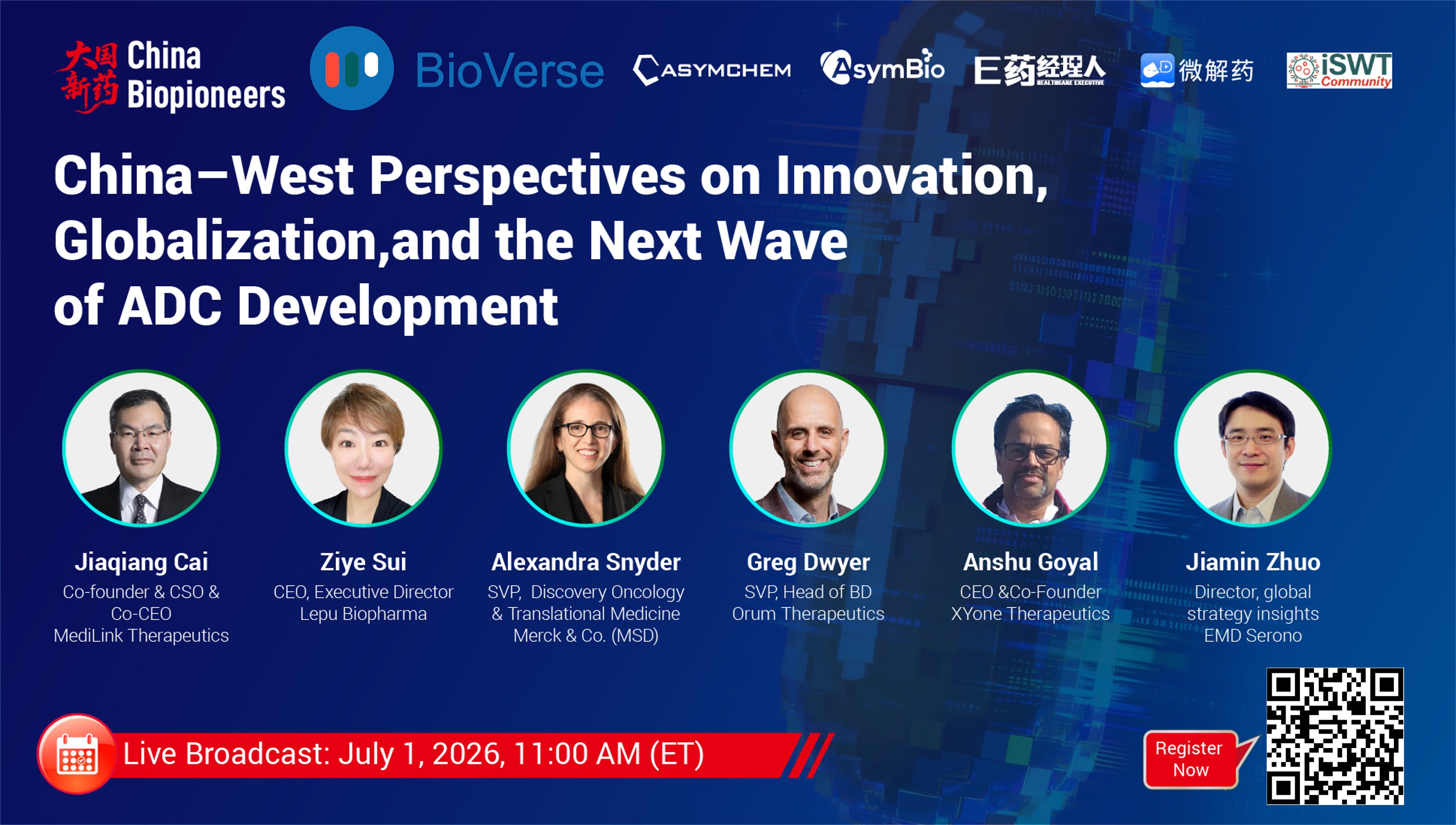
On July 1st, an ADC expert panel that consists of Jiaqiang Cai from MediLink, Ziye Sui from Lepu Biopharma, Alexandra Snyder from Merck & Co, Greg Dwyer from Orum Therapeutics, Anshu Goyal from XYone Therapeutics, and our very own from EMD Serono will converge at BioVerse #32 to share their thoughts on the current landscape of this exciting field. Sign up for the webinar here.
Hundreds of iSWT Community members are heading for San Diego for BIO and its Satellite events from Jun 21 to 25, and 200+ iSWTC members have joined our IN-PERSON attendees-ONLY networking group. Please contact Feng Pan, Ting Yi, or to join this exciting and curated networking group.
Paid members please check the events from the paid members’ session to learn about the events organized by iSWT Community members and access discount codes.

Thanks for reading! Subscribe to join the InScienceWeTrust Community as a free or paid member. Paid subscribers will receive exclusive access to special content, all previous newsletters, invitation-only events, complimentary tickets, and more.
, , and have been the proud writers and editors of this newsletter since 2023.
Email us at contact@iswtc.org to learn how to support or contribute to our newsletter.
A Framework for Western Biotechs Choosing a CRO Partner for China FIH/POC Studies
A $9.1M seed-funded startup just announced plans for an IIT study in China.
Kopra Bio, a UCSF spinout working on virus therapy for brain cancer, is the latest western biotech to head to China for early clinical data. As Endpoints News put it:
“Increasingly, US companies are looking to conduct their own IITs in China and to get their first clinical data for a fraction of the cost of a traditional Phase 1 study in the US.”
It is a pattern that is hard to ignore — and the numbers back it up. Pfizer’s CEO has described Chinese biotech firms conducting clinical research at “half the cost and three times the speed” of their western counterparts. For an early-stage company burning through a $9M seed round, that math is existential. FIH and POC data are what separate fundable from un-fundable, and China’s world-class hospitals, deep patient pools, and regulatory pathway that often moves faster than the FDA make it a compelling venue to get there.
Western biotechs no longer need convincing. They get it.
The harder question is how. And the hardest part of “how to Pick the right CRO?”
Why CRO Selection in China Is Different
FIH and IIT programs are not smaller versions of late-stage trials — they are structurally different. These are focused studies of 2 to 50 subjects, asking specific questions about safety, target engagement, and dose response. They require iterative protocol design, close PI collaboration, and rapid mobilization, and they demand a CRO with genuine scientific depth — real endpoint and biomarker expertise — not just logistical capacity.
Layer cross-border complexity on top — timezone gaps of 12 to 16 hours, differences in how issues escalate, the challenge of managing a China program while keeping investors and board members informed — and the right partner needs to be more than a China operator. They need a western-facing point of contact who bridges the gap between what is happening in the clinic and what the sponsor needs to know.
Know the Landscape
China’s CRO market presents three broad categories of partners:
Small/Mid-Sized China CRO. Locally rooted with a predominantly domestic client base. Western-facing infrastructure is almost nonexistent, cross-border track records are thin, and many suffered significant staff attrition during the domestic funding downturn — with downstream implications for study continuity and data quality.
Large China-Based CRO. Scaled operators with broad hospital networks and growing global ambitions, but built around late-stage, large-trial execution. International contracting structures are still maturing, and whether a small western sponsor’s program receives genuine priority attention deserves scrutiny.
Large Global CRO. Strong institutional credibility and global reach, but infrastructure and pricing calibrated for pivotal, late-stage programs. The overhead of their operating model may not suit the agile demands of a first-in-human study.
Four Dimensions That Determine Fit
Clinical Trial Focus. Look for a CRO for whom early-stage work is a primary focus, not a niche grafted onto a late-stage engine. The signals: dedicated early-phase teams with genuine endpoint expertise; a track record of supporting protocol amendments without re-negotiating scope; and staff continuity from initiation through data readout. Ask directly — what share of this CRO’s active portfolio is FIH and IIT work, and who specifically will run your program?
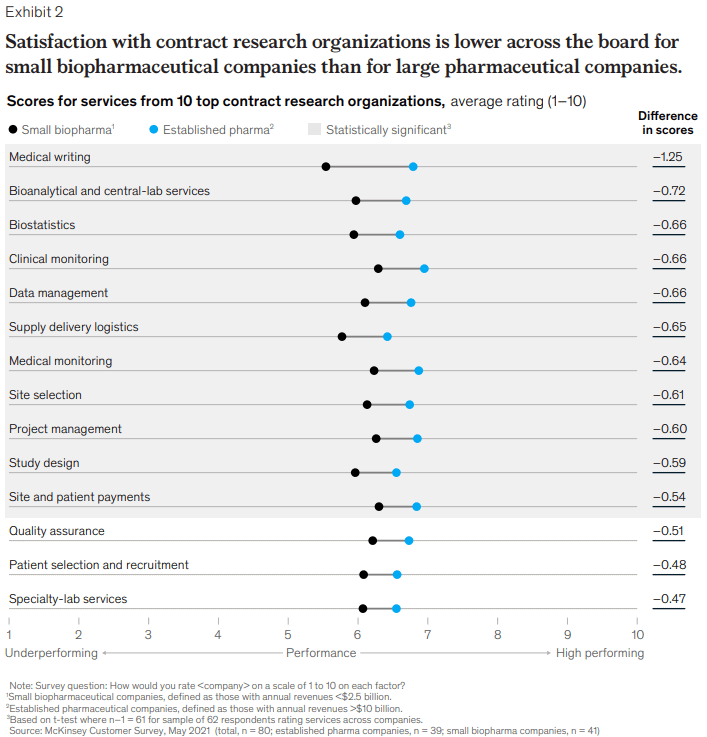
Client Base. A small biotech with a single program needs to be a priority client, not a secondary account. A 2022 McKinsey analysis documented the pattern[LT1] : small companies are routinely assigned less experienced teams, receive less proactive communication, and face higher personnel turnover than large pharma clients at the same CRO. Watch for the “bait-and-switch” — a polished senior team wins the contract, then hands off to a less experienced operational team once the ink is dry. Insist on meeting — and contractually naming — the individuals who will manage the study before signing.
Counterparty Credibility. A CRO with active master service agreements across leading global pharmaceutical companies has already passed rigorous legal, financial, and data governance due diligence by sophisticated procurement organizations. That externally validated baseline of accountability is meaningfully different from a CRO signing its first western client — and it reduces the due diligence burden on a lean early-stage team.
Competitive Positioning. The right question is not which CRO owns the most China infrastructure. It is which one takes full accountability for the outcome while assembling best-of-breed capabilities around the program. The same McKinsey analysis identified this integrator model as the necessary evolution for CROs serving innovation-driven biotech — and AI is accelerating the shift by reducing the cross-border coordination costs that once made such orchestration impractical.
The Legal Layer Most Sponsors Underweight
Before signing any CRO agreement for a China study, three questions demand explicit answers.
Jurisdiction. What law governs the contract? A contract governed by Chinese law operates under a fundamentally different framework than one governed by U.S. or English law. For a company funded by U.S. or European investors, this is not a technicality.
Counterparty substance. Is the entity you are signing with the real accountable party? Some CROs establish overseas offices primarily as contracting interfaces, with execution occurring through separate domestic entities. Understanding whether the counterparty has meaningful staff, assets, and direct accountability for delivery is essential due diligence.
Ownership and conflicts. Who owns the CRO? China’s biotech ecosystem is highly interconnected, with investors frequently holding stakes across CROs, CDMOs, and the biotech companies they fund — sometimes including competing programs. Ask directly: do any investors in the CRO hold positions in competing pipelines?
The Bottom Line
Each CRO category has genuine strengths — local clinical networks, global reach, or institutional scale. The challenge for early-stage biotech is that none was designed with your program in mind. What you need is a partner who can draw on those strengths selectively while taking full accountability for the outcome.
McKinsey’s 2022 analysis points to exactly this model — the “integrator” CRO whose competitive advantage is coordination and accountability across best-fit capabilities, not the breadth of its own internal infrastructure. For a cross-border FIH or POC study, that means a partner fluent in both Chinese clinical operations and western sponsor expectations, with the institutional standing to hold all parties to the same standard.
The CRO selection decision is, in effect, a decision about where accountability sits. The four dimensions in this framework are simply a structured way to find the partner who has earned it.
Steve Yang — Co-Founder and CEO of , Board Member and CFO of MERIT CRO, Inc.
Steve publishes regularly on early-stage biotech development strategy and the evolving China clinical landscape. Contact: syang@mianuscapital.com
Some good news at the FDA
The FDA is showing some signs of returning to normal, although probably only temporarily.
This week, uniQure announced that the FDA, in a U-turn, agreed that a three-year analysis from a phase 1/2 trial of the company’s Huntington’s disease gene therapy, AMT-130, would be enough to support a filing for accelerated approval.
Before uniQure’s planned BLA submission in the third quarter, the company and the agency plan to align on the confirmatory study design, “including consideration of concurrent control on standard-of-care therapy instead of a sham procedure,” uniQure said.
As we covered in Issue 116 and Issue 130, the FDA’s previous sudden rejection of uniQure’s accelerated approval plan—and the agency’s demand for a sham-controlled study—was part of a high-profile drama that led to complaints from the rare disease community and stirred up concerns within the biopharma industry around regulatory consistency. Along with several other negative opinions from the FDA (e.g. Moderna and Replimune, more on those later), it fed into a campaign to bring down former CBER director Dr. Vinay Prasad and then-FDA chief Dr. Marty Makary. Both have since left the FDA.
The announcement follows a June 3 meeting between rare disease advocacy groups and the current FDA leadership, including Commissioner Kyle Diamantas, CDER Director Dr. Mike Davis, CDER Director Karim Mikhail—all serving in acting capacity. No specific applications were discussed, but participants described the meeting as constructive, according to Endpoints News.
“Two things really resounded from the discussion – we need to improve the infrastructure for gathering evidence in rare diseases and also work in the here and now, meeting science where it is and using the tools we have to discern treatment effect even when populations are small and heterogenous. I believe FDA heard that we cannot afford to choose between those goals,” Kara Berasi, CEO of the Haystack Project, said, as quoted by Endpoints.
In another good sign for the industry, the FDA’s internal review of Moderna’s mRNA flu vaccine, mFlusiva, was less critical than what Dr. Prasad raised in a surprise “refusal to file” (RTF) letter back in February.
In briefing documents prepared for an advisory committee meeting this past week, the FDA still raised the issue of the standard-dose control in Moderna’s phase 3, flagging that the preference for individuals ages 65 years and older is a high-dose version. But the agency also said that “no major deficiencies were identified.”
After the RTF, Moderna has adjusted its regulatory plan. For the 65 and above group, the company instead is seeking an accelerated approval while committing to a confirmatory study.
During Thursday’s adcomm, members voted 9-to-0 supporting the flu shot in both those 50 to 64 and 65 and above.
Meanwhile, Replimune said in late May that it and the FDA are “aligned on a path forward” for the agency to reconsider the company’s twice-rejected melanoma cancer vaccine RP1 (vusolimogene oderparepvec). The third chance afforded to Replimune follows endorsement from The Wall Street Journal’s editorial board in tandem with the newspaper’s open salvo against Dr. Makary’s leadership.
Last week, the FDA also granted accelerated approval to Sanofi’s Tzield for stage 3 Type 1 diabetes to delay the progression of disease, confirming the use of decline in C-peptide levels as an approvable endpoint. This application recently hit a hiccup, as Sanofi at one point asked to be removed from the controversial Commissioner’s National Priority Voucher program.
An FDA memo (PDF) now shows that during CNPV review meetings, then-CDER director Dr. Tracy Beth Høeg tried to overrule the review team’s recommendation for approval, causing the agency to miss its original PDUFA date in April.
All these new events suggest that the FDA is gaining stability after last month’s regime change. As a lawyer who had no prior experience in drug development, Diamantas didn’t come in with a preset agenda on how he wants to run the FDA’s drug departments. So, he’s been leaning on the expertise of career scientists, earning their trust while bringing back some level of regulatory certainty.
During the June 3 meeting, Diamantas reportedly told the rare disease advocates that he would prevent political interference in the decision-making of career staff. In his (probably) no-more-than-3-month tenure as commissioner, maybe; but it’s quite impossible for a permanent appointee, as we discussed in Issue 139 about Dr. Makary’s ouster, because political loyalty to President Trump—not science—is a requirement to serve in this administration.
So folks, enjoy it while it lasts.
— , Deputy Editor at Fierce Pharma and iSWTC volunteer

Comments
Nothing yet. Say the first thing.
Sign in to join the conversation.