
So excited to get to feature this one today from Caelyn Cobb.
Right away, the voice pulls me right in. “Our girl,” the story tells us, over and over, to such hypnotic effect. It makes me wonder who the narrator is, and why this protagonist is =“our girl”; it makes me feel like we’re picking right up with a story already in progress, and it has me rooting for her, right from the start.
And then, and I don’t want to give to much away, but it introduces this relatively small speculative element that turns the story a little sideways in the most fun and perfect ways. It really hits my sweet spot for what I so love that a short story can do. I’m excited to get to share it today and for you all to read it!
—Aaron Burch
Editor, Short Story, Long
“Time Management”
Once there was a girl who wanted to be a part of something bigger than herself, and so she moved to a big city and tried to get a job at a company everyone else had heard of before. That didn’t work, but she did land a job, and that job, she was sure, would lead to a better job, one at one of those aforementioned heard-of-before companies. As far as decisions go, it wasn’t the worst one. Some people searching for community end up living in weird New Age compounds or following musicians around to every concert they play for the rest of their lives. Our girl just wanted to work, and for the work to give her meaning.
The office for the job was full of other girls just like her, with the same dreams and the same longings. None were women: in this city, you were either a girl or a crone with nothing in between, and at the office it was no different. Row after row of girls sat at identical desks, with matching half-walls separating them into their own neat squares. They swished in each morning in their fast-fashion work attire, carrying iced coffees with cubes that clacked on the plastic sides of their cups. They sat, and they typed, and they furrowed their brows. All of them were firm-cheeked and slim and had eyes shining with youth.
The work appeared like most work did, on papers of unknown origin, passed from hand to hand in an order little understood but followed religiously. Sometimes the Boss came down to supervise and give out tasks of his own making. The Boss stood straight and broad and blonde and dashing, and to the girls, he was like the sun. He smiled and waved at them as he strode through the aisles, and they waved and grinned back. It was hard not to admire him, so lit up and supercharged as he was.
When the Boss came to our girl’s desk for the first time, she bloomed up at him, happy to be in his glow at last. He handed her a stack of papers to work on. She asked when he wanted her to finish the task. “As soon as you can,” he said. “Right now, if you can swing it. Yesterday, really!”
The other girls around her all laughed and so did the Boss. But when he walked away, the girl sitting next to our girl leaned over her half-wall. “He is not really joking,” she whispered.
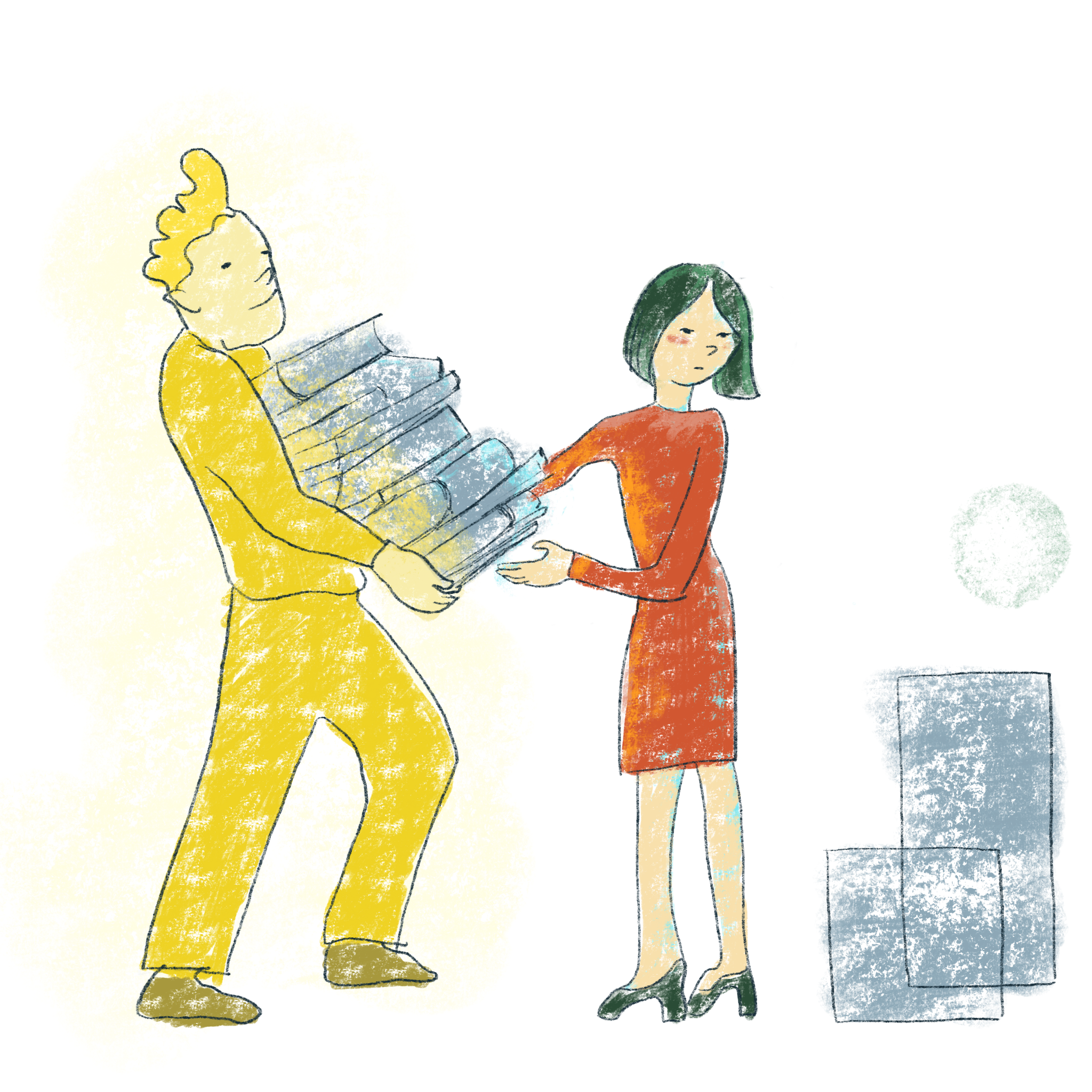
Our girl tried mightily to comply with the Boss’s request. She wanted to finish the task as soon as she could. But the stack of papers was so high. And worse, the next day brought another, waiting on her desk when she arrived, and there were more papers each day after that. She couldn’t keep up.
The Boss did not smile at her when he came by. Instead he frowned. “You need to work on your time management,” he said.
“How?” she asked. She could barely see him over the papers piled in front of her.
“Beats me,” he shrugged. “Ask That Girl over there.”
That Girl. She sat a few rows over, at a desk surrounded by walls that actually went up to the ceiling, almost. She did not wear fast fashion; she wore vintage cardigans, pilled at the sides. She drank her coffee black and burned from the office’s ancient pot. Once she had been one of them. Now she stared into the middle distance in her corner, surrounded by piles of paper, guarding the history of the company with her unfathomable mind. Some of the girls wanted to be like her, to sit behind real walls and be trusted with important things. Others thought her a cautionary tale. They didn’t want to be That Girl, they murmured to each other. They wanted to be the Boss, even though the Boss had never been one of them.
For the most part, our girl found That Girl a little intimidating. When she plucked up the courage to peek around the corner and ask about time management, she thought perhaps she had been right to be scared: That Girl just laughed. “No such thing,” she said. Her laughs continued as our girl slunk back to her own desk. None of the girls around her looked up. Nor did they offer any solution to our girl’s problem. At the end of the day, it was every girl for herself.
“You need to work on your time management,” he said.
“How?” she asked. She could barely see him over the papers piled in front of her.
“Beats me,” he shrugged. “Ask That Girl over there.”
That night, our girl had no place to be. She went straight home as soon as she became too tired to keep working. She ate cereal for dinner and then she set out to do laundry during the hours when the rest of her neighborhood was likely to be elsewhere, having fun. She had resigned herself to the fact that this was the only foolproof way to ensure she got any machines.
The laundromat was still, alarmingly, full—though not of customers, she saw with relief, but with workers. Women. Or, in the uncharitable parlance of the city, girls well on their way to becoming crones, with smile lines at their eyes and silver streaks in their hair. One at the front desk with the cash register and a supply of quarters. Three at the machines, doing wash-and-fold orders for pickup. Another in the faded blue plastic seats by the door, minding a set of three young children playing with dolls and trucks.
“Hello,” the woman at the register said to our girl as she walked in.
“Hello,” the woman with the children said as our girl wheeled her house cart of laundry past her. She looked just like the woman at the register, down to the same gray three-quarter sleeve shirt under the same purple floral apron. Both had a mole on their right cheek and a small scar cutting through the left side of their upper lip.
“Hello,” said the woman emptying a washer full of clothes into a dryer at the back, an exact match to the others, too.
“Are you guys…related?” our girl asked. They really looked like sisters, or quintuplets, or whatever ‘tuplets’ for the number of them that they were.
The women looked at each other. “Sort of,” said another woman with the same mole and scar and clothes loading coins into the machines on the opposite row.
Our girl, feeling stupid, just nodded, face heating up. She started to put her dirty clothes in a washer. But the women saw the clothes: fast-fashion, coffee-stained, shiny in the way that only cheap polyester can be. They saw our girl’s tired face. They saw the tote bag she used instead of a purse.
“Ok, you caught me,” the woman at the machine to her left said. “We’re actually the same person.”
“There was so much work, and not enough machines, so we found a solution to get it done when no customers are around,” said another.
Our girl looked up from her laundry. The women had kind smiles on their faces. They had among them an air of shared understanding. She thought: time management.
“How?” our girl asked.
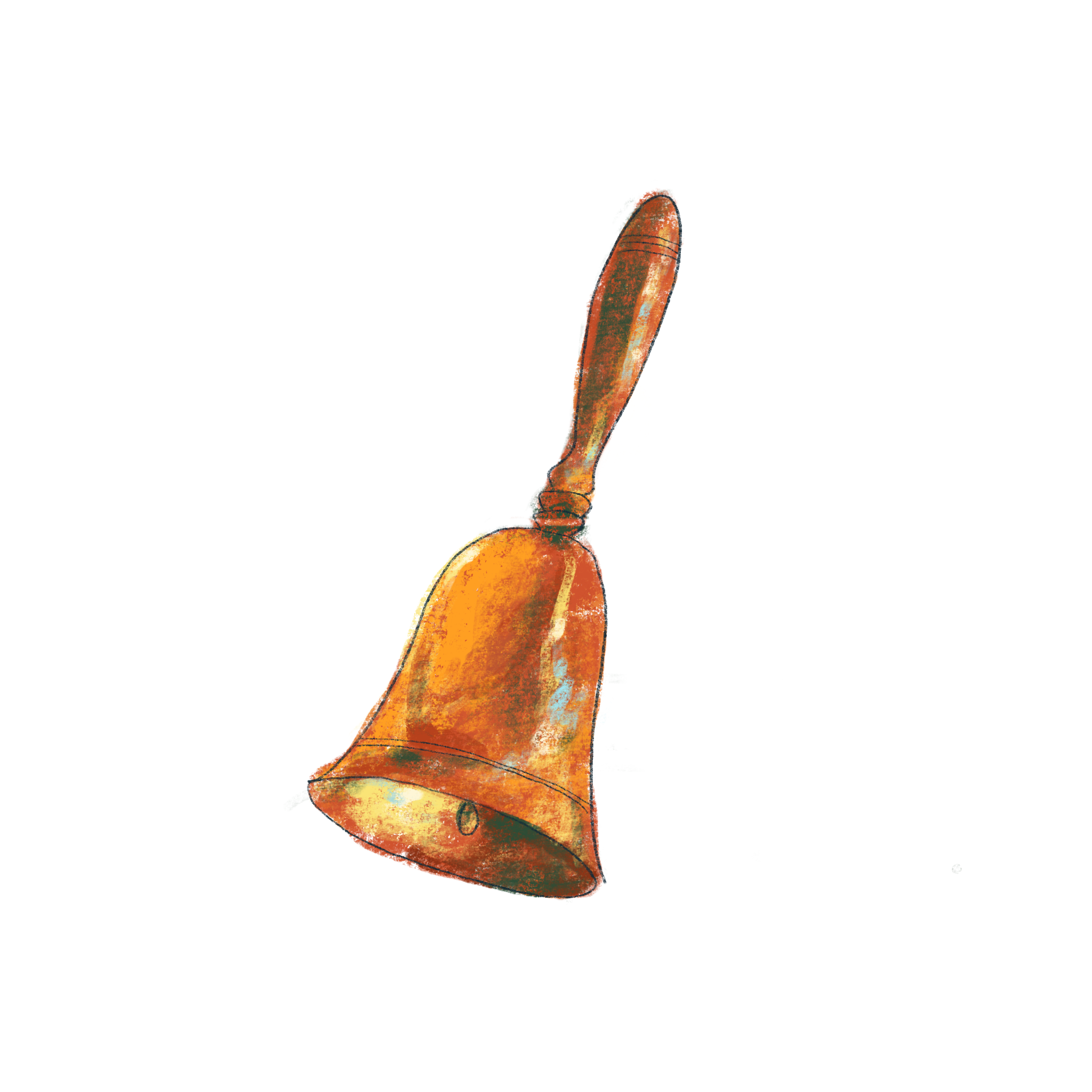
They each reached into the front pocket of their aprons. From inside, they all withdrew their own tiny brass bell.
“Go to the thrift store at the corner,” the woman at the register said. “Ask for Helga.”
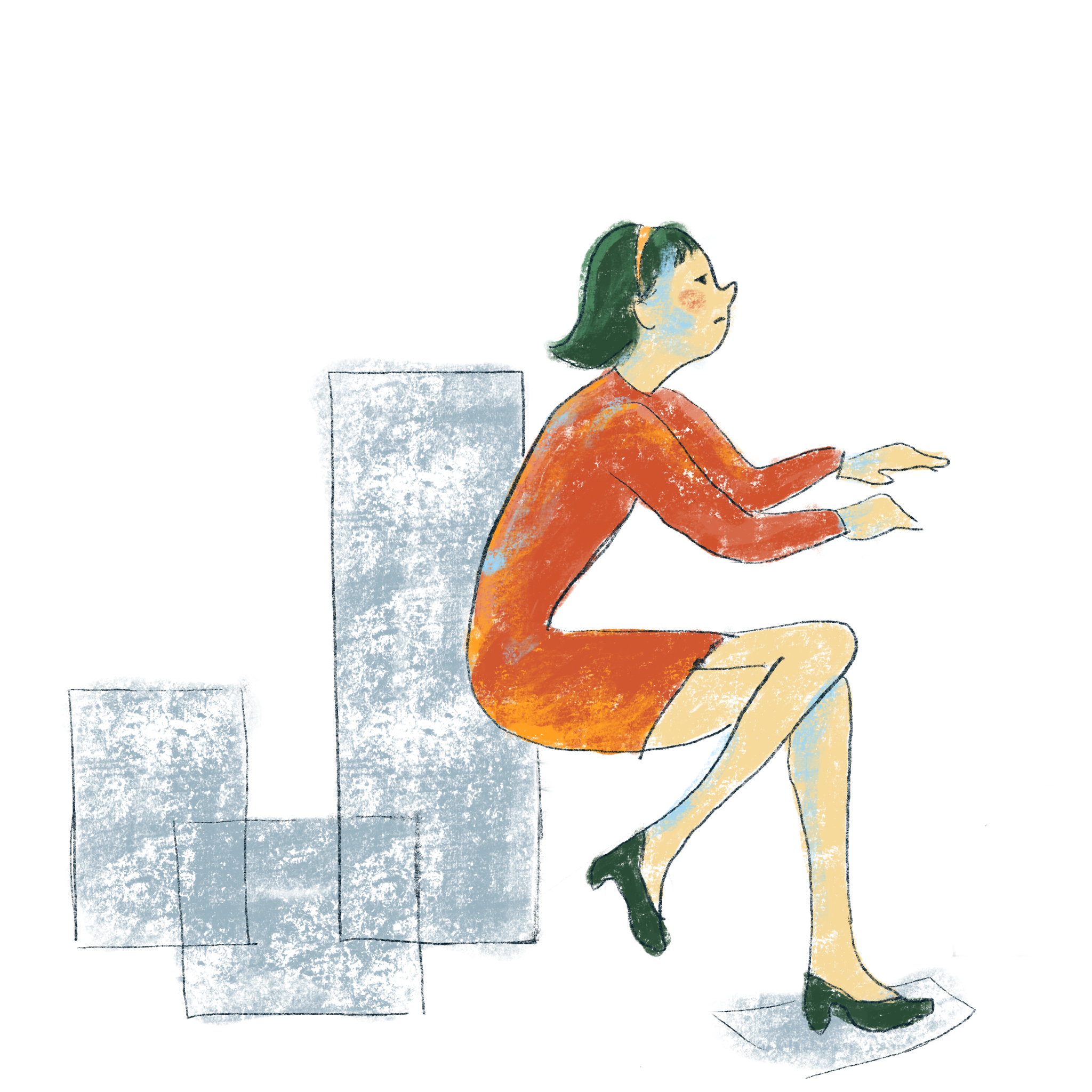
The thrift store, which had no sign out front, was in our girl’s mind (and many others’) barely deserving of the name. She passed it twice daily, on the way to the subway and then back again. Each morning, a stout crone of an indeterminate advanced age dragged out bins of books and notebooks and tiny decorative boxes, and she laid them out on foldable tables outside the door. Each night she re-boxed everything and brought it all back inside again. The door to the place was always ajar, though it was near impossible to see inside. Racks of clothes and shelves full of various accessories jammed both sides of the narrow shop, piled high to the ceiling and leaving only a small, dark aisle by which to pass through. Our girl always wondered if that shop really sold anything it had on display. Never once had she seen a customer.
Our girl squeezed herself into the thrift store and asked, as advised, for Helga. The thin man at the front desk pointed at the back of the store, not saying a word.
Our girl pushed aside sweaters and scarves and muumuu dresses someone had definitely made in bulk from the same pattern, and she wound her way to the back. There, behind a beaded curtain, wedged in the corner, sitting at a tiny desk that looked like it came from an elementary school, was Helga. She was the one our girl always saw setting up the boxes out front. She was a crone through and through: stooped and wrinkled and gray-haired.
“Ah,” Helga said. “You’re here for the bell.”
Our girl was not sure how she knew. Perhaps the woman at the laundromat had told Helga to expect her, she thought. In front of her, Helga was holding out another brass bell just like theirs—gleaming almost golden, about the size of a grape.
“How does it work?” the girl asked.
“With each ring, it transports you back in time one hour,” Helga said.
The girl took the bell by its chain and studied it in the air. She asked if she could give it a ring before she bought it. Helga shrugged like it was of no importance one way or the other. The girl shook the bell. For a second the air stilled, and she felt a light static pressing all along her skin. Her vision went a little fuzzy, like she’d stood up too fast. When it cleared, she could see she was still standing in the corner by the old school desk, but that the store around her was dark.
Someone peered around the beaded curtain. Helga. She held a paper to-go cup of coffee in her hand. At the sight of the girl she clucked her tongue. “You rang it too many times,” she said. “You’ve got to flick it with your wrist real fast, and then wrap your fist around it.” She pulled out her own bell and demonstrated. For a split second after she finished the ring, trapping the bell in her hand to muffle the sound, her eyes went glassy, but then she was back to staring pleasantly at our girl.
“What do I do now?” the girl asked.
“Whatever you want! You have three extra hours. You’ll feel it when the other you rings the bell.”
Our girl paid Helga for her bell. The sum was large, especially for someone who worked at the company where our girl did, but she decided to see it as an investment. Then she went out to breakfast at a diner. She sat there with her coffee and pancakes, reading amidst the gentle early morning din. Our girl couldn’t remember the last time she had such a luxurious weekend. Usually she only had time for sleep, chores, and staring at the wall until it was time to go back to work. Forget applying for those other jobs that her current job was supposed to lead to.
In the diner, she read slowly and chewed even slower. At last, she felt a fuzzy zap behind her eyes, a zap that she could only assume meant her other self had gone to the thrift store and then back in time. She inhaled the scent of her coffee, the mug cooling in her hand, and she grinned.
For a split second after she finished the ring, trapping the bell in her hand to muffle the sound, her eyes went glassy, but then she was back to staring pleasantly at our girl.
“What do I do now?” the girl asked.
“Whatever you want! You have three extra hours. You’ll feel it when the other you rings the bell.”
The following Monday, our girl got to work at the customary time. The streets were crawling with girls, as always, iced coffees in one hand and smartphones in the other. They streamed into her office building and the other buildings just like it on the block. They chattered as they rode up the elevator and parted on their respective floors. Inside, though, instead of going straight to her desk, our girl strode into the bathroom. There, she locked herself in a stall and rang her bell, just once, in the way Helga had shown her. When her vision cleared, she was still in the bathroom. Outside it was slightly grayer. The office itself was hushed. The morning rush had not yet begun. Our girl gave a little jump of elation and strolled over to her desk.
When she got there, she found herself already sitting there, sorting papers into piles.
“Good morning,” her other self said. “You’ve got about thirty minutes until you ring the bell. In the meantime, want to start on our filing?”
And so it began that our girl made the most of her mornings. She rang the bell once, twice, sometimes three times. She stopped feeling the zap behind her eyes. She got through each task faster and faster. As the months wore on, there were days where she actually ran out of tasks to do before the day was out.
“More?” the boss gasped when she asked for another project. He was pleased all the way up to his golden eyebrows. Our girl basked in his approval. It was the warmest thing she’d felt since coming to the city.
The girl in the next cubicle over did not like it. “You’re making it harder for the rest of us,” she hissed.
“I can’t help it if I’ve figured out my time management,” our girl replied, her voice going a bit sing-songy. She turned away from her neighbor, whose face was harsh and stormy, and smiled to herself a little.
The following morning, the girl from the next cube over came to work before the customary time. She had seen our girl already at her desk every day when she arrived, and thought she had guessed what her secret was. Then she saw two of our girl standing in the cube working.
“Oh, hello,” the two versions of our girl said pleasantly.
The girl in the next cube over could only stammer in reply. “How are you doing that?” she asked, finally, when she could get her mouth working again.
Our girl thought about not telling her. She had been enjoying her few weeks of winning the race against her neighbor. The Boss’s smile flickered within her chest even when she was at home, making soup from a can for dinner and watching pirated episodes of prestige TV shows that came with Chinese subtitles. But in the fluorescent lights of the office, standing face to face with the other girl, she saw the exhaustion in the dark circles and flaking dry skin of her face, and she gave in. She really didn’t have it in her to live an every-girl-for-herself life, deep down.
“I have this bell,” she said. Then she gave the other girl directions to the thrift shop.
Our girl and her neighbor in the next cube over did not become friends. They still wanted to outdo one another. When our girl rang the bell three times, and then two, and then one, the other girl rang hers four and then three and then two times. Sometimes the sound of our girl’s bell alone was enough to cause her neighbor to jump up and ring her own, even though all her selves were taking care of her work and she didn’t need more. Our girl rolled her eyes and made her other selves laugh and roll theirs in reply.
And yet, without meaning to, the two girls became teammates. One self would drop a folder and the other’s selves would help her clean it up. The neighbor needed a pen and our girl would hand her one over the half-wall. When one started to drag a bit by mid-afternoon—all those extra morning hours did take quite a bit out of them—the other would nudge her awake, even bring her a fresh mug of subpar office coffee to keep her going. They wouldn’t admit it, but both found it to be rather nice. When the Boss came by and beamed at their clear desks and fast progress, the two of them shared a smug grin.
“You must tell me your secret,” he said. The two girls caught each other’s eyes. They could easily read the emotions hidden there. Their productive mornings were special. Their own little thing. A source of private revving joy. There was the Boss, though. How they longed to make him smile at them even more brightly than he already did. And what about the other girls, distressed and alone, in the cubes that surrounded them? What right did they have to deprive their colleagues of the opportunity to work smarter?
“We can show you,” our girl said.
“Come tomorrow, before the customary time,” the girl in the next cube over added.
They already had their other selves hard at work when the Boss arrived. He stared and gawked and then he grinned. He laughed when they demonstrated the bell for him, both ringing theirs in sync.
The Boss was thrilled at this development. He told all the other girls to talk to our girl and her neighbor about time management. Some already hated them quite a bit for being so efficient, and so they stayed away. Other girls, newer girls, came as soon as they could. “I always thought there was something weird about that thrift store,” confided a girl who lived in the same part of the city as our girl did.
The girls at the company got very good at time management. Our girl and the girl in the next cube over let their other selves work during the customary hours, instead of only in the morning. Their secret was a secret no longer. Eventually even their enemies gave in and asked for directions to Helga’s shop. Due to high demand, she had raised her prices, which the enemies blamed on our girl too. Not everyone would become your teammate, she and her neighbor realized. It still didn’t stop the enemies from getting their own bells, though.
The only one of them that didn’t use the bell was That Girl. “Hell no,” she said, when one of the girls asked her if she wanted to get her own. She just started handing her piles of paper over to the other girls when she noticed a girl wandering around with nothing to do.
The Boss couldn’t come up with new tasks fast enough. He now seemed a little sweaty when he patrolled the aisles. His light was a bit dimmer. The office brimmed full of girls—so many that there weren’t enough desks. Girls sat on the floors. They sat on the aisles. They perched side-by-side on the ledges of cubicle walls. They passed each other pens when they needed them and papers when they dropped them. They shared smiles and laughs. They came in when they were ready to work and left when the work was done. They’d be crones before their time if they continued on as they had been, and who decided what hours were the customary ones, anyway? The office became something else. It became theirs. Our girl thought of those other jobs, and she decided that maybe this one was the one, at least for now.
The girls at the company got very good at time management. Our girl and the girl in the next cube over let their other selves work during the customary hours, instead of only in the morning. Their secret was a secret no longer.
One day, a quite normal day, really, our girl sat at her desk typing, and on her floor filing, and on top of the photocopier, making copies for herself and for anyone who needed them. The girl next to her had a self out on a coffee run and another bringing out bottled water and snacks. The Boss came down and everyone looked up to smile at him: rows and rows of girls and girls and girls, grinning as if one single entity. The Boss couldn’t smile back right away.
“Great job, girls,” he said. He swallowed. “Can I—can I get you anything?”
The girls turned to look at him. It was a long stare: thousands of eyes, pausing. Then our girl, the one of her at her desk, stood up. She held out a stack of paper to him. “If you don’t mind, we could use some help with this,” she said. “As soon as possible, of course.” He could borrow one of their bells, if he wanted. He had been so excited when the girls first brought them to the office.
She glanced over at her compatriots. There was something else they had been meaning to say. “And a raise too, while you’re at it,” she added, her voice ringing out loud above the din.
“It’s only fair,” our girl, the one on the floor, said, standing up to join her self at the desk.
“We’re working so hard,” the girl the next cube over added.
“This company wouldn’t be what it was without us,” someone else piped up. The others and their other selves all clapped. They were ready. They knew this was coming.
The Boss for a moment said nothing. Then he nodded, stiffly, as if it caused him pain. He reached out and took the papers. His hands were shaking. He no longer smiled. If he still glowed, the girls paid it no mind. As soon as he looked down at the papers, they turned back to their work. They chattered and typed and laughed. All around them was the sound of bells ringing.
STORY:
Caelyn Cobb is a writer and university press editor living in Queens, NY. She is the author of the short story collection Saturn Return, forthcoming from Whisk(e)y Tit Books. Her writing has appeared in Passages North, X-R-A-Y, HAD, and elsewhere.
*
ART:
Vicki Xu is a writer and illustrator living in New York, NY.
Next Tuesday, we’ll feature a bonus interview with Caelyn about this story.
Short Story, Long is a reader-supported publication. To receive a new short story every week, consider becoming a subscriber. Every paid subscription helps pay contributing writers and artists. Thank you.
Comments
Nothing yet. Say the first thing.
Sign in to join the conversation.