
First, a note:
Since launching Short Story, Long in 2023, we have paired every short story with some kind of “bonus material.” This usually means an interview with the author about the story, but sometimes a “deleted scene” or some other look behind-the-scenes. These have been kept behind a paywall, intended as encouragement and enticement to pay for a subscription, with paid subscriptions being important so that we can pay contributors. Starting now, and as something of an experiment for the rest of 2026, we are going to make these interviews available for free for a limited time (a week, until the next story publishes? a month? not totally sure yet!), before then moving them behind the paywall. Been thinking about trying something like this for a while, and this seemed like a perfect opportunity, as this look behind how Holic creates a comic seems especially cool and unique and we really just wanted to share it with you all!
That said… if you like the journal, a reminder that becoming a paid subscriber helps us pay human artists for creating work we enjoy and want to support and celebrate! (As a reminder, we are currently paying writers $150/story, as well as commissioning original art for said story, for which we are paying the artist $150 as well.)
Thanks!
*
If you haven’t already, read the story now… then read our short interview about the story, as well as some “behind the scenes” bonus material on Nathan’s process for making comics!
“Lake of the Gulfs” by Nathan Holic
Aug 11
"It's a story that's been told a thousand times. Daddy leaves early morning, goes out to the pier. Spends the day fishing with his buddies..."

Aaron Burch: We typically start by asking about how the story came to be, so! What can you tell us about the genesis of this story, where did it come from?
Nathan Holic: Strangely, this story actually dates back to my time in grad school, maybe ‘06 or ‘07? I wrote a two-page opening scene about a college kid home for the summer who steps outside to see that his father has brought home a muppet-fish with his fishing buddies, and they’re all convinced it’s valuable. I didn’t know where the story should go, and so I never continued with it. Maybe it was going to be about how the kid was embarrassed of his home town and his lower-income background, now that he was a college kid who’d seen the world? That sounds about right, but I’m not sure. I still have that original opening somewhere, but I couldn’t find a way to push past it.
So I guess it wound up in that mythical Writer’s Drawer where all unfinished or unpursued work goes.
It’s only been in the last few years that I’ve started to really focus on drawing short comics more than traditional short story writing. Comics are obviously very good at conveying single memorable/ resonant/ haunting images, and when I’m thinking about new ideas for short comics, I find myself drawn to stories that... can’t believe I’m typing this sentence, but kind of don’t want to not type the stupid pun...stories that I want to draw.
Mostly, it’s something in the Florida landscape, something incredibly ordinary but also incredibly surreal or bizarre or frightening when viewed from a different angle. Like our oak pollen in March, when it falls into these massive clumps on our sidewalks and streets and actually clogs the gutters and paints the whole state yellow. Or like Spanish moss, which is totally normal on trees, but also—the more you look at it—could also be a fucking alien, Florida’s version of a killer blob or a face-hugger.
I honestly don’t know how I remembered the old muppet-fish opening, but I must have started sketching the fish one afternoon. And I know that I liked drawing it, and that I wanted to draw more panels. I just needed somewhere for the story to go. And once I started thinking about it as a comic story... I don’t know... it just came more easily, because I really needed something to draw! As a writer/ artist, I’m kind of selfish like that: I write what I want to draw (or avoid writing what I don’t want to draw sometimes), and the story follows, for better or worse.
I’ve been surprised how many of these SSL stories have been percolating or being worked on for YEARS. You actually touched on this some at the end there, “I honestly don't know how I remembered the old muppet-fish opening, but I must have started sketching the fish one afternoon,” but I wonder if this is somewhat normal for you or if this was more of an outlier, revisiting this 10-20 years ago idea? And maybe what it felt like when you realized this muppet-fish you sketched was actually an idea you’d had so long ago?
I’m not sure if this is a good quality or a bad quality, but I’m kind of a packrat as a writer. I don’t ever really get rid of anything. I still have handwritten stories from 15 years ago in a file folder in my closet that I know I’ll never touch again, and that I know are terrible, but I still have them for some reason.
I think it was Benjamin Percy who wrote about creating a “Graveyard” folder on his computer to store all the crap he cuts from his work, just so he doesn’t have to delete it. I’m the same way, but I also have all the physical junk, too.
I don’t know if I’m super precious about this stuff, or if there’s just this voice in my head that always says “Someday there will be time to finish this one,” or “Someday there will be time to revise,” or whatever. And, you know, there’s never time. Life continues, and there’s always a new idea, a new story, a new essay, a new comic. But I guess this piece proves that maybe you do return to old ideas and story scraps?
It was definitely an outlier, though, in terms of how long it had been. It’s more common for me to take an element of a story I’m working on--a character, an image, a scene--realizing that the story itself isn’t working, and re-appropriate it for some other piece that is working. But I do think it’s a nice lesson for young writers who maybe haven’t yet learned the patience required to do the writing thing. Academia trains you to complete projects in little four- or five-week timelines, often one at a time, and to think that you’re finished because you’ve been graded, but the real world doesn’t care when you start or when you finish a project. Telling my students about a 15- or 20-year-old story that finally became something worthwhile is a lesson in patience, and maybe a suggestion that all writers are insane multitaskers with dozens of projects ongoing/ unfinished at any one time.
I’m so curious about being a writer and artist. You touch on this some as well, but I’d love to drill down a little and hear even more about how and when you know an idea might be better suited for prose or comics? At this point, is it more instinctual? Does one ever become the other, or vice versa? (I’m asked versions of this sometimes as a writer who does both fiction and non, and who’s fiction often has at least moments drawn from my real life, and I think there’s an interesting second layer to that here when adding in the drawings.)
Well, I think it’s interesting that you ask this, because you’re a writer and an artist too, right? Your watercolors are great! What would it take to get you to create some comics?
For me, the easiest answer is, I think maybe I go through phases as a creator. (I tell my comics students to just call themselves “creators.” It feels easier that way, so you just never have to make a final grown-up decision about what you are.) I remember going through an intense phase of personal essay writing in the early 2010s, and just about every idea I had was for an essay. There have been other times when it’s just fiction, or when I can only work on a novel, or only long short stories, or only flash. In the last 5 years or so, I’ve mostly been thinking with a comics mindset. I’m still writing stories, and I’m still working on a few different novels (all at once, and stupid slow), but the things that come quickest and easiest are the comics ideas. Probably this is because of what I mentioned earlier: I selfishly want to draw something, and then I’m like, “Write a story, Nathan, so you can draw more of this.” A muppet fish. A story about jogging in the humid Florida mornings. A man melting. Spanish moss. Flying jellyfish. As a creator, I just want to have fun, and so I’m always just thinking about how I’m going to enjoy my own time creating.
Maybe a better answer, though, is that I developed a course at UCF back in 2015 called “Rhetoric of Comics,” and then another in 2022 called “Graphic Medicine,” where I force students to draw comics all semester. And these are not art students, so it’s a challenge, and I’m kind of like this obnoxious cheerleader for comics all semester long. I tell the students to try to see the world in comics: wherever you go, look at what is written in text, and ask yourself “Could that be a comic?” Would it be more dynamic as a comic? Would it reach more people? Would it be more memorable? Would it transcend language barriers? A poster on the wall, a syllabus, a “terms and conditions” sheet, all that. It gets into their heads, and they can’t stop the voice. They’ll write “thank you” notes or requests for recommendation letters as little comics, and it’s so damn cool.
Anyway, I’ve said it so much that I’ve internalized it, and now it’s a mindset for me. When I get an idea, or when I start writing, I can’t help but ask myself, “Could this be a comic?”
Sometimes the answer is determined by where I find my joy, as I mentioned above. How can you not find joy in drawing flying jellyfish? Let’s go! But other times my answer is determined by constraints. A particular story idea is not visual enough (i.e. it’d be too static, just heads talking), or a particular idea requires more page space and I don’t feel like dedicating 5 years of my life to drawing a graphic novel. Sometimes I just know I don’t have the skill level to draw a particular thing. For an idea to really work, it has to be short, something that I know will be under 15 pages (even a story that would be 2-3 pages can swell into a very long comic), and cannot ultimately be too text-heavy. Too much talking or too much thinking/ interiority/ exposition, and I might as well write a prose story. When I draw the comic, I want the visuals to do meaningful work; if I can’t make that happen, then I should probably stick with traditional text.
This is a little open-ended, and maybe too big of a question to try to tackle here, but I’d love to hear about your process for drawing comics — in general, or maybe specifically this one, if that is easier or more helpful to talk about. How much is written before sketched, are you doing rough sketches to map out the whole and then drawing the more refined version, are panels or pages deleted or added after the fact or moved around, the kind of comics-version of prose revision?
Honestly, Aaron, I love that you’re curious about this. That’s one of the things I love most about your site, and about your work as an editor. There are people on the inter-webs who seem weary of talking “process,” and I get that, but I do still learn from listening to others, and I do still get inspired by others. I particularly love reading/ seeing more about comics creators and their process, even when they think it’s boring or rote.
And I say that, I guess, because it took a long time for me to find a process that works for me. When I first started creating comics, I did everything all at once. I didn’t write a script, so much as I tried to draw a complete page one at a time, with all the text and all the images. And I’d usually be very motivated for pages 1 and 2, and then either give up, or my next pages would be just totally drained of energy. It’s too much to script and draw at the same time, and it prevents any discovery or flexibility.
But it took me awhile to learn how best to separate the two. For this particular piece (which is pretty representative of my process now), I write out a script by hand, and it’s usually some weird hybrid of rough text and then ideas for images; sometimes I’ll include very rough sketches, too, either on a different page or within the handwritten script notes. When you’re thinking in both text and visuals, not everything comes all at once; sometimes you have a great idea for a visual, and other times you’re like “I have no clue what the panel will look like, but I know that the character will be saying something.” So as I’m drafting, I just have to be prepared to write and sketch, back and forth, whenever the mood strikes.
When I type up the notes, that’s the moment that I start to think in “pages” as well as story beats. I try to break up the text as I’m typing so that I never have too much on any single page (at most, like a quarter of the page), and I break that text apart onto separate lines, almost like I’m turning prose into poetry, but really I’m starting to roughly consider how much text will go in a panel. This is also where I’ll type out ideas for the visuals, too. In the case of “Lake of the Gulfs,” I broke apart the story into maybe 12 pages initially? When the pages are printed, I’ll thumbnail directly onto the script page (below the text, or on the back of the page) so that text and visuals are never far from one another.
After that, the process becomes straightforward and boring: pencil the panel layouts for the full comic, then pencil the artwork, one page at a time, then inks, then erasing all that pencil (tedious af) to see whether I’ve got a good page or whether I somehow screwed it up!, then scans of the black and white pages, then lettering in Photoshop, then watercolors, then another round of scans, then text edits, then the inevitable shouting of “Fuck!” when I realize that a panel is terrible and I have to re-draw it. And yeah, I definitely wound up drawing and inserting additional panels and pages into the original story, kind of like movie reshoots, where I realized something hadn’t been fully explained or visualized and required another panel. (Or when I realize I have too much text for a panel, and it needs to be spread out.)
And wow. Now that I’ve typed that paragraph, I see why comics creators get bored talking process! Sheesh.
This comic took the entirety of my Fall ‘25 semester to create and fine-tune, and maybe the most useful thing I can say to other writers who might want to attempt comics creation? Even though it’s time-consuming, it is an incredible brain break from teaching and grading. I’ll spend a full morning grading essays, and then I turn to the other side of my desk, and I’ll spend an hour inking a page, or watercoloring a page, and my brain is totally turned off. I’m just lost in the page. And it might take an afternoon to ink a single page, but I’m in no hurry. I’ve made progress while also giving myself relief from the tedium of teaching/ grading. Not a bad deal. Even as I’ve been typing these responses, I’ve drifted back and forth to a page I’m currently watercoloring. A great break.
Okay shit, that was a long response about process. I can totally give you some photos of script pages and thumbnails, if you’d like, to help visualize some of these ideas?
Oh, hell yeah, I’d LOVE to see some script pages and thumbnails! That would be amazing!
For some reason, from time to time this particular part of a line comes into my head: “Their relationship grew quickly, in part because Marv’s apartment had burned down, an unsolved arson that Ruben didn’t commit but nonetheless was grateful for…” Ruben is grateful for an arson! For me, it fits perfectly to his character. Though throughout the story his perspective sometimes shifts, at that point he doesn’t really care what happens so long as it benefits him. It was a surprise to write, but once it popped into my head, it felt spot-on.
Script With Thumbnails
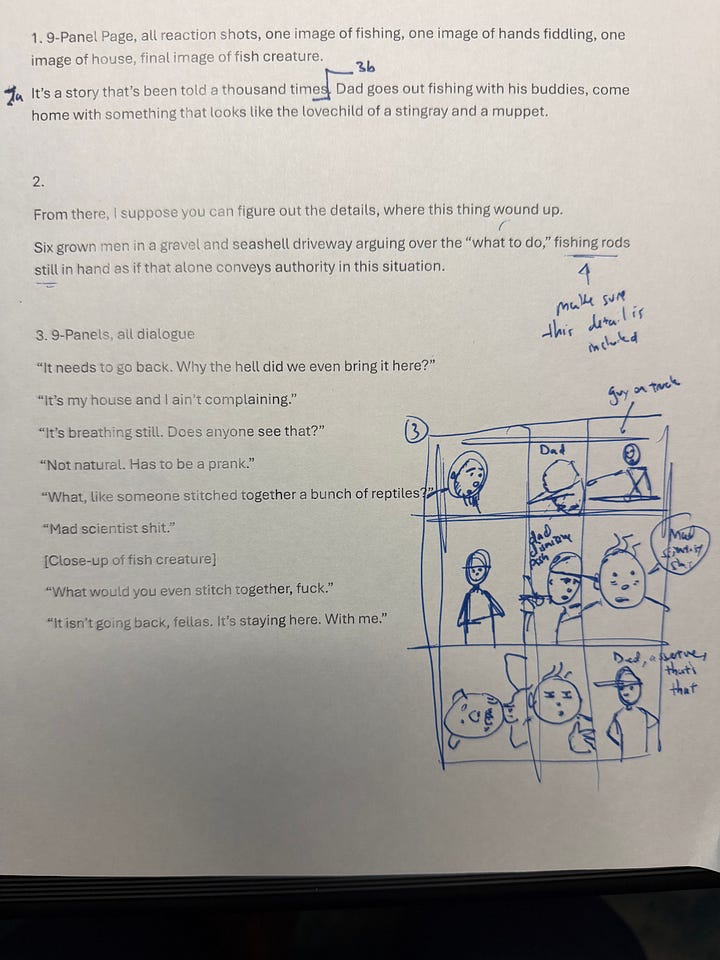
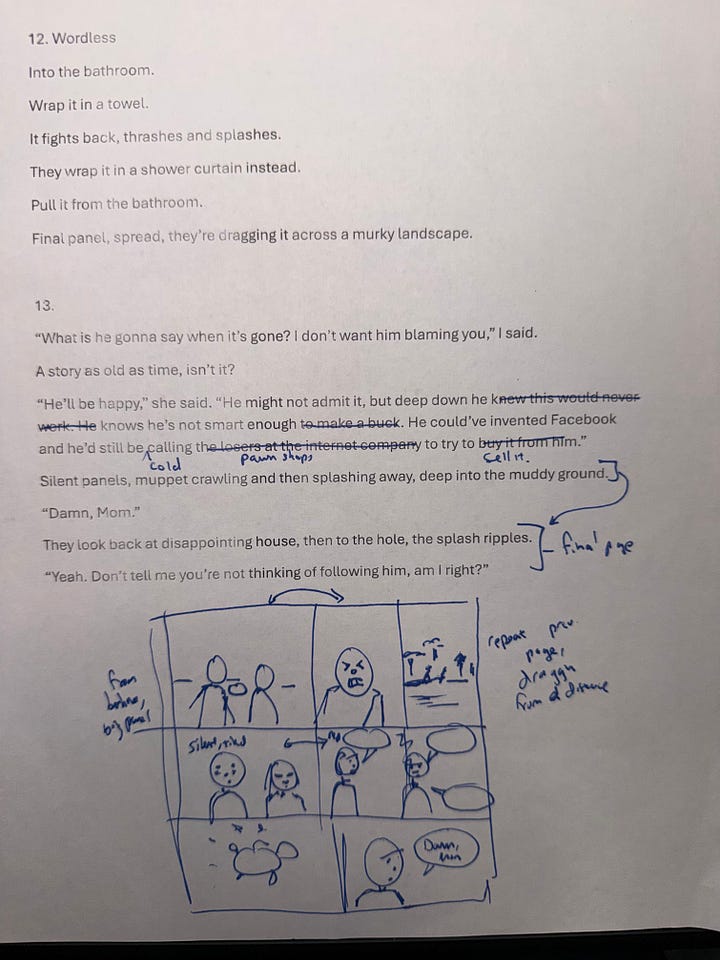
Two pages that actually show my original working script, along with the hand-drawn thumbnail right below it. I prefer to draw small and quick, and it’s helpful to do it right on the script page. That way, I can draw arrows all over the page, identifying which text will go where.
In some cases, you’ll see that my script is incredibly sparing (i.e. “It fights back”). It makes for terrible prose, but it’s a script to myself, so I’m really just giving myself ideas about how this thing should go. If there’s a very specific image I have in mind, I’ll write it in the script; if not, it’s often helpful to write something general (“Into the bathroom”) so that I can maintain a sense of discovery when I actually start to draw.
As I’m moving from script to thumbnail, I’m also getting a sense of what fits on a page. So you’ll sometimes see little notes to self, where I’m questioning whether something is one panel or two, or where I’m actively telling myself “This needs another page,” or something to that effect.
Much of the script is really embarrassing to read now, but I also know at every step of the process that I’m going to keep refining the “shitty first draft” into something better. The revision and editing of the text continues during the thumbnailing, and then continues when I draw the pages large, and then continues again when I type the text into a layer on Photoshop. So much of the prose is actually determined by space (it’s a lot like poetry in that sense!), and I might start typing a really cool bit into a panel only to see that I haven’t left myself enough room. So then I’ve got to decide: create another panel, or just start trimming the text? Those decisions are a lot of fun, actually. The page is a creative constraint.
Thumbnail 9-Panel Page
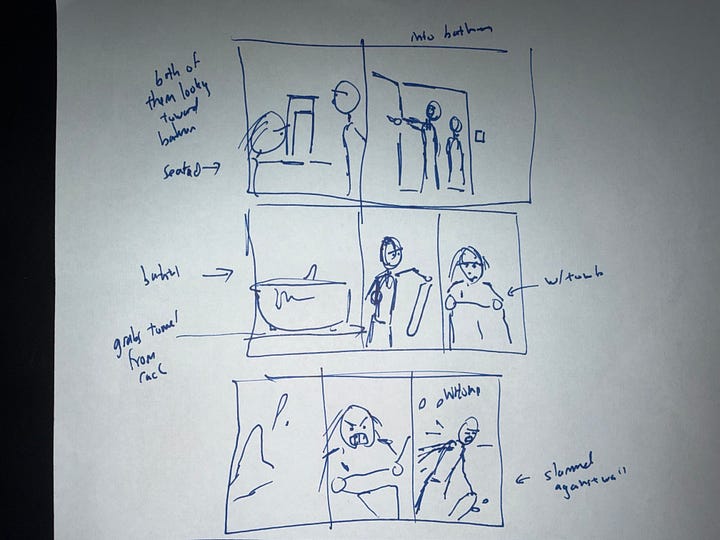
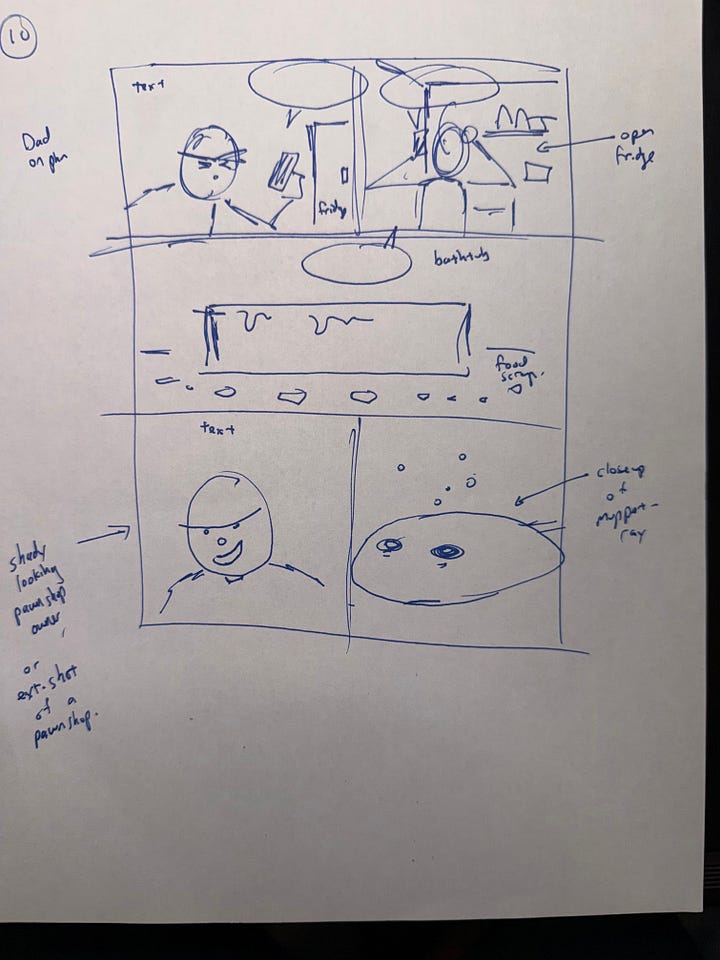
A couple of pages of thumbnails that were drawn on the backs of script pages, too, where I just didn’t have enough room to do it beneath the text.
You’ll see that the art is often so bad (sorry for subjecting you to it!) that I have to write little notes to myself. (“Bathtub.”) The goal with the thumbnails is to give myself an image to draw on a larger page, and to think about framing, and how this image interacts with the others around it, so it’s not about “good art,” just about creating a visual approximation and a plan.
Thumbnail Opening Page
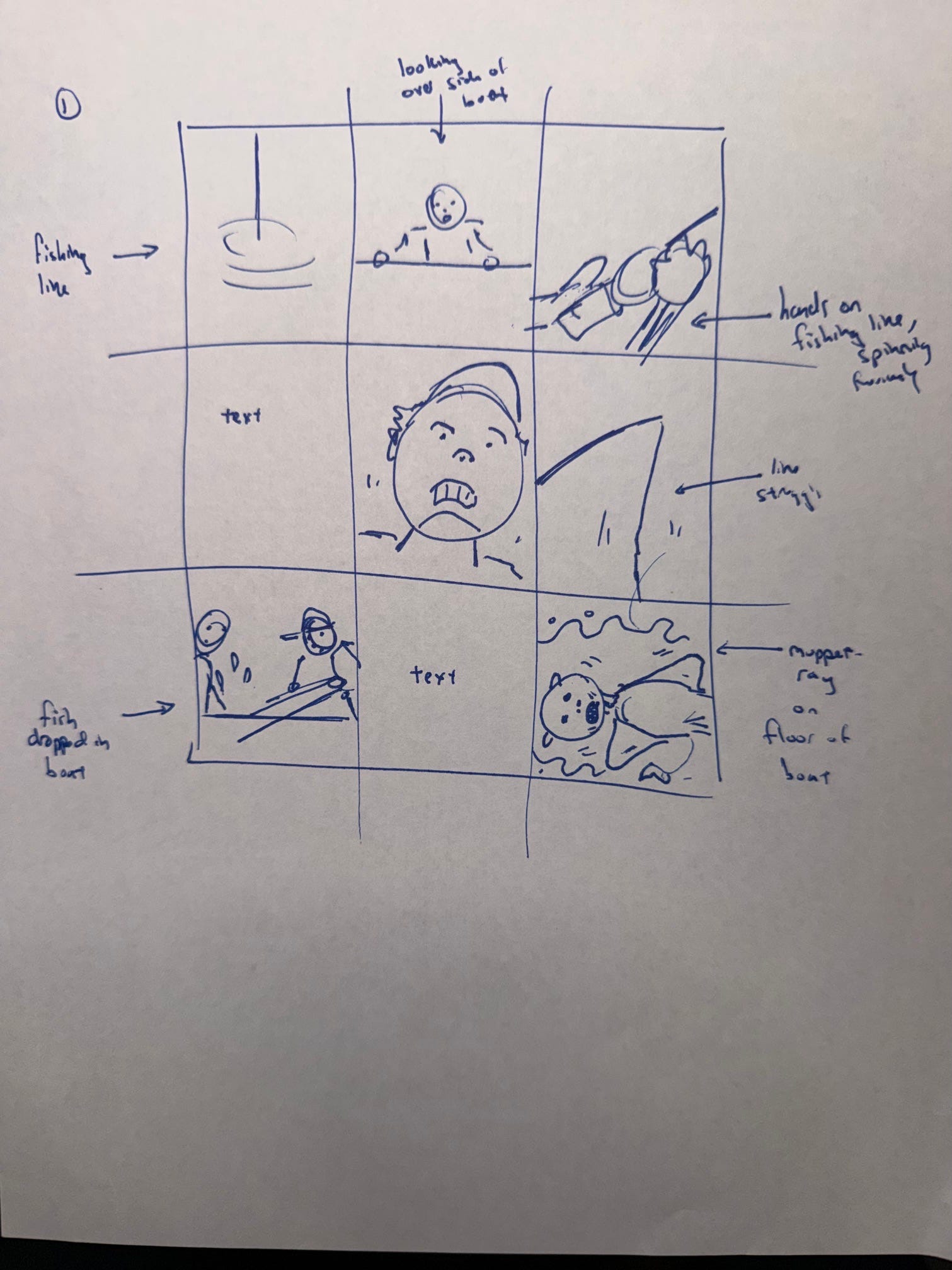
I figured I’d include this page, just because it’s the first full page in the story and it’s easy to compare to the final product. You can see how some of the panels changed entirely, but others are actually pretty close to the original idea (i.e. the muppet fish at the end). I give myself a lot of freedom to change images, and to shift panels around, but it’s really the final panel on a page that’s most important... everything has to build dramatically to that image, and then that image has to kind of stick with you as you make the turn (or the digital scroll, I guess) to the next page. The final panel needs to interact with the first panel of the next page, maybe?
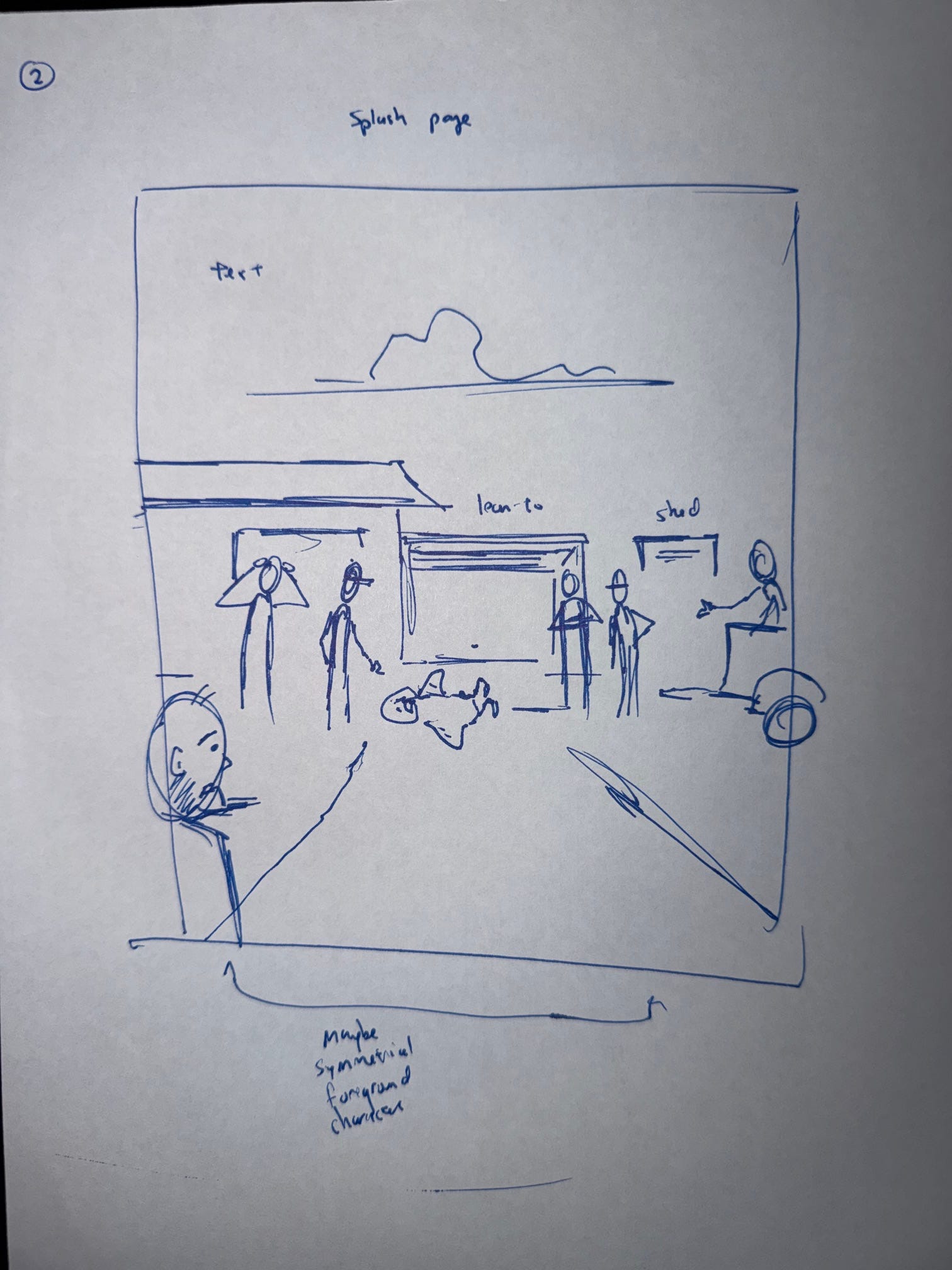
I also included the splash page, as that one offers a pretty clear comparison with the final drawing of the men standing around the fish in the driveway. The image is just so remarkably simple, but I’m really just “blocking” the characters as if I’m taking a family photo or directing a stage drama. Looking for symmetry. Looking for foreground/ background/ depth. I’m not always great at it, but I try!
Corrections/ New Panels/ Re-Do
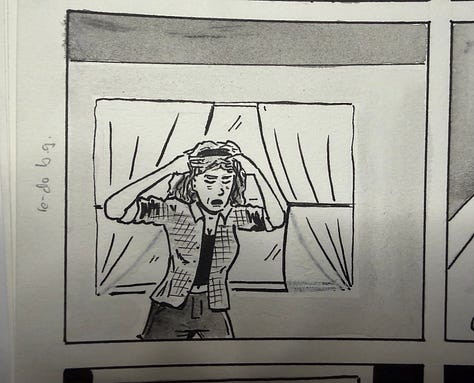
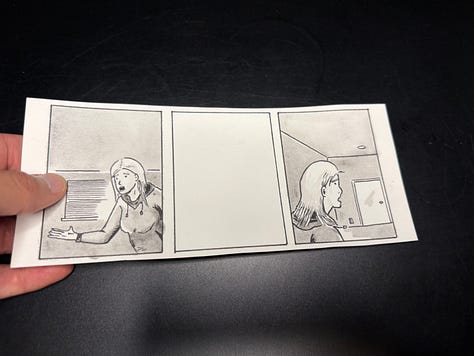
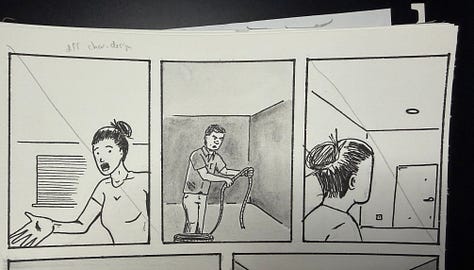
You asked an awesome question during your last email, too, that I might have kind of breezed over, so I wanted to address it, too. You mentioned something along the lines of, do the panels get chopped up and moved around?, and I think I was just like, Yeah!
So here’s a great example of this.
I usually do character sketches of my central characters in a comic before starting to draw, and I did that here, too. But I misplaced my character sketch of the daughter/ narrator, and just started drawing the first couple pages (she’s not in those pages, so it didn’t matter). Then I was in the zone and wanted to keep drawing, and stupidly drew a page without looking at my reference sketches. The daughter is totally different! And I realized she looked like another teenage character I’d drawn in something different, and so I slowed down and drew the rest of the comic with the sketch in front of me... had to go back, of course, and draw new panels to replace the brunette with the blonde.
There’s also a panel where I stupidly forgot to look at my notes and drew the wrong background. You can probably see the white-out in the “corrections” panel. I hate using white-out because it doesn’t interact well with watercolors, and so I’ll usually just re-draw the entire panel if I screw something up (I have a lightbox for tracing), but in this case, it was something in the background, so it wasn’t that big of a deal.
Okay, so that’s the process behind this one! Lots of pencil, ink, watercolor, and scissors! I’m sure you’re familiar with the old “Marvel Method” of comics, where the writer would deliver to the artist a sort of outline of a story, and the artist would draw, and then the writer would go back in and write all the dialogue? And then there’s the “Marvel Method” with the MCU, where they’re doing all these re-shoots and reconfiguring the story based upon what they have, and what’s already been spoiled, and all that. I think a lot of purists make fun of those methods because they seem so haphazard, and yeah, when you watch “Ant-man and the Wasp in Quantamania” and it’s just this CGI mess and you feel sorry for all the actors involved, it’s easy to ridicule that process. But when working with something on your own, and it’s low-stakes? I love having the freedom to chop it up, to type new text, to never box myself in, and to always think about growth and transformation at every stage (script to thumbnail to pencil to ink to watercolor to scan to lettering to final pages). It’s a different story every time, and that’s fun and exciting to me, even if it sucked for Paul Rudd.
Is there anything else you wanted to mention about this story or that you wish I’d brought up?
I don’t have any other questions, but maybe I could ask you: is there a story in the archives that you can imagine being a really cool comic? Which would you pick? (Or even which story from your own personal archives?)
Sorry to flip it on you, but I love the questions about mediums, and adaptation, and what changes from medium to medium. Maybe your readers might even want to chime in? Or maybe not, and I just get weirdly fixated on this stuff, haha.
Oh, that’s a fun question and thought exercise! With SSL stories, I kinda become attached to the handful of images an artist makes to pair with the stories, so I already think of them as somewhat visual but, at the same time, I’m having trouble thinking unpairing any of the stories with those images and thinking of them as a full comic. As you note, I’d be curious if any readers (who get this far), and/or SSL authors themselves, have any ideas.
With my own writing… this actually remind me that, maybe 15 years ago, I was working with an artist friend to turn one of my shorts into a comic. It was about this couple where the woman had lost two of her fingers in an accident when young. As she grew up, they slowly grew back, like an anole that loses its tail. The short ends with her wanting her partner to chop her fingers off again, to see if it would happen again. It was short (and some more easily adaptable) and seemed like there were a lot of good images to draw. We roughed it out and had thumbnails but the work of then it fell apart during that long process of actually doing all the drawing.
Now, thinking about newer stories what might be fun to try to adapt, what first came to mind was my three short, speculative pieces on hex —”The Lake of My Youth,” “The Future Is Not What Was Promised But Is Almost Here Regardless,” and “The Attic.” Again, it feels like their brevity lend them to this, as does their speculative elements that might be more fun to draw.
Thanks again, Nathan! This was super fun.
Nathan Holic is the author of Bright Lights, Medium-Sized City, a not-so-medium-sized novel from Burrow Press, as well as the forthcoming hybrid collection (combining short fiction and short comics) Florida Gothic from Bridge Eight Press. His traditional-text fiction has been published in The Portland Review, Iron Horse, and The Apalachee Review, and his comics have appeared in Booth, Saw Palm, and Redivider, with one recent piece winning the Visual Narrative Contest at Black Warrior Review. Additionally, he created the position of Graphic Narrative Editor at The Florida Review twenty years ago, and has worked with the journal ever since.
No posts
Comments
Nothing yet. Say the first thing.
Sign in to join the conversation.