
One night in and there is already activity! Upon investigation this morning, my mug had moved two centimeters to the left, and a bag of molded chamomile tea had been placed inside. The instant coffee has disappeared completely. Absolutely sinister. But as always, I had a backup plan and had a second package in my bag.
As I noted down this morning’s observation in my case notes and waited for the kettle to boil, I reexamined the kitchen and found that two out of the four chairs that surrounded the small table in the breakfast nook the night before were missing, as was the refrigerator.
The dead, it seems, are already trying to get my full attention.
Armed now with a fresh cup of coffee, I will describe the room: At one point, the kitchen in a house such as this would have been someone’s pride, I am sure. It is a large, spacious room, with a large brick fireplace at one end, and rooms for what used to be a scullery and larder at the other. I am terrified of entering the larder, worried I will find a mass of molded food.
A wide, deep sink is underneath a window so dirty I’m unable to see through it. Some of the tiles are cracked and crumbling, and overall, the room smells powerfully of mildew, a scent that plagues most of the ground floor.
It feels as if time is frozen here, in this house. It’s as though the last living resident had simply got up and left rather than died in his bed. The eerie way the formal dining room is still set, as if in expectation of guests. In the kitchen sink, there is a faded blue porcelain teacup, set aside for later washing up.
The other windows in the kitchen, though grimy and covered in dust, show a typically gray Midwestern fall day. Hopefully, the weather will hold off and I will be able to walk into town about a mile down the road and get started on the research that needs to be completed.
Though I am not physically at school, my time here is technically an assignment, and therefore I have continued to wear the starch white pinafore, with the Sibyl Society crest sewn into the top right breast corner. Its pockets now habitually hold my notebook, pencil, and a small, silver bell.
I will begin the first steps of my investigation on the first floor, starting with the Agatha La Faeul Meditation technique.
I have no magical blood or bone, but I have discovered during my first few investigations alongside Sister Adelita that regardless of magic or psychic abilities, ghosts had once been human, and therefore the frequencies of powerful ones can still be picked up by ordinary human beings, such as myself.
Goosebumps on your arms, hair prickling on the back of your neck, shadows only seen out of the corner of your eye - all moments of the human mind trying to make sense of a ghost. The La Faeul technique, I have found, helps open the mind and hear whoever is trying to make contact.
I thought briefly about beginning in the dining room. At the mouth of the room, I took in the scene before me once more. The empty dishware, caked in dust, was obviously expensive in nature, though time has diminished its initial beauty. It is my understanding that the house has only been vacant for six or so years, though the last tenant, Alater Knock, secluded himself to only one room of the manor. This room seems to have been set up nearly a decade ago or more then left untouched.
It was a curious, depressing room, but to my keen nature, I knew it to be unoccupied for the moment. Besides, I have found that the best room to mediate was one more open to the rest of the home, not enclosed in dark drapery and peeling wallpaper. I took one of the high-back wooden chairs from the dining room and carried it carefully back out, through the parlor, and into the front hall.
Meditation has not been a difficult practice for me to accomplish. I am of neat and organized nature, and it takes very little effort for me to silence my thoughts, tuck them into folders and drawers and invite whatever spirit wants to contact me to make itself known.
I placed the chair just before the front of the door in the center of the room, sat down, and smoothed out my dress and pinafore over my legs. Then from my pocket, I took out a tiny brass bell.
I straightened my shoulders, shut my eyes, and rang the bell.
A delightful noise. It echoed throughout the foyer, and I let it resonate inside my head. I thought of nothing but the twinkling sound of the bell and my steady breath.
Then suddenly, a presence.
She arrived alongside the smell of smoke. I opened my eyes to find a small woman of indeterminate age in a faded black dress, uniform like in appearance. Dust covered the top of her shoulders, and her ashy blond hair was pulled back in a neat bun. Her face was pale, void of any color, with ashen lips, a small nose and cracked round spectacles.
She was also completely transparent, as ghosts ought to be.
“Ah, that didn’t take very long,” I said, pleased.
The ghost narrowed her eyes, “Well,” she told me begrudgingly, “it’s my job to greet the guests of the master’s home.” Her eyes narrowed further, until she was practically squinting at me, perhaps due to the cracked nature of her glasses, “But master hasn’t had many guests as of late.”
“I’m sure he hasn’t,” I told her.
“Who’re you?”
I looked the ghost straight in the eye, “My name is Beatrice St. Anne, and I am the new owner of Knockbury Manor.”
The ghost giggled girlishly, her small nose scrunching, “‘Course you’re not.”
When my expression didn’t waver, she squinted at me again, “Well, you don’t look like a Knock, forgive me for sayin’.”
I nearly laughed. “No, I’m sure I don’t,” I said,
She squinted harder until her eyes were just beads behind her spectacles as if still trying to catch me in a lie.
I rolled my eyes before standing up. I was quite a bit taller than her, and my movement had the ghost stepping back from her place and tilting her small, pointed chin to look up at me, as I intended. “Now,” I said, “if you will. What is your name?”
The ghost shifted uncomfortably, “Name is Ruthie, Miss.”
“And how many of you are still here? That you’re aware of.”
“Well,” Ruthie blinked quickly, “Many of them don’t make themselves known to me, you see. Missus Hester is here from time to time, but she’s never really here. Was like that in life too, I suppose.”
“No others?” I asked her while quickly writing the name Hester in my notes.
“Lots I don’t know the names of. Before my time, you see.” Ruthie shrugged before motioning quickly over her shoulder without looking, “Mrs. Haskins, the old cook, she’s here sometimes. Then there’s -” and here she paused, cutting herself off as if listening.
Ruthie’s head swiveled around, looking down the narrow dark corridor to the side of the stairs. I noticed then that the hall was so much darker than it had seemed earlier, as if the shadows that dwell within the hall had sucked out all the light. I could barely see the outline of the kitchen entrance from where I stood.

I was eager to get any answers I could from Ruthie, however, so the darkness would have to wait. I encouraged her to continue with whatever she was trying to tell me.
“There’s -” Ruthie turned back to me, but her ghostly face had a distant look to it. Her voice dropped, “She doesn’t like me talking to visitors.”
I was surprised by this. “She?”
“I suppose,” Ruthie continued, ignoring my question, her voice still monotone and low, “She doesn’t like any of us talking to each other, let alone any others.”
I tried again, “Who are you referring to?”
The ghost’s eyes snapped back to mine, and the dull, distant look left her face. Ruthie giggled, “Did I? Silly of me. You must forgive me, miss, I do tend to ramble on.”
I was disturbed, I admit. But we are encouraged not to judge the dead. They are neither in our world nor the next, and at times communicating with them can be difficult and confusing. I did not want to scare Ruthie away, so I gentled my approach, “Not at all,” I said, “I appreciate you coming to speak with me.”
I sat back down in my chair and thanked Ruthie again, dismissing her by ringing the bell twice. The ghostly outline of the small woman in front of me de-materialized in a soft breeze, leaving behind the smell of ectoplasm and cigarette smoke.
I have no other notes for now, only that I am encouraged by the knowledge that more than one ghost haunts Knockbury Manor.
Later ---
This afternoon I ventured into the village. It is strange to find places in America that will still argue itself a village. Though Knockbury is certainly the size of one. My journey the day before had been a long, tedious one. The Amtrak from Chicago would only take me as far as Duluth; I had to then travel by bus to Ashford and then by ferry across the lake. A very reluctant cab driver took me the remaining eight miles to the manor. I had not been able to get a good glimpse of the modest village through the rain.
It is not a busy town, almost desolate during the winter, and not many shops have remained open. The few storefronts that are available to the full time residents of the island are a pub that has windows decorated with flower boxes filled with dead marigolds; a store called only Kit’s; a post office that is attached to a humble brick Village Hall; and, most importantly, a public library.
I left school without much fanfare, but in preparation for my time here I attempted to check out a few textbooks from the Society Library – for reference! And research! But Sheila O’Shaunnassy limited me to only three! She has been interning under Sister Louisa for the past six months and I think the power has gone to her head. She has become an absolute dragoness at the library. A medieval gatekeeper who stifles others’ academic progress for her own petty amusement. I still think she is mad about what happened during first year Herbalism.
Knockbury Library is a short, squat brick structure with two fading white pillars standing guard at the entrance. Walking through the heavy wooden doors, I was met with a large, rounded wooden desk, a banker’s lamp perched on one side, its green glass lamp shade glowing warmly.
To one side of the librarian’s desk was a card cataloging cabinet and behind it several neat rows of bookshelves. On the other, a few available wooden tables and more bookshelves. Above the desk was a round brass clock, the ticking of it the loudest noise in the room.
The librarian herself was surprisingly young. She wore a long plaid skirt, suede brown boots, and a neat tucked-in blouse paired with an olive-green jacket. On the jacket’s lapel sat a pin that read FIGHT FOR LIBERATION above a picture of the Venus symbol, a fist at its center. Her eyes, when they looked up at me, were a startling shade of green.
When I introduced myself and told her why I was visiting, from librarian she quickly turned into a dragoness, questioning immediately why I was asking for the birth, death, and property records of the Knock family.
I announced that I was the new owner of the Knockbury Manor, and there must have been some talk in town about my inheritance, for she conceded, though with obvious reluctance. I soon found myself in the position of a surprisingly small stack of material dedicated to the Knock family. I settled myself at one of the available wooden tables, and the smell of the library, the wooden bookcases, and paper folders made me suddenly reminiscent of the extensive library we are privileged to have at the Sibyl Society for Young Women.
It is not often I find myself melancholy, but whenever I feel out of place or, very rarely, homesick, I think of where I had been truly happy for these past glorious years. Being recruited by the Sibyl Society has been the best thing to ever happen to me. Here I am, a proud student of the Society. Though the general public may not know of the important and good work we do, those that the Society helps do, and that is enough for me.
I turned my attention back to my research and was surprised by how little content the library had, given that the village was named after the Knock family. A slim volume titled “A Short History of the Knock Family” and a thin folder of birth, death, and marriage certificates.
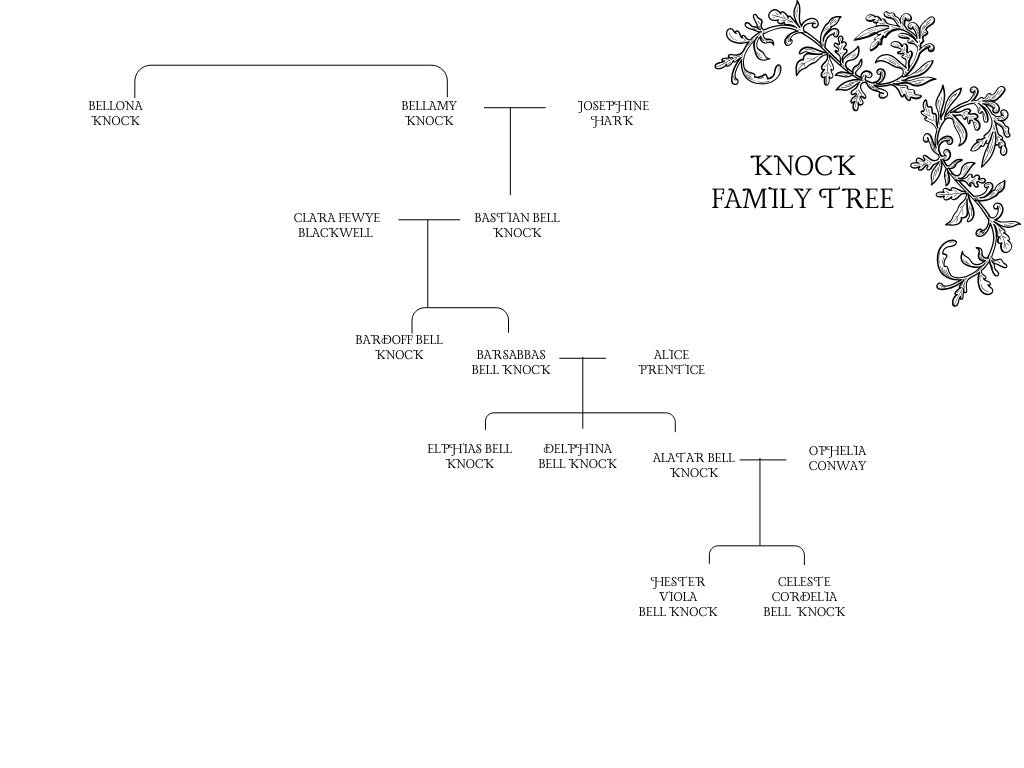
The volume begins by listing two twins, Bellamy and Bellona Knock, who sailed from the mainland during a sudden spring storm. The boat crashed into the cliffs that Knockbury Manor now sits upon. Bellamy and Bellona survived and went on to build the manor as their main homestead, while also running a very successful clothing empire from Chicago.
The family seemed to reap in tragedy. The fourth generation of Knocks seemed to experience the most loss. The eldest brother, Elphias Bell Knock, committed suicide at seventeen by throwing himself off the rocks Knockbury Manor was built upon.
His sister, Delphina Bell Knock, was an amateur archaeologist and explorer who disappeared somewhere in Eastern Europe while traveling.
The youngest brother, Alater Bell Knock, lost his wife Ophelia who died giving birth to their twins daughters, Celeste and Hester.
Celeste committed suicide in 1959. Hester disappeared in 1960.
The orphanage presumed my birth year to be 1958 or 1959. If one of the Knock daughters, be it Celeste or Hester, is my birth mother, she would have been twenty-eight when she gave birth to me.
Twenty years ago, there may have been rumors about a surprise - and clearly unwanted - pregnancy at the Knockbury home. Secrets like that never stay true secrets for long, not when many of the manor’s servants probably came from the town. And most certainly not when both daughters of childbearing age ended up dead or gone the following years after.
I admit that I had no desire to ask the librarian, or really anyone in town, about these rumors. I know that it is the Society’s protocol to do and is probably the smartest avenue to explore given the lack of physical documentation on the Knock family, but for something pertaining to my life I cannot stand idle or malicious gossip.
I am almost surprised by how vehemently I do not want to do it. I believe I am better off questioning the ghosts.
I retraced the Knockbury property lines for my own reference. Much of the original Knock land had been sold off throughout the years to pay off the debts the family owed. Debts that Delphina had incurred in life doubled in her death and came to haunt her brother Alater’s doorstep.
In 1949 a fire erupted in the kitchen killing the family’s long-time cook, Annie Haskins. A freak flood in 1962 swept away the family’s collection of automobiles, quite literally carrying them off into the sea. And in 1967 my new friend Ruthie Daniels was cleaning her master’s hunting rifle when it went off unexpectedly. While it missed hitting Ruthie, it did not miss a supporting beam overhead, causing a mass of plaster to collapse upon the poor woman’s head.
I have recorded each name, date, and death in my case file, as well as here for my personal reference. Now that I have completed my tasks, I will attempt to beat the weather and hurry back to the manor.
Thanks for reading BEATRICE! Subscribe for free to receive new posts and support my work.
Comments
Nothing yet. Say the first thing.
Sign in to join the conversation.