
I think it’s probably bad form to start the story post with anything but the promised story. But nevertheless I’m going to open with a rundown of my Substack plans because I feel like my lovely subscribers might wonder why, after receiving absolutely nothing from me ever, they’ve been blessed to find my pond story in their inboxes on this most auspicious of days.
I was going to ramble on for a while here about how my effort to come up with a thematically unified, intelligent, and possibly marketable plan for Substack ultimately resulted in my decision to just post whatever whenever I feel like it, but no one really cares so here’s the fundamental point: I like writing, and I like being read. I’m not the most prolific writer, but I go through productive phases and I’m hoping that posting here will give me a little bump of external motivation to cultivate more of those and provide a space to promote my existing work.
So, for now, you’ll get the following from me on Substack: a monthlyish post consisting of a short story or essay, some new, some previously published in lit mags.
That’s it! Thanks for reading in advance!
I wrote “The Rules of Jim’s Pond” last summer on a bit of lark and was very pleasantly surprised when it was chosen as a finalist for the 2026 Raleigh Review Flash Fiction Prize last spring. Hope you find some enjoyment in it!
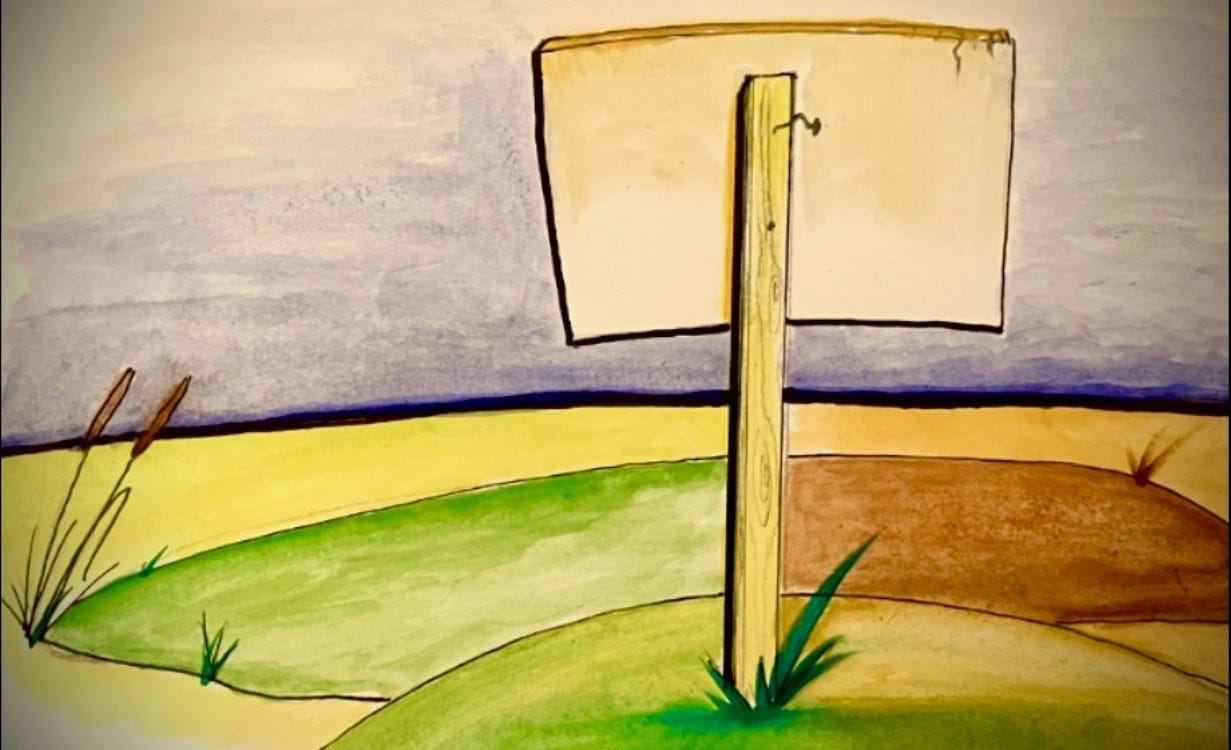
The Rules of Jim’s Pond
These are the rules of Jim’s pond: Don’t litter. If you catch the white catfish or the silver grass carp, throw it back. If you catch anything, throw it back, unless you’re hungry.
Uncle Jim’s dead now, but the rules still apply. The pond keeps track. I know this because I know the pond the best. Been fishing there every day since I was sixteen months old, and now I’m sixteen years old. These days I fish at Jim’s pond more than anyone, heading over as soon as school’s out and staying until dusk every day from the first chirp of the spring peepers until ice shards circle the water’s edge. And I know things like this: There’s an old Ford pickup submerged way deep on the far side, which is where you want to sink your line if you’re looking for something big. The Ford’s cab is teeming with old catfish, filling its crevices with their dark, oily bodies. In its bed are forty empty quart-size jars that Gus Lee used to use to carry his best corn liquor.
Gus considered himself Jim’s best friend and so entitled to stopping by the pond to throw in a line on his way home from his route every Saturday morning, the empty jars he’d traded back for full ones rattling behind him. But one particular Saturday morning Pierce Pelham, the town’s oldest deputy, was rattling behind him too, so Gus decided to dump the truck in the pond, on account of it needed a new suspension, anyway. But somehow Gus got his foot tangled in the seat belt he never wore, and the Ford dragged him straight through the young poplars crowding the steep bank and pinned him underwater. It took the Ford a day or two to sink into the muck and disappear. It took Gus less than three minutes to drown in six feet of depth. That’s the way Jim told it to me, anyway. There’s no littering at Jim’s pond.
Uncle Jim died six months ago, like this: Shortly after having his breakfast biscuit, he tossed in a line and caught a small bluegill. The bluegill caught the attention of a brown water snake, which clamped its jaws around it and did not let go as Jim reeled them both in. Jim stared that son of a bitch straight in the eye until it released its jaws, dropped to the ground, and struck him on the right calf muscle before slithering like crazy into the woods. The fish was already wrecked, no use throwing him back. The pond can tell a dead fish from a live one. And the snake was long gone, no tossing his ass back in, either. Jim went in his house, stuck a Band-Aid on his leg, made sure his bills were paid, called up Patty Bridges to confess that he’d loved her his whole life, and cracked open a beer. The infection set in fast and strong; the leg was black in two days and Jim was gone in a week. Even he had to follow the rules.
The pond had never belonged to anyone but Jim, who had dug the hole and dammed the spring himself, but my dad thought it’d be better in the form of liquid cash. He tried to sell Jim’s little house and the pond along with it to Miles Burdich, the town’s most popular auctioneer. The deal didn’t go through; Miles thought to throw in a line in while taking a look at the property. With more luck than skill he caught the white catfish, its skin a match for the white leather seats in his Mercedes, and quick as he could he slit its belly and drove it to the nearest convenience store to be weighed for a trophy citation.
Miles wasn’t paying much attention to his surroundings as he struggled across the parking lot with the bloody fish slung over his shoulder. This was unfortunate, as it happened that just then Mabel Pritchett pulled up in her boat of a Lumina, stopping to pick up a tomato for her lunch sandwich after a routine eye exam. The sudden emergence of the sun from behind a cloud overwhelmed Mabel’s eyes, sensitive from dilation drops, and flustered, she mistook the brake for the gas and barreled right over Miles and the fish. You can’t just leave the premises and expect the pond rules not to apply.
My dad passed away a week later—a brain aneurysm. I found him in Jim’s kitchen, phone in hand—he’d been taking pictures of the pond and house for a property listing. The photos of the house were good enough, as good as you could get of a house like Jim’s—pretty much a single-wide with a solid foundation. The photos of the pond were strange, though—the clear water, always bottle green in real life, appeared a flat tan, and the trees had no leaves even though it was the middle of June.
These are the rules of Jim’s pond: Don’t litter. If you catch the white catfish or the silver grass carp, throw it back. If you catch anything, throw it back, unless you’re hungry. The pond is not for sale.
They buried my dad in the Methodist churchyard, but I scattered my uncle’s ashes in the pond. Catfish swam up in droves, thinking I was tossing in breadcrumbs, and the silver grass carp came too, making ripples across the water before it surfaced feet from the edge. I didn’t throw in a line that day, out of respect for Jim and the pond, but I was back the next afternoon with my rod. I caught six little bluegill and one big catfish and threw them all back. Jim always said you and the pond both would know it if you were hungry enough to keep one, and I’ve yet to experience that sort of pang.
*
This story originally appeared in Raleigh Review, vol. 16.1.
No posts
Comments
Nothing yet. Say the first thing.
Sign in to join the conversation.