
Note: this is a crosspost from Bartleby on Trial
As Southern California burned this week (and continues to), the scenes coming out of the Los Angeles area didn’t seem quite real. Our brain, conditioned by social media, is now used to receiving only a few moments of information before different information is presented to it. These apps were designed to obliterate our attention spans so that we would ingest more and more content. What this means, of course, is that our ability to process complex and, especially, novel information has been damaged. Some of us may experience this when we start reading. Maybe it takes you a a little longer now to get focused, to suspend disbelief (a requirement for reading fiction).
It feels like we’re being asked to suspend disbelief in order to process what is happening in California right now. The images we’re seeing provoke something in us that other wildfires have not, although if you’ve been paying attention, you’ve had the sense that the nature of these fires have been changing over the last five years.
Massive fire events like the string of Canadian wildfires between 2016-2023 have caused enormous damage, mostly to forests—which is the template most of us understand, having been on this planet a while. We may be sick at heart over the lost of habitat and empathetic for those caught in evacuation scenarios, but we comprehend the idea of a “fire season” in forested areas.
It’s more difficult to comprehend Malibu burning.
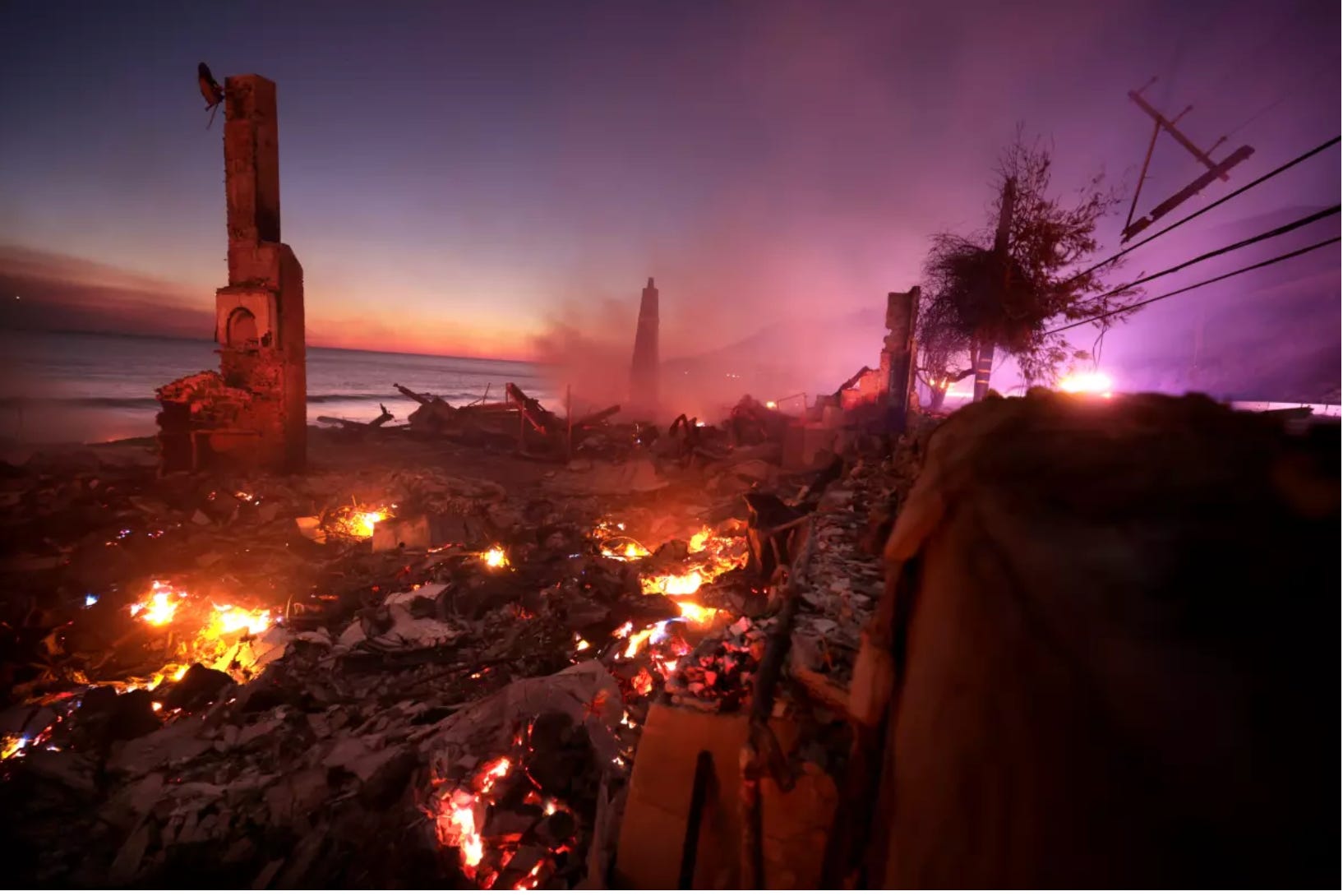
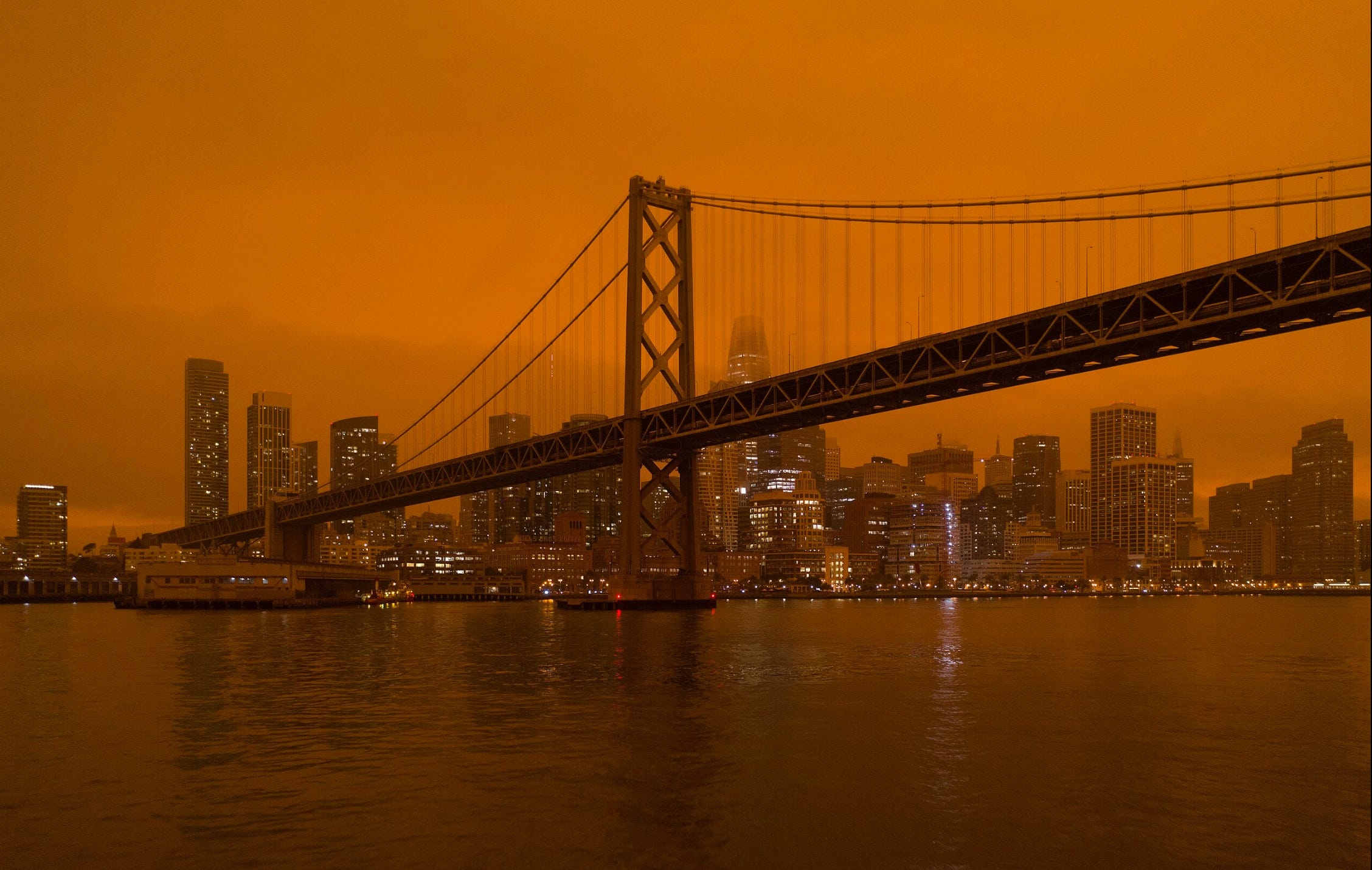
One by one, wildfires in the United States have taken on a different character. We were shocked (and even awed) by the scenes in Northern California during the Bay Area Fires of 2020 and the 2023 firestorms that obliterated large swathes of Maui.
But seeing parts of Los Angeles incinerate before our eyes has struck a more primal chord in many of us, not because Los Angeles is more important than Maui, but because somehow L.A. seemed untouchable. Maybe because of Hollywood. Maybe because “important” and obscenely wealthy individuals live there. Maybe because there’s a part of us that has grown so cynical that we feel bad things only happen to the non-rich.
But while this fire disproportionately has affected the non-rich, per usual, the wealthy folk have been, too.
We saw the Hollywood Hills evacuated and billionaires forced to flee their luxury compounds.
We watched million dollar homes along the Pacific Coast Highway in Malibu reduced to rubble in real-time.
For most of the wealthy, this was the first time they’ve experienced misfortune like this. How they respond would, of course, be telling. And boy, was it.
Virulent climate change denier actor James Woods wept in a television interview because his home burned down in a climate change-fueled fire. But before anyone had a chance to feel sorry for him or see if maybe this misfortune had humbled him and changed his mind about climate change, he jumped on Twitter:
"This fire is not from 'climate change,' you ignorant (expletive). It’s because liberal idiots like you elect liberal idiots like Gavin Newsom and Karen Bass.”
A multi-millionaire appealed to his fellow rich for leads on “private firefighters” for “any amount.”
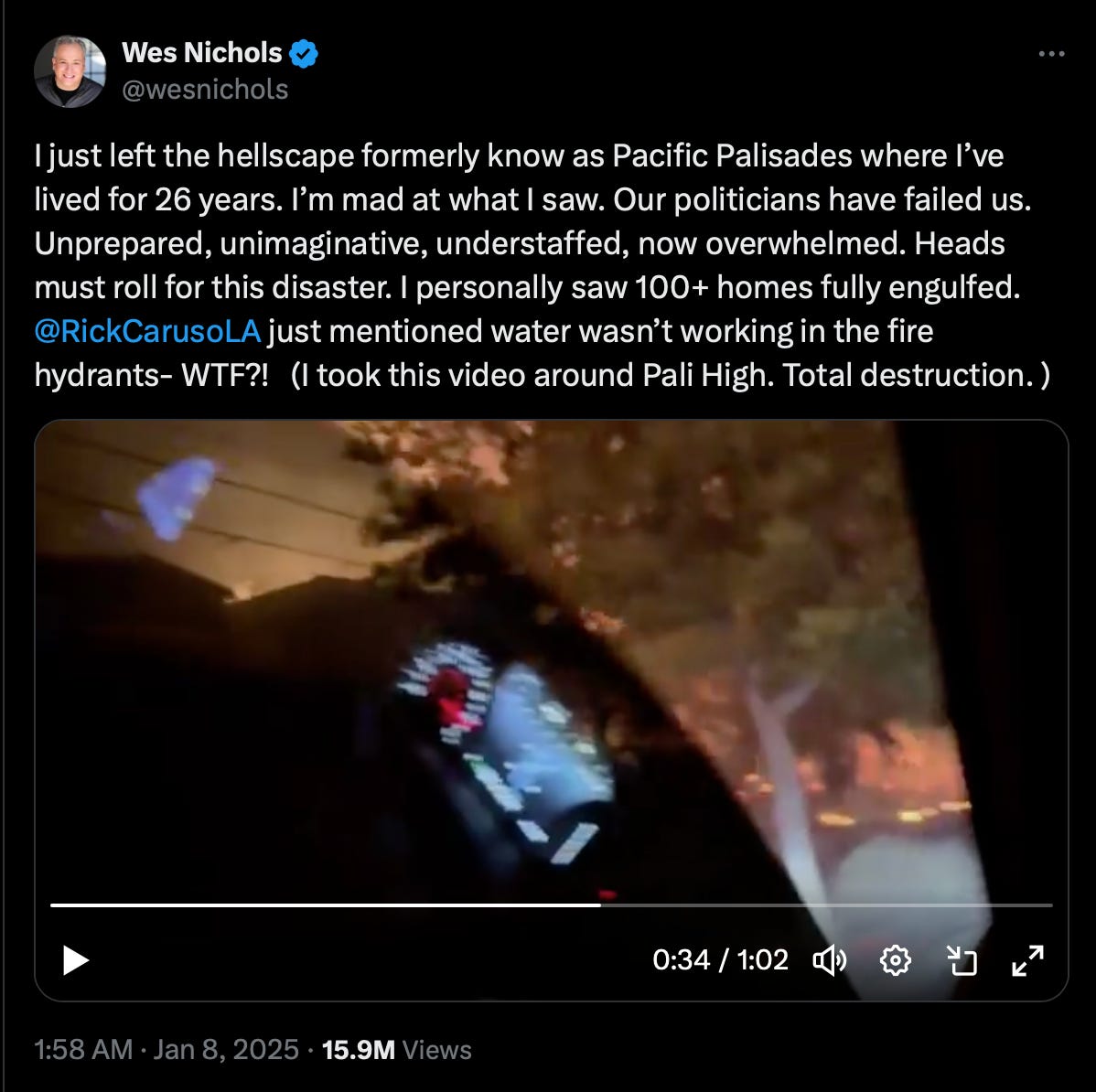
A billionaire hedge fund guy named Wes Nichols was forced to leave his home. On the way he posts on Twitter to berate the fire response, despite agitating for policies that gut public services like firefighting and doing his best to avoid paying his fair share of taxes. Tellingly, in his entire cri du coeur, Nichols doesn’t evince any concern, or even mention, the firefighters risking their lives to protect his wine cellar. He does, however, take pains to mention the property damage that has so enraged him.
The coverage of the fires is so heavily focused on the high net worth neighborhoods that we could be forgiven for thinking that middle-class and working-class neighborhoods must have been spared. Nah, they weren’t spared. The corporate-owned media was just telling us that they don’t matter as much as the rich folks who lost their third home.
A familiar feeling starts creeping in. I call it The Mangione Effect.
The Mangione Effect is a phenomenon where the social norm of empathy for those experiencing misfortune and sympathy for those who have died is rendered non-functional due to the unfortunate’s past behavior, actions, rhetoric, and abuse.
We see it in the fact that many of us don’t feel very sorry for the CEOs, Hollywood stars, billionaires who own (or stole) 80% of California’s water (that “owning water” is a thing defies all concepts of human decency, of course), and hedge fund. managers who are watching their palatial estates go up in flames. Their attempts to gain sympathy—their tweets, their interviews, their videos—have the opposite effect.
As social creatures, we, of course, understand that we probably “should” feel bad for these people, but we don’t. We know they have other homes. We know many of them have luxury underground bunkers already built. We know that some are buying up entire neighborhoods in climate-stable cities, razing the houses, and preparing to build enormous compounds. We know that billionaire tech bros like Mark Zuckerberg (well, it *was* Zuck) are censoring stories about climate change. And we know that these people have spent billions of dollars propping up the “climate change is a hoax” narrative, which has resulted in unimaginable amounts of suffering, irreversible habitat and species loss, and the loss of their fourth home.
As a result, we find that we don’t feel all that bad. Maybe one of us—petty af, admittedly—laughs when she sees James Woods sobbing on television, mostly because she (read: me) knew he’d clap back on social media with his usual mix of Dunning-Kruger climate denialism bullshit.
The “regular rich”—your basic millionaires with one very expensive home instead of ten—are thrown in the same lot, and are offended. It’s possible some of us understand why they’re offended. It’s possible some of us wonder if this event might open their eyes to the fact that the L.A. fires are the predictable end result of decades of climate change denial rhetoric and policy, fueled by billionaires who knew it was a lie but wanted time to continue plundering the earth to make a few billion more.
Millionaires aren’t that powerful, though they can be blind or willingly ignorant of the machinations going on around them. As long as they’re comfortable, they’re not going to raise the alarm.
Well, now they’re uncomfortable. And as hard as it may be to believe, they have more in common with us than they do with the Non-Reciprocating Class. Maybe they, too, are experiencing the Mangione Effect.
This is not something I anticipated as a possibility, and I’ve not been terrible at anticipating climate-related outcomes (in the realms of culture and society). I’ve spent the last ten years writing about climate change, both in my fiction and nonfiction. My climate fiction work is, by definition, speculative. But when you are the kind of fiction writer who wants to “get the science right” and make her speculative settings plausible, even if they are set in the future, things can get weird. In my case, some of the stories in my collection of climate fiction are more like “anticipatory nonfiction.”
That’s not because I’m uniquely imaginative. It’s because scientists have been telling us exactly what was going to happen if we—that is, the ruling class—didn’t take decisive action. None of this is a surprise, even though the billionaires and the media they own are acting like it is.
They knew.
The media was complicit in elevating corporate-bought scientists—termed merchants of doubt—and treating the climate change question like it was a legitimate debate. To put it on par with an argument that has the same level of scientific consensus, this would be like putting renowned biologist E.O. Wilson at the same CNN dais as a Bigfoot “expert.”
Except this had massive, existential consequences—for us and for our kids.
When I was younger, I was deeply disturbed by the idea of bought scientists. Exxon had them, and tried to destroy one government scientist’s career, something I documented in a piece I wrote for The Nation a long time ago. The tobacco companies had them, too. In an attempt to understand it, I went so far as to write a major character into my Antarctica novel who was a bought scientist for a consortium of energy companies.
I now realize all that work was unnecessary. It seems painfully obvious now—now that billionaires have captured our government, torn the fabric of our democracy, and grown richer than a human brain can accurately conceptualize. These people and the politicians they own pushed the idea that climate change was a hoax, not because they didn’t believe climate scientists. In fact, as we see spray-painted across the country by American patriots, Exxon knew. They all knew. That’s why they built underground bunkers. That’s why they’re obsessed with colonizing Mars and the moon.
And that’s why the shooting of Brian Thompson and the public’s overwhelmingly indifferent response to his death and robust support for alleged shooter Luigi Mangione terrifies them. It’s why they pressured the DOJ to file death-penalty level charges for a single Manhattan murder, one of over 380 in 2024.
They knew, but they obstructed any effort to address climate change, they tried to silence the brave scientists who have tried, at the cost of their careers and their mental health, to tell us what would happen if the country didn’t act. All because they want to make more money. Not money they need. Not money that would change their lives. Money for the sake of some sociopathic idea of power.
They traded our planet, and our lives, for money.
And they wonder why we don’t care about their luxury compound going up in flames, why we laugh when they cry, and why we wear t-shirts bearing the face of an accused murder.
That’s the Mangione Effect. It’s spreading. It’s spreading because the billionaire class feels it has won the decades-long chess game and no longer need to worry about us. They own the Supreme Court and a good number of federal judgeships. They’ve owned our legislators for years. They’ve installed Chief Billionaire in the White House through their coordinated efforts (and not the orange one). And they’ve abandoned the voters they radicalized into voting against their own interests, because they think the game is over, and that they’ve won.
I know better, and you probably do, too: that if the Non-Reciprocators don’t pivot immediately and start pouring their billions into mitigating climate change, providing health care, feeding children, and doing the very basic kinds of philanthropy—in their case “reciprocation”—that even the Robber Barons understood they had to deliver to a public they stole from, the Mangione Effect is here to stay.
No posts
Comments
Nothing yet. Say the first thing.
Sign in to join the conversation.