
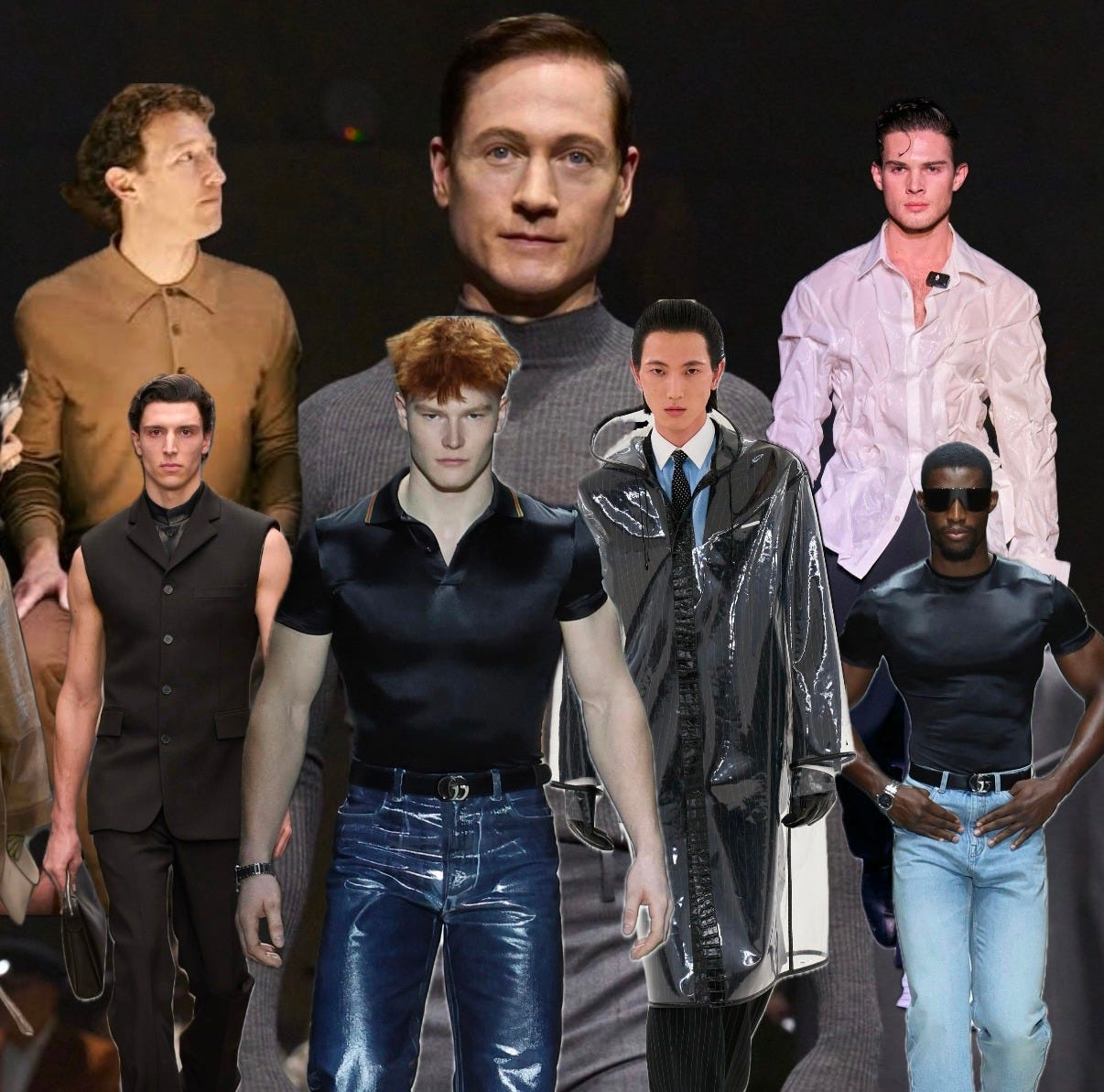
What do pumped-up gym bros, looksmaxxers, biohackers and the 0.01% have in common? They’ve all started showing up at fashion week.
This season was dominated by various forms of extreme, sometimes bleak expressions of masculinity. Absurdly muscular guys bulged out of glossy black T-shirts at Gucci, Tom Ford showed Patrick Bateman clones in clear raincoats, and biceps popped out of the sleeveless tailoring at Calvin Klein. Most striking was the casting: Braden Peters (the looksmaxxing streamer known as Clavicular) and Bryan Johnson (the tech bro who wants to live forever) made their modelling debuts at Elena Velez and Matieres Fecales. Clavicular wore a white shirt that looked as though it had been drenched in slime, while Johnson was in a tight grey knit that made him look like a spaceship lieutenant. Mark Zuckerberg, once considered a terminal nerd, was around too: front row at Prada, amid talks of a Meta AI glasses collaboration.
wimpy is a reader-supported publication. To receive new posts and support my work, consider becoming a free or paid subscriber.
I wrote about it all for Vogue Business this week, and interviewed academics, designers, analysts and fashion experts to try to examine—sincerely—why this surge of behaviour had spilled over from fringe internet culture onto the runway. We called it “hypermasculinity”, which a lot of people in the comments took issue with, but I don’t know we have a better word to sum up the display of aesthetics we saw this season. Engineered masculinity? It certainly feels male: a narcissistic belief that the body is a system to be engineered for longevity, beauty or power. After thinking it over, I landed on android chic: an age of impending transhumanism when male bodies are obsessively enhanced by peptides, supplements, surgery and steroids. Whether it’s chic or not is up for debate, but argue amongst yourselves.
Android chic was clearest at Gucci, newly inherited by Demna. The brawny men in the show almost looked like AI and walked with a mecha-like swagger, their pecs and abs straining against shiny T-shirts. It was an exaggeration of the steroid-drenched spornosexual bodies now normalised on social media. Even so, it wasn’t a particularly groundbreaking or beautiful collection, and this season’s archetypes of sexpot Italians, jerk rappers and roadmen felt too true to real life to be properly interesting.
But Gucci was just the most visible sign of a deeper shift that came through in the casting of Bryan Johnson and Clavicular as runway models. Under the lights, their pale and waxy faces appeared as machines. It’s prescient that both Ghost in the Shell and Neon Genesis Evangelion—anime that explore these themes—are both currently happening here in Tokyo. Anrealage even put Ghost in the Shell on the runway.

Looksmaxxing—once a fringe school of thought that grew in the petri dish of incel forums—was also a big talking point this season. After Clavicular walked for Elena Velez, fashion watch party organiser and influencer Lyas asked male models at Burberry what they thought of looksmaxxing, and this weekend the New Yorker ran a story about the language that surrounds it.
On one hand, I am aware of how hard it is to be immune to all of it. I work out, I moisturise, I drink Savas and sometimes take creatine. Every couple of months I get acupuncture on my face (hit me up if you want a connect with my guy). I too want to be hot and successful and live a long and healthy life! Banal, natural desires! The danger happens when our appetite for these normal things goes unchecked, and is enabled and encouraged by culture and technology.
The idea that you can rank a person with by their bone structure reminds me of that episode of Dexter’s lab where Dexter gives himself super-laser eye surgery. He can see everyone in ultrahigh definition—every pore, every flaw—but the cost is that his family are rendered nauseatingly ugly and he goes insane. Moving through the world conscious of everyone else’s canthal tilt and maxilla metrics is no life, like judging a person’s worth of character by their follower count.
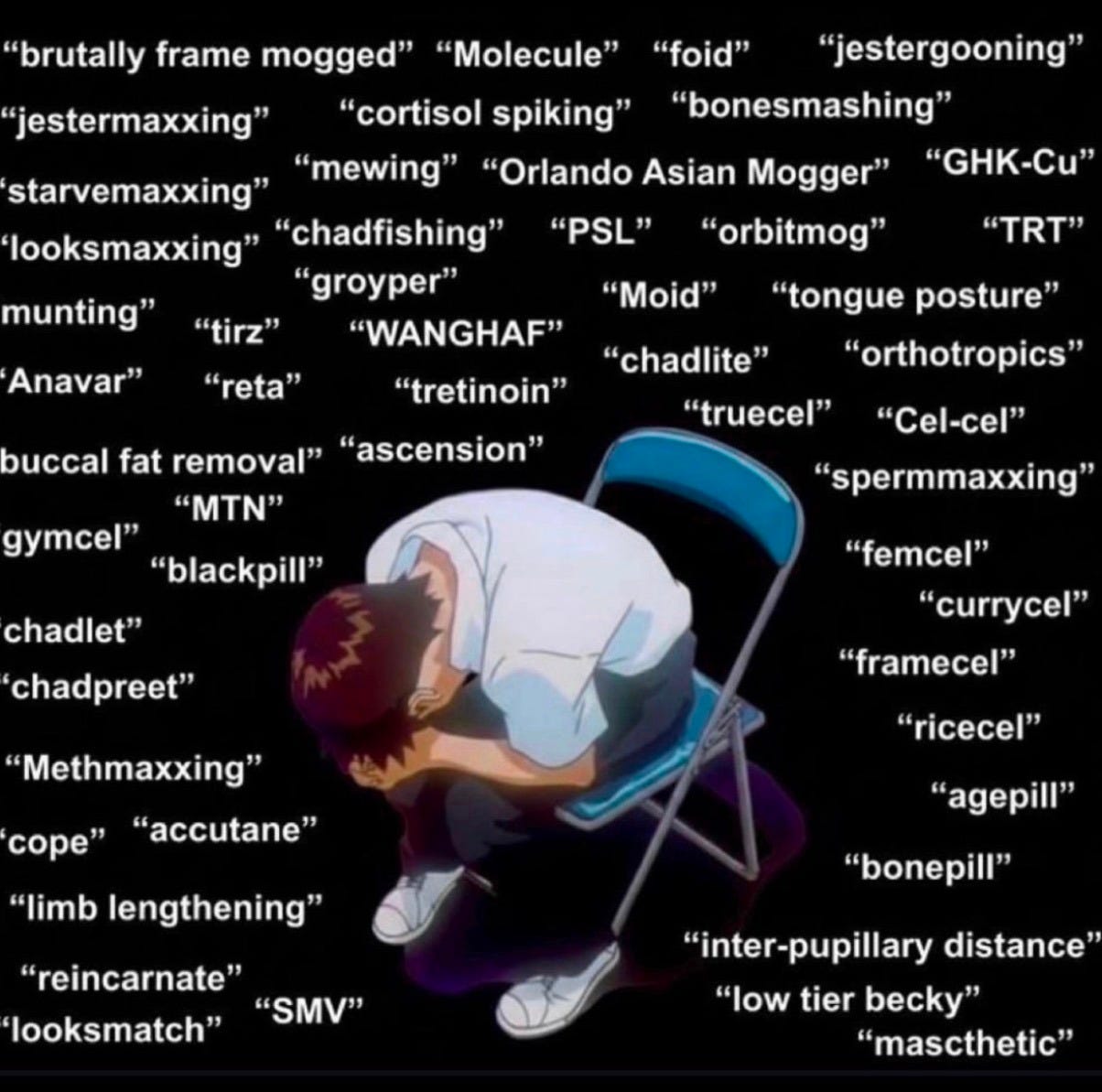
There’s an interesting duality at play with Bryan Johnson and Clavicular. The former is on a mission to live forever, while the latter, a so-called incelebrity who takes crystal meth to stay lean, reads as semi-suicidal—a Ballardian car crash hoping for a beautiful death. Between them both is a dichotomy of self-love and self-hatred: one side wants to prolong its life for as long as possible through ultimate wellness, and the other to smash itself into oblivion in the pursuit of beauty.
What unites the two in their Sisyphean “ascension” of cheating death and ugliness is an undeniable void. Johnson, who is a former Mormon, seems cheery enough, but he lives the life of a man who has already donated his body to science. He will never again experience the singular joy of having a cigarette with a friend outside a party, or, I don’t know, eating parfait. His physical body is fully optimised but his soul has been laid to rest. Perhaps the human race will benefit from Johnson’s project, and aid medical science in finding cures to age-related disease. The advantage of Braden Peters’ existence is less clear. In both cases, the pleasureless price of their work is a necessary comfort that allows us to pity rather than envy them. One must imagine Clavicular unhappy.
wimpy is a reader-supported publication. To receive new posts and support my work, consider becoming a free or paid subscriber.
The upshot of all of this is that there’s a huge opportunity in menswear right now for clothes that speak to a wider variety of bodies and identities. It’s one of the reasons many guys—and many of you reading Wimpy—are more interested in shopping from disruptive designers or craft-focused brands than they are in what the big luxury players are putting out. It’s clothing that is beautiful, on or off the body. Against that, those apocalyptic spectres melt away.
MORE WIMPY:
An interview with 2026 LVMH shortlist designer Tíscar Espadas
Welcome to the Age of Honest Menswear
wimpy is a reader-supported publication. To receive new posts and support my work, consider becoming a free or paid subscriber.
Comments
Nothing yet. Say the first thing.
Sign in to join the conversation.