
Welcome back to Wimpy!
Today’s edition is about Oliver Church, who runs Oliver Church Singular Garments, a very slow fashion brand based in Paris, with devotees from New York to Osaka.
I was first introduced to Oliver a few years ago by a good mutual friend and find him to be a refreshing presence in the fashion industry. He’s also got excellent chat. This summer, just before fashion week kicked off, we spent an afternoon chatting at his Paris studio before he took us for noodles and a couple of glasses of off-menu plum wine at his local Vietnamese lunch spot. Enjoy!
“I’m just finishing a pair of shorts, I’ll be down in a few minutes.”
It’s a sweltering 39 degrees in Paris—undeniably shorts weather—and Oliver Church can whip up a pair on a whim.
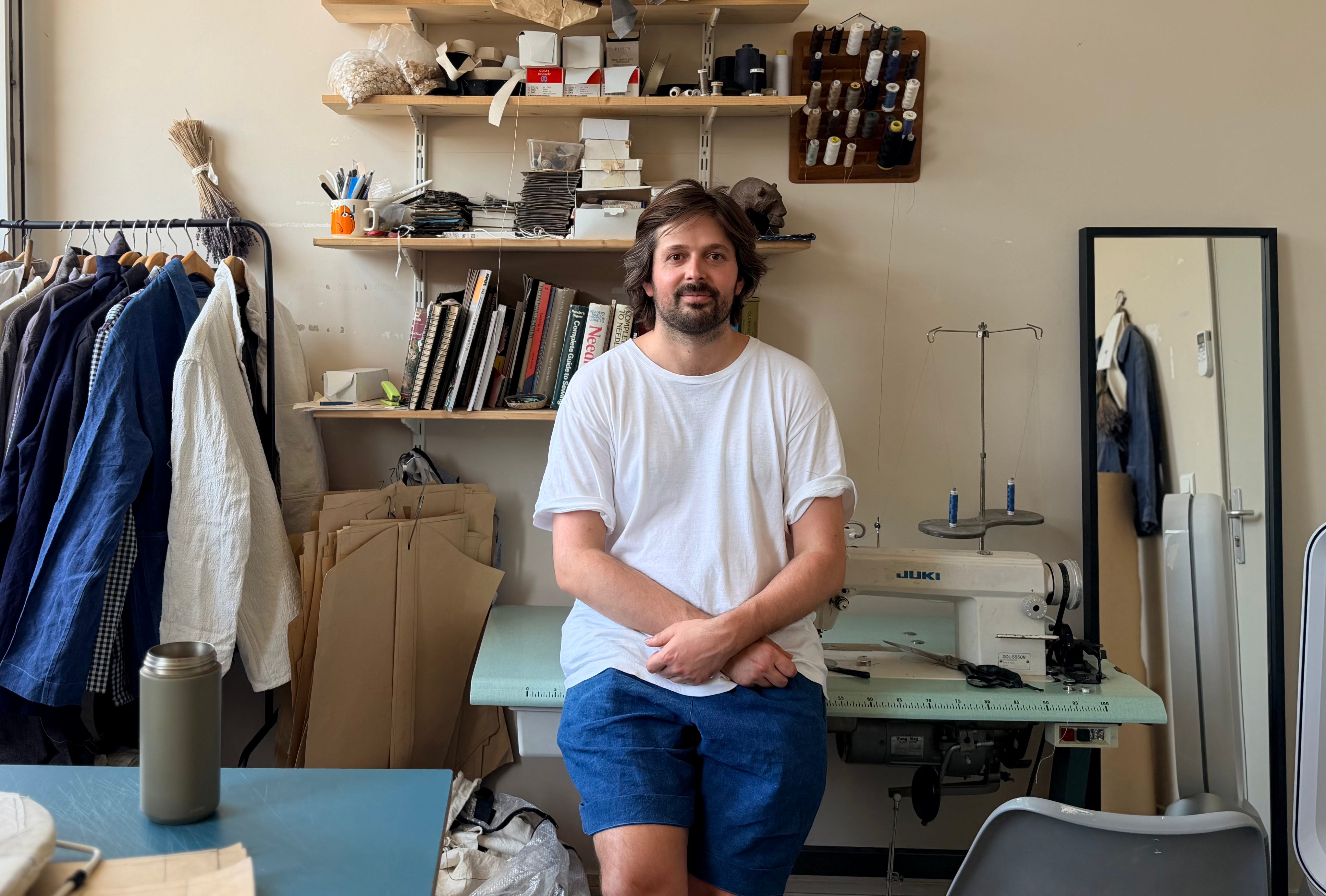
The 35-year-old New Zealander is an old-world image of a fashion designer, before designers were even a thing: he makes clothes by himself alone in his studio, sourcing mostly antique and vintage fabrics that he transforms into what he calls ‘Singular Garments’. When he appears at the door of his studio, he’s wearing the blue pair of cotton shorts, hot off the sewing machine. “I got to work and was like, I need a new pair of shorts, so I made some,” he says. “Brill!”
His sunlit studio, which he moved into recently, is a few floors up in a large building in the 10th arrondissement. There’s a large cutting table by the window, and a desk and sewing machine above which is a bookshelf stacked with guides to sewing and embroidery; rails on either side hold works in progress or vintage pieces, and a sprig of lavender hangs on the wall. “The lavender is good because I use a lot of antique materials, so some of them are stuffy,” he says. “It keeps out moths, and I love flowers.”
Three or four days a week, Church holes up in his studio for 12 hours a day, where he divides his time between each garment. Depending on the piece, he can do the machine work for two items in a single day. Button holes take 12-25 minutes each, and he might add a herringbone stitch to a shirt collar or finish a sleeve by hand. He mostly makes shirts, which start at €700, as well as jackets and occasionally trousers. Each piece comes with a strip of extra fabric, with the intention that you can use it to repair the piece. These are, without cliche, clothes to last a lifetime.
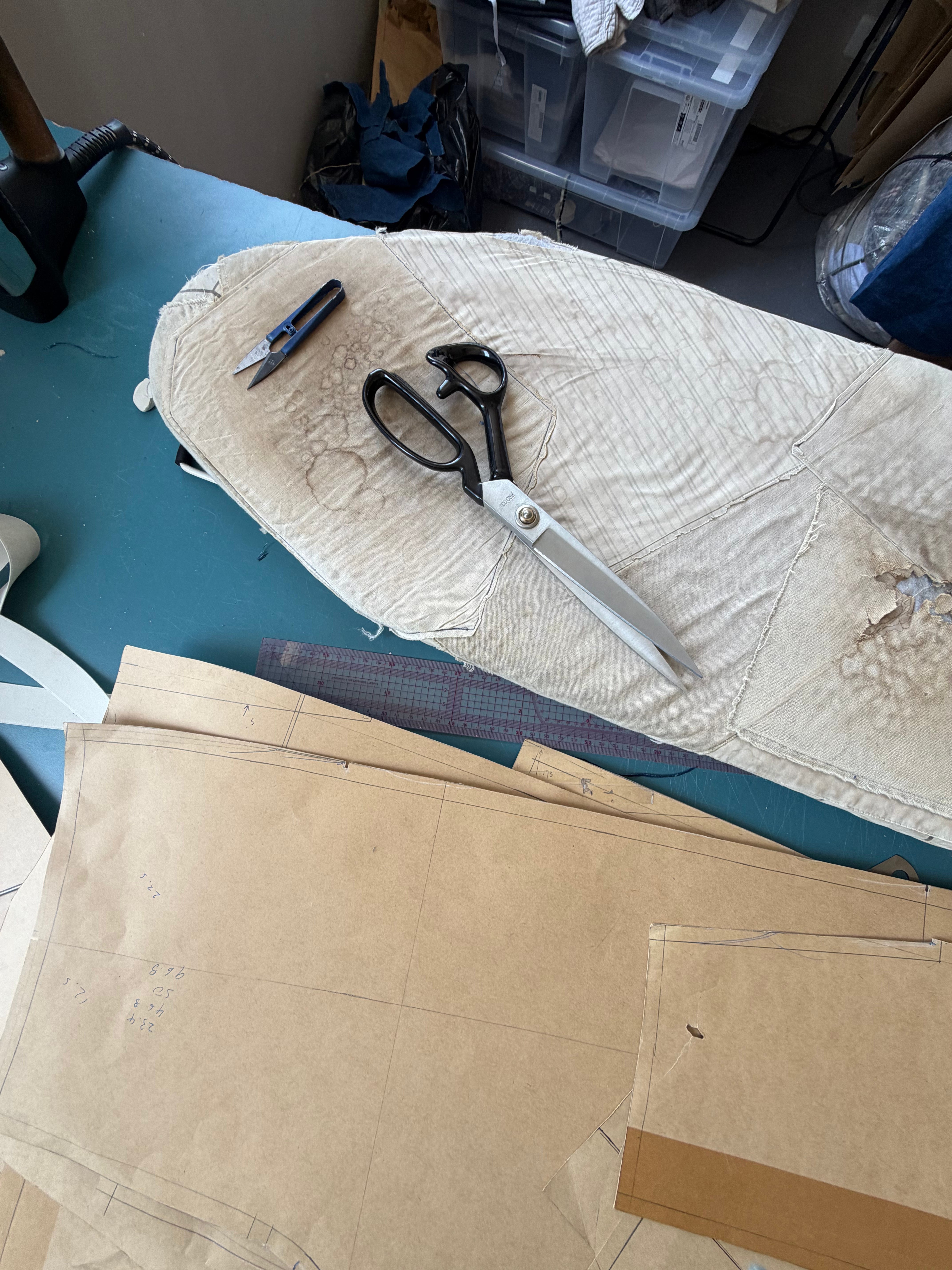
“I don’t produce pieces that I don’t like. And I’ve never worked anywhere where that was the case,” he says. “There were always some pieces in the collection where you go, meh, because you’re trying to hit all categories.” Later this year, he will release knitwear for the first time, made in collaboration with an Italian mill that his friend, the designer Evan Kinori, introduced him to. “It felt like the right fit, a small artisanal factory with an incredible dedication to their work.”
The designer’s output is under 200 pieces a year, and he intends to keep it that way until retirement. “Or arthritis,” he laughs. He currently sends his singular garments to 12 stores that include Mouki Mou in London, Maidens Shop in Tokyo, and Neighbour in Vancouver—the S-tier retailers, in other words.
The one that got to him first, though, was Localers, a pioneering store in the small city of Morioka in northern Japan. “I remember feeling strangely drawn to his work,” says Localers’ founder Yoshi Nakamura. “I cannot quite explain why, but it may have been my instinct as a buyer.” He messaged Church and ordered a jacket, appropriately called the Big Pocket Jacket. “What I find most compelling about his clothes is the sense that they carry a soul, and that he truly engages with each piece he creates,” says Nakamura. “He is not influenced by trends at all, and in this fast-moving fashion industry, he is trying to establish a new kind of business model.”
Church works mainly with vintage and antique textiles, which he sources from a small network of fabric-dealing brocanteurs. “Oliver has a truly exceptional eye for selecting textiles,” says Shinya Makino, founder of Maidens Shop, who was first introduced to Church by Yoshi and is now one of his biggest stockists. Makino points out Church’s use of antique Kelsch, a checked fabric made in Alsace. It’s robust, with a slubby texture and a slight bounce; the kind of thing that lasts for decades. “There was one occasion when Oliver and I found some vintage Kelsch fabric together at a flea market, and he made garments from it especially for us.”
The arrival of Church’s brand has coincided with a growing appeal for clothes in natural fabrics that are made in small runs. The designer is wary of this, and intends his clothes to live beyond the moment. “I guess I am hoping to make something a bit anachronistic or sitting outside of time. Not timeless in a commercial way, but timeless in that it does not belong to any time in particular.”
Comments
Nothing yet. Say the first thing.
Sign in to join the conversation.