
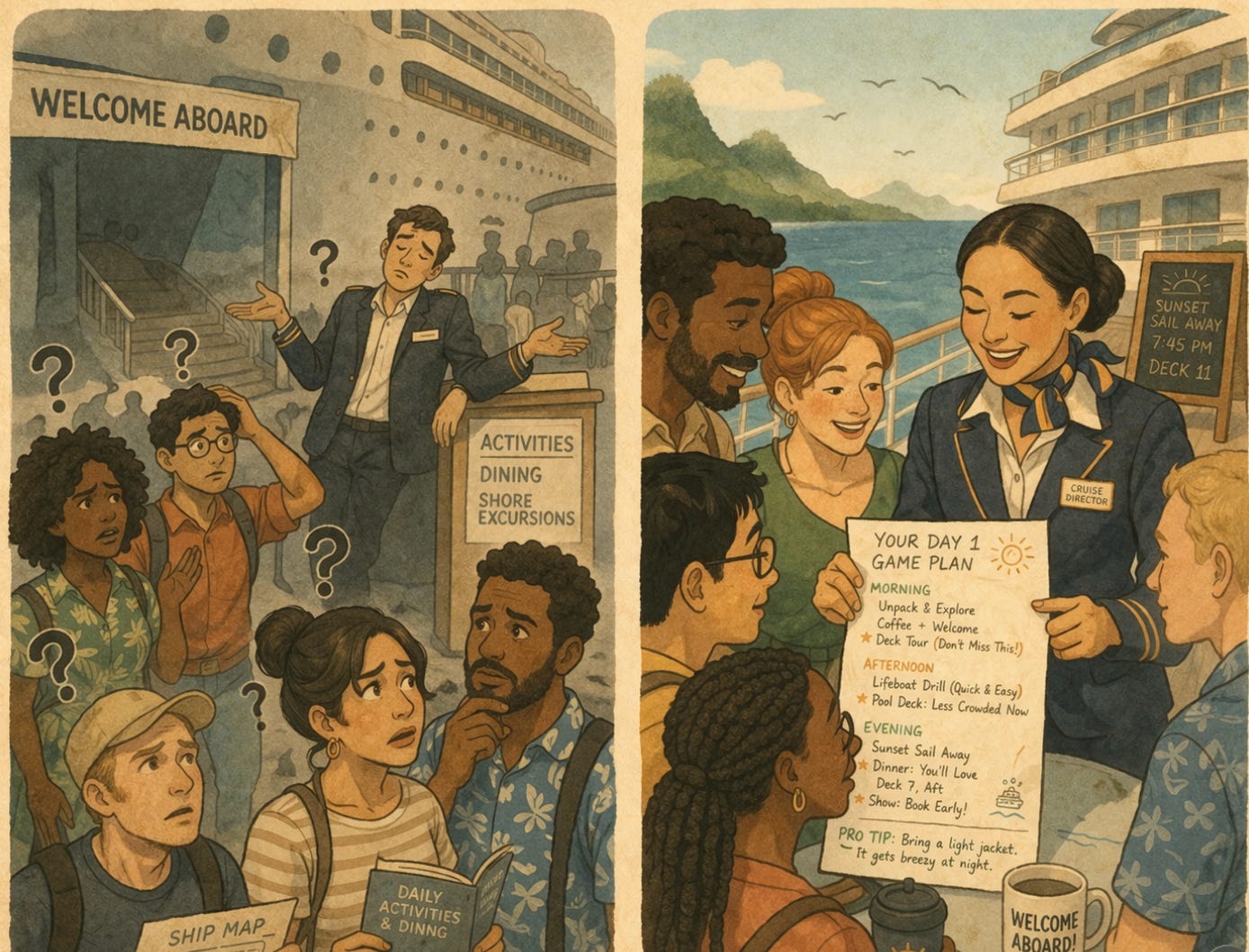
Picture two cruise ships leaving the same port on the same day.
On the first ship, you board and nobody greets you. You get a binder with a list of activities. Someone tells you to let them know if you need anything. You wander around figuring it out yourself.
On the second ship, a Cruise Director meets you at the gangway. She already knows your name. She tells you what’s worth doing on day one, what to skip, what most people miss, and exactly what to expect at every port. She doesn’t ask what you want to do. She tells you what you should do — and why — based on what she knows about people like you.
You tip the Cruise Director on the second ship.
You leave a bad review for the first one.
This is the difference between a reactive CS motion and one built on expertise and intention. And it’s where most companies get it wrong from the very start.
Before I get into the Cruise Director phase specifically, I want to give you the full picture..because this is the first in a series of articles I’m writing on what a high-performing customer strategy actually looks like.
The framework has five phases:
The Cruise Director — leading with expertise, not questions. This is where we’re starting today.
The Destination — defining the transformation your customer hired you to deliver. What does success actually look like for them?
The Departure — your onboarding motion. The moment that sets the tone for everything that follows.
The Voyage — the ongoing work of continuously driving value and moving the customer forward without losing momentum.
The Waypoints — defined milestones that mark real progress and create predictability across your entire book of business.
Each phase builds on the one before it. But none of them work if you haven’t nailed the Cruise Director mindset first. That’s why we’re starting here.
Here’s a situation I see constantly across startups and growing SaaS companies.
A customer signs. There’s a kickoff call. The onboarding specialist or CSM asks: “So what are your goals for the next 90 days? What would make this successful for you?”
It sounds thoughtful. It sounds customer-centric. It sounds like you care.
But here’s what the customer is actually thinking: “I thought you were going to tell me that.”
They bought your product because you’re the expert. They’ve never implemented your solution before. You’ve done it hundreds of times. And yet, you’re handing the pen back to them and asking them to draw the map.
The cost of getting this wrong isn’t theoretical. According to OpenView’s 2024 SaaS Benchmarks, only about 1 in 3 new SaaS users successfully completed onboarding and became active product users — and best-in-class companies activated at more than double that rate. The gap between good and great onboarding isn’t incremental. It’s the difference between keeping your customers and losing them before they ever got started.
That’s not a product problem. That’s a leadership problem.
Most companies hand customers the wheel because they believe the customer knows where they want to go. And they do.. at a high level. But they have no idea how to get there, what to do first, what the gotchas are, or what success looks like at 30, 60, and 90 days.
That’s your job. And if you’re not doing it, you’re not serving them. You’re just being polite.
After years of building CS teams at high-performing companies and now working inside early-stage and growth-stage companies as a consultant — the patterns are painfully consistent.
“We let the customer drive.” This sounds like a virtue. It isn’t. Customers who drive their own implementation almost always go slower, miss critical steps, and blame the product when things don’t work out. The best customer outcomes happen when your team is in the driver’s seat.
Onboarding is treated as a checklist, not a commitment. There’s a difference between a checklist you hand someone and a plan you walk through together. One is a document. The other is a shared commitment. Most teams are handing out documents and wondering why customers don’t complete them.
Nobody owns the timeline. Deadlines exist on paper but nobody holds them. The customer misses a step and the CSM waits. Weeks pass. Momentum dies. The customer who was excited on the kickoff call is now three months in and still not live .. and quietly starting to wonder if this was a mistake.
The CSM is reacting instead of leading. I see this most in early-stage companies where CS is still being built. CSMs are smart, well-intentioned, and completely underwater. They respond to tickets, answer questions, and show up to calls. But they’re not driving the customer toward anything specific. They’re keeping the relationship alive, not moving it forward.
The handoff from Sales is broken. Sales closes the deal and hands off a customer who has a set of expectations that CS doesn’t know about. The CSM starts from scratch trying to understand what was promised, what the customer cares about, and what success looks like. By the time they figure it out, the customer has already formed an impression.
Every customer gets a different experience. Each onboarding looks slightly different depending on which CSM is running it, what they remembered to cover, and how much the customer pushed back. No repeatable motion. No way to know what good looks like. No way to improve what you can’t measure.
Here’s the change..
The Cruise Director doesn’t ask the customer where they want to go. She tells them what the journey looks like, what they need to do at each stop, and what happens if they fall behind.
She’s warm. She’s confident. She’s genuinely invested in their experience. But she leads. She doesn’t wait.
In CS terms, this looks like:
Showing up to the kickoff with a plan, not a blank slide. You’ve done this before. You know what the first 30 days should look like for a customer like this one. Present it. Walk them through it. Get their buy-in. Don’t ask them to build it with you from scratch.
Owning the deadlines, not just tracking them. When a task is overdue, the Cruise Director doesn’t wait for the customer to notice. She reaches out, asks what’s blocking them, reschedules if needed, and keeps things moving. The customer feels taken care of — not chased.
Being specific about what success looks like. Not “our goal is to get you fully onboarded” but “by day 30, you’ll have completed X, Y, and Z — and here’s why each one matters for your outcome.” Specificity builds confidence. Vagueness breeds doubt.
Defining what both sides own. The Cruise Director makes clear what she and her team will do and what the customer needs to do. Accountability lives on both sides. No ambiguity about who’s responsible for what.
Connecting every touchpoint to the bigger picture. Every call, every task, every check-in should be moving the customer closer to the outcome they bought. If it isn’t, it shouldn’t be in the plan.
Being a Cruise Director requires confidence. It requires believing that your experience is more valuable than your customer’s instincts about what they need. That can feel uncomfortable, especially for CS teams trained to be helpful and agreeable.
But here’s what I’ve seen in practice: customers who are led with intention don’t just get to value faster. They feel better about their decision to buy. They trust you more. They’re more likely to stay, grow with you, and tell others.
The Cruise Director doesn’t just deliver a better outcome. She delivers a better experience.
And here’s the uncomfortable truth for leaders: if your team isn’t operating this way, it’s usually not because your CSMs aren’t good enough. It’s because they don’t have the structure, the playbook, or the tooling to do it consistently.
When I was a CSM, this mindset was the thing that separated my accounts from everyone else’s. I didn’t wait for customers to tell me what they needed. I came in with a plan, held the timeline, and made sure both sides knew exactly what was expected — and what happened if we slipped.
More recently, I’ve been building this structure for clients — designing the motion, defining the milestones, and now building the tooling to support it.
I just deployed a custom onboarding plan tool for a client over the weekend. It’s a web app built with Claude, connected to HubSpot and Slack, that gives both the internal team and the customer a shared view of the onboarding plan — tasks, owners, deadlines, linked resources, and real-time notifications when anything happens on either side.
It’s the Cruise Director’s itinerary. Built into a tool.
Next week I’m going to walk you through the build at a high level — what it does, why I built it instead of buying something, and what you’d need to think about if you wanted to do the same for your team or your clients.
Not because buying is bad.. there are great tools built for exactly this. But you should know what works for your team before you invest in a product built around it. Build the house in your head before you sign the mortgage.
Stay tuned.
No posts
Comments
Nothing yet. Say the first thing.
Sign in to join the conversation.