
TLDR: Retention Isn’t Just a CS Problem
Churn usually starts long before CS is involved.
The best teams treat retention as a shared responsibility across Sales, Product, Marketing, CS, and Execs.
Cross-functional trust and collaboration matter more than tooling or playbooks.
Goal alignment across departments is what turns strategy into execution.
Great operators don’t just put out fires.. they look upstream and fix the system.
If your CS team feels like they’re doing all the cleanup they probably are.
And that needs to change.
The Story: When CS Gets the Blame, but Not the Setup
I was talking recently with a newly promoted Senior Customer Success Manager at a Fortune 500 company.
Smart, steady, deeply invested in her customers. She’d inherited a few difficult accounts, including one that seemed, at first glance, to be in great shape.
Product usage was strong.
Their champion seemed to be engaged.
The team liked the platform.
And then, suddenly, things fell apart during renewal.
The original deal had been discounted heavily and bundled across multiple products. There was no clear success plan, and half of the tools were never onboarded.
The AE was long gone. And whatever paper trail of what was sold lived in 5 different outdated Google documents.
The customer didn’t remember the original expectations. And now they wanted the same discount, better support, and fewer headaches.
She looked at me and said, “I don’t think I ever had a real shot here.”
And she wasn’t wrong..
She was being asked to fix a relationship that was never set up for success.
That’s not a CS failure.. that’s a systems failure.
And it’s what happens when one team owns the customer, but every other team controls their experience.
So does this mean CS is blameless?
Absolutely not..
In fact, sometimes churn is on CS. Sometimes follow-through is sloppy. Sometimes relationships get neglected. Accountability still matters. It always will.
But too often, CS becomes the catch-all for every upstream issue.
They don’t just manage the customer.. they manage the expectations no one else set properly.
Thanks for reading Success & Growth ! Subscribe for free to receive new posts and support my work.
The Real Reason Retention Slips
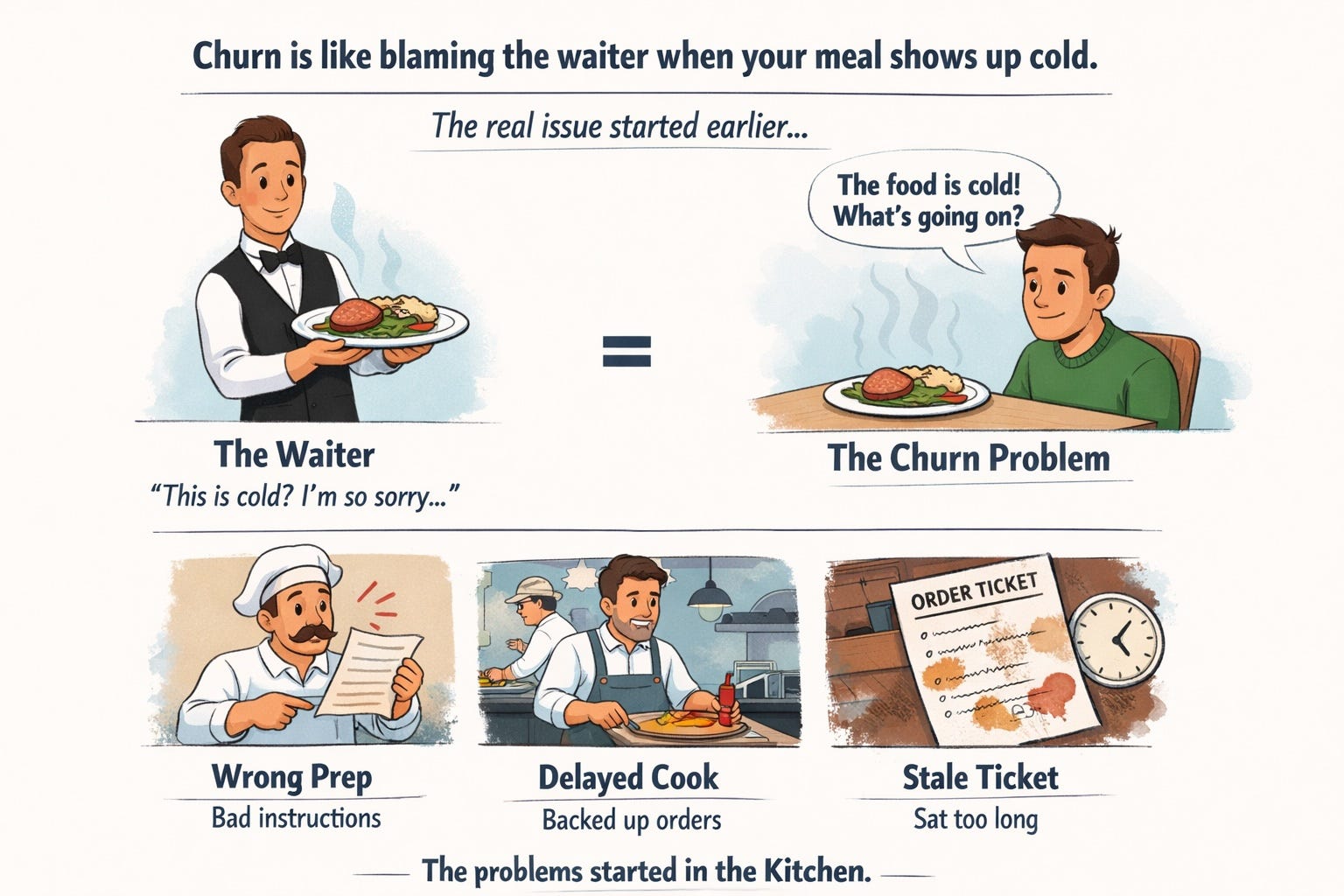
When churn happens, the easy thing to do is look at the people closest to the customer.
But churn is often the result of a long chain of avoidable decisions.
It’s like blaming the waiter for delivering a cold meal to the guest.
Now, someone might say, “well, shouldn’t the waiter have checked the food before serving it?”
Fair. But most waiters don’t prep the meal, don’t manage the timing, and don’t control the kitchen. They’re expected to trust the system. Same with CS. Could they catch an issue early? Maybe. But if the entire system depends on the last person in the chain to spot a failure.. you don’t have accountability. You have cleanup duty disguised as ownership.
Same with CS.
By the time they step in, the deal is already signed.
The expectations are already set.
And the customer has already formed an opinion of what success should look like.
Could the waiter have checked the plate? Sure.
Could CS have spotted the risk earlier? Maybe.
But if your system depends on the last person in the chain to catch every mistake..
You don’t have a performance issue.
You have a process issue.
The Best Teams Think Cross-Functionally
The best customer-facing teams treat retention like a shared goal.
They build tight relationships across departments.
CS and Sales understand each other’s lanes.
They communicate regularly.
They hold each other accountable in a healthy way.
They say things like:
“We sold this. Now let’s figure out how to deliver it.”
“We’re hearing X from customers. Let’s bring Product into the loop.”
“We think Y is trending. Can we proactively partner with Marketing on messaging?”
And this doesn’t just happen at the exec level.
It happens between ICs, managers, and every team that cares about delivering the full customer experience.
This Doesn’t Just Apply to Leaders
I’ve coached CS leaders to build strong partnerships with Sales, Product, Engineering, and even Finance.
But this isn’t just a leadership problem.. and it’s definitely not a leadership-only solution.
Whether you’re managing five accounts or leading the department,
You need cross-functional alignment.
Because:
If Sales doesn’t understand the onboarding lift, they’ll overpromise.
If Product doesn’t hear about friction points, they won’t prioritize fixes.
If Engineering doesn’t understand customer impact, tickets get deprioritized.
If CS is left out of go-to-market strategy, risk increases before value ever lands.
And when all of this happens silently, CS ends up holding the entire relationship together with duct tape and hope.
Alignment Doesn’t Start at the Bottom
Want to reduce churn? Start by aligning goals.
The best companies don’t just set vision from the top.. they cascade that vision into every function.
Execs define where we’re going.
Teams define how we get there.
And every department can clearly articulate how their work contributes to the whole.
Companies with aligned goals are 72% more profitable than those without clear alignment.
When you don’t have this, you get disconnected KPIs.
Sales optimizes for logos.
CS tries to drive value.
Product ships features.
Marketing promotes outcomes.
But none of it lines up.
Alignment isn’t just about collaboration. It’s about velocity and execution.
What Great Operators Actually Do
This is where the best operators step in.
They don’t just know their lane.
They understand the system.
They move laterally, not just up.
They ask better questions.
They drive clarity.
They don’t wait for someone else to escalate.
They spot the pattern and say, “Here’s the gap, here’s what’s at risk, here’s how we fix it.”
Operators:
Flag misaligned pricing before the deal closes
Bring onboarding in before the SOW is finalized
Loop in product when a feature gap is about to create churn
Track signals across the customer journey and surface issues early
They don’t just plug leaks.
They fix the plumbing.
This Isn’t Just CS Work
If your CS team feels like they’re constantly cleaning up after everyone else.. they probably are.
But it doesn’t have to stay that way.
Retention is a team sport.
And it’s time we started playing like it.
Thanks for reading Success & Growth ! Subscribe for free to receive new posts and support my work.
Comments
Nothing yet. Say the first thing.
Sign in to join the conversation.