
A few weeks ago, one of my clients stopped me mid-sentence.
We were reviewing a list of AI tools and workflows they had been rolling out. Things were moving. Things were getting built. And she looked at me and said:
Thanks for reading Success & Growth ! Subscribe for free to receive new posts and support my work.
“Sometimes I wonder if we’re moving too fast with AI. Some things are still good for humans.”
She wasn’t being resistant. She wasn’t skeptical of the technology. She was being thoughtful.
And then I sat in an invite-only AI deployment session hosted by Zapier with leaders from Netflix, Indeed, and ServiceTitan.. and I heard the exact same sentiment, almost word for word, from people running AI programs at some of the most sophisticated companies in the world.
Tracy St. Dee, Zapier’s Global Head of Talent, said something that’s stayed with me: what gets labeled as “resistance to AI” is almost never actual ideological resistance. When you dig in, it’s almost always the same four things. No time to experiment. No relevant examples to follow. No management support. No clear ask or expectation.
My team member wasn’t resistant. She was overwhelmed. And she was also right.
The Real Problem Isn’t Moving Too Fast.
It’s Moving Without a Filter.
The teams I see struggling with AI aren’t the ones moving too slow. They’re the ones moving without intention.
Every idea sounds good in the moment. “Can we use AI to automate X?” Probably. “Should we?” That’s the question most teams skip entirely.
I’ve watched teams burn cycles on AI initiatives that:
Solved a problem nobody had more than twice a month
Produced output that required more human effort to review than it saved
Lived outside the systems where the team actually worked.. so adoption died within weeks
Were built by one person for their own workflow and never scaled to anyone else
None of these were bad ideas. They were just premature. Or the wrong layer. Or built before the underlying process was actually understood.
Indeed’s VP of AI Innovation, Hannah Calhoun, described a version of this exact problem at scale at the Zapier session. They built an “AI fast-track” process to approve pilots quickly. Good intent. The result was five versions of the same AI note-taking tool built across different departments, an IT team frustrated after years of trying to simplify the stack, and nobody talking to anyone else about what they’d already built.
The lesson: experimentation and standardization are two different things and they need two different processes. Without that distinction, “move fast” just means “create a mess faster.”
What I Built to Prevent This
After watching the “build anything” pattern play out one too many times, I built a structured scoping framework. A Claude Project that acts as a decision layer before any AI initiative moves forward.
It’s not a project management tool. It’s not a spreadsheet. It’s a thinking partner that asks the right questions before anything gets built.. and tells you whether the idea is actually worth pursuing.
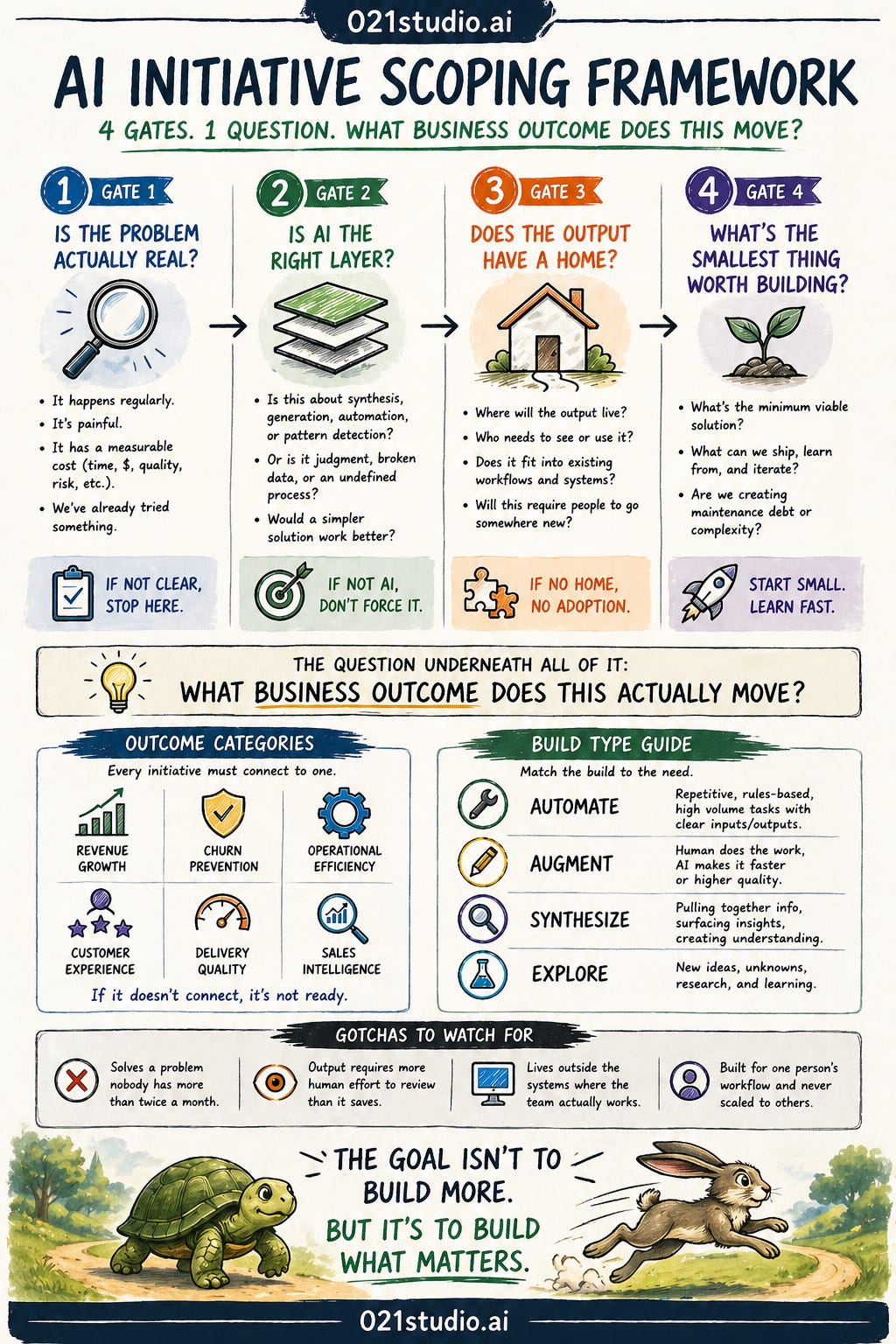
The framework runs every initiative through four gates:
Gate 1 — Is the problem actually real? Not “we could probably improve this” but “this is painful, it happens regularly, and here’s what it’s costing us.” If the problem is fuzzy, the build will be too.
Gate 2 — Is AI actually the right layer? AI is genuinely good at synthesizing information, generating drafts, automating repetitive steps, and surfacing patterns. It’s not good at making authoritative judgment calls, fixing broken data, or replacing a process that hasn’t been defined yet. This gate catches the mismatch before you’ve invested time building the wrong thing.
Gate 3 — Does the output have a home? Where does what AI produces actually land? If the output doesn’t connect to a system where the team already works, adoption will fail. Tools that require people to go somewhere new get abandoned. Every time.
Gate 4 — What’s the smallest thing worth building? Not the most impressive thing. The smallest thing that actually solves the problem. Overbuild creates maintenance debt. Under build creates shadow processes.
The Question Underneath All of It
Before any AI initiative gets built, it has to connect to one question:
What business outcome does this actually move?
Not “this would save time.” Not “this would be cool.” Not “our competitor is doing something like this.”
A specific outcome. Churn prevention. Revenue expansion. Operational efficiency. Delivery quality. Customer experience. Sales intelligence.
If an idea can’t connect clearly to one of those categories, it’s not ready to build.
Hannah’s “function-first” principle from the Zapier session is exactly this applied at the leadership level. Instead of tracking separate AI metrics, every department ties their AI strategy to KPIs they already own. Sales wants to grow rep book size? Show how AI moves that. CS wants to reduce escalations? Build around that. The outcome is already something the team cares about. The measurement system already exists.
That’s how you get buy-in. That’s how you know if it worked.
What Changes When You Have a Filter
When every AI initiative has to pass four gates and connect to a business outcome, a few things happen.
The team gets better at scoping problems. “Is this worth building?” becomes a muscle, not a blocker.
The backlog gets cleaner. Ideas that don’t pass the filter get parked with a reason.. not abandoned, just held until the context changes.
The builds that do get approved actually get used. Because they’re connected to a real problem, a real workflow, and a real owner.
And the person who said “are we moving too fast?” starts to feel heard. Because the framework proves that speed isn’t the goal. Value is.
I’ll Share the Full Project With You
The Claude Project behind this framework — the full system prompt, the four gates in detail, the outcome categories, the build type decision tree, and the gotchas I’ve run into rolling this out — is something I want to put in the hands of readers who are actively working on this. Take the project, replace the placeholders in the Claude instructions with your own priorities and goals and run with it.
I’m not putting it behind a paywall.
If you want access, drop a comment on this issue or reply to this email and I’ll send you the direct link.
It’s free for subscribers.
Thanks for reading Success & Growth ! Subscribe for free to receive new posts and support my work.
Comments
Nothing yet. Say the first thing.
Sign in to join the conversation.