

Mike Michaelson: Christof, let me ask you, why do you think that Truman has never come close to discovering the true nature of his world until now?
Christof: We accept the reality of the world with which we’re presented.
It’s as simple as that.
-The Truman Show
Every day, I receive multiple emails in my primary inbox pitching the same solutions to the same problems. Some are short. Some are long. Some are signed by vague-sounded names, a la Jane Johnson. Others are signed by well-known authors, like Kristin Hannah and Catherine Newman.
Some begin with, “Dear Author …”
Others begin with, “Hi Ms. Gadd …”
The subject lines vary:
(No Subject)
I’d Like To Drive 50+ Book Sales For You
Helping Your Book Reach More Readers
A Quick Idea To Make Your Book More Engaging
Your Book Is Better Than Its Numbers Suggest
Here’s a doozy, possibly the longest subject line to ever grace my inbox: I was planning to reach you sooner, but I had to be honest with myself first: your book is not reaching the audience it was written for, and that is a visibility problem I know how to solve!
I never open the emails or read them. I simply hit “mark as spam” and block the sender, although for every email moved into my digital trash can, three more pop up like an unrelenting game of whack-a-mole. Here’s another one. Subject line: You‘re In Good Company and the 10 Years of Coffee + Crumbs Readers Who Haven‘t Reviewed It Yet.
Against my better judgement, I open this one. Unlike most messages I receive, this email is long. Very long. Multiple paragraphs, a whopping 1600 words. The text reads like a persuasive essay, which I suppose is the whole point.
The cheerios are still on the carpet. The laundry is still piled on the chair. The baby is crying again. And in the middle of all of it, a mom opens her phone and sees a notification from Coffee + Crumbs. A story about someone else who also vacuumed cheerios today. Someone else who also feels like she is failing. Someone else who also showed up, imperfectly, and called it enough. That notification is not a distraction. It is a lifeline. And you built that lifeline because you knew that motherhood is not meant to be done alone.
The email goes on to stroke my ego: complimenting my work and my books and the “incredible platform” I’ve built over the past decade, which is described as “a community of mothers who have grown up alongside you, Ashlee, who have read your words since their first baby was born and still look to you for encouragement.”
Every plot needs tension, however, and halfway through the message, there it is: a “visibility gap.” My latest book is not getting enough eyeballs or reviews.
Lucky for me, this person named Emerson can help. She is willing and able to provide me with a digital audit, a 14-day execution calendar, and a direct line to her for the duration of the campaign. Her message is laced with promises: more exposure, more reviews, more sales. In a nutshell, more success.
The suggested strategy and promised outcome are not unique; I’ve received some rendition of this email hundreds—if not thousands—of times. The only thing different about this message is that it’s far more personalized.
Out of my own curiosity, I Google the name at the bottom of the message. I am taken to a website that—to the naked eye, or perhaps a low-informed internet user—looks legit. Flashy graphics with the words, “Turn Visibility Into Revenue” stretch across the home page. As I scroll down, I read through a list of impressive services, everything from Amazon optimization to email marketing to Goodreads maximization. When I click the team page, I almost laugh at the names. Harry Banks. Daisy Johnson. Roseline Jones. At a cursory glance, the headshots could almost pass as authentic.
Despite knowing there is an inkling of truth to the actual words in the email—my books could use more visibility, more reviews, more sales—I am not tempted to reply to this message in the slightest.
I am not tempted to reply, because none of it is real.
///
Just this morning, I received a note from The New York Times Book Section informing me they are considering a review of my work.
“Kristin Hannah” has emailed me four times in the past month offering to get more eyeballs on my Amazon author page.
Again and again, I wonder, Is anyone actually falling for this?
Delete, delete, delete.
Block, block, block.
Mark. As. Spam.
///
A few years ago, I had to temporarily disable the commenting feature on Coffee + Crumbs after we received more than 300 comments in a 24-hour period from a self-proclaimed witch doctor promising to save marriages.
At that time, Squarespace didn’t have any kind of AI integration. There were no good robots to fight the bad ones.
It took me several human hours to delete them all.
///
Sometimes I picture myself as an old lady trying to explain to my great grandchildren what the internet used to be like—the digital version of walking to school barefoot in the snow. You know, uphill both ways.
“Back in my day,” I’d start, “We only had trolls.”
Anonymous commenters were terrible, sure, but at least they were real.
Ahhh, the good ole days.
///
I always thought at some point, I’d outgrow the internet like an old sweater. That one day I’d simply leave Instagram of my own accord and give up publishing online in favor of a quieter, more private life. In my worst case scenarios, I occasionally wondered if one day I’d be canceled.
I never considered it would go down like this. That one day I’d be driven away not by trolls or my own agency, but by sheer madness.
I never considered death by spam—the slow burn of robots gradually driving me insane.
///
Last Wednesday afternoon, I called the pharmacy to see if my prescription could be moved to a different location. For the first time ever, I got trapped speaking to an AI bot with zero option to talk to a real person.
I began by asking nicely. By the end of the call, I could feel my blood pressure rising as I practically yelled, “TALK TO A PERSON, I WANT TO SPEAK TO A HUMAN BEING, OPERATOR, ANYONE, HELLO??? TALK TO A REAL HUMAN!!!!!!!!!”
The AI bot responded in a calm, soothing voice, “I’m sorry, I don’t understand that request.”
///
I recently received a photography inquiry from a sweet mom who lives in the Bay Area. Unlike many of my prospective clients, when I Googled her name, I struggled to find any evidence of a digital footprint. I found myself wondering for the very first time whether or not she was a real person.
Am I being catfished?
Am I going to be murdered in some random Bay Area basement?
Up until very recently, this fear had never crossed my mind.
///
Two years ago, a photographer in a Facebook group shared a before and after photo of a woman with long dark hair in a yellow dress, hands perfectly poised on her pregnant belly.
In the before photo, she is standing in a parking lot.
In the after photo, she is standing in a field of flowers.
I felt both confused and disoriented reading through the comments.
Wow, that’s amazing!
Looks beautiful!
What a transformation!
Stunning!
She had, of course, used generative AI.
///
For almost 12 years now, I’ve been writing about motherhood on the internet alongside my friends. We’ve received plenty of criticism in that time, but plenty of praise, too.
Generous readers have sent us messages and notes over the years calling our work authentic, honest, raw, and vulnerable.
Some might even call it: real.
///
I recently listened to a podcast about how AI is affecting the publishing industry.
When asked to describe the difference between AI and human writing, one of the women said, “There is just this … spidey sense of flatness. It’s very emotionally one note, and yeah, it’s a feeling … it’s a feeling where you sense literally a lack of mind behind the text.”
///
I show the 1600-word email from “Emerson” to my husband, who asks, “How do you know it’s fake?”
I fumble through an explanation. Read excerpts aloud. Show him the website linked to the email signature and gesture wildly at my laptop, “Can’t you see?!! Isn’t it obvious?! NONE OF THIS IS REAL!”
I have no proof, of course.
I only have a feeling deep in my gut.
An instinct.
A perceived spidey sense of flatness, if you will.
///
Am I allowed to call this grief? Not big G Grief, of course, but little g grief? My beloved internet—this digital ecosystem where I have invested time, energy, love, where I have made friends and shared art and laughed and cried and connected with strangers all over the world via stories and photographs and the mystery of motherhood—is no longer recognizable to me.
///
I am scrolling social media when I stop, horrified, at the words on my screen.
Jesus AI.
A new website “dedicated to meaningful conversations with Jesus Christ.”
For just $1.99 a minute, you can video chat with a Jesus avatar, designed after actor Jonathan Roumie of “The Chosen.” Need more time? No problem. You can have 45 minutes with Jesus AI for the small price of $49.99/month.
///
This is, of course, only the beginning. Countless more “spiritual” apps are being built with AI as I type this. Here’s a new one: Text with Jesus™️
A divine connection in your pocket!
Start your spiritual journey now!
Naturally, if you’d like an ad-free experience, you’ll have to subscribe to the premium model.
///
Something worth noting now more than ever: God did not simulate being human; God became human.
Jesus, the real Jesus:
Embodied himself with us (John 1:14),
Became lower than the angels (Hebrews 2:9),
Submitted to human weakness (Phil 2:7),
Subjected himself to death (Phil 2:8).
This is the truest thing I know: driven by love, God put on skin.
Sacrificed his real body, his real blood.
For us.
///
Sometimes when I wake up at 3am and cannot go back to sleep, I think of the world we are leaving for our kids. Farms replaced by data centers. Surging energy costs. Erosion of critical thinking, literacy, human connection. Suicides inspired by conversations with chatbots. Deepfake abuse. The brutal impact on our planet.
And all for what?
Yesterday at a baseball game, I overheard a woman behind me talking about how she uses AI. She recently uploaded faces of her family members into ChatGPT and asked it to recreate a scene from Dirty Dancing.
“It looked SO real!” she told the person next to her, “Isn’t that wild?”
Wild, indeed.
The tech bros keep trying to sell me a utopia, but all I see is a dystopian novel in the making. One where we—as Neil Postman warned—amuse ourselves to death.
///
Another day. Another photography Facebook group. Another before and after photo. This time, a photographer asks what to do because her client is the one who made the changes.
In one picture, a mom holds her son, while his hand covers his mouth.
In the other, his hand is down at his sides, a new smile plastered on his face.
In one picture, her shoes are black.
In the other, her shoes are white.
In one picture, the little boy is wearing unbranded grey sneakers.
In the other, he is wearing black sneakers with a big white Nike swoosh.
Subtle changes but … changes nonetheless.
The comments are mixed.
You need to fix your contract!
The photos belong to the client — they can do whatever they want!
The photos are yours — this is not okay!
FWIW: I like the original photo better.
Hate to say it, but I like the new photo better.
///
Counter argument: Photoshop has always existed.
(Counter-counter argument: I’m a professional photographer and I’ve never used Photoshop.)
But what does it even matter, now?
AI is the new photoshop. And anyone can use it.
///
I just got home from a trip with my friends, and noticed there is a white tag sticking out of my black bathing suit in one of the photos. For a brief moment, I wondered if I should edit the tag out. It would be easy to do: zoom in, hit the “clean up” button, move my finger around the tag and watch it disappear.
Then again, what’s the point?
In the real world, sometimes our tags stick out.
Sometimes our eyes are closed.
Sometimes we wish we had different shoes.
(Different bodies.)
(Different faces.)
I leave the tag. Publish as is.
///
A few times a year, someone in my local mom’s Facebook group will post, “I need a new headshot, any recommendations?!”
These threads used to be full of actual names, women tagging photographers they had used in the past. The last several times I’ve seen a thread about headshots, though, the comment section is flooded with the same response.
ChatGPT!
ChatGPT!
Did you know you can make a headshot for free with ChatGPT?
Sometimes I wonder if it’s only a matter of time before families stop hiring photographers altogether and simply upload selfies into AI, prompting it to create a session on some magical beach that doesn’t even exist.
///
Last week I photographed a mother and her three young children, all on film.
Over the course of 90 minutes, I rotated between crouching on the floor, standing on the edge of the bathtub, and lying down flat on the cement in the front yard. We danced to K Pop Demon Hunters and followed the light. At one point, I got her son to laugh by yelling POO POO at the top of my lungs.
In the end, the mom told me she was pleasantly surprised at how comfortable her children had been with me.
I took her compliment to heart, clinging to the truth (or is it hope?) that part of what makes me a good photographer is my own humanity.
///
Another email pops up in my inbox. Subject line: Protecting your slow art + a reader-growth idea for Create Anyway
The robot writes:
I was spending some time reading your notes and essays over on your Substack, and your dedication to slow art, deep humanity, and keeping your creative fingerprints strictly human truly resonated with me.
<praise my work>
<praise my work>
<praise my work>
You should be allowed to just write and take film photos; let me handle the noise of the market. I have mapped out a quiet, algorithm-free campaign strategy designed to introduce Create Anyway to targeted book clubs and maternal communities. Can I send over that human-centered campaign outline right here in this email thread?
///
Several weeks ago, I received a DM on Substack from a mother who has been following Coffee + Crumbs for nine years. She told me about her life raising four boys under eight, including her sweet six-year-old who is fighting a brain tumor. Like me, she recently turned 40, and was planning a trip with her girlfriends to celebrate.
She wanted to know the best place to purchase 10 copies of You’re in Good Company to include in gift bags for her friends. I could hardly believe her generosity.
Part of me wanted to forward her message to all the robots.
See THIS? Now THIS is a human-centered campaign.
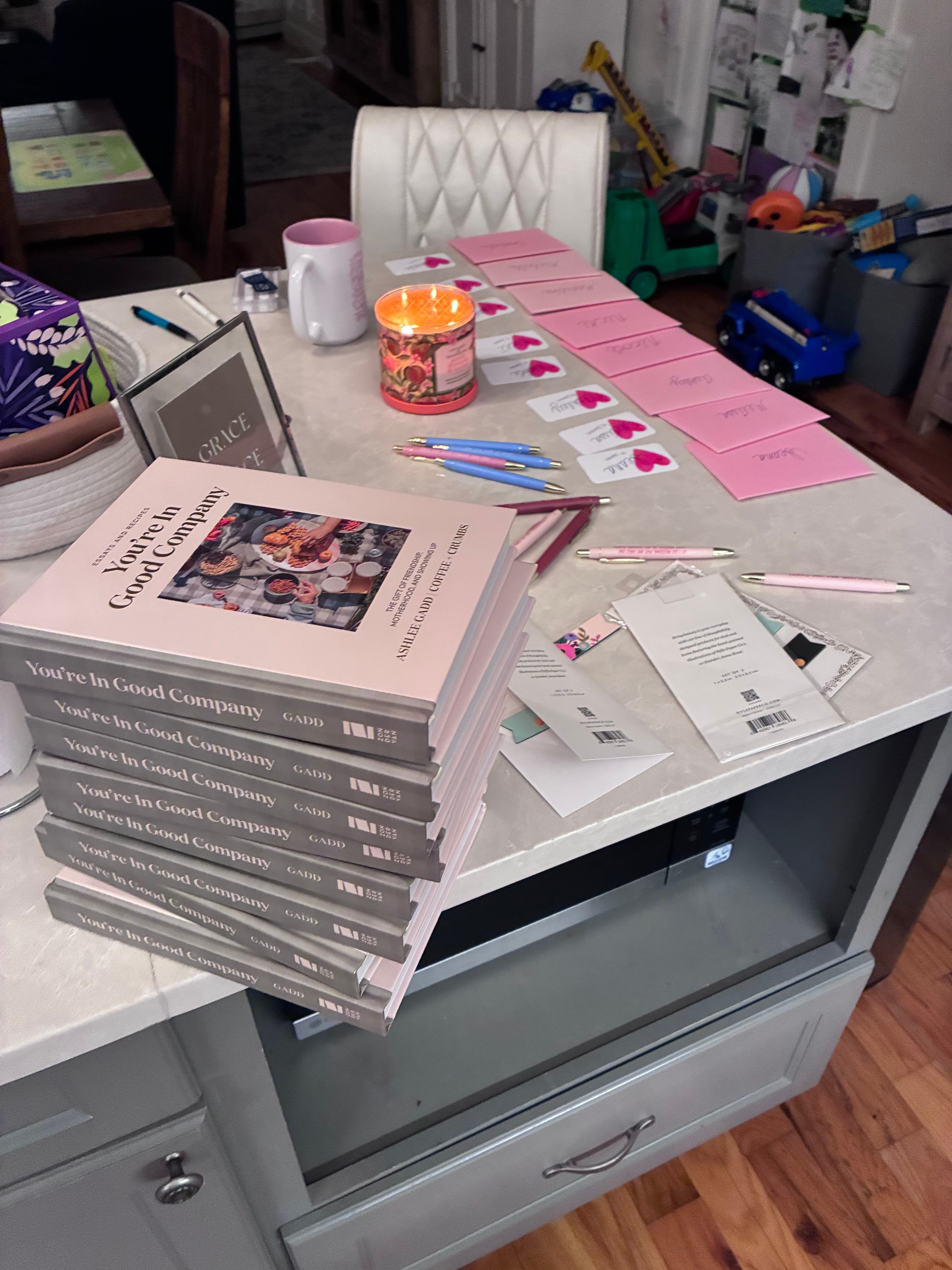
///
Questions I’m asking:
How much longer can I stay here?
How much longer can I create here?
How can I keep fine-tuning my spidey sense of flatness?
How can I protect my parents from getting scammed?
How can I protect myself from being spammed?
How can I teach my children to value human writing over Claude?
How can I fight for something better, truer?
How can I opt out?
How can I rebel?
What is the antidote?
///
This is the part of the essay where I can sense I’ve been rambling. Cue the background music to politely play me off stage. Time’s up. What’s the point, Ash? Are you really going to leave us on a cliff of despair?
///
Of course not.
Some “counterweights”—as my friend Shannan calls them:
We can still put pen to paper. We can still use our messy, clunky, imperfect brains. We can still create and consume slow “chewy” art, as Joy Sullivan says. We can still hang out at the library (the original data center!) and chug books like our minds depend on it.
We can still resist the temptation to optimize, optimize, optimize. Resist the temptation to use tools we don’t need that are actively harming our work force and planet. We can resist the temptation to build things at neck-breaking speeds, choosing instead to create slowly, carefully, deliberately, with deep intention and purpose.
We can still take the scenic route.
We can still cultivate a life rich in human connection, human collaboration, human-made music and movies and art.
We can still practice courage. We can still opt out. We can still touch grass, cry at a live concert, support brands who refuse to use generative AI.1 We can still embrace a wonderfully complicated human life, one filled with wonder and curiosity and every form of friction.
In a world that is gradually becoming more and more of a simulation, we, us, you and me, can still channel our inner Velveteen Rabbits.
We can still be loose in the joints and very shabby.
Online and offline, we can still be real.
My Substack is always free to read, but you can buy me a coffee anytime you’d like to support my creative work. ❤️ All of my writing is 100% AI-free, written with the shabby, imperfect human brain that God gave me.
Dove, Polaroid, Aerie, LEGO, to name a few.
Comments
Nothing yet. Say the first thing.
Sign in to join the conversation.