
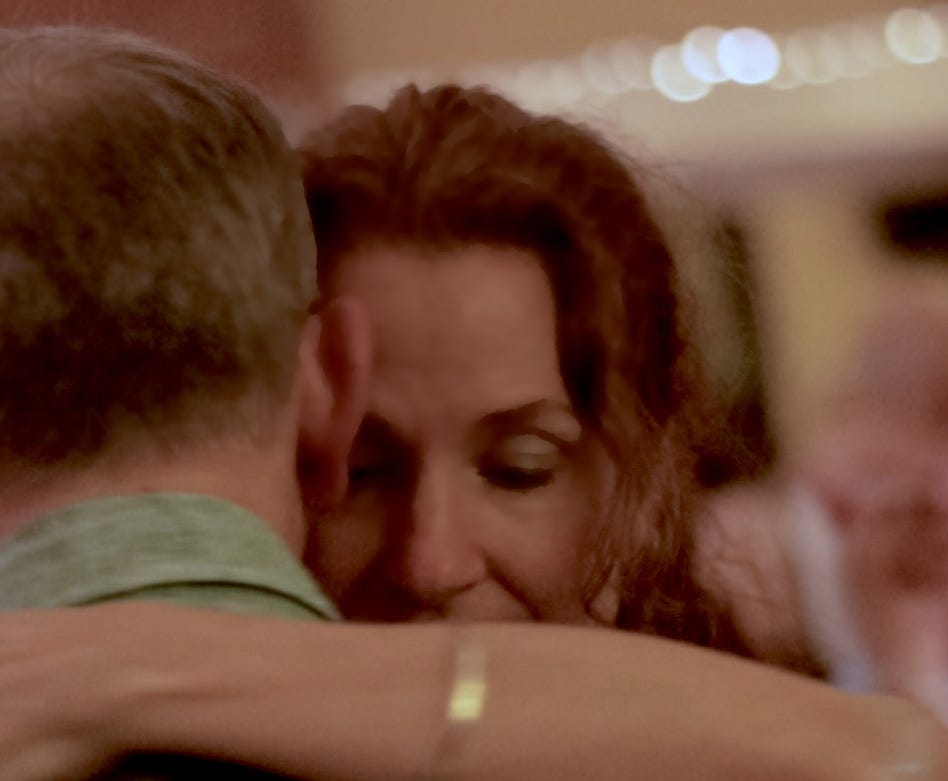
Lots of people say – and I, myself, have said – that Argentine tango is a form of meditation. But is it really?
I know more about meditation than I once did, and I’m not so sure this dance can be considered actual meditation, but it shares many of the same qualities and benefits.
Stress reduction. Meditation has been proven time and time again, study after study, to reduce stress and anxiety. Physical activity, dance in particular, and tango even more specifically are also well-documented stress and anxiety reducers. (I even once gave a presentation to a group of educators on tango for stress reduction.)
Improved concentration. The practice of mindfulness meditation begins with concentration exercises, which may lead eventually to a meditative state. In the practice of yoga, there are eight limbs, or steps. The physical poses (asanas) come before concentration, which in turn comes before meditation. Tango, too, is an exercise in focus and concentration. We have many tools, including music, movement and a partner, at our disposal to help us. Many meditation techniques also use tools: a voice to guide us, sounds (such as chanting) or our own breath to help us focus.
Increased happiness. Meditation has been shown to improve practitioners’ self-image and outlook on life. If you dance tango, I don’t need to tell you that it, too, can bring new joy to your life. The socialization aspect, the enjoyment of the music and the sense of accomplishment as we improve our skills are all proven mood-boosters.
Better self-awareness. Both practices improve our body awareness, which in turn can develop our self-awareness.
Slower aging. Meditation and tango have both been shown to slow the aging process. Meditation can reduce age-related memory loss, while tango is sometimes used as a therapy for people living with such diseases as Parkinson’s and Alzheimer’s. Partner dancing improves the ability to multi-task, or do two things at once – such as navigating in space while remaining in sync with your partner. Research – including a 2015 study on tango for people with Parkinson’s disease by the Montreal Neurological Institute and McGill University – has shown that Argentine tango offers particular benefits for the brain, probably in large part due to its improvised nature.
Psycho-emotional benefits. On this front, meditation and tango have much in common. Being a good tango dancer and attentive partner involve letting go of the ego, which is an important concept in meditation. Tango dancers also need to be able to let go of the plan – another concept present in the process of meditation (and a topic I explored in this article). And have you ever taken a tango class in which the teachers didn’t mention the need to be present? In the moment, in your body, for your partner. Meditation, too, is an exercise in presence.
Anecdotally, people who compare tango to meditation all say the same thing: It allows them to let go of their thoughts, worries and stresses and to live completely in the moment. This is one of the things that drew me to dance and specifically to Argentine tango. I have an overly busy brain – the kind that loves to wake me up at 3 a.m. or to distract me from the task at hand – and tango is one of the only activities that is pretty much guaranteed to still my mind and make me fully present. Meditation attracts me for the same reasons, though the work for me is more challenging without the music, movement and human contact to help.
Most dancers also say that a meditative state is easier to find for the follower. As someone who dances both roles (but still considers following my primary one), I must agree. Because leaders have to keep a good part of their attention on navigation and step planning, it’s not so easy to let go mentally and enter that state of abandon. That does not mean it’s a cinch for followers: Achieving such a state requires immense trust in their partners and themselves. It also requires active listening, so, as with meditation, it’s not about just “emptying your mind” or “not thinking.” You have to learn what to focus on (connection, technique, music) and what to let go of (doubt, frustration, mistakes). Since meditation always begins with concentration, leaders can also get there through a deep focus on things like musicality and connection. One suggestion: Don’t talk while you’re dancing. That will surely detract from any possibility of achieving a state of abandon or flow.
That being said, I had an interesting exchange with a couple of tango friends recently. Toward the end of a milonga, all three of us were exhausted and decided to avoid any miradas in our direction and sit out a tanda, a pretty amazing Pugliese tanda. At one point I was listening to the beautiful music and said, “I can’t believe we all chose to sit this one out!” And my leader friend said, “But it’s amazing. I don’t have to worry about being interesting, so I can actually just enjoy the music!” We all laughed, but I knew just what he meant. Of course you enjoy the music you are dancing to, but particularly as a leader, the underlying desire to be creative, get it right, and keep your partner happy can be a demanding distraction; sitting a tanda out now and then can relieve the pressure of constantly “doing” to the music and allow you the experience of simply “being” in it.
I cannot write about meditation without encompassing yoga. The two are not synonymous: You can do the physical part of yoga without practising meditation and you can practise meditation without doing yoga. But in my personal experience as a yoga practitioner and teacher, they are inseparable. True yoga is much more than downward dog or sun salutations, and meditation is an integral part of it. Every savāsana (relaxation pose) at the end of a practice is a form of meditation; every time we focus on our breath we are moving toward a meditative practice. Add the benefits of the yoga poses to those of the meditative process, and the similarities with tango only multiply. Both yoga and tango require postural work and body awareness; both can improve alignment, strength, mobility, balance and cardiovascular health. In yoga, the physical poses come before meditation because if we are not able to be well aligned and well positioned we will be physically uncomfortable and have difficulty meditating. In tango, if we are not well aligned and well positioned we will have difficulty dancing because we and our partners will experience discomfort.
Another teacher once said to me “what yoga is to fitness, tango is to dance,” meaning yoga and tango both require a deep awareness of body and self, more so than in some other forms of exercise or social dance.
Even the advice I read about learning meditation resembles that which I give my tango students:
Consistent practice matters more than long practice. Better a few short sessions a week than just one long one.
If your mind wanders, that’s OK. In meditation, you notice what is happening in your mind and redirect your thoughts back to the focus of your practice. In tango, if your mind wanders, it means you’re not overthinking and you’re dancing what you feel, using your instinct and acquired technique rather than your conscious mind.
Avoid striving for perfection. Even long-time practitioners find meditation challenging. And even professional maestros find tango challenging. Both are life-long, life-enhancing practices that are about reaping the benefits of the journey rather than always “getting it right” or trying to reach a final destination.
So how is tango not like meditation?
Of course, tango is a social activity, which is probably the biggest difference with meditation, a pretty solitary pursuit. However, meditation is centred around the connection to oneself, and, as mentioned above, we also have to connect to ourselves if we want to improve our dancing.
In tango you are using tools – music and movement – that help channel your concentration and distract you from your busy mind and the outside world. One could argue that this is not true meditation, because distractions are, well, distracting us from the process. However, tango is certainly a type of concentration exercise, and, again, concentration is a step on the path to meditation.
Several years ago I went on a silent meditation retreat and along with the many hours of silent, seated meditation, we practised what is called walking meditation, where we would walk through the woods in silence, trying to be present and fully focused on our movements, surroundings and sensations. Sounds a lot like tango, doesn’t it? Minus the partner, of course.
So I guess tango, while not exactly meditation, is almost undeniably meditative. In any case, it benefits us in many of the same ways.
Know someone else who might like to read this? Please share!
No posts
Comments
Nothing yet. Say the first thing.
Sign in to join the conversation.