
Freyfaxi is this August holiday, and the 8th holiday of the year. This holiday’s place in the cycle is at the Northern European grain harvest, and it is a celebration of plenty, of hard work paying off, and of abundance. The seeds that we planted at Sumarmál grew through the summer, and have come time to harvest: now, we reap them, and offer to the Lord of the World some of the bounty that blesses us.
Freyfaxi has been a bit of a bugbear for some, because as we all know, “Freyfaxi was a horse!”. And indeed, in Hrafnkels Saga, there is a horse named “Freyfaxi” that is owned by a priest of Freyr, owing to said horse’s wheat-colored mane. Get it? “Freyfaxi”? “Freyr’s mane”? Wheat-color? Freyr, the God of the Harvest?
Now, Hrafnkells Saga has... basically nothing to do with grain harvests, and the horse is only tangential to the narrative, which is about a humbling of Goði Hrafnkell Hallfreðson, who dedicates the horse to being Freyr’s property.
As in, he just lets the horse wander around in a field, because it is now Freyr’s (this is a very common Indo-European practice, and is actually what the “Cattle of the Sun” are in the Odyssey): he doesn’t kill the horse to offer it as a meal to Freyr, he literally gives Freyr a live horse, and swears to protect it, and prevent others from riding it. Hrafnkell ends up murdering a man for riding Freyfaxi. So of course, Hrafnkell’s enemies throw Freyfaxi off of a cliff to spite him. This is all part of a narrative of Hrafnkell being humbled.
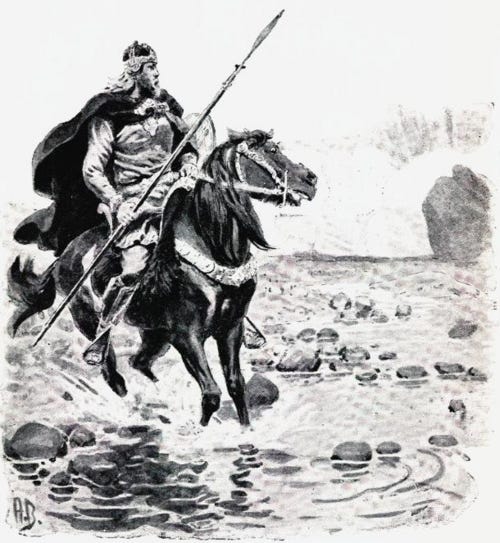
A horse named Freyfaxi also shows up in Vatsndæla Saga, where a man named Brandr, similarly, dedicates it to Freyr. He apparently lavished this horse a bit too much for Medieval Icelandic standards, so his neighbors called him “Faxabrandr” (“Brandr of the mane”). Flateyarbók meanwhile mentions horses sacred to Freyr in Þrandheim, Norway, and Olaf Tryggvason riding it as part of his campaign of militant atheism.
The Sagas tell us that at the time of the grain harvest, that Icelanders would engage in horse-trading, and horse fighting (as in, they’d make two stallions fight, and gamble on which would win). This was because horse fighting was fun, and part of the fun and games that was done at the grain harvest (in addition to religious rituals and such). The Norse term for this is “hestavíg” which means something like “horse combat”, and this practice shows up in both Njálssaga and Víga-Glúmssaga
As said, this time of year is just when Europeans harvested grain at the time, due to the climate and agricultural practices. So, it’s when there’s lots of bread around, because there’s lots of grain. Pretty simple, right?
This celebration of fertility and abundance was performed in Anglo-Saxon England about this time, and was coopted into Christianity as Lammas. “Lammas” is the actual modern English term for the celebration, having gone through a series of phonological compactions like many words in British English: the actual name is “Loaf-Mass”, and is attested as “Hlafmæsse” in Old English.
Many Anglo-Saxon practices were coopted into Christianity under the excuse that they are actually of Jewish origin, such as the practices of Tenths, hoftollr, parceling land out in Hides and Hundreds, blót and symbel, sippenhaft, swine feasts, and so on. None of these have anything Israel or Israeli culture and religion (ah yes, the traditional “swine feats” of Israel...), but that was the justification. Holidays got coopted by holding mass after the traditional festivities: it is for this reason that “Christmas” is a contract of “the Christ-Mass”. So, “Loaf-Mass” is the mass held after the grain harvest.
We’re told of various bread offerings that were done with the bread baked from the first grain of the harvest, which were of course justified as the Halakhic mandates that Jews have to offer Yahweh harvested grain. So, of course, the proper Christian thing to do was to... take that grain, bake it into bread, and then offer that grain to various land spirits instead of Yahweh, or to use it in magic spells. Æcerbot in the Lacnunga, and chastising peasants for performing Ásatú rituals to ensure the health of fields (particularly grain) is a frequent topic that shows up in Christian Penitential Literature.
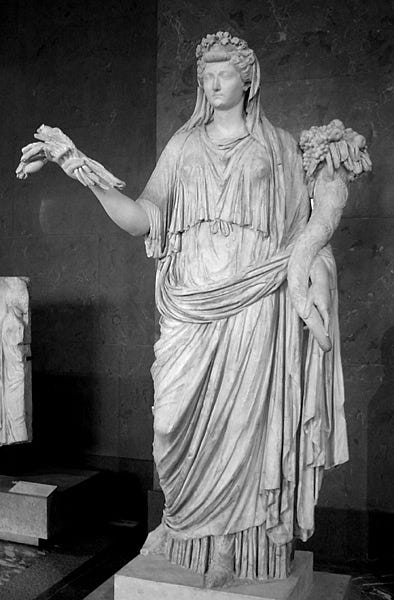
Lammas is often associated with the Gaelic festival of Lughnasadh, which occurs at roughly the same time (the start of August), and is, similarly, a holiday about harvesting grain. Lughnasadh’s place in Gaelic religion is complicated, but ultimately unimportant for where this story heads. Amongst the Romans, in August OPICONSIVIA was celebrated, in which the grain Goddess Ops, who was a consort of Saturn, was worshipped.
So, in 1968, Allfather Óðinn makes Steve McNallen his Herald, and tasks him with reforging the faith in the modern era. Steve forms the Asatru Free Assembly, and then he and a bunch of other clever fellows do their homework, and start studying ancient lore. There is a religious tradition that, according to academia and every Christian church at the time, was the modern continuation of ancient Pagan religions: it’s called “Wicca”.
So, a number of the people that came to early Ásatrú were familiar with Wiccan theology, and their studies of actual European religious lore lead to them realizing that while Wicca was assembled out of a bricolage of European religious traditions, at a systematic level it was simply nonsense. This lead to the formation of a group within the Asatru Free Assembly called “The People of the Lord and Lady”, who were particularly devout to Freyr, Freyja, and Njörðr. They were a small clique of people who were, essentially, trying to lead people out of Wicca. The Herald himself had basically no knowledge of Wicca until after beginning the reforging of Ásatrú, so this is something sort of parallel to him.
It was this group that would choose the name “Freyfaxi”, as a clever reference to grain, but also Freyr’s relationship to power, fertility, and majesty (get it? “Frey’s mane”? Because of the color that wheat is?). The horse, as a symbol of power, fertility, majesty, and abundance, was an obvious one for the holiday, particularly due to its relationship to grain in the Sagas. And these early Freyr worshippers were very interested in fertility, in health, in beauty, in the unfolding of bounty and opulence from hard work: these are things that Wiccans say that they are interested in, but don’t really actually care about. That misalignment was noted, and something that these early Vanir worshippers sought to rectify.
1980’s Fall issue of The Runestone is when the term first shows up in reference to the holiday, and in a context where it’s simply assumed that the reader knows what it’s referring to. However, 1980’s Summer issue does not give the holiday a name, but does say that in August the grain-harvest festival would be celebrated, in honor of Freyr, and that the stallion would be the motif of this grain-harvest holiday. Hence the name, unifying grain and horses.
A later development was the breadhorse, which is probably the most famous aspect of this holiday. This came about sometime after 1980, and its origins are shrouded in mystery: the earliest references to it that I can find are from the early 2000s, but I have been told by old-timers that it was done in the 1990s.
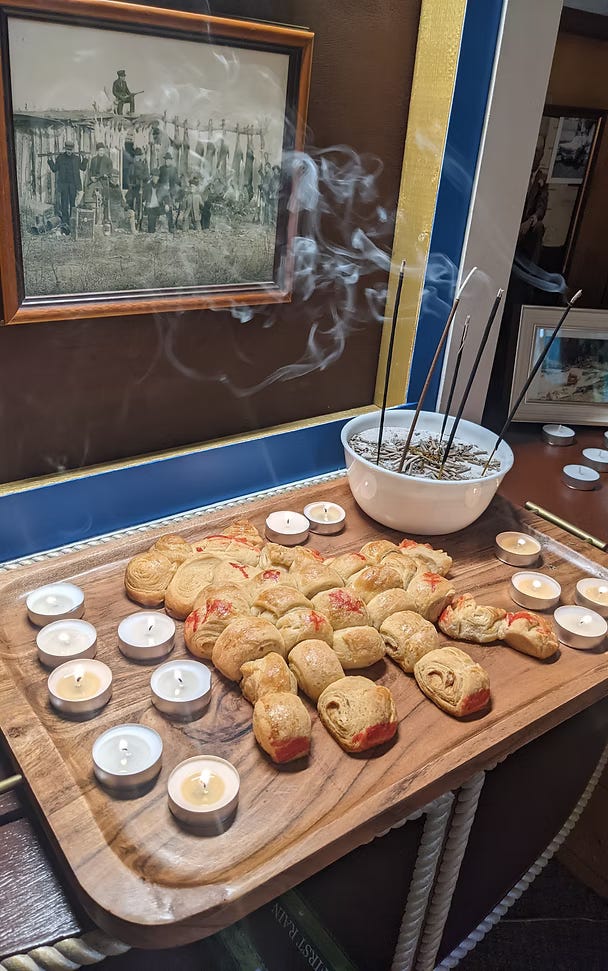
In any event, one constructs a horse out of dough, bakes it, and then offers it to lord Freyr via the fire. The simplest way to do this is to construct the breadhorse, and then offer the breadhorse at the end of the offering round of an otherwise normal Freyblót. A flashier, but more organizationally complicated, idea is to cut the horse in half, offer the portion with the head to Freyr, and then the gathered folk consume the other half. It’s important to remember the scope, scale, and timing of when you’re doing a ritual, especially given that we in the Asatru Folk Assembly do this with large, but variable, numbers of people. If you make a massive cake the size of an actual stallion and stuff it with strawberry jelly, are you going to be able to get it on top of that mountain that you’re ascending in your hike-mót, and then construct a fire capable of burning it, and eat the entire back half with your 10-man crowd? And then hike down with a belly full of 1/11th of a horse’s back-end of cake and jelly?
The horse being made out of bread, which is of course baked grain, is obvious: grain is one of the principle symbols of the end result of effort, but also the fuel of life: it is a symbol of growth. But horses are more complicated. This practice today splices in theology related to the offering of horses, and the consumption of horse meat. The ritual eating of horse flesh in the Germanic world, and its comparisons in the Roman and Vedic world, is so fabulously well-attested as to be a tedious and unnecessary intrusion in this piece.
The horse is an animal of power, might, royalty, fertility, strength, majesty, speed, and honor. In the Medieval period, and earlier, horses were an extremely valuable possession, and a status symbol. In part this was because a horse required a great deal of accessories to care for it, let alone use it. Not only was getting a horse hard, but maintaining one was as well. But if you got your hands on one, they were useful. A horse made travel easier, it made transporting goods easier, and of course they could not only carry a man from his enemies, but also towards them with great momentum. They were expensive, cumbersome, beautiful, and useful.
Today, horses are not hard to source: there’s a thriving equine industry that churns them out. They are expensive to maintain, but not particularly difficult to care for: you can quite easily save up, or take out a loan, to make all of the initial purchases and simply budget to account for the cost of boarding and care. And there’s very thorough guides on the internet on how to do all of this! And what’s more, the horse doesn’t actually do anything: they are a luxury good, a product consumed for pleasure.
Buying a horse, killing it, chopping it up, and then eating it would be an empty act, and one bordering on vanity.
More important than any physical object today are three things: time, loyalty, and care. These are things that cannot simply be bought. Going on Amazon, getting mead, or a sword, or a horse, or chunk of gold, and then tossing it into a fire: that’s easy. That’s actually not all that costly, if you really think about it, and all it tells the Gods is that you can afford to toss out a bottle of mead. But time, every human only gets a finite amount of that; loyalty, that is something that even money has a hard time buying; and care, that’s personal. Words are wind, deeds are iron: are you good iron? Or bad iron?
It’s for this reason that we take the grain, the literal end result of production, and the symbol of sustenance, and form it into the breadhorse to offer to lord Freyr: we are giving him our time, loyalty, and care, crafted into an effigy of power, might, royalty, fertility, strength, majesty, speed, and honor. It is through this that we participate in the Gift Cycle: we offer to lord Freyr, and he blesses us in return. In doing so, we not only make sacrifice to the God in question, but we also reach back into the mists of time and grasp the strands of the ancient horse sacrifices that are today meaningless, and in doing so rescue the meaning of those ancient sacrifices. Every breadhorse that is baked and then burnt is an act of piety not only towards Freyr, the God of grain and galloping, but also piety towards the ancestors, by maintaining the meaning of their struggles, and ensuring that their causes are not lost to time.
-Folkbuilder Chris Savich
For more about the Ásatrú Folk Assembly, visit our website!
Thanks for reading the Runestone Newsletter! Subscribe, share, and donate to help bring the Folk home.
No posts
Comments
Nothing yet. Say the first thing.
Sign in to join the conversation.